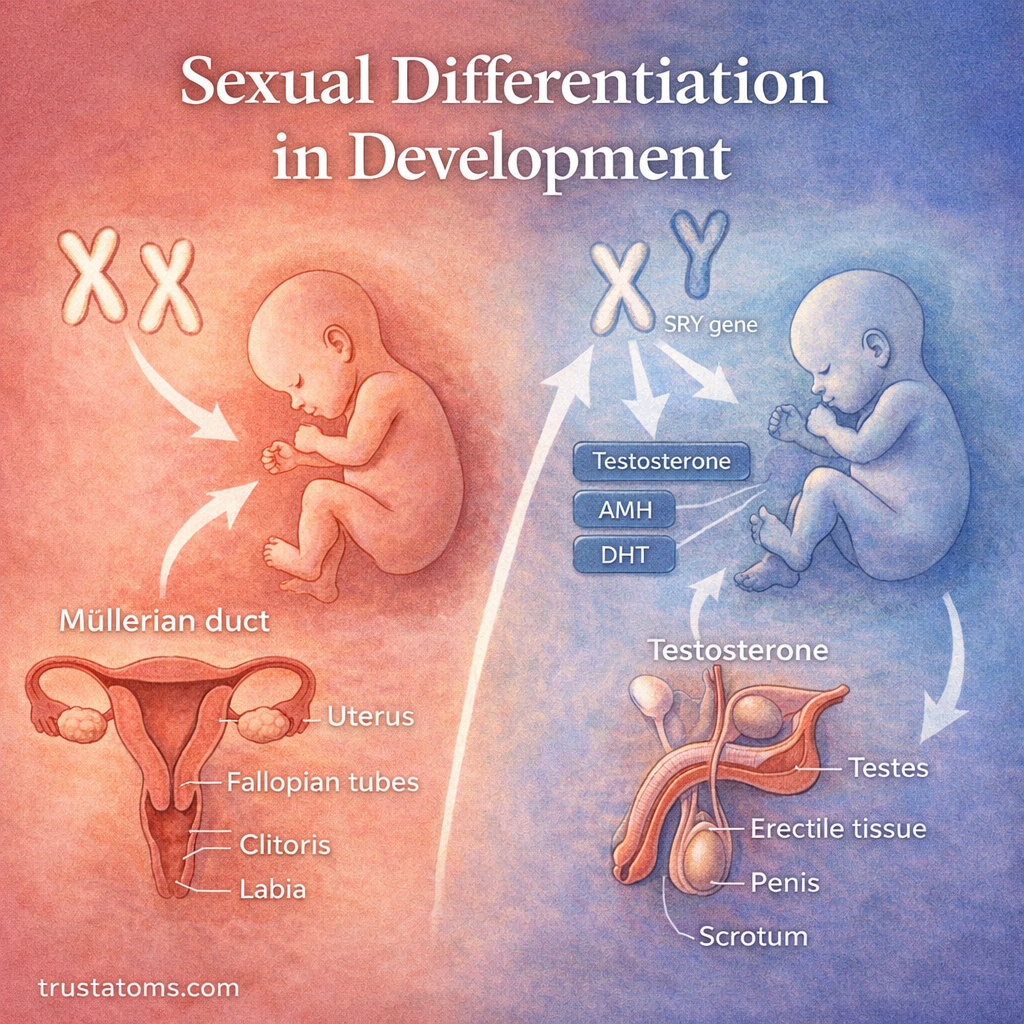
Sexual differentiation is the biological process through which an embryo develops male or female anatomical characteristics. This process begins early in fetal development and is guided by genetic signals, hormonal activity, and cellular responses.
Understanding sexual differentiation provides insight into how the human reproductive system forms and why variations can occur.
What Is Sexual Differentiation?
Sexual differentiation refers to the development of physical sex characteristics from an initially similar embryonic structure.
In early development, all embryos share the same basic reproductive anatomy. Over time, specific genetic and hormonal signals direct the body to develop male or female structures.
The Role of Chromosomes
The process begins at fertilization with the combination of sex chromosomes:
- XX → typically leads to female development
- XY → typically leads to male development
Key Gene: SRY
On the Y chromosome, a gene called SRY (Sex-determining Region Y) plays a crucial role.
- Activates development of testes
- Initiates male differentiation pathways
If the SRY gene is absent or inactive, the embryo typically follows the default pathway toward female development.
Early Embryonic Development
During the first few weeks, embryos have:
- Undifferentiated gonads (potential to become ovaries or testes)
- Two duct systems:
- Müllerian ducts (female structures)
- Wolffian ducts (male structures)
At this stage, development is considered bipotential, meaning it can proceed in either direction.
Hormonal Influence on Differentiation
Hormones are the primary drivers that guide sexual differentiation after genetic signals initiate the process.
In Male Development (XY)
The testes begin producing key hormones:
- Testosterone
- Promotes development of Wolffian ducts into male internal structures (e.g., vas deferens)
- Anti-Müllerian Hormone (AMH)
- Causes regression of Müllerian ducts (prevents female internal structures)
- Dihydrotestosterone (DHT)
- Derived from testosterone
- Responsible for development of external male genitalia
In Female Development (XX)
In the absence of significant androgen (male hormone) influence:
- Müllerian ducts develop into:
- Fallopian tubes
- Uterus
- Upper vagina
- Wolffian ducts regress naturally
- External genitalia develop along female pathways
Development of Internal Reproductive Structures
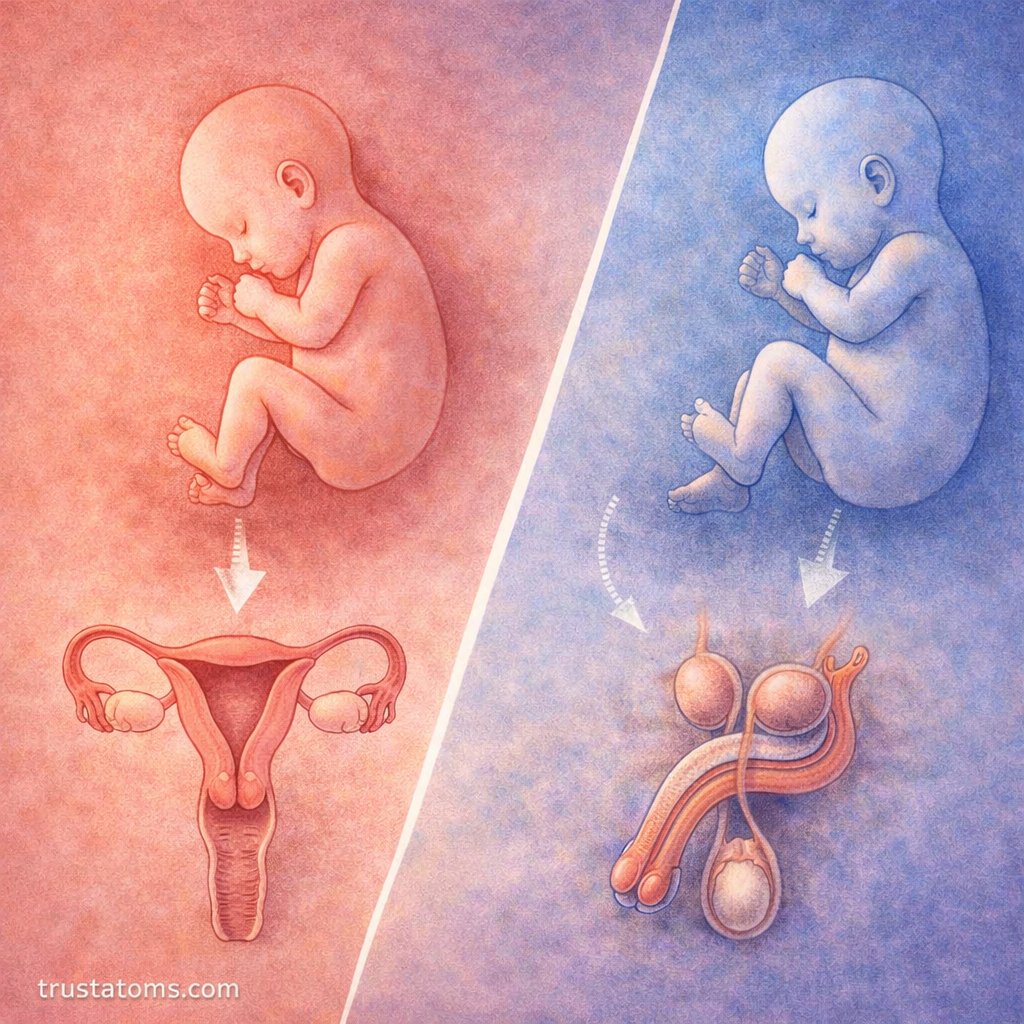
Male Pathway
- Wolffian ducts develop into:
- Epididymis
- Vas deferens
- Seminal vesicles
- Müllerian ducts disappear due to AMH
Female Pathway
- Müllerian ducts form:
- Uterus
- Fallopian tubes
- Part of the vagina
- Wolffian ducts regress due to lack of testosterone
Development of External Genitalia
External genital structures begin from the same embryonic tissues:
- Genital tubercle
- Urogenital folds
- Labioscrotal swellings
Male Development
Driven by DHT:
- Genital tubercle → penis
- Urogenital folds → urethra
- Labioscrotal swellings → scrotum
Female Development
In the absence of DHT:
- Genital tubercle → clitoris
- Urogenital folds → labia minora
- Labioscrotal swellings → labia majora
Timing of Sexual Differentiation
Key stages occur during early pregnancy:
- Weeks 0–6: Undifferentiated stage
- Weeks 6–8: Gonadal differentiation begins
- Weeks 8–12: Hormonal influence shapes internal and external structures
This timeline is critical, as disruptions during these windows can affect development.
Variations in Sexual Development
Sexual differentiation does not always follow typical patterns. Variations can occur due to:
- Genetic differences (e.g., variations in chromosomes)
- Hormonal imbalances
- Differences in hormone receptor sensitivity
These are often referred to as differences in sex development (DSDs).
Examples of Variations
- Androgen insensitivity (body does not respond to testosterone)
- Congenital adrenal hyperplasia (excess androgen production)
- Gonadal development differences
These variations highlight that biological sex development exists on a spectrum rather than a strict binary.
Why Sexual Differentiation Matters
Understanding sexual differentiation is important for:
- Medical education and diagnosis
- Reproductive health awareness
- Understanding developmental biology
- Recognizing natural biological variation
It also helps explain how genetics and hormones interact to shape human anatomy.
Common Misconceptions
“Sex is determined only at birth”
Sex is influenced by multiple stages of development before birth.
“Male development is the default”
Female development is often considered the default pathway in the absence of specific male signals, but both pathways require complex biological processes.
“Hormones only matter at puberty”
Hormones play a crucial role much earlier—during fetal development.
Final Thoughts
Sexual differentiation is a complex, multi-step process involving chromosomes, genes, hormones, and timing. From a shared embryonic starting point, the body develops specialized reproductive structures through carefully coordinated biological signals.
Recognizing how this process works—and how it can vary—provides a deeper understanding of human anatomy and development.