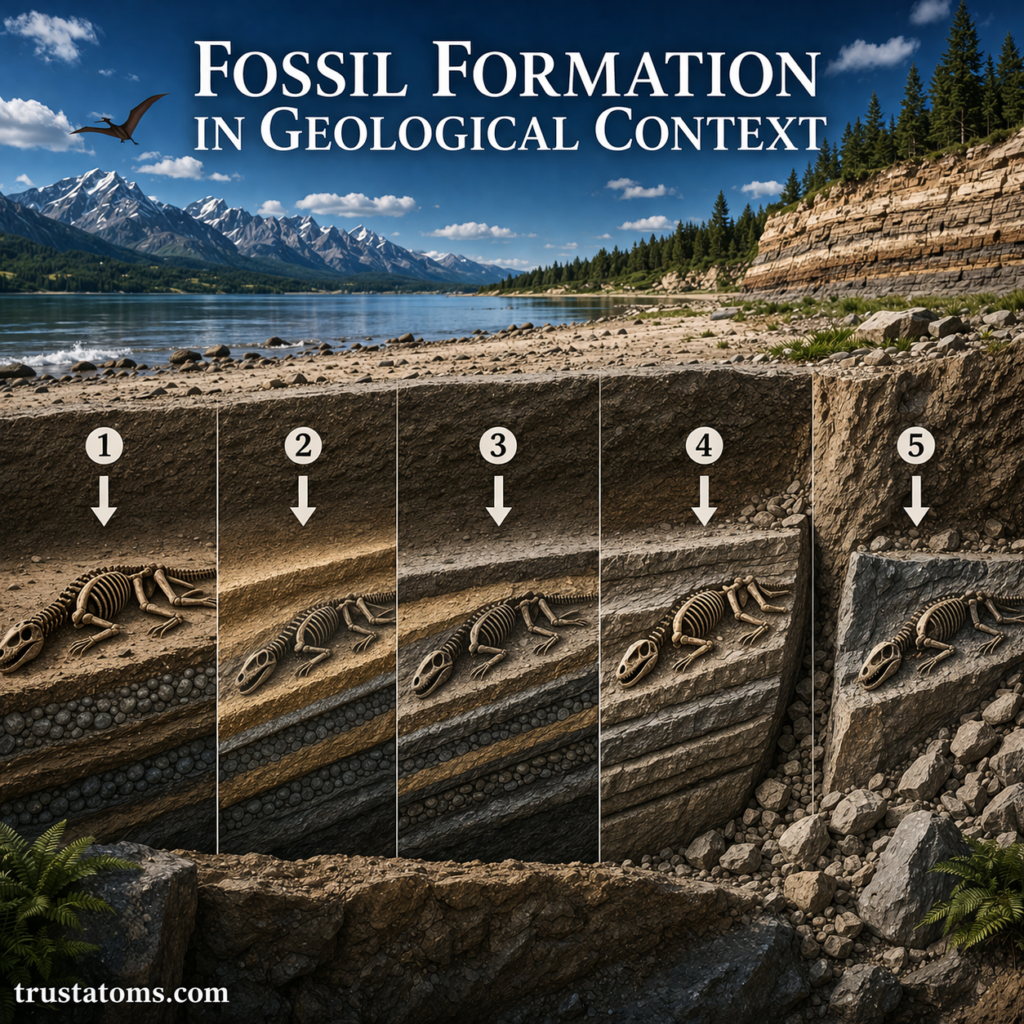
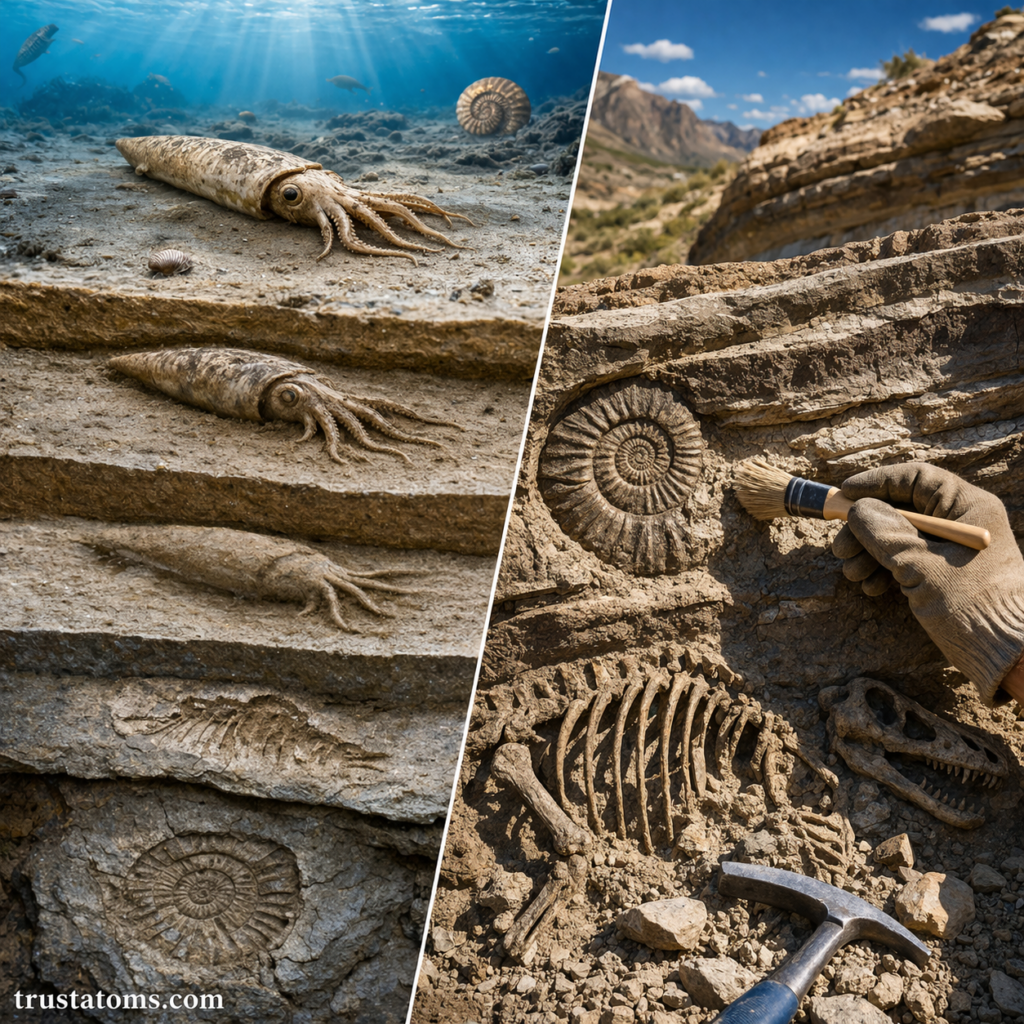
Fossils form when the remains or traces of organisms are preserved through processes such as rapid burial, mineralization, or the formation of impressions in sediment. Their geological context—the surrounding rock layers, sediments, and evidence of past environments—helps scientists determine how they formed and what they reveal about earlier life on Earth.
Most organisms never become fossils because decomposition, scavenging, and erosion destroy their remains. Understanding the conditions that allow preservation is part of Earth science, connecting the study of rocks with evidence of past environments and biological history.
What Is a Fossil?
A fossil is preserved evidence of an organism that lived in the geological past. Fossils include body remains, such as bones and shells, as well as traces of activity, such as footprints, burrows, and feeding marks.
Most fossils occur in sedimentary rocks because accumulating sediment can bury and protect biological material. Understanding sedimentary basins and stratigraphy helps geologists interpret the layers in which fossils are discovered.
The differences among igneous, sedimentary, and metamorphic rocks also explain why some geological environments preserve fossils better than others. Sedimentary rocks commonly retain recognizable remains, while intense heat and deformation can alter or destroy them.
Why Fossil Formation Is Uncommon
After an organism dies, its remains are usually broken down by microorganisms, consumed by scavengers, or scattered by environmental processes. Fossilization requires circumstances that interrupt or slow this destruction.
- Rapid burial: Sediment covers remains before they are extensively disturbed or destroyed.
- Reduced oxygen: Oxygen-poor conditions can slow some forms of decomposition and scavenging.
- Durable body parts: Shells, teeth, and bones generally survive longer than soft tissues.
- Favorable chemistry: Mineral-rich groundwater or other chemical conditions may support preservation.
No single condition guarantees fossilization. The type of organism, burial environment, and subsequent geological history all influence whether recognizable evidence survives.
How Fossils Form Step by Step
A common fossilization pathway involves burial in sediment followed by physical and chemical changes. Other fossils form through different processes, so these stages describe a typical example rather than a universal sequence.
- Death and deposition: An organism dies, and its remains settle on a surface such as a lakebed, riverbed, or seafloor.
- Burial: Mud, sand, or other sediment covers the remains, reducing exposure to scavengers and destructive surface processes.
- Sediment lithification: Additional sediment accumulates, and compaction and cementation gradually turn loose material into sedimentary rock.
- Mineral preservation: Groundwater may deposit minerals within pores or replace some original material, helping preserve structural details.
- Exposure and discovery: Uplift and erosion may eventually expose fossil-bearing rock, allowing fossils to be found and studied.
A Concrete Example: A Shell Buried on the Seafloor
Imagine a clam dying in a shallow sea. Its soft tissues decay, but its hard shell remains on the seabed. A storm deposits a layer of mud over the shell, protecting it from some scavengers and physical disturbance.
As additional sediment accumulates, the mud gradually becomes rock. The shell may remain preserved, dissolve and leave a mold, or be replaced by minerals. If the rock is later exposed by erosion, a geologist might discover the fossil and examine the surrounding sediment for clues about the ancient marine environment.
This example shows why a fossil’s location and surrounding rock are as informative as the preserved organism itself.
Different Ways Fossils Are Preserved
Permineralization and Replacement
Permineralization occurs when dissolved minerals fill spaces within porous remains, such as bone or wood. Replacement occurs when original material dissolves and minerals take its place. Both processes can preserve detailed internal structures.
Molds and Casts
A mold forms when an organism leaves an impression or cavity in sediment that becomes rock. If minerals or sediment subsequently fill the cavity, the resulting three-dimensional replica is called a cast.
Carbon Films and Amber
Carbonization can leave a thin carbon-rich film representing an organism’s outline, particularly in some plant fossils. Amber preservation occurs when organisms become trapped in tree resin that later hardens and undergoes chemical changes, sometimes retaining fine anatomical details.
Trace Fossils
Trace fossils preserve evidence of behavior rather than body parts. Footprints, burrows, and feeding trails can reveal how organisms moved, interacted with sediment, or used their environments.
Geological Conditions That Favor Fossil Formation
River deltas, lakebeds, floodplains, and marine sedimentary basins commonly provide opportunities for burial. Fine-grained sediment can preserve delicate impressions, while rapid deposition may protect remains before extensive decomposition occurs.
Geologists also consider how environments changed after burial. Tectonic uplift, erosion, and continental movement can relocate or expose fossil-bearing formations. Research into plate reconstruction in geological history helps explain why fossils from similar ancient environments may now occur on widely separated continents.
How the Rock Cycle Affects Fossil Preservation
Fossils are closely tied to the Rock Cycle. Sediment burial and lithification can preserve remains, while weathering and erosion may expose fossils or destroy them after exposure.
Metamorphism can deform or erase fossils through heat and pressure, although some recognizable fossils survive low-grade metamorphism. Melting generally destroys fossil structures. Consequently, sedimentary formations provide most of the fossil record used by paleontologists.
Fossils and Geological Time
Scientists use fossils to compare the relative ages of sedimentary rock layers and reconstruct changes in life through geological history. The scientific framework described in Geologic Time Scale and Earth History combines fossil succession with radiometric dating and other geological evidence.
Index fossils are especially useful when organisms were geographically widespread, recognizable, and existed over relatively short geological intervals. Finding the same index fossil in separate rock formations can help geologists correlate those layers.
Fossils generally provide relative age information rather than exact numerical dates. Radiometric dating of suitable rocks, such as volcanic ash layers above or below fossil-bearing sediment, can help establish numerical age constraints.
What Fossils Reveal About Past Environments
Fossils help scientists reconstruct ancient habitats, climate conditions, and biological communities. Marine shells found in rocks now located high above sea level, for example, can indicate that those sediments originally accumulated in a marine environment before geological uplift.
Fossil evidence is incomplete, however. Organisms with durable skeletons are more likely to be preserved than many soft-bodied organisms, and geological processes can remove entire sections of the record. Scientists therefore compare fossils with sedimentary structures, rock chemistry, and other independent evidence.
Scientific Evidence and Faith Perspectives on Earth’s History
According to the scientific explanation supported by radiometric dating, stratigraphy, and other geological evidence, Earth formed approximately 4.54 billion years ago. Fossils document changes in organisms and environments across geological time, providing important evidence for biological evolution and the history of life.
Religious perspectives differ in how they interpret this history. Many faith traditions hold that God created the universe and life. Young-earth creationists generally believe Earth and the universe are thousands of years old and interpret geological evidence differently. Old-earth creationists accept scientific estimates of Earth’s age while maintaining belief in divine creation, while proponents of theistic evolution accept scientific ages and biological evolution as processes through which God created life.
Science investigates testable natural explanations using observable evidence, while faith perspectives also address questions of purpose and meaning. People hold a range of views about how scientific findings and religious beliefs relate, and creationist interpretations should be distinguished from conclusions established through scientific research.
Frequently Asked Questions
How long does it take for a fossil to form?
There is no single fossilization timescale. Burial may occur rapidly, while mineralization and other preservation processes can take much longer depending on environmental conditions. Many fossils are preserved in rocks that scientists date to millions of years ago, but fossilization does not always require millions of years.
Why are fossils mostly found in sedimentary rocks?
Sedimentary environments can bury remains under accumulating layers without the intense heat associated with melting. This allows shells, bones, impressions, and traces to survive as sediment becomes rock.
Can fossils tell scientists the exact age of a rock?
Fossils generally help establish relative ages and correlations between rock layers. Numerical ages require additional evidence, often including radiometric dating of suitable geological materials associated with the fossil-bearing formation.
Fossil formation depends on the interaction of biological remains, sediment deposition, groundwater chemistry, and subsequent geological change. By examining fossils alongside their surrounding rock layers, scientists can reconstruct ancient environments and establish relationships between events in Earth’s history. The most reliable interpretations combine fossil evidence with stratigraphy, geochemistry, and geological dating methods.
Sources: U.S. Geological Survey (USGS), Geologic Time resources; Smithsonian National Museum of Natural History, Department of Paleobiology; Michael J. Benton and David A. T. Harper, Introduction to Paleobiology and the Fossil Record.