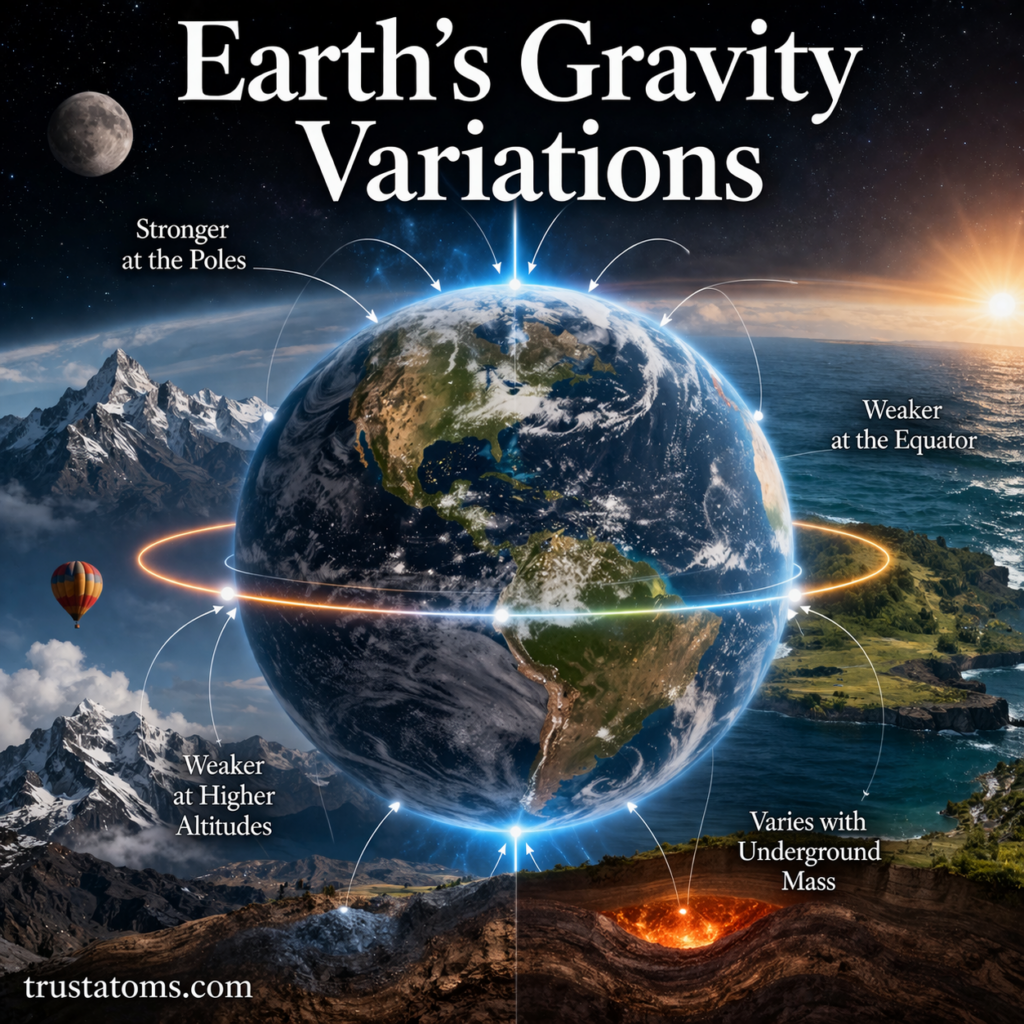
Gravity feels constant in everyday life, but it actually varies slightly across Earth’s surface. These variations are small—often unnoticed without precise instruments—but they reveal important details about our planet’s shape, structure, and internal composition.
Understanding how and why gravity changes from place to place helps scientists study Earth more accurately, from mapping underground features to tracking ocean currents.
What Is Gravity?
Gravity is the force that pulls objects toward the center of Earth. It gives weight to objects and keeps everything grounded.
Basic concept
- Gravity depends on mass and distance
- Earth’s mass creates the gravitational pull we experience
- The farther you are from Earth’s center, the weaker gravity becomes
Even though this force feels constant, it is not exactly the same everywhere.
Why Gravity Varies Across Earth
Gravity differences are caused by several key factors that affect how strongly Earth pulls on objects.
Earth’s Shape (Oblate Spheroid)
Earth is not a perfect sphere. It is slightly flattened at the poles and bulging at the equator.
How this affects gravity
- The equator is farther from Earth’s center
- The poles are closer to the center
- Gravity is slightly stronger at the poles than at the equator
This difference is small but measurable.
Rotation of the Earth
Earth’s rotation also affects gravity.
Centrifugal effect
- As Earth spins, objects at the equator experience a slight outward force
- This reduces the effective pull of gravity at the equator
- The effect is minimal near the poles
This is another reason gravity is weaker at the equator.
Altitude (Elevation)
Gravity decreases with height above Earth’s surface.
Key points
- Higher altitude means greater distance from Earth’s center
- Gravity is slightly weaker on mountains than at sea level
- The difference increases with elevation
For example, gravity at the top of a mountain is slightly less than at its base.
Local Mass Variations
Earth’s interior is not uniform. Differences in density beneath the surface affect gravity.
What causes local variations?
- Mountain ranges (extra mass increases gravity slightly)
- Ocean trenches (less mass reduces gravity slightly)
- Variations in rock density underground
These differences create small gravitational anomalies across the planet.
Tides and External Forces
Gravity is also influenced by other celestial bodies, especially the Moon and the Sun.
Effects on Earth
- The Moon’s gravity causes ocean tides
- The Sun contributes to tidal forces
- These forces can slightly alter local gravity
Although subtle, these changes are measurable with sensitive instruments.
Measuring Gravity Variations
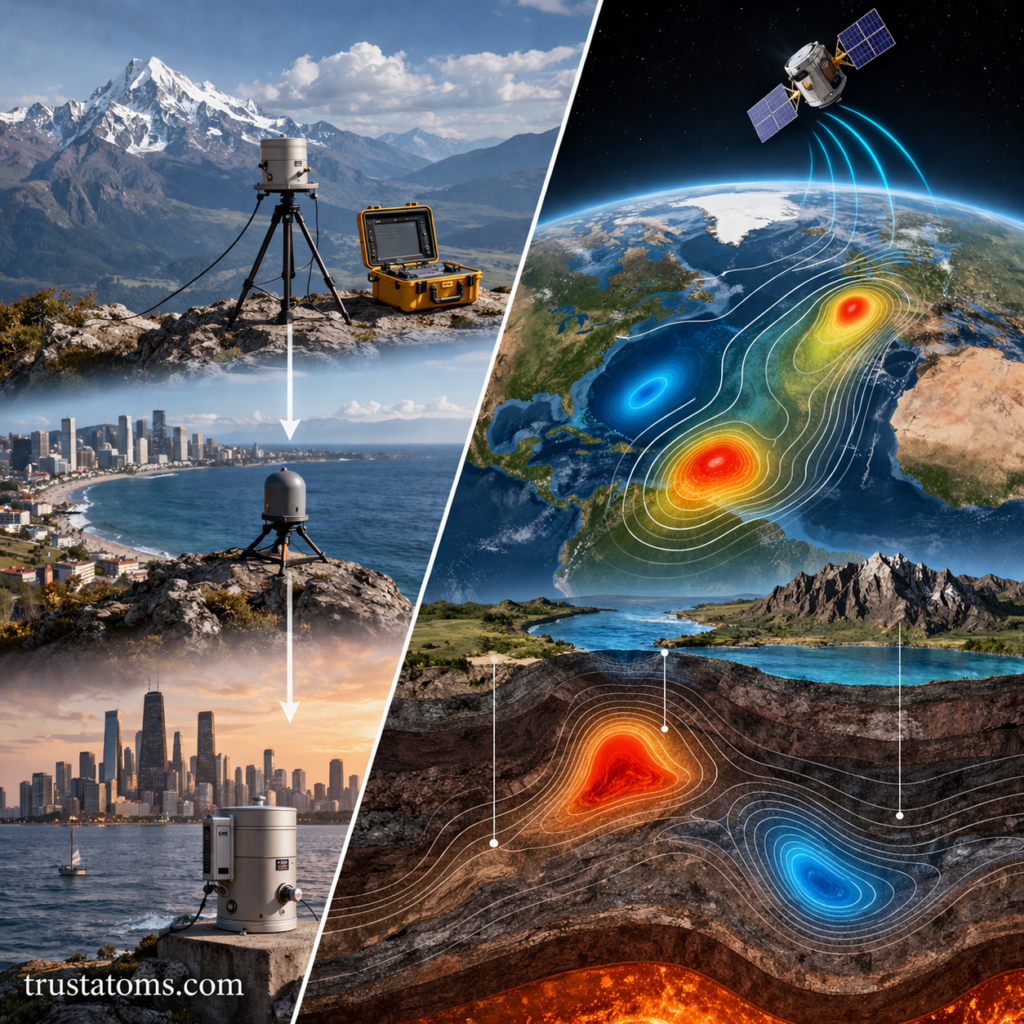
Scientists use specialized tools to detect small changes in gravity.
Common methods
- Gravimeters (devices that measure gravitational strength)
- Satellite missions that map Earth’s gravity field
- Remote sensing and geophysical surveys
These measurements help scientists better understand Earth’s structure.
Why Gravity Variations Matter
Even small differences in gravity provide valuable information.
Practical applications
- Mapping underground resources (oil, minerals)
- Studying tectonic activity
- Monitoring ice sheet changes
- Understanding ocean circulation
Gravity data is an important tool in Earth science and environmental research.
Examples of Gravity Differences
While variations are small, they can be quantified.
General comparisons
- Gravity is slightly stronger at the poles than at the equator
- Higher elevations experience slightly weaker gravity
- Areas with dense rock beneath the surface show stronger gravity
These differences are typically measured in very small units, but they are meaningful for scientific analysis.
Key Takeaways
- Gravity varies slightly across Earth due to shape, rotation, altitude, and mass distribution
- Earth’s equatorial bulge and rotation reduce gravity near the equator
- Higher elevations experience weaker gravitational pull
- Local geological features can increase or decrease gravity
- Scientists use gravity measurements to study Earth’s interior and surface processes
Final Thoughts
Although gravity feels constant in daily life, it is a dynamic force that reflects the complexity of our planet. Subtle variations in gravity reveal hidden details about Earth’s structure and movement.
By studying these variations, scientists gain a deeper understanding of how Earth works—from its core to its surface—and how different systems are connected.