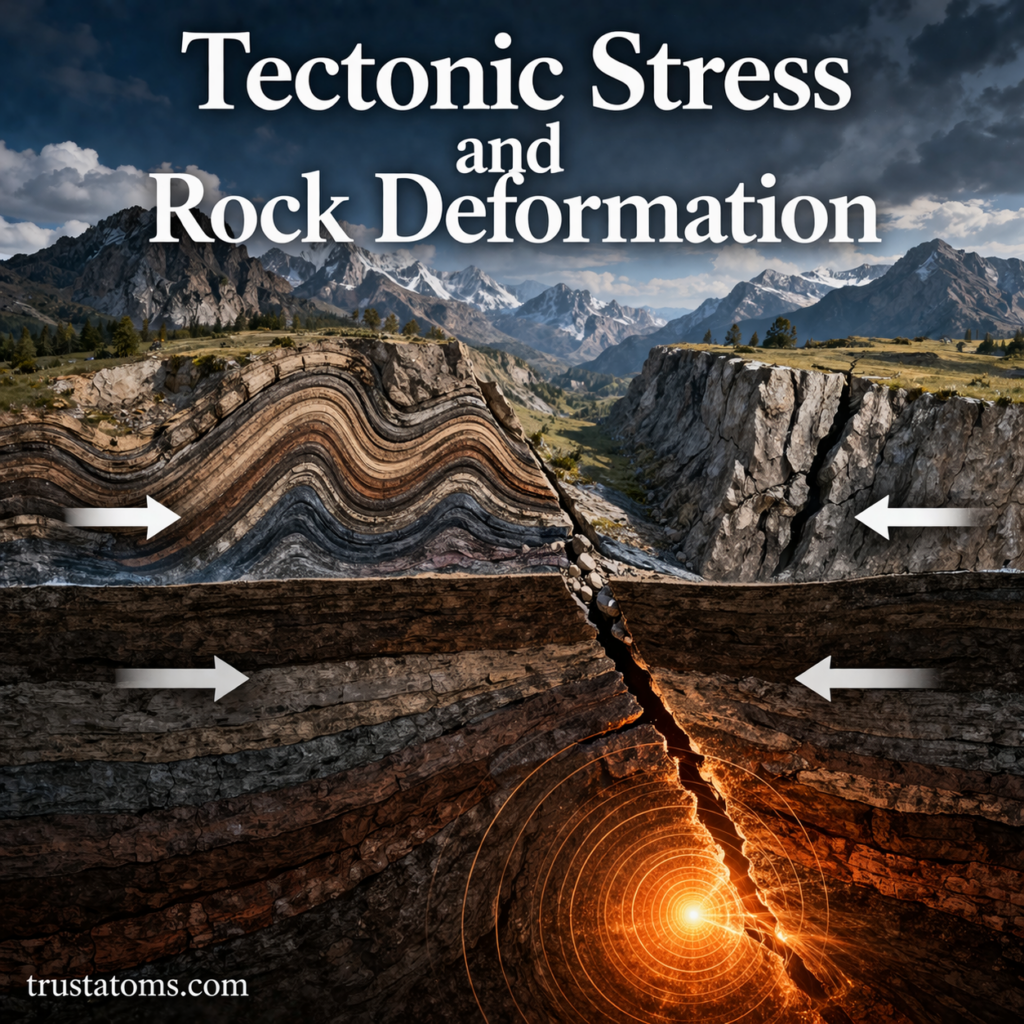
Earth’s crust is constantly under pressure. Deep beneath the surface, forces generated by moving tectonic plates create stress within rocks. Over time, this stress can bend, break, or reshape rock layers—a process known as rock deformation.
Understanding tectonic stress and deformation helps explain earthquakes, mountain formation, and many of the features we see in Earth’s landscapes today.
What Is Tectonic Stress?
Tectonic stress refers to the forces acting on rocks within Earth’s crust due to plate movement.
Key idea
- Stress builds up as tectonic plates push, pull, or slide past each other
- Rocks respond to this stress by deforming in different ways
- The type of deformation depends on the amount of stress and the properties of the rock
The Three Main Types of Stress
Geologists classify tectonic stress into three primary types based on how forces act on rocks.
Compressional Stress
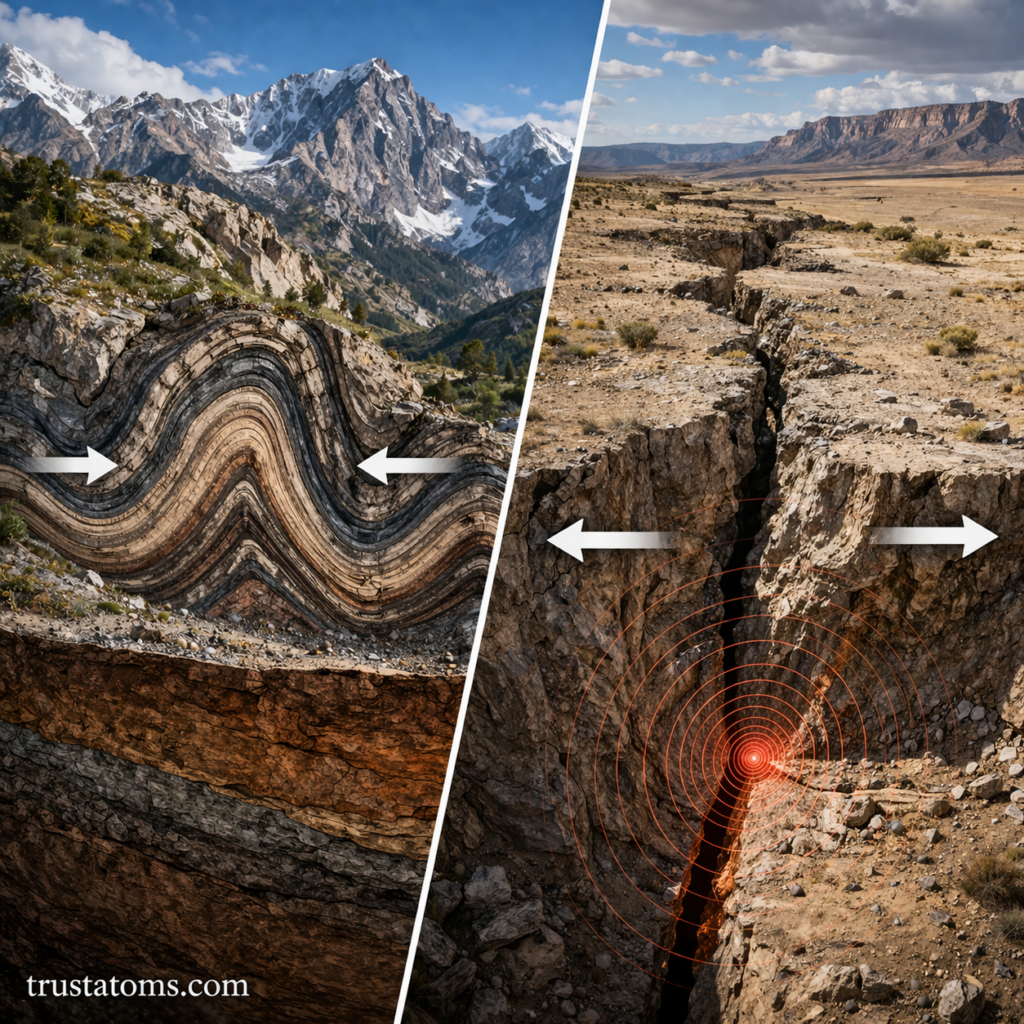
Compressional stress occurs when rocks are pushed together.
What it does
- Shortens and thickens rock layers
- Causes folding or faulting
- Common at convergent plate boundaries
Real-world effects
- Formation of mountain ranges
- Creation of folded rock structures
Tensional Stress
Tensional stress happens when rocks are pulled apart.
What it does
- Stretches and thins the crust
- Can cause rocks to break
- Common at divergent plate boundaries
Real-world effects
- Formation of rift valleys
- Creation of normal faults
Shear Stress
Shear stress occurs when rocks slide past each other in opposite directions.
What it does
- Causes rocks to twist or tear
- Produces lateral movement
- Common at transform plate boundaries
Real-world effects
- Formation of strike-slip faults
- Generation of earthquakes
What Is Rock Deformation?
Rock deformation is the change in shape, position, or volume of rock due to stress.
Two main types
- Elastic deformation
- Permanent deformation
Elastic Deformation
Elastic deformation is temporary.
Key features
- Rocks bend or stretch under stress
- Return to original shape when stress is released
- Occurs before rocks break
This type of deformation stores energy, which can later be released during earthquakes.
Permanent Deformation
Permanent deformation occurs when stress exceeds a rock’s strength.
Two forms
- Ductile deformation (bending)
- Brittle deformation (breaking)
Ductile Deformation (Folding)
Ductile deformation happens when rocks bend without breaking.
Conditions
- High temperature
- High pressure
- Slow application of stress
Results
- Folded rock layers
- Curved geological structures
This is common deep within Earth’s crust.
Brittle Deformation (Faulting)
Brittle deformation occurs when rocks break under stress.
Conditions
- Lower temperatures
- Lower pressures
- Rapid stress
Results
- Cracks and fractures
- Fault lines
- Sudden movement (earthquakes)
This is more common near Earth’s surface.
Factors That Influence Deformation
Not all rocks respond to stress in the same way.
Key factors
- Temperature (higher temperatures promote ductile behavior)
- Pressure (greater pressure allows bending rather than breaking)
- Rock type (some rocks are stronger or more flexible)
- Time (slow stress leads to ductile deformation)
How Tectonic Stress Shapes Earth
The interaction between stress and deformation creates many of Earth’s major landforms.
Examples
- Mountain building from compressional stress
- Rift valleys from tensional stress
- Fault zones from shear stress
These processes continuously reshape Earth’s surface over millions of years.
Why This Matters
Tectonic stress and rock deformation are essential for understanding natural hazards and Earth’s evolution.
Practical importance
- Helps predict earthquake-prone areas
- Explains formation of natural resources
- Guides construction and engineering decisions
- Improves understanding of plate tectonics
Key Takeaways
- Tectonic stress comes from the movement of Earth’s plates
- Three main types: compressional, tensional, and shear
- Rocks deform through elastic and permanent processes
- Permanent deformation includes ductile (folding) and brittle (faulting) behavior
- These processes shape landscapes and influence natural hazards
Final Thoughts
Tectonic stress and rock deformation are fundamental to how Earth works. From slow bending deep underground to sudden breaks that trigger earthquakes, these processes reveal the dynamic nature of our planet.
By studying how rocks respond to stress, scientists can better understand Earth’s past, present, and future changes.