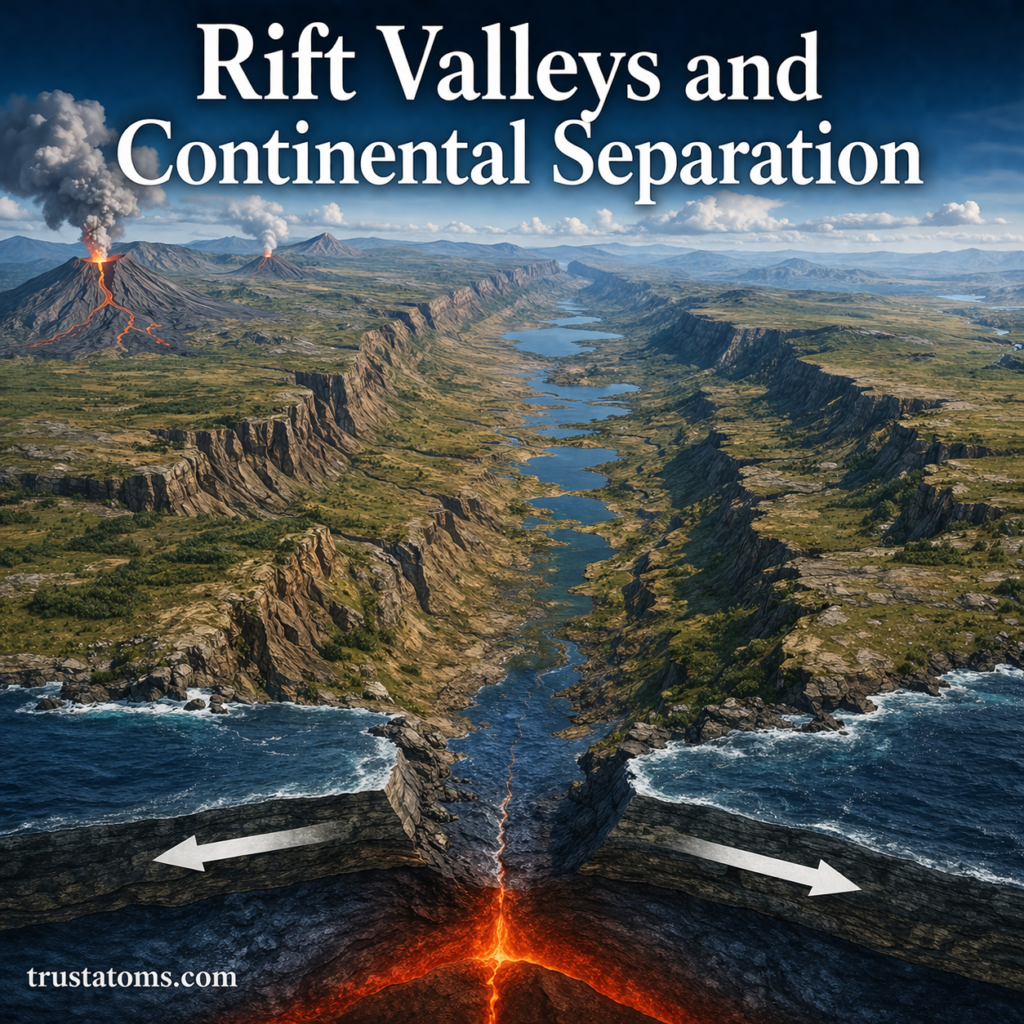
Rift valleys are some of the most striking geological features on Earth, marking places where continents are slowly pulling apart. These विशाल depressions in Earth’s crust provide a rare glimpse into the dynamic forces shaping our planet from within.
From the famous East African Rift to ancient rift systems hidden beneath oceans, these formations reveal how continents break, oceans form, and Earth continues to evolve over millions of years.
What Is a Rift Valley?
A rift valley is a long, narrow depression that forms when Earth’s crust stretches and breaks apart. This process is known as continental rifting.
Key characteristics include:
- Steep cliffs or fault lines on either side
- A sunken central block (graben)
- Volcanic activity in some regions
- Linear or elongated shape
Rift valleys can occur on land or beneath the ocean and often represent the early stages of continental separation.
The Role of Plate Tectonics
Rift valleys form at divergent plate boundaries, where tectonic plates move away from each other.
This process involves:
- Upwelling of hot mantle material beneath the crust
- Heating and thinning of the crust
- Tension forces pulling the crust apart
- Cracking and faulting of the surface
- Sinking of central blocks to form a valley
Over time, continued separation can lead to the formation of a new ocean basin.
How Rift Valleys Form
The formation of a rift valley happens gradually in several stages.
Stage 1: Uplift and Doming
- Heat from the mantle causes the crust to rise
- The surface forms a broad dome
- Tension begins to build
Stage 2: Crustal Stretching
- The crust thins and fractures
- Normal faults develop
- The central section begins to drop
Stage 3: Rift Valley Development
- A clear valley forms between fault lines
- Volcanic activity may occur
- Lakes often develop in low areas
Stage 4: Continental Separation
- The rift widens over millions of years
- Magma rises and creates new crust
- A narrow sea may begin to form
Stage 5: Ocean Basin Formation
- Continued spreading leads to a full ocean
- Mid-ocean ridges develop
- The original continent splits into two
Types of Rift Valleys
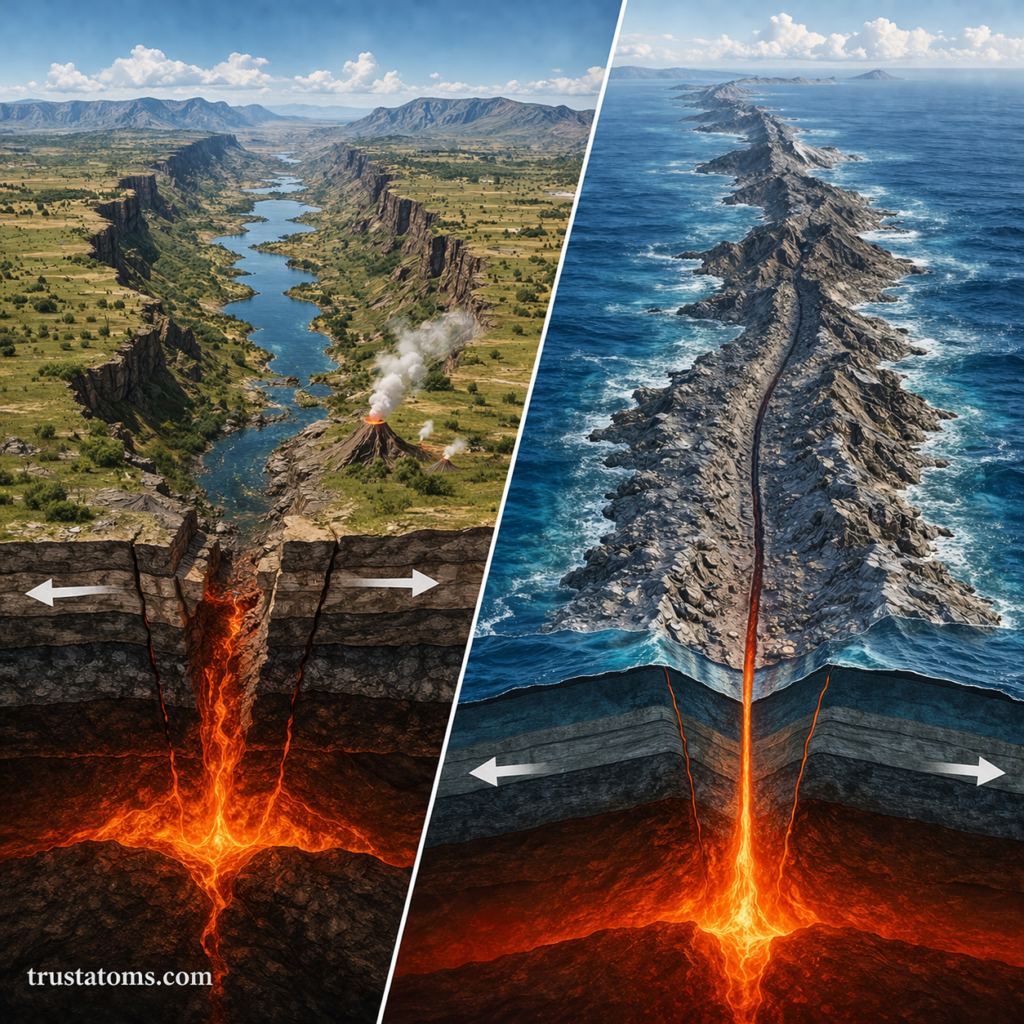
Not all rift valleys look the same. Their appearance depends on location and stage of development.
Continental Rift Valleys
These form within continents and represent the early stages of separation.
Features:
- Deep valleys with steep sides
- Active faulting and earthquakes
- Possible volcanic activity
Examples include:
- The East African Rift
- The Rio Grande Rift in North America
These regions are often geologically active and evolving.
Oceanic Rifts
Oceanic rifts occur along mid-ocean ridges where new crust is created.
Features:
- Underwater mountain chains
- Central rift zones
- Continuous volcanic activity
These rifts are responsible for seafloor spreading and the creation of new oceanic crust.
Rift Valleys and Volcanic Activity
Rifting is often associated with volcanism due to rising magma.
Common volcanic features:
- Shield volcanoes
- Lava flows
- Geothermal activity
As the crust thins, magma can more easily reach the surface, leading to frequent eruptions in some rift zones.
The East African Rift: A Living Example
One of the best-known examples of continental rifting is the East African Rift system.
It stretches thousands of miles across eastern Africa and shows multiple stages of rift development.
Key highlights:
- Active volcanoes like Mount Kilimanjaro
- Large lakes such as Lake Tanganyika
- Ongoing tectonic activity
Scientists believe this region may eventually split Africa into two separate continents.
Geological and Environmental Importance
Rift valleys play a major role in shaping Earth’s systems.
Natural Hazards
Rift zones can experience:
- Earthquakes
- Volcanic eruptions
- Ground instability
Resource Formation
These regions often contain valuable resources:
- Geothermal energy
- Mineral deposits
- Freshwater lakes
Biodiversity
Rift valleys can support unique ecosystems:
- Isolated habitats
- Diverse plant and animal life
- Important migration corridors
The Future of Continental Separation
Continental rifting is an ongoing process that can take tens of millions of years.
Over time:
- Continents continue to drift apart
- New oceans expand
- Old land connections disappear
This process has already shaped Earth’s continents as we know them today and will continue to do so in the future.
Key Takeaways
- Rift valleys form where tectonic plates move apart
- They are early indicators of continental separation
- Formation involves stretching, faulting, and subsidence
- Some rift valleys eventually become oceans
- These regions are geologically active and resource-rich
Final Thoughts
Rift valleys offer a powerful look at Earth in transition. They show continents not as fixed landmasses, but as ever-changing pieces of a dynamic system.
By studying rift valleys and continental separation, we gain insight into the forces that have shaped our planet—and the changes still unfolding beneath our feet.