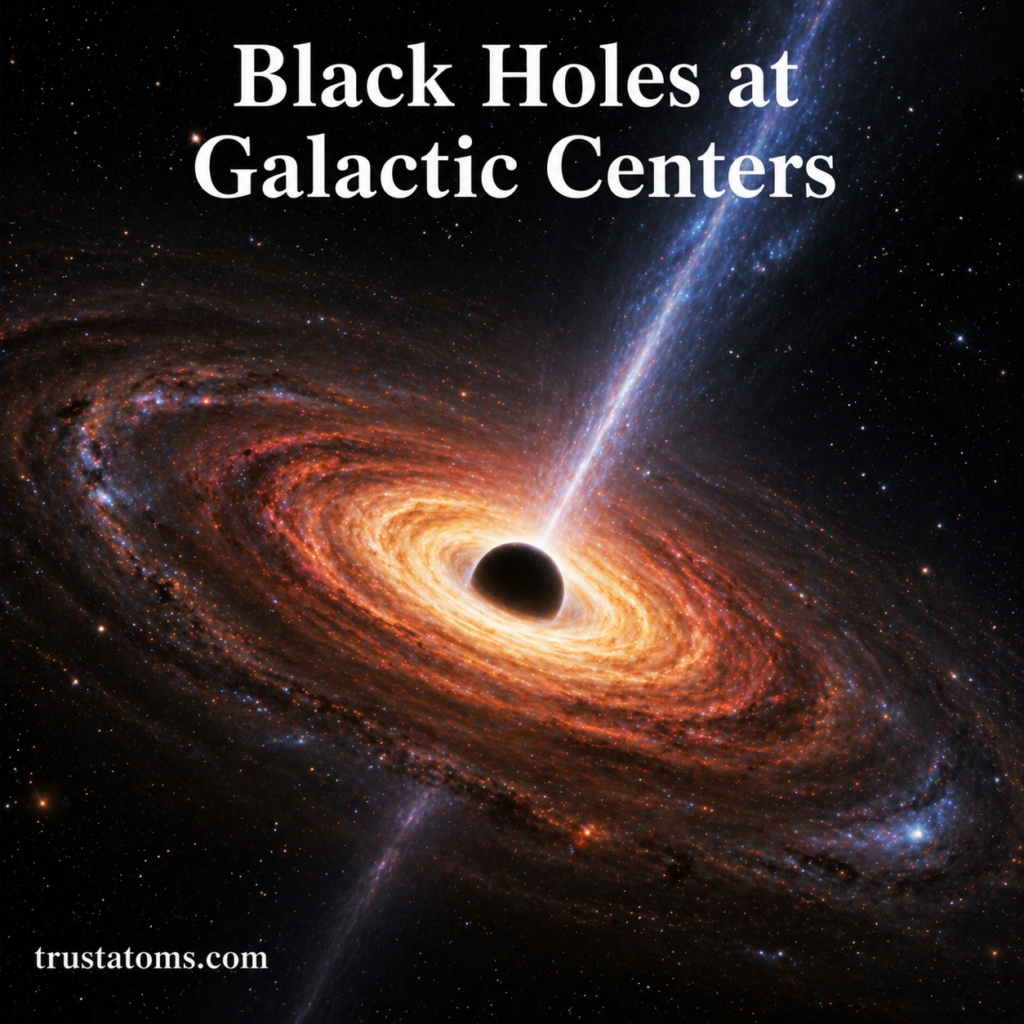
At the heart of nearly every large galaxy lies one of the most mysterious objects in the universe—a supermassive black hole. These cosmic giants, millions to billions of times more massive than the Sun, play a crucial role in shaping the structure, behavior, and evolution of galaxies.
Far from being passive objects, black holes at galactic centers influence everything from star formation to galaxy growth, acting as powerful engines that regulate cosmic environments.
What Are Black Holes at Galactic Centers?
A black hole is a region of space where gravity is so strong that nothing—not even light—can escape. At the centers of galaxies, these are known as supermassive black holes.
Key Characteristics
- Mass ranges from millions to billions of solar masses
- Located at the core (nucleus) of galaxies
- Surrounded by dense regions of gas, dust, and stars
- Often associated with high-energy activity
Unlike smaller black holes formed from collapsing stars, supermassive black holes have origins that are still not fully understood.
How Do We Know They Exist?
Black holes cannot be seen directly, but astronomers detect them through their effects on nearby matter.
Methods of Detection
- Tracking the motion of stars orbiting an invisible massive object
- Observing high-energy radiation from surrounding gas
- Detecting jets of particles moving at near-light speed
- Imaging the “shadow” of a black hole using advanced telescopes
One of the strongest pieces of evidence comes from stars moving at extreme speeds near galactic centers, indicating the presence of an enormous unseen mass.
The Structure Around a Central Black Hole
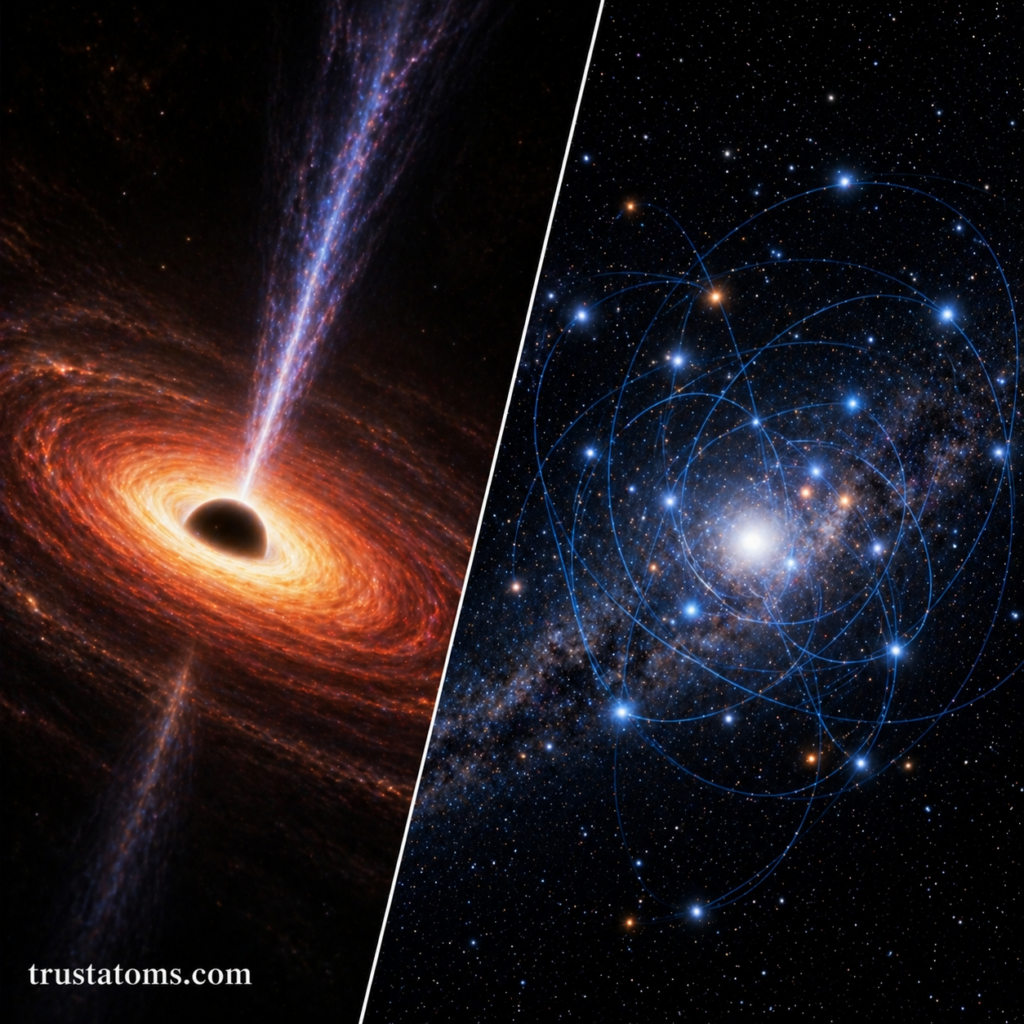
Black holes are not isolated—they are surrounded by complex structures that influence their environment.
Accretion Disk
- A rotating disk of gas and dust spiraling into the black hole
- Heated to extreme temperatures
- Emits intense radiation, especially in X-rays
Event Horizon
- The boundary beyond which nothing can escape
- Defines the “point of no return”
Relativistic Jets
- Narrow beams of particles ejected at high speeds
- Can extend thousands of light-years into space
- Powered by magnetic fields and rotation
Active vs. Quiet Black Holes
Not all supermassive black holes are actively consuming material.
Active Galactic Nuclei (AGN)
- Extremely bright and energetic
- Powered by matter falling into the black hole
- Can outshine the entire galaxy
Dormant Black Holes
- Currently not feeding on significant material
- Emit little radiation
- Still exert strong gravitational influence
Our own galaxy’s central black hole is relatively quiet compared to active ones in other galaxies.
How Black Holes Influence Galaxies
Supermassive black holes are deeply connected to the galaxies they inhabit.
Major Effects
- Regulate star formation by heating or expelling gas
- Shape galaxy structure through gravitational forces
- Control the flow of matter in galactic centers
- Influence galaxy mergers and interactions
This relationship is so strong that the mass of a galaxy’s central black hole often correlates with the size of its central bulge.
The Role of Feedback Mechanisms
Black holes don’t just consume matter—they also release energy back into their surroundings, a process known as feedback.
Types of Feedback
- Radiative Feedback
- Energy released as radiation
- Heats surrounding gas and prevents star formation
- Mechanical Feedback
- Jets and outflows push material away
- Can clear gas from the galactic center
These processes help regulate galaxy growth and prevent runaway star formation.
How Do Supermassive Black Holes Form?
The formation of supermassive black holes remains one of the biggest questions in astronomy.
Leading Theories
- Collapse of massive early stars into “seed” black holes
- Direct collapse of large gas clouds
- Growth through mergers of smaller black holes
- Rapid accumulation of matter in the early universe
Understanding their origin helps scientists explain how galaxies formed so quickly after the Big Bang.
Black Holes and Galaxy Mergers
When galaxies collide and merge, their central black holes also interact.
What Happens During a Merger
- Black holes move toward each other due to gravitational forces
- They form a binary system
- Eventually merge into a larger black hole
These events produce powerful gravitational waves, offering new ways to study the universe.
The Black Hole at the Center of the Milky Way
At the center of our galaxy lies a supermassive black hole known as Sagittarius A*.
Key Facts
- About 4 million times the mass of the Sun
- Located roughly 26,000 light-years from Earth
- Surrounded by fast-moving stars
- Currently in a relatively quiet state
Observations of nearby stars have provided some of the strongest evidence for its existence.
Common Misconceptions
Despite their reputation, black holes are often misunderstood.
Myth vs. Reality
- Black holes do not “suck in” everything indiscriminately
- Objects must come very close to be captured
- Earth is not at risk from the Milky Way’s black hole
- Most of a galaxy remains unaffected by its central black hole
Key Takeaways
- Most galaxies contain supermassive black holes at their centers
- These black holes influence galaxy evolution and structure
- They can be active or dormant depending on available material
- Feedback from black holes regulates star formation
- Galaxy mergers can lead to black hole mergers
Final Thoughts
Black holes at galactic centers are among the most powerful and influential objects in the universe. While invisible by nature, their presence shapes entire galaxies and drives some of the most energetic phenomena observed in space.
As technology advances, astronomers continue to uncover new insights into these cosmic giants—bringing us closer to understanding how the universe evolves on the grandest scales.