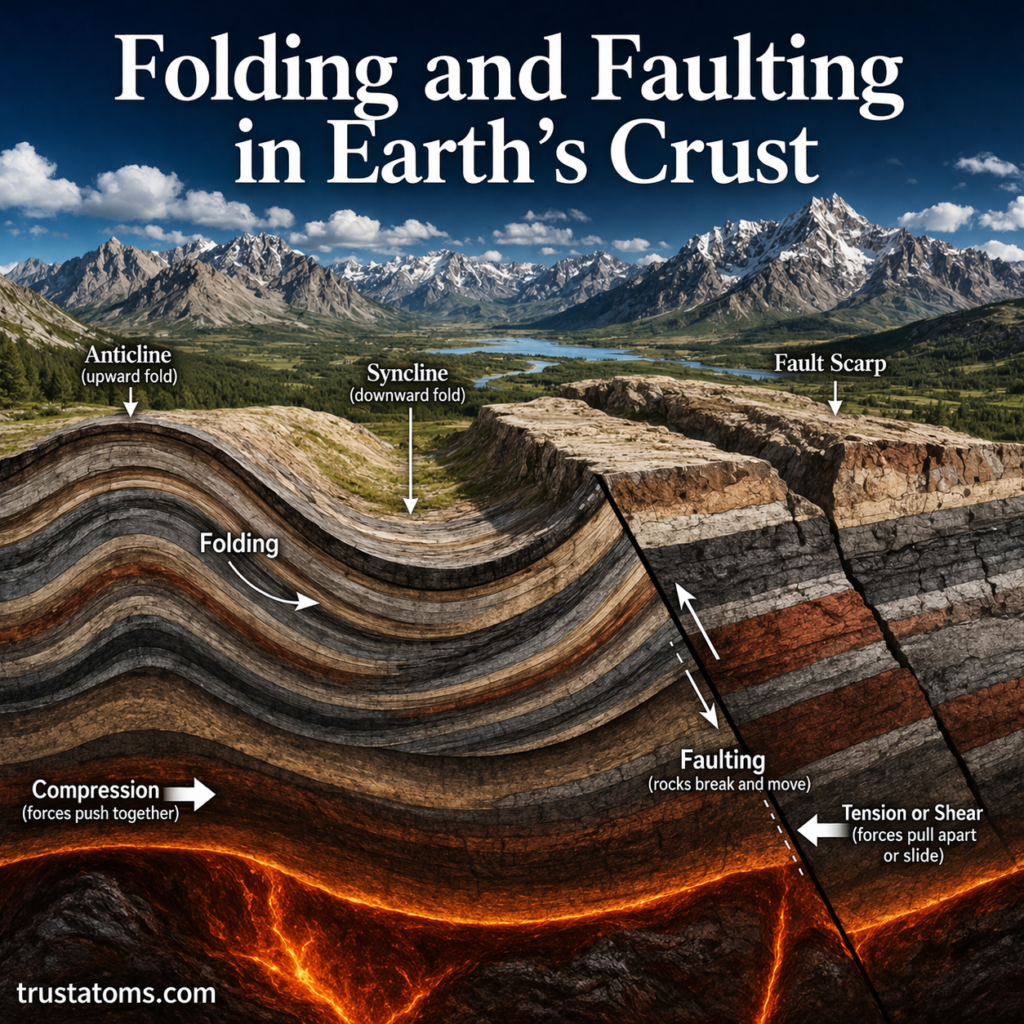
Folding and faulting are two ways Earth’s crust deforms under tectonic forces: folding bends rock layers, while faulting fractures rocks and moves them along a break. Both processes help form mountains, valleys, and other geological structures, but they involve different responses to stress.
These changes are part of Earth science, which examines how the planet’s systems interact and reshape its surface. Folding and faulting have shaped many of the landscapes we see today. They also play a major role in earthquakes and the overall structure of Earth’s surface.
How Folding Bends Rock Layers
Folding occurs when rock layers undergo permanent bending without breaking apart. It commonly develops under compression, particularly where tectonic plates converge and squeeze the crust.
Although rocks seem rigid at Earth’s surface, they can deform ductilely under suitable temperatures, pressures, and strain rates. Over geological time, layers that were originally nearly horizontal may become curved, tilted, or tightly compressed.
Common Types of Folds
- Anticline: An arch-shaped fold with rock layers dipping away from its center. In a typical upright anticline, the oldest layers occupy the core.
- Syncline: A trough-shaped fold with layers dipping toward its center. The youngest layers generally occupy the core of an upright syncline.
- Monocline: A step-like bend where otherwise relatively flat layers change elevation across a zone of folding.
- Overturned fold: A fold in which one limb has tilted beyond vertical, causing both limbs to dip in the same general direction.
Fold shapes reveal how rocks responded to deformation. However, an anticline does not always form a hill, nor does a syncline always form a valley. Erosion and differences in rock resistance also determine the landscape.
How Faulting Breaks and Moves Rock
Faulting occurs when rock fractures and the blocks on opposite sides move relative to each other. The movement may happen suddenly during an earthquake or gradually through fault creep.
A fracture without measurable displacement is generally called a joint rather than a fault. Faults can range from small breaks visible in a rock outcrop to major structures extending hundreds of kilometers.
Three Main Types of Faults
- Normal fault: Forms mainly under extension. The hanging wall, or rock block above the inclined fault plane, moves downward relative to the footwall. Normal faults are common in stretching crust and rift valleys.
- Reverse fault: Forms mainly under compression. The hanging wall moves upward relative to the footwall. A reverse fault with a low-angle fault plane is commonly called a thrust fault.
- Strike-slip fault: Accommodates primarily horizontal movement as rock blocks slide past each other. The San Andreas Fault in California is a well-known example.
Some faults combine vertical and horizontal displacement. Geologists call this oblique-slip movement, which reflects more than one component of motion.
Folding vs. Faulting: The Main Differences
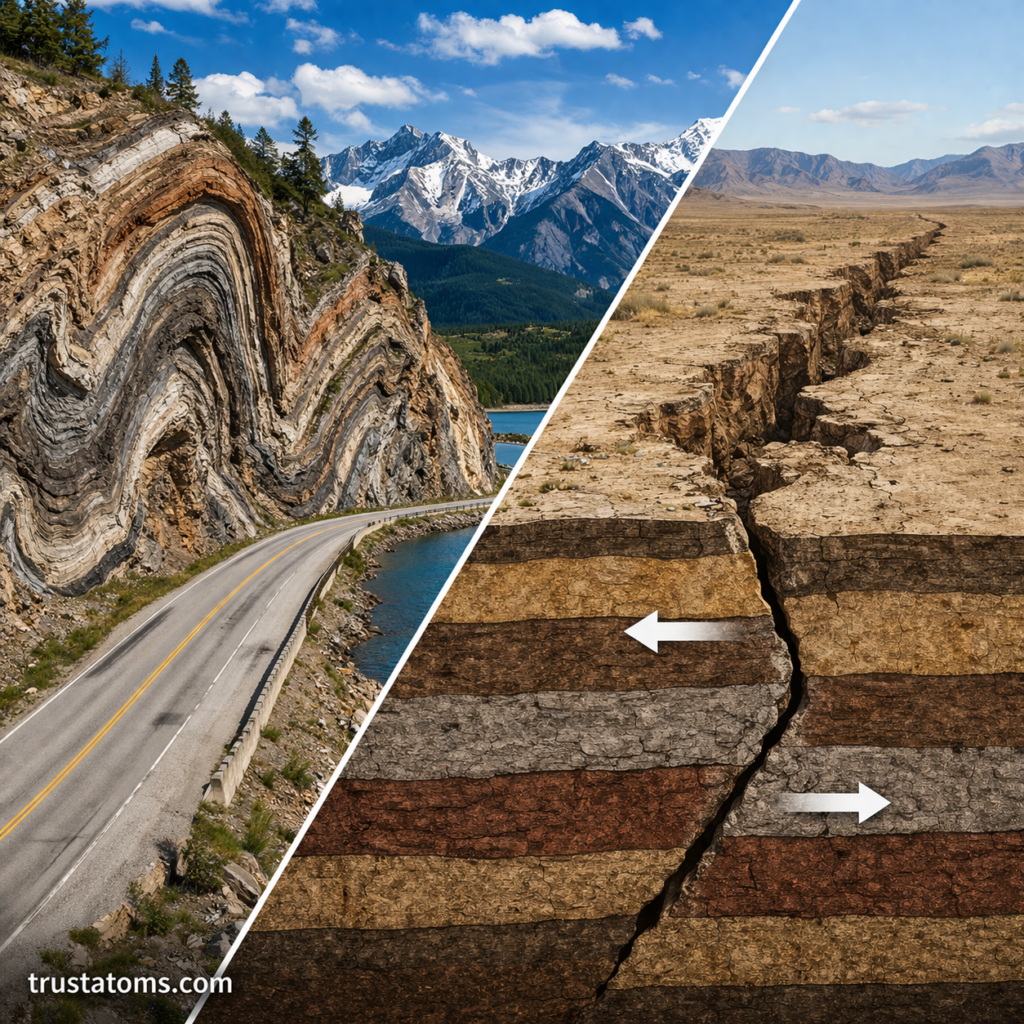
Although both processes result from tectonic stress, they differ in how rocks respond:
| Feature | Folding | Faulting |
|---|---|---|
| Rock response | Bending without major fracture | Fracture with displacement |
| Deformation | Primarily ductile | Primarily brittle |
| Typical structures | Anticlines and synclines | Normal, reverse, and strike-slip faults |
| Common conditions | Higher temperatures, pressure, or slower deformation | Conditions favoring brittle failure |
| Earthquake connection | Usually gradual deformation | Sudden slip can generate earthquakes |
The distinction is not simply that folding happens slowly and faulting happens quickly. Rock type, temperature, confining pressure, fluids, and deformation rate all influence whether rocks bend or fracture. Both behaviors can occur within the same mountain belt.
What Causes Folding and Faulting?
Plate tectonics produces much of the stress responsible for large-scale crustal deformation. Three common stress conditions help explain the resulting structures:
- Compression: Squeezes rocks together, encouraging folding and reverse faulting.
- Tension: Pulls rocks apart, encouraging extension and normal faulting.
- Shear: Causes adjacent rock masses to move sideways relative to one another, commonly producing strike-slip faults.
Temperature and pressure also affect deformation. Rocks deeper in the crust may bend under conditions that would cause similar rocks near the surface to fracture.
Role in Mountain Formation
Where continental plates converge, compression can shorten and thicken the crust. Rock layers may fold while thrust faults stack sections of crust on top of one another, contributing to uplift and mountain growth.
The Himalayas illustrate this combination of folding, thrust faulting, and crustal thickening associated with the collision of the Indian and Eurasian plates. The broader formation of mountain ranges also involves erosion, uplift, and other geological forces.
Different mountain building processes explain why some mountain belts contain tightly folded layers while others feature large fault-bounded blocks.
Connection to Earthquakes
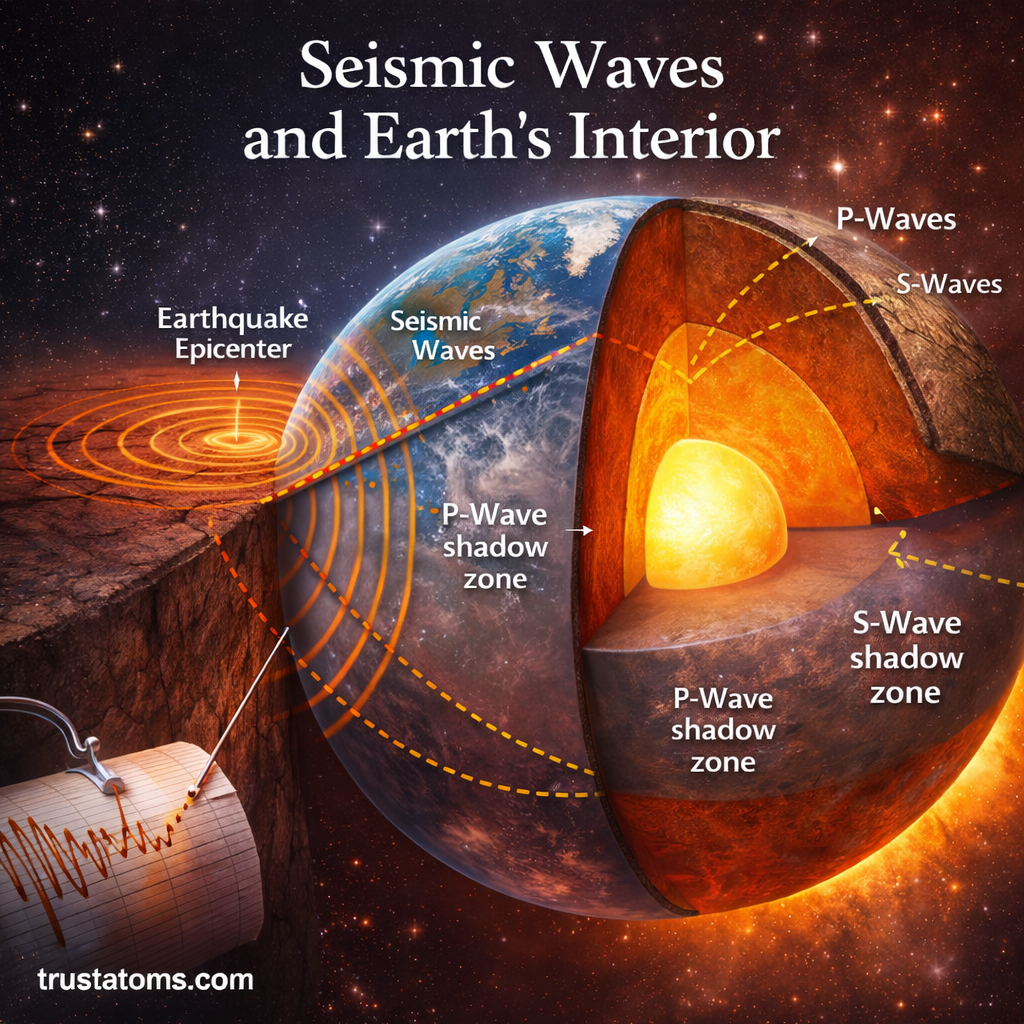
Many earthquakes occur when accumulated stress overcomes friction along a fault, allowing rock blocks to slip suddenly. The released elastic energy travels outward as seismic waves.
For a concrete example, imagine a road crossing an active strike-slip fault. If an earthquake produces two meters of horizontal surface displacement at that crossing, the road’s two sides may become offset by approximately two meters. Actual displacement varies along a rupture, and many earthquakes produce no visible surface break.
The relationship between fault movement and visible ground changes is explored further in Fault Rupture and Surface Displacement. Some faults also move slowly without producing a major earthquake each time they slip.
How Geologists Recognize Folds and Faults
Geologists study exposed rock layers, geological maps, and underground imaging to identify deformation. Curved or tilted strata may reveal folds, while displaced layers, polished fault surfaces, and crushed rock can indicate fault movement.
Seismic measurements and satellite observations help scientists detect active deformation, including movement too small to recognize by eye. These observations support geological mapping, earthquake hazard assessments, and reconstructions of past tectonic activity.
Frequently Asked Questions
Can folding and faulting happen in the same place?
Yes. Compression can produce folds and thrust faults together, especially in mountain belts. Some faults even generate folds in the rock layers above them.
Does every fault cause earthquakes?
No. Some faults are inactive, while others move gradually through creep. Active faults that become locked can accumulate stress and produce earthquakes when sudden slip occurs.
Why do some rocks fold instead of breaking?
Rocks can deform ductilely when conditions favor permanent bending rather than brittle fracture. Higher temperatures, greater confining pressure, rock composition, and slower deformation rates can encourage folding.
Folding records how rock layers bend under stress, while faulting reveals where the crust has fractured and moved. Together, these structures help geologists explain mountain growth, reconstruct tectonic movements, and identify areas where active faults may pose earthquake hazards.
Sources: U.S. Geological Survey (USGS), Earthquake Hazards Program; Steven M. Stanley and John A. Luczaj, Earth System History; Edward J. Tarbuck, Frederick K. Lutgens, and Dennis G. Tasa, Earth: An Introduction to Physical Geology.