Volcanic eruption patterns describe the different ways volcanoes release lava, gases, ash, and fragmented rock, ranging from relatively gentle lava flows to powerful explosions. These patterns depend mainly on magma viscosity, dissolved gas content, pressure changes, and the conditions through which magma reaches the surface.
Recognizing eruption styles helps scientists interpret volcanic activity and assess potential hazards, although no volcano follows a perfectly predictable schedule. Within Earth science, eruption patterns also reveal how processes beneath Earth’s surface shape landscapes and affect surrounding communities.
What Is a Volcanic Eruption?
A volcanic eruption occurs when molten rock, gases, or fragmented material escapes through an opening in Earth’s crust. Molten rock beneath the surface is called magma; once it reaches the surface, it is called lava.
Some eruptions release lava continuously, while others produce sudden explosions that fragment magma into ash and larger pieces of rock. The same volcano may display different behaviors during separate eruptive episodes.
Examples from Historic Volcanic Eruptions demonstrate how eruption style influences the scale of damage, atmospheric effects, and consequences for nearby populations.
What Controls Volcanic Eruption Patterns?
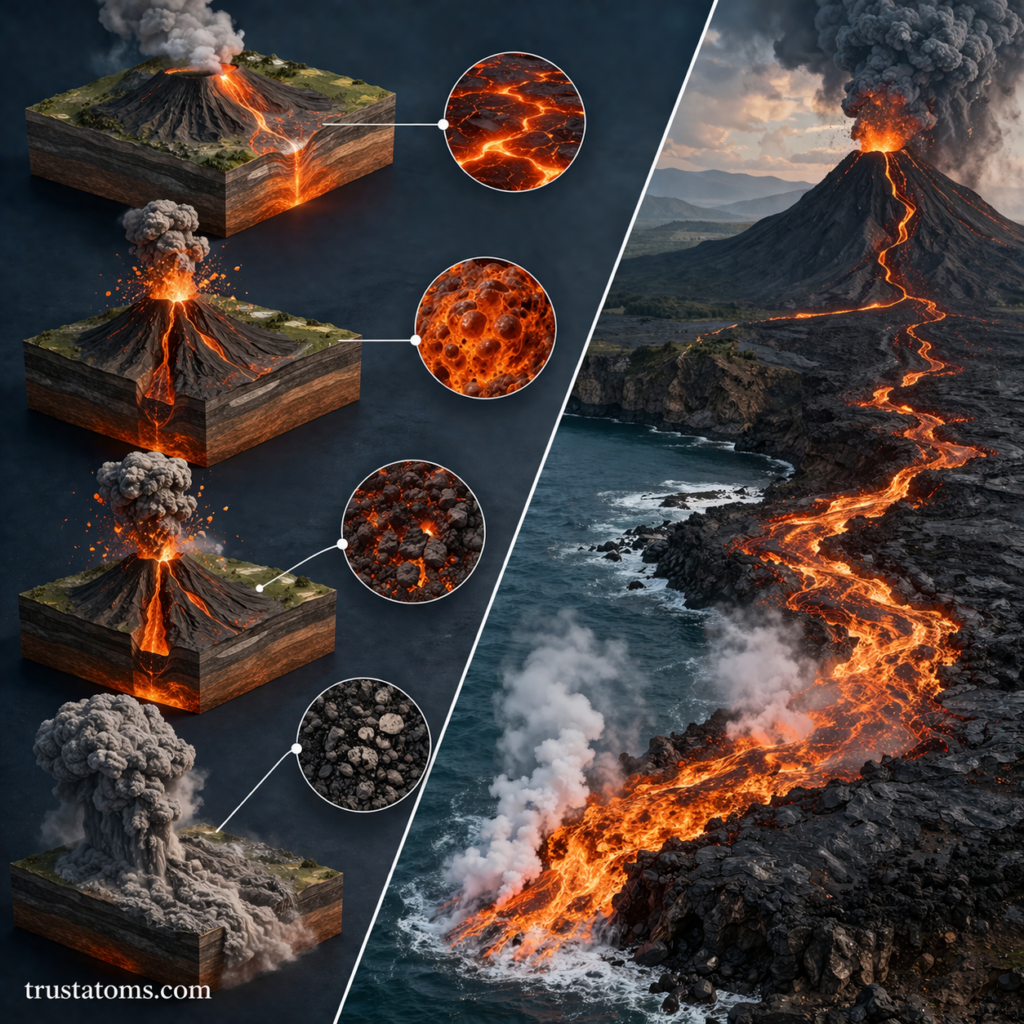
Volcanic eruptions are shaped by several important variables. These factors determine how easily magma flows, how gases escape, and whether pressure builds enough to fragment molten rock.
Magma Composition and Viscosity
Viscosity describes a fluid’s resistance to flowing. Magma with higher silica content generally has greater viscosity at comparable temperatures, making it more difficult for gases to escape.
- Basaltic magma: Usually has relatively low silica content and low viscosity, allowing lava to flow readily.
- Andesitic magma: Commonly has intermediate silica content and can produce both lava flows and explosive activity.
- Rhyolitic magma: Typically contains more silica and is highly viscous, often favoring explosive behavior when substantial gas is present.
Temperature and crystal content also influence viscosity. Magma composition alone cannot determine whether an eruption will be explosive.
Dissolved Gases and Pressure
Magma contains dissolved gases, including water vapor, carbon dioxide, and sulfur dioxide. As magma rises and pressure decreases, gases can form expanding bubbles, much like carbon dioxide escaping when a carbonated drink is opened.
If bubbles escape easily, lava may flow with limited explosive activity. If gases remain trapped, pressure can build until magma fragments violently. Interaction with external water can also trigger explosions.
Types of Volcanic Eruption Patterns
Scientists classify eruptions by observing how material is released, the intensity of explosions, and the resulting deposits. These classifications describe typical behaviors rather than rigid categories.
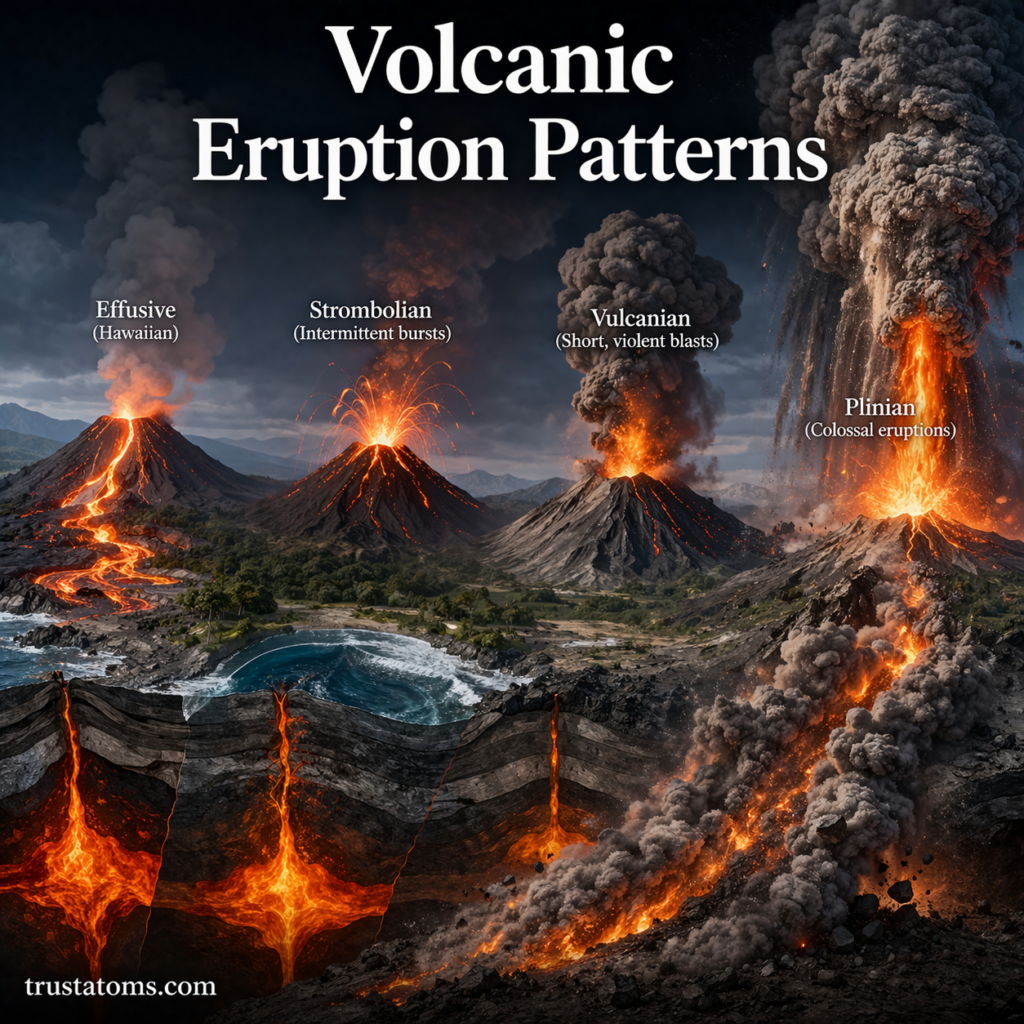
Effusive Eruptions: Flowing Lava
Effusive eruptions primarily release lava rather than large quantities of fragmented material. They are common at basaltic volcanoes, where relatively fluid magma can travel through vents and across the ground.
Although often less explosive, lava flows can destroy buildings, roads, and agricultural land. Their speed varies with slope, lava composition, temperature, and eruption rate.
Strombolian Eruptions: Repeated Bursts
Strombolian eruptions involve intermittent explosions caused by expanding gas bubbles. They eject glowing lava fragments, cinders, and volcanic bombs around a vent.
The Italian volcano Stromboli is the classic example. Its explosions may recur frequently, but their timing and strength can vary, so they should not be treated as reliably predictable.
Vulcanian Eruptions: Short, Powerful Explosions
Vulcanian eruptions produce brief, forceful explosions that can send ash and rock fragments high above the volcano. They may occur when a solidified or viscous magma plug obstructs a vent and gas pressure increases beneath it.
These events can create hazardous ash clouds and eject large blocks near the eruption site.
Plinian Eruptions: Sustained Eruption Columns
Plinian eruptions involve sustained, powerful explosive activity that produces towering columns of gas, ash, and pumice. Some columns reach the stratosphere, allowing fine particles and volcanic gases to spread over large areas.
These eruptions can produce widespread ashfall and dangerous pyroclastic density currents if an eruption column collapses. The 1991 eruption of Mount Pinatubo is a well-documented example of a major explosive event.
Different eruption styles also produce distinctive volcanic landscapes. Volcanic Landforms and Lava Types explains how lava properties and repeated eruptions shape volcanic cones, domes, and other features.
A Practical Comparison: Hawaii and Mount St. Helens
The contrast between Hawaiian volcanoes and Mount St. Helens illustrates how magma properties affect eruption behavior.
Kilauea in Hawaii commonly erupts relatively fluid basaltic lava that can spread across the landscape. Mount St. Helens, in Washington, experienced a highly explosive eruption on May 18, 1980, when rapid pressure release and gas expansion contributed to a devastating lateral blast and ash-producing eruption.
According to the U.S. Geological Survey, the 1980 eruption column rose more than 20 kilometers into the atmosphere. These two volcanoes show why eruption hazards cannot be judged simply by whether lava is visible: one may primarily threaten property through advancing flows, while another can generate dangerous blasts, ashfall, and fast-moving debris.
How Eruption Activity Changes Over Time
Volcanoes may alternate between periods of unrest, eruption, and relative quiet. Increased earthquakes, ground swelling, or changing gas emissions can indicate that magma or fluids are moving underground.
However, volcanic activity does not follow a universal cycle. Some volcanoes remain quiet for centuries, while others erupt frequently. A dormant volcano may erupt again, whereas an extinct volcano is one that geologists consider unlikely to erupt in the future.
Scientists evaluate each volcano using its geological history and current measurements rather than assuming that a fixed sequence of stages will repeat.
How Plate Tectonics Influences Eruption Styles
Volcanoes occur in several tectonic settings, and each can favor particular magma compositions and eruption behaviors.
- Divergent boundaries: Plates move apart, commonly allowing basaltic magma to rise and produce lava flows.
- Convergent boundaries: Subduction-related melting can generate diverse magmas, including those capable of explosive eruptions.
- Hotspots: Volcanism may occur within plates, producing anything from fluid basaltic lava to highly explosive eruptions depending on the setting.
Tectonic location provides useful context, but magma chemistry, gas content, and eruption conditions are more direct controls on eruption style.
Volcanic Hazards Associated With Eruption Patterns
Different eruption styles create different hazards, sometimes simultaneously. Understanding the likely products of an eruption helps communities prepare for the dangers most relevant to their location.
- Lava flows: Can burn or bury infrastructure and vegetation.
- Ashfall: Reduces visibility, affects breathing, disrupts aviation, and can damage roofs and machinery.
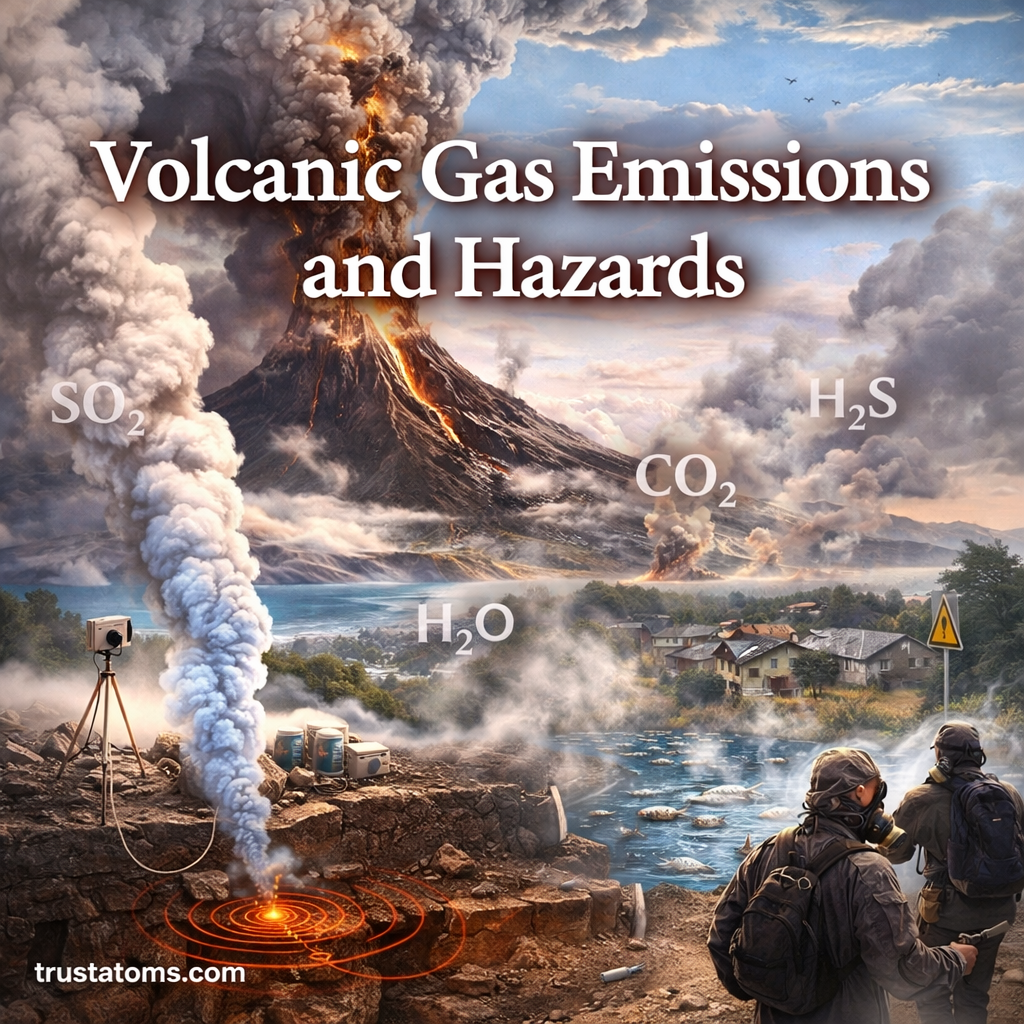
- Volcanic gases: Can create hazardous air conditions near vents and in low-lying areas.
- Pyroclastic density currents: Fast-moving mixtures of hot gas and volcanic material that can devastate areas around a volcano.
Pyroclastic Flows and Volcanic Hazards examines why these hot, ground-hugging currents are particularly dangerous during explosive eruptions.
How Scientists Monitor Eruption Patterns
Volcano observatories combine multiple measurements to identify changes that may indicate increasing activity.
- Seismometers: Detect earthquakes and volcanic tremor associated with underground movement.
- GPS and satellite radar: Measure ground deformation caused by changing underground pressure.
- Gas instruments: Track changes in volcanic emissions.
- Thermal observations: Identify temperature changes near vents and lava-producing areas.
Monitoring improves hazard forecasts, but scientists generally cannot predict the exact time, size, or style of every eruption. Warnings are based on multiple observations and updated as conditions change.
Using Eruption Patterns to Assess Risk
Eruption patterns help scientists identify areas likely to experience lava flows, ashfall, explosions, or pyroclastic currents. Hazard maps and evacuation plans can then be designed around the volcano’s history, terrain, and nearby communities.
Volcano shape also provides clues about likely behavior. Shield vs Composite Volcanoes compares two major volcano types and explains how their structure relates to magma properties and eruption styles.
Frequently Asked Questions
What determines whether a volcano erupts explosively?
Explosive behavior depends mainly on how rapidly gases expand and whether they can escape from rising magma. High viscosity, abundant dissolved gases, and interactions with external water can increase the likelihood of explosive activity.
Can one volcano produce different eruption types?
Yes. Changes in magma composition, gas content, pressure, or the supply of magma can cause the same volcano to alternate between lava flows and explosive eruptions, sometimes during a single eruptive episode.
Can scientists predict exactly when a volcano will erupt?
Not reliably. Monitoring can reveal signs of unrest and support forecasts of increased eruption probability, but the exact timing and behavior of future eruptions often remain uncertain.
Volcanic eruption patterns reflect the interaction of magma viscosity, gas expansion, and geological conditions rather than a fixed sequence of events. Comparing Kilauea’s flowing lava with Mount St. Helens’ explosive activity shows why understanding eruption style is necessary for identifying hazards and planning effective responses.
Sources: U.S. Geological Survey, Volcano Hazards Program; Smithsonian Institution, Global Volcanism Program; British Geological Survey, volcanic eruption and monitoring resources.