Earth’s atmosphere is more than just the air we breathe—it’s a complex system that regulates temperature, protects life, and controls how energy moves around the planet. One of the most important processes in this system is radiation balance, which determines how much energy Earth receives from the Sun and how much it sends back into space.
Understanding atmospheric layers and radiation balance helps explain climate, weather patterns, and global temperature changes.
What Are the Layers of the Atmosphere?
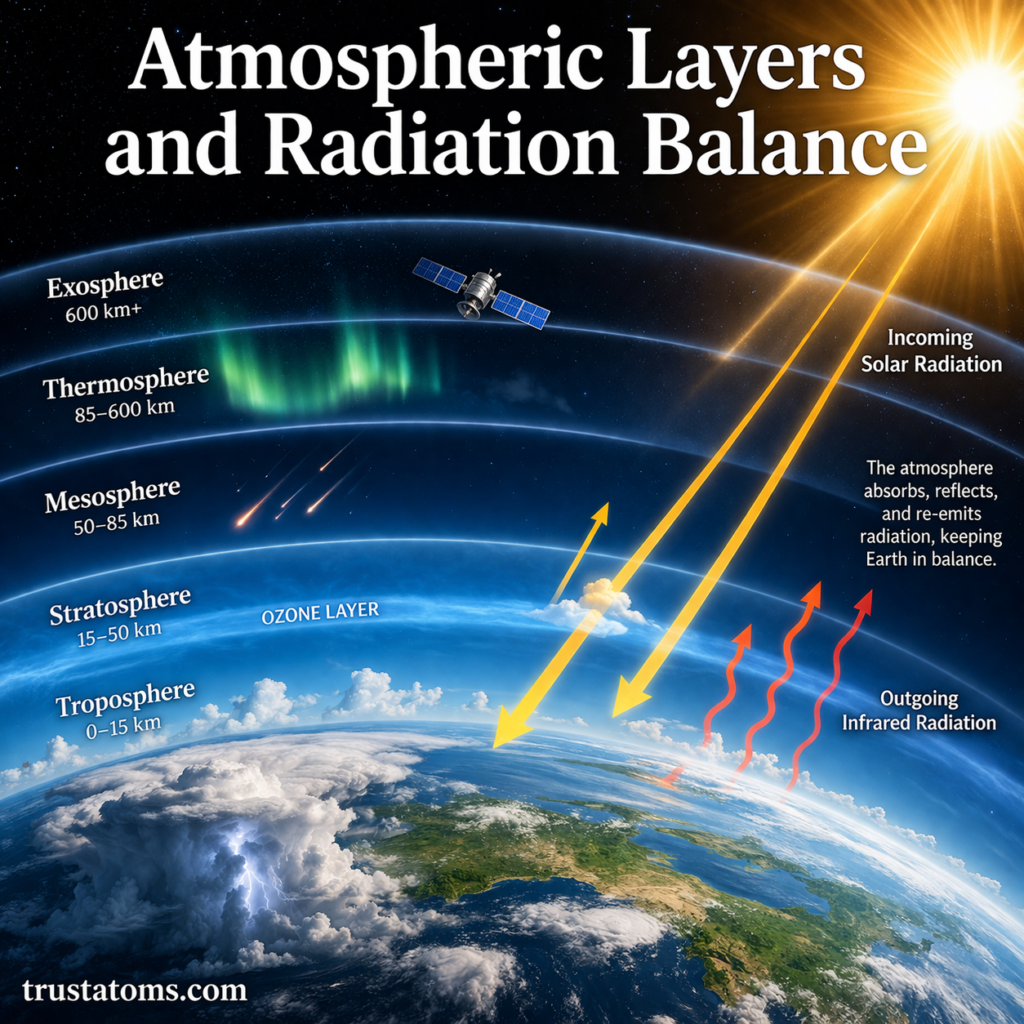
The atmosphere is divided into several layers based on temperature changes with altitude. Each layer plays a unique role in energy absorption, reflection, and transfer.
1. Troposphere
The troposphere is the lowest layer, where all weather occurs.
- Extends from the surface up to about 8–15 km
- Contains most of the atmosphere’s mass and water vapor
- Temperature decreases with altitude
Key role:
- Controls weather and cloud formation
- Plays a major role in trapping heat near Earth’s surface
2. Stratosphere
Above the troposphere lies the stratosphere.
- Extends from about 15 km to 50 km
- Contains the ozone layer
- Temperature increases with altitude
Key role:
- Absorbs harmful ultraviolet (UV) radiation
- Helps stabilize atmospheric conditions
3. Mesosphere
The mesosphere sits above the stratosphere.
- Extends from 50 km to about 85 km
- Temperature decreases with altitude
Key role:
- Burns up meteors entering Earth’s atmosphere
- Acts as a transitional layer
4. Thermosphere
The thermosphere is a very thin but highly energetic layer.
- Extends from about 85 km to 600 km+
- Temperature increases dramatically with altitude
Key role:
- Absorbs high-energy solar radiation (X-rays and UV)
- Contains the ionosphere, important for radio communication
5. Exosphere
The exosphere is the outermost layer.
- Gradually fades into space
- Extremely low density of particles
Key role:
- Acts as the boundary between Earth’s atmosphere and space
What Is Radiation Balance?
Radiation balance refers to the balance between incoming energy from the Sun and outgoing energy from Earth.
The Basic Concept
- The Sun sends energy to Earth as solar radiation
- Earth absorbs some of this energy
- The rest is reflected or re-emitted back into space
When incoming and outgoing energy are equal, Earth’s temperature remains stable.
Incoming Solar Radiation
Solar energy reaches Earth in the form of shortwave radiation.
What Happens to Incoming Energy?
When sunlight reaches Earth:
- Some is reflected by clouds, ice, and surfaces
- Some is absorbed by land and oceans
- Some is absorbed by atmospheric gases
Albedo: Reflection of Energy
Albedo is a measure of how much sunlight a surface reflects.
- High albedo (ice, snow): reflects more energy
- Low albedo (oceans, forests): absorbs more energy
Albedo plays a major role in regulating Earth’s temperature.
Outgoing Terrestrial Radiation
After absorbing solar energy, Earth releases energy back into space as longwave (infrared) radiation.
Key Processes
- Surface heats up from sunlight
- Heat is radiated upward
- Some escapes into space
- Some is absorbed and re-radiated by greenhouse gases
The Greenhouse Effect
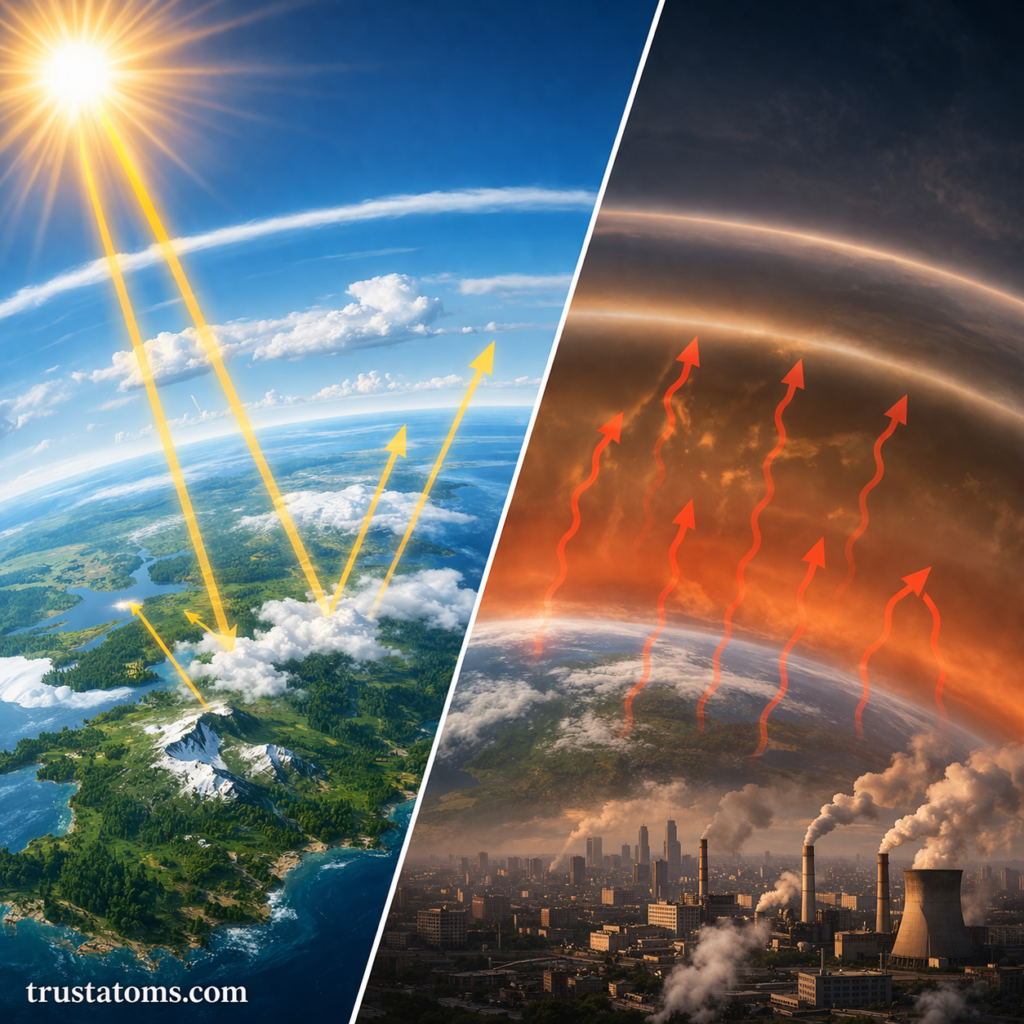
The greenhouse effect is a natural process that helps keep Earth warm enough to support life.
How It Works
- Sunlight reaches Earth’s surface
- Earth absorbs energy and warms up
- Earth emits infrared radiation
- Greenhouse gases absorb and re-emit this heat
- Some heat is trapped, warming the lower atmosphere
Major Greenhouse Gases
- Carbon dioxide (CO₂)
- Water vapor
- Methane (CH₄)
- Nitrous oxide (N₂O)
Without the greenhouse effect, Earth would be too cold to sustain most life.
How Atmospheric Layers Affect Radiation
Each atmospheric layer interacts with radiation differently.
Troposphere
- Traps heat through greenhouse gases
- Drives weather and energy exchange
Stratosphere
- Absorbs UV radiation via ozone
- Protects life from harmful radiation
Upper Layers
- Absorb high-energy radiation
- Prevent harmful solar energy from reaching the surface
Energy Imbalance and Climate Change
Radiation balance is not always perfectly stable. When more energy enters than leaves, Earth warms.
Causes of Imbalance
- Increased greenhouse gas concentrations
- Changes in albedo (melting ice, deforestation)
- Variations in solar output
Effects of Imbalance
- Rising global temperatures
- Melting glaciers and ice caps
- Sea level rise
- Changes in weather patterns
Why Radiation Balance Matters
Radiation balance is central to understanding Earth’s climate system.
It Helps Explain:
- Why some regions are hotter than others
- Seasonal temperature changes
- Long-term climate trends
- Extreme weather patterns
Key Takeaways
- Earth’s atmosphere is divided into five main layers, each with a unique role
- Radiation balance determines how energy enters and leaves the planet
- Solar radiation is absorbed, reflected, or re-emitted
- The greenhouse effect helps regulate temperature
- Imbalances in radiation can lead to climate change
Final Thoughts
The interaction between atmospheric layers and radiation balance is one of the most important systems on Earth. It controls temperature, protects life, and shapes weather and climate patterns.
As human activities influence this balance, understanding how it works becomes even more critical for predicting future climate changes and protecting the planet.