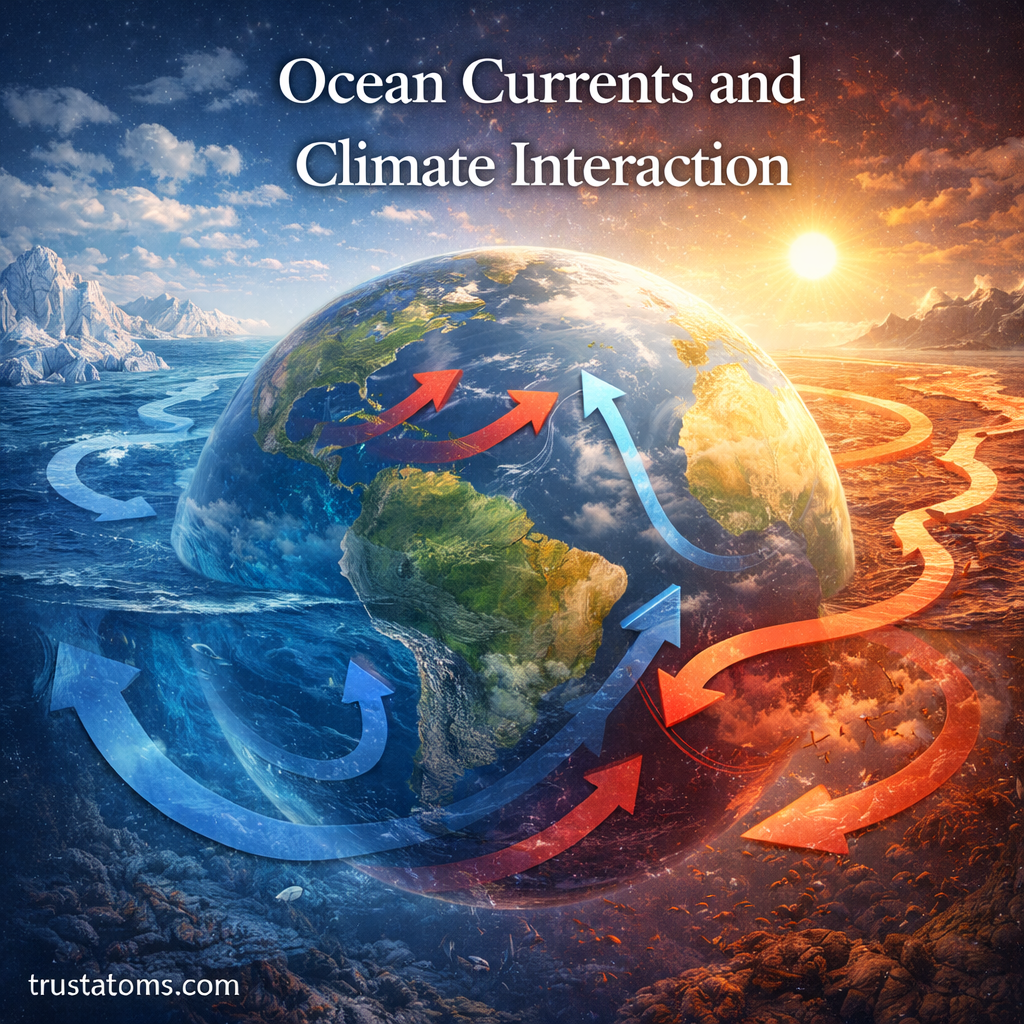
Ocean currents are powerful, continuous movements of seawater that play a major role in shaping Earth’s climate. Acting like a global transport system, these currents move heat, nutrients, and gases across the planet.
Understanding how ocean currents interact with climate helps explain weather patterns, regional temperatures, and long-term environmental changes.
What Are Ocean Currents?
Ocean currents are large-scale flows of water within the ocean, driven by various forces.
Main Drivers of Ocean Currents
- Wind patterns (surface currents)
- Earth’s rotation (Coriolis effect)
- Differences in temperature and salinity (deep currents)
- Gravitational forces
These forces create complex circulation systems that connect all major oceans.
Types of Ocean Currents
Ocean currents are generally divided into two main categories.
Surface Currents
- Occur in the upper 400 meters of the ocean
- Driven primarily by wind
- Move quickly compared to deep currents
Examples:
- Gulf Stream
- California Current
Deep Ocean Currents
- Driven by density differences (thermohaline circulation)
- Move slowly but affect the entire ocean system
- Operate below the surface layer
These currents form part of the global conveyor belt that redistributes heat.
The Role of Ocean Currents in Climate
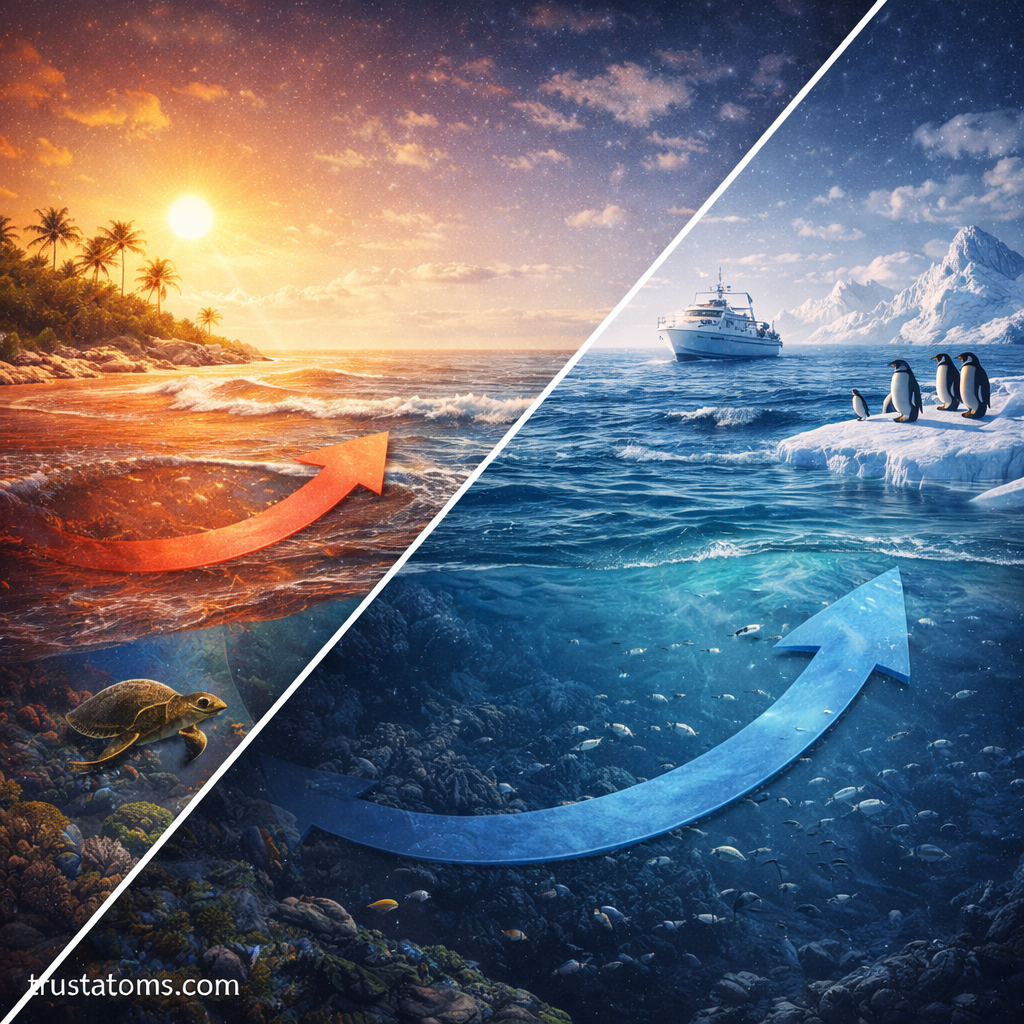
Ocean currents are essential for regulating Earth’s climate system.
Heat Distribution
- Warm water moves from the equator toward the poles
- Cold water flows back toward the equator
- Balances global temperature differences
Impact:
- Prevents extreme temperature variations
- Helps maintain habitable climates
Influence on Weather Patterns
Ocean currents affect atmospheric conditions and weather systems.
Examples:
- Warm currents can increase humidity and rainfall
- Cold currents can create dry, stable air
This interaction influences:
- Storm formation
- Seasonal weather patterns
- Coastal climates
Major Ocean Currents and Their Climate Effects
Gulf Stream
- Warm current in the Atlantic Ocean
- Carries heat from the Gulf of Mexico toward Europe
Climate impact:
- Warms Western Europe
- Contributes to milder winters
El Niño and La Niña (ENSO)
The El Niño–Southern Oscillation (ENSO) is a major climate pattern involving ocean-atmosphere interaction.
El Niño
- Warmer-than-average ocean temperatures in the Pacific
- Reduces upwelling
- Alters global weather patterns
Effects:
- Increased rainfall in some regions
- Droughts in others
La Niña
- Cooler-than-average ocean temperatures
- Stronger upwelling
- Opposite effects of El Niño
Effects:
- More intense storms in some areas
- Cooler global temperatures
Antarctic Circumpolar Current
- Flows around Antarctica
- Connects the Atlantic, Pacific, and Indian Oceans
Climate impact:
- Helps regulate global ocean circulation
- Isolates cold Antarctic waters
Ocean Currents and the Carbon Cycle
Ocean currents play a key role in storing and transporting carbon.
How It Works
- Oceans absorb carbon dioxide from the atmosphere
- Currents move carbon-rich water to deeper layers
- Carbon can remain stored for centuries
Why it matters:
- Helps reduce the impact of greenhouse gases
- Influences long-term climate stability
Upwelling and Its Climate Connection
Upwelling is the process where deep, cold water rises to the surface.
Effects of Upwelling
- Brings nutrients to the surface
- Supports marine ecosystems
- Influences local climate
Climate impact:
- Can cool coastal regions
- Affects atmospheric circulation
The Coriolis Effect and Ocean Movement
Earth’s rotation influences the direction of ocean currents.
Key Effects
- Currents deflect to the right in the Northern Hemisphere
- Currents deflect to the left in the Southern Hemisphere
This creates large circular systems called gyres.
Climate Change and Ocean Currents
Climate change is altering ocean current patterns.
Key Changes
- Rising ocean temperatures
- Melting ice affecting salinity
- Changes in wind patterns
Potential Impacts
- Slowing of major currents (like the Gulf Stream system)
- Disruption of heat distribution
- Increased climate variability
These changes could have significant global consequences.
Why Ocean Currents Matter
Ocean currents influence many aspects of life on Earth.
Environmental Importance
- Regulate climate and weather
- Support marine biodiversity
- Maintain ecosystem balance
Human Impact
- Affect fishing industries
- Influence shipping routes
- Impact coastal communities
Final Thoughts
Ocean currents are a vital part of Earth’s climate system, connecting oceans and continents through the movement of water, heat, and nutrients. From regulating temperatures to shaping weather patterns, their influence is both powerful and far-reaching.
As climate change continues to affect ocean systems, understanding these currents becomes increasingly important for predicting future environmental conditions and protecting our planet.