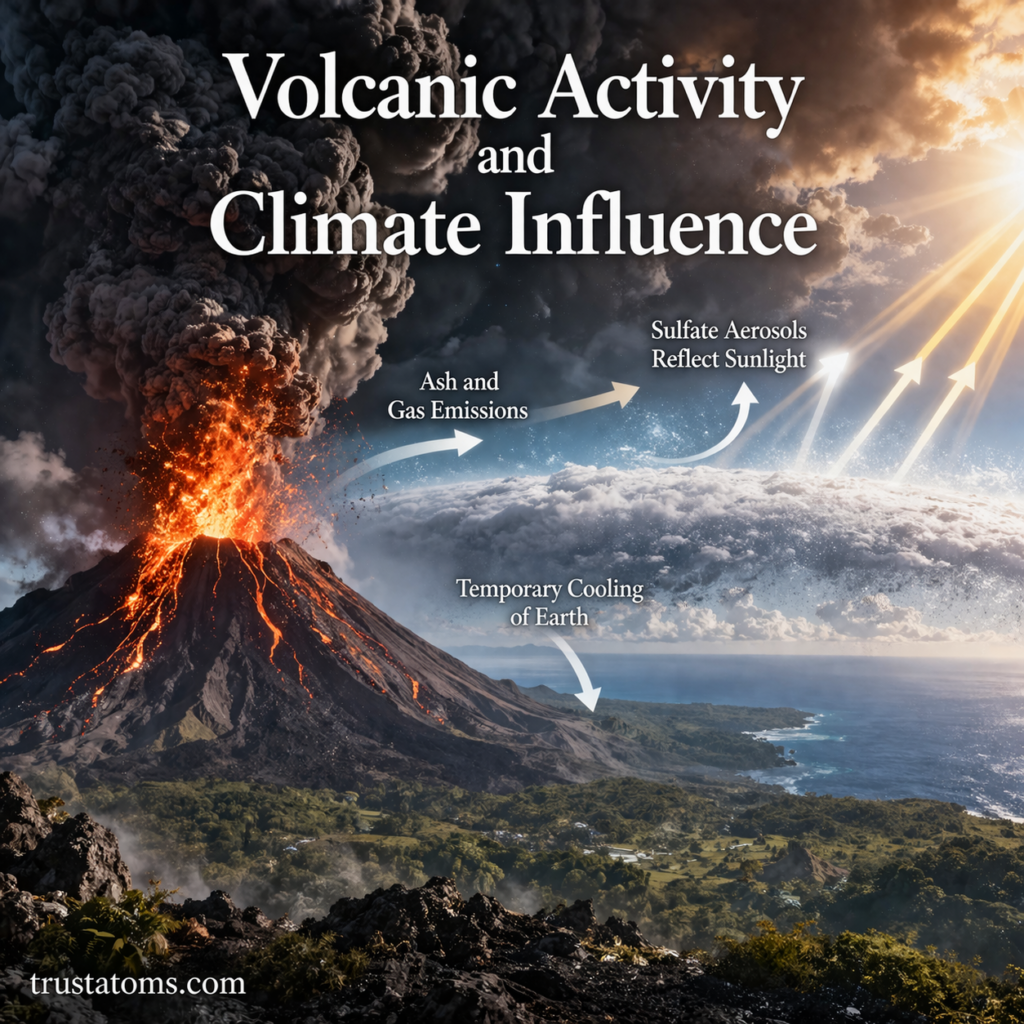
Volcanoes are among the most powerful natural forces on Earth. Beyond shaping landscapes, volcanic eruptions can significantly influence the planet’s climate—sometimes cooling it, sometimes contributing to warming.
While volcanic activity is a natural part of Earth’s system, its impact on climate depends on the type, scale, and location of eruptions. Understanding this relationship helps explain both short-term climate changes and long-term geological trends.
How Volcanoes Affect Climate
Volcanoes influence climate primarily by releasing gases and particles into the atmosphere.
Key Emissions
- Sulfur dioxide (SO₂)
- Carbon dioxide (CO₂)
- Water vapor
- Ash and aerosols
These emissions interact with sunlight and atmospheric processes in different ways, leading to either cooling or warming effects.
Short-Term Cooling Effects
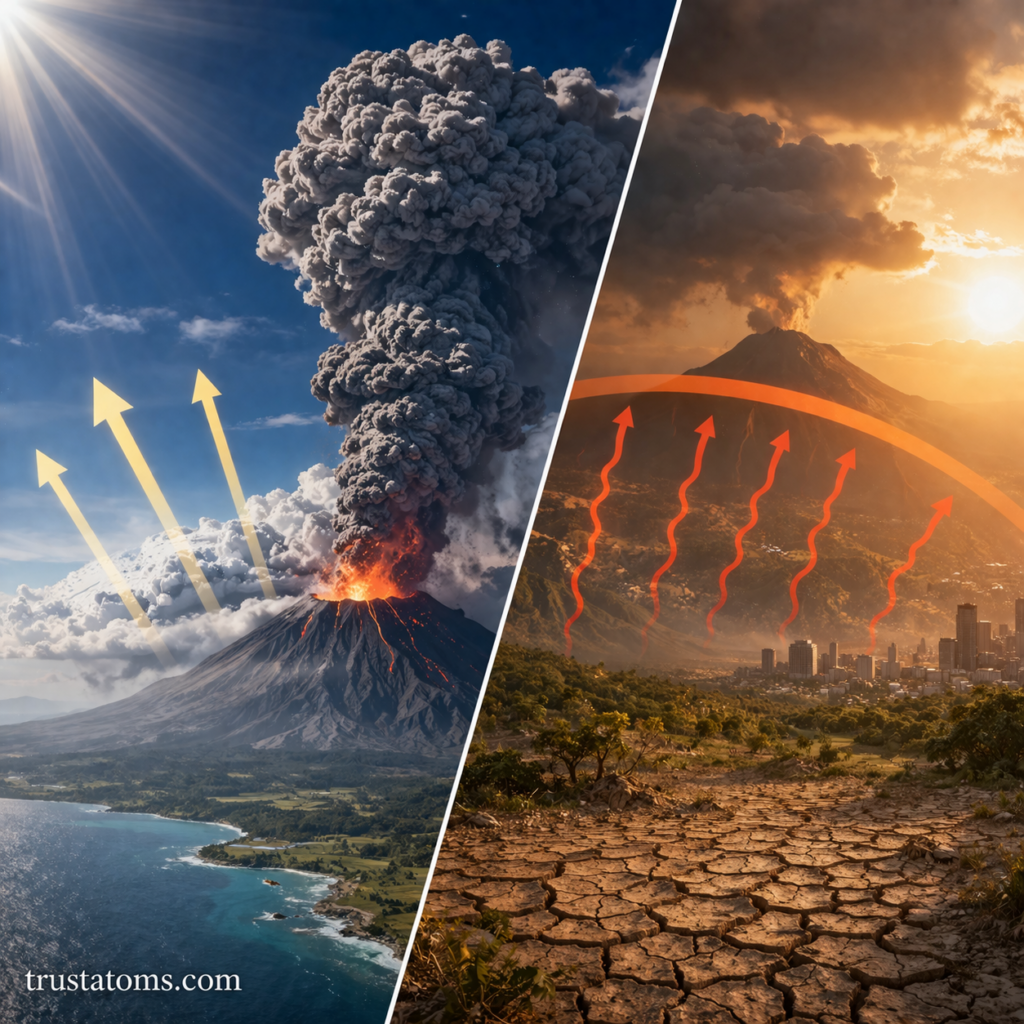
Large volcanic eruptions often lead to temporary global cooling.
Role of Sulfate Aerosols
When sulfur dioxide is released into the upper atmosphere:
- It reacts with water vapor
- Forms tiny particles called sulfate aerosols
- These particles reflect sunlight back into space
Climate Impact
- Reduces the amount of solar radiation reaching Earth
- Lowers global temperatures for months to years
- Can disrupt weather patterns
Example Effects
- Cooler summers
- Changes in rainfall patterns
- Temporary shifts in atmospheric circulation
Long-Term Warming Contributions
Volcanoes also emit carbon dioxide, a greenhouse gas.
CO₂ Emissions
- Contribute to the greenhouse effect
- Add to atmospheric carbon levels over time
However:
- Volcanic CO₂ emissions are much smaller than human-generated emissions
- Their long-term warming effect is relatively limited compared to human activity
Ash Clouds and Atmospheric Impact
Volcanic ash plays a short-lived but important role.
Characteristics of Ash
- Made of fine rock and mineral particles
- Can spread over large areas
Effects on Climate
- Blocks sunlight temporarily
- Cools local regions
- Settles out of the atmosphere relatively quickly (days to weeks)
Ash impacts are usually more regional than global.
Stratospheric vs Tropospheric Eruptions
The altitude of volcanic emissions determines their climate impact.
Tropospheric Eruptions
- Occur in the lower atmosphere
- Particles are quickly washed out by rain
- Limited climate impact
Stratospheric Eruptions
- Reach higher altitudes
- Aerosols remain suspended for longer periods
- Have a greater global cooling effect
The most climate-influential eruptions inject material into the stratosphere.
Volcanic Forcing and Climate Systems
Volcanic eruptions are considered a form of natural climate forcing.
Negative Forcing (Cooling)
- Caused by reflective aerosols
- Reduces incoming solar radiation
Positive Forcing (Warming)
- Caused by greenhouse gases like CO₂
In most major eruptions, cooling effects dominate in the short term.
Historical Examples of Volcanic Climate Impact
Major Eruptions and Their Effects
- Mount Tambora (1815):
- Led to the “Year Without a Summer”
- Caused global cooling and crop failures
- Krakatoa (1883):
- Produced vivid sunsets worldwide
- Lowered global temperatures
- Mount Pinatubo (1991):
- Reduced global temperatures by about 0.5°C for several years
These events demonstrate how powerful volcanic eruptions can temporarily alter global climate.
Volcanic Activity and Ocean Systems
Volcanic cooling can also affect oceans.
Key Impacts
- Reduced sea surface temperatures
- Changes in ocean circulation patterns
- Altered marine ecosystems
Ocean responses can extend and amplify climate effects over time.
Volcanic Activity vs Human Influence
While volcanoes impact climate, their role differs from human-driven changes.
Key Differences
- Volcanic effects are temporary
- Human emissions create long-term warming trends
Important Comparison
- A single major eruption may cool the planet briefly
- Human greenhouse gas emissions cause sustained warming over decades and centuries
Monitoring Volcanic Climate Effects
Scientists track volcanic activity and its climate impact using:
Satellite Observations
- Detect ash clouds and gas emissions
- Measure atmospheric changes
Ground Monitoring
- Track eruption activity and gas release
- Provide real-time data
Climate Models
- Simulate how volcanic emissions affect global systems
- Predict short-term climate responses
Why Volcanic Activity Matters for Climate Science
Volcanoes provide valuable insights into how Earth’s climate system works.
Key Contributions to Research
- Help scientists understand atmospheric processes
- Offer real-world examples of climate forcing
- Improve accuracy of climate models
Studying volcanic eruptions helps researchers separate natural variability from human-driven climate change.
Key Takeaways
- Volcanoes influence climate through gases and particles
- Sulfate aerosols from eruptions can cause short-term cooling
- Volcanic CO₂ contributes to warming but is relatively small
- Stratospheric eruptions have the greatest global impact
- Volcanic effects are temporary compared to long-term human influence
Conclusion
Volcanic activity is a powerful natural force that can temporarily reshape Earth’s climate. From cooling the planet through reflective aerosols to releasing greenhouse gases, volcanoes play a complex role in the climate system.
By studying these natural events, scientists gain a deeper understanding of climate processes—helping distinguish between short-term fluctuations and long-term global trends.