Earthquakes are among the most powerful natural events on Earth. They occur when energy stored within the planet’s crust is suddenly released, causing the ground to shake.
While some earthquakes are barely noticeable, others can cause widespread destruction. Understanding what causes earthquakes and how they are measured is essential for improving safety, predicting risks, and studying Earth’s internal structure.
What Is an Earthquake?
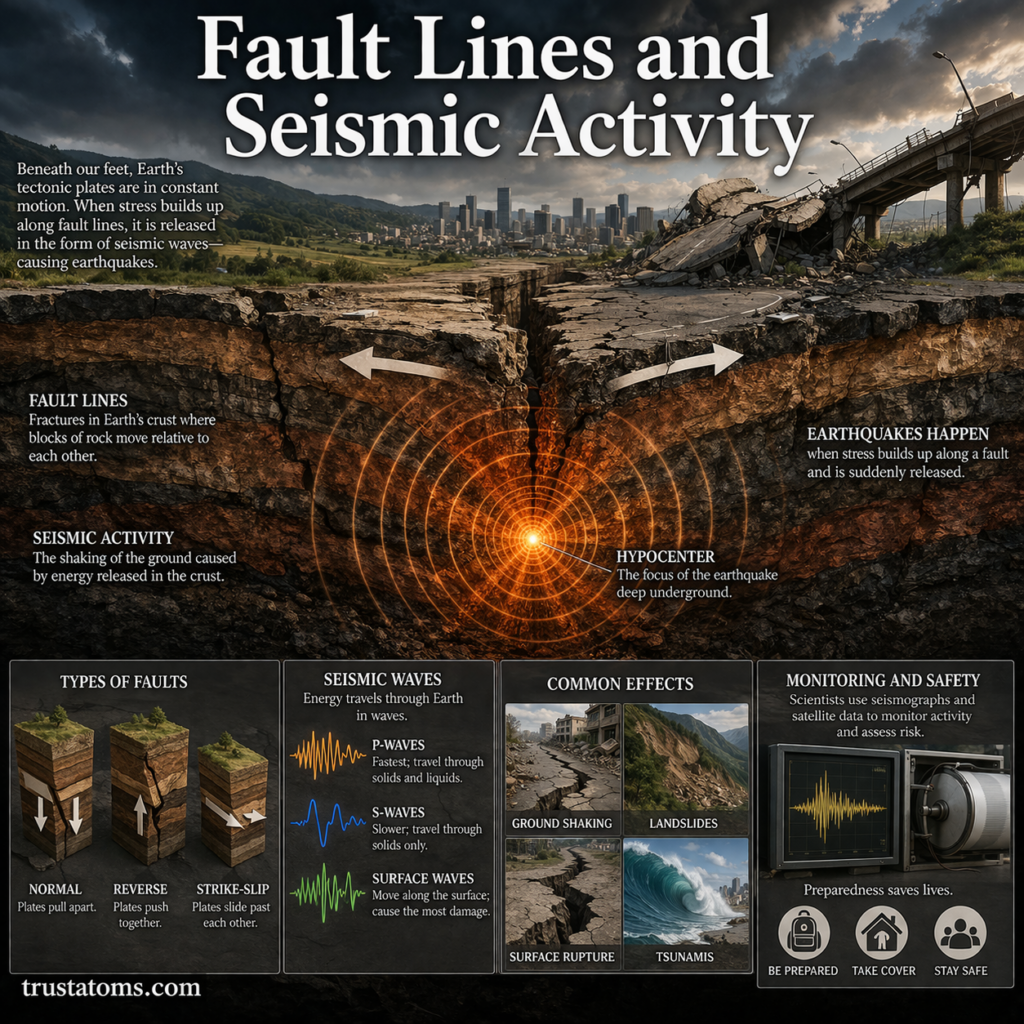
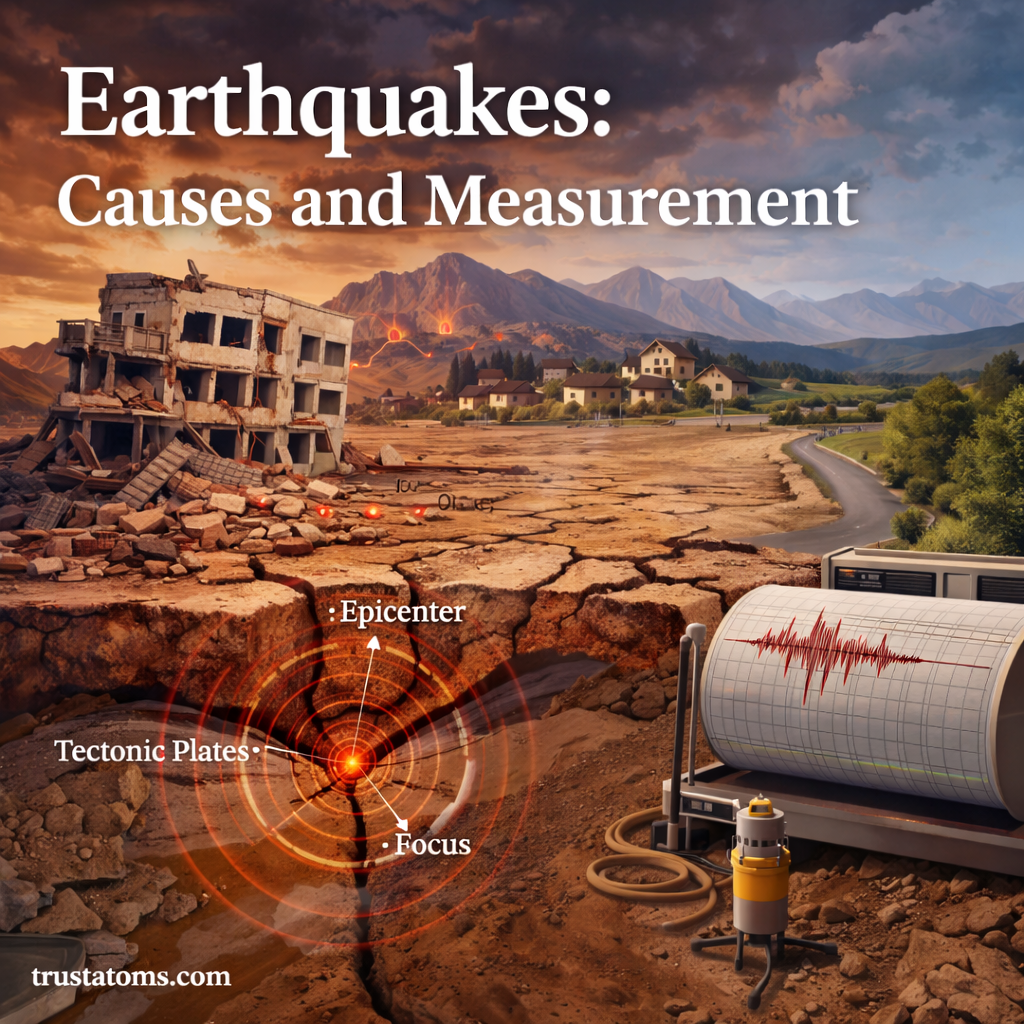
An earthquake is the sudden shaking of the ground caused by the movement of rocks beneath Earth’s surface.
This movement typically occurs along faults—fractures in the Earth’s crust where blocks of rock shift relative to each other.
Key Terms
- Focus (Hypocenter): The point underground where the earthquake begins
- Epicenter: The point on the surface directly above the focus
- Fault: A crack in the Earth’s crust where movement occurs
What Causes Earthquakes?
Most earthquakes are caused by the movement of tectonic plates.
Plate Tectonics
Earth’s outer shell is divided into large pieces called tectonic plates. These plates are constantly moving, though very slowly.
When plates interact, stress builds up along their boundaries. Eventually, the stress becomes too great, and the rocks break or slip—releasing energy as an earthquake.
This process is closely related to Plate Tectonics.
Types of Plate Boundaries
Different types of plate interactions produce different kinds of earthquakes.
Convergent Boundaries
- Plates move toward each other
- One plate may be forced beneath another (subduction)
- Often produce powerful earthquakes
Divergent Boundaries
- Plates move apart
- Magma rises to fill the gap
- Typically cause smaller earthquakes
Transform Boundaries
- Plates slide past each other
- Stress builds up along faults
- Sudden release leads to earthquakes
Other Causes of Earthquakes
While most earthquakes are tectonic, other factors can also trigger them.
Volcanic Activity
Movement of magma beneath the surface can cause shaking, especially near active volcanoes.
Human-Induced Earthquakes
Certain human activities can trigger smaller earthquakes:
- Mining operations
- Reservoir construction (large dams)
- Injection of fluids underground
How Earthquakes Travel: Seismic Waves
When an earthquake occurs, energy travels outward in waves.
Types of Seismic Waves
- P-Waves (Primary Waves)
- Travel fastest
- Move through solids, liquids, and gases
- S-Waves (Secondary Waves)
- Slower than P-waves
- Only travel through solids
- Surface Waves
- Travel along Earth’s surface
- Cause the most damage
These waves are key to understanding both the earthquake and Earth’s internal structure.
How Earthquakes Are Measured
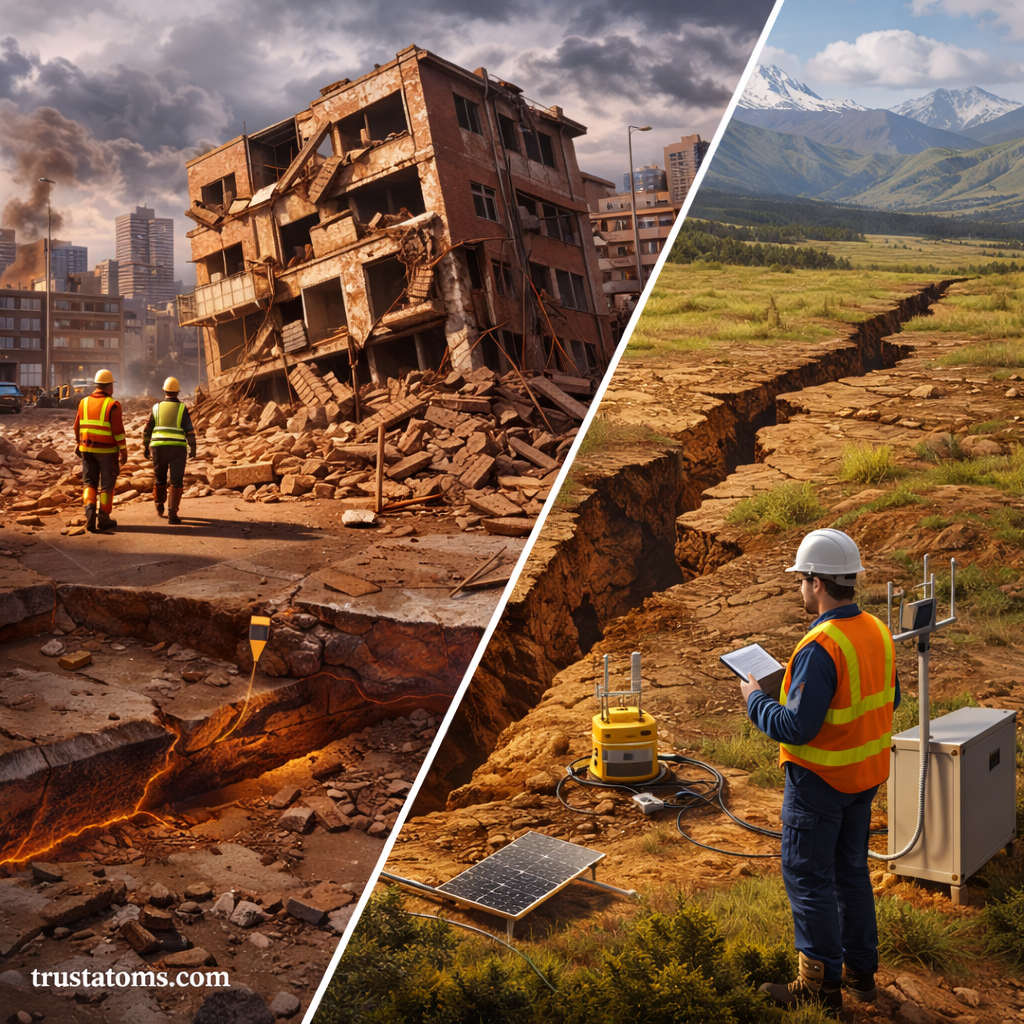
Scientists use specialized instruments and scales to measure earthquakes.
Seismographs
A seismograph records ground motion during an earthquake.
- Detects vibrations
- Produces a recording called a seismogram
- Helps determine location and intensity
Magnitude: Measuring Energy
The size of an earthquake is measured by magnitude.
The most commonly used scale today is the Moment Magnitude Scale.
- Measures total energy released
- Logarithmic scale (each step is much stronger than the previous)
Example:
- Magnitude 5: Moderate shaking
- Magnitude 7: Major damage possible
- Magnitude 9: Catastrophic destruction
Intensity: Measuring Impact
Intensity measures how an earthquake affects people and structures.
The Modified Mercalli Intensity Scale is commonly used.
- Based on observed effects
- Varies by location
- Includes levels from I (not felt) to XII (total destruction)
Locating an Earthquake
Scientists determine the location of an earthquake using seismic data.
Triangulation Method
- Seismographs at different locations record wave arrival times
- Distance from each station is calculated
- Circles are drawn around each station
- The intersection point reveals the epicenter
This method allows accurate mapping of earthquake activity worldwide.
Why Earthquakes Happen in Certain Areas
Earthquakes are not evenly distributed across the planet.
High-Risk Zones
- Plate boundaries (e.g., Pacific Ring of Fire)
- Fault lines
- Subduction zones
Low-Risk Areas
- Stable continental interiors
- Regions far from plate boundaries
Earthquake Hazards
Earthquakes can trigger a range of secondary hazards.
Common Effects
- Ground shaking
- Surface rupture
- Building collapse
- Landslides
Secondary Hazards
- Tsunamis (if undersea earthquakes occur)
- Fires from damaged infrastructure
- Liquefaction (soil behaving like liquid)
Earthquake Preparedness and Monitoring
While earthquakes cannot yet be predicted with precision, monitoring systems help reduce risk.
Early Warning Systems
- Detect initial seismic waves
- Send alerts seconds before strong shaking arrives
- Provide time to take protective actions
Preparedness Measures
- Building earthquake-resistant structures
- Creating emergency plans
- Educating communities
Why Understanding Earthquakes Matters
Studying earthquakes helps scientists:
- Understand Earth’s internal structure
- Improve hazard assessment
- Develop safer infrastructure
- Enhance emergency response systems
For communities, this knowledge can mean the difference between safety and disaster.
Final Thoughts
Earthquakes are a natural result of Earth’s dynamic and ever-changing crust. While they can be destructive, advances in science and monitoring have greatly improved our ability to understand and respond to them.
By studying their causes and measurement, we gain valuable insights into the forces shaping our planet—and how to better protect ourselves from their impact.