Earth is our home planet and the only known place in the universe where life exists. Positioned within the vast structure of the Solar System, Earth occupies a unique and favorable location that allows life to thrive.
Understanding Earth’s place in the Solar System helps explain everything from our climate and seasons to the conditions that make life possible.
Overview of the Solar System
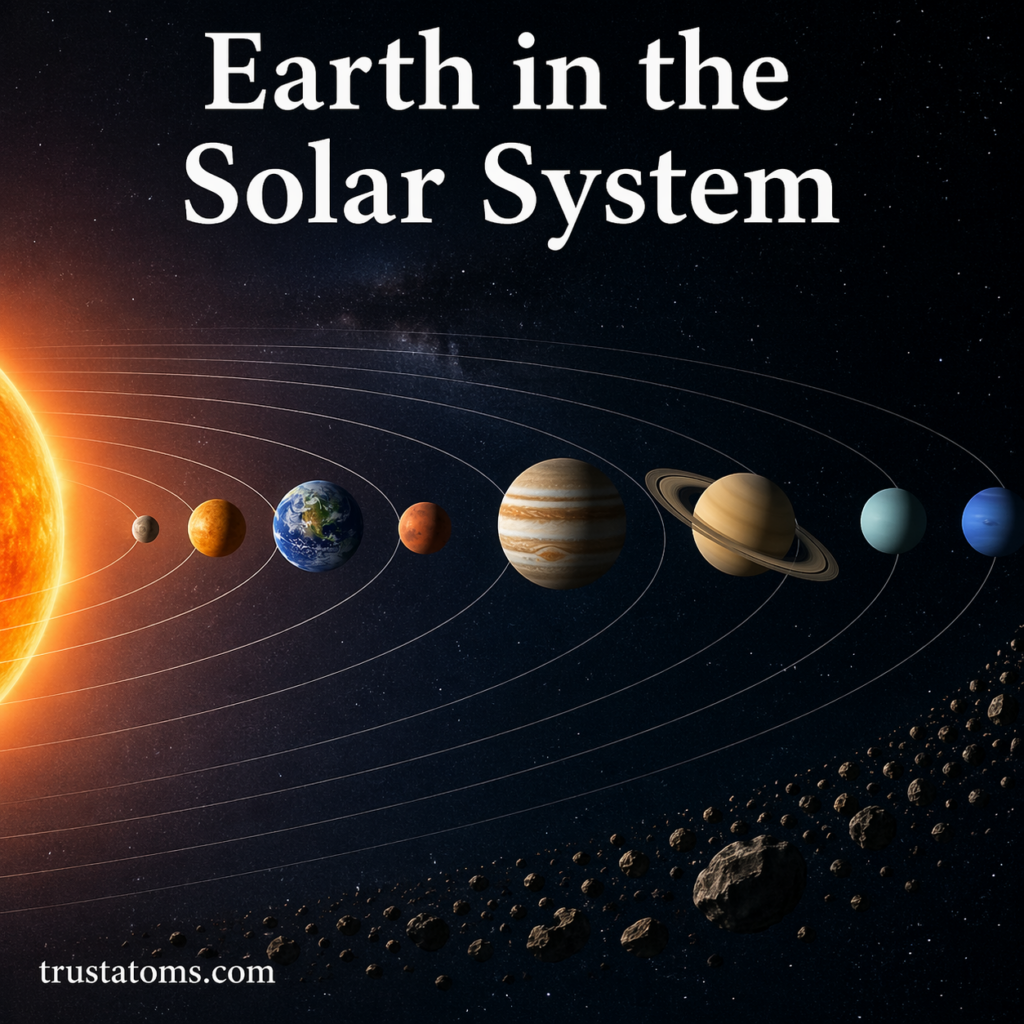
The Solar System is centered around the Sun, a massive star whose gravity holds everything together. Orbiting the Sun are:
- Eight planets (including Earth)
- Dwarf planets like Pluto
- Moons
- Asteroids and comets
Earth is the third planet from the Sun, sitting between Venus and Mars.
Earth’s Position: The Habitable Zone
Earth lies within what scientists call the “habitable zone” (or Goldilocks zone). This is the region around the Sun where conditions are “just right” for liquid water to exist.
Why this matters:
- Too close to the Sun (like Venus) → extreme heat
- Too far from the Sun (like Mars) → freezing temperatures
- Earth’s distance allows stable temperatures for life
This precise positioning is one of the main reasons Earth supports a diverse range of living organisms.
Key Characteristics of Earth
Earth stands out from other planets due to several unique features:
1. Presence of Liquid Water
- About 71% of Earth’s surface is covered by water
- Essential for all known life forms
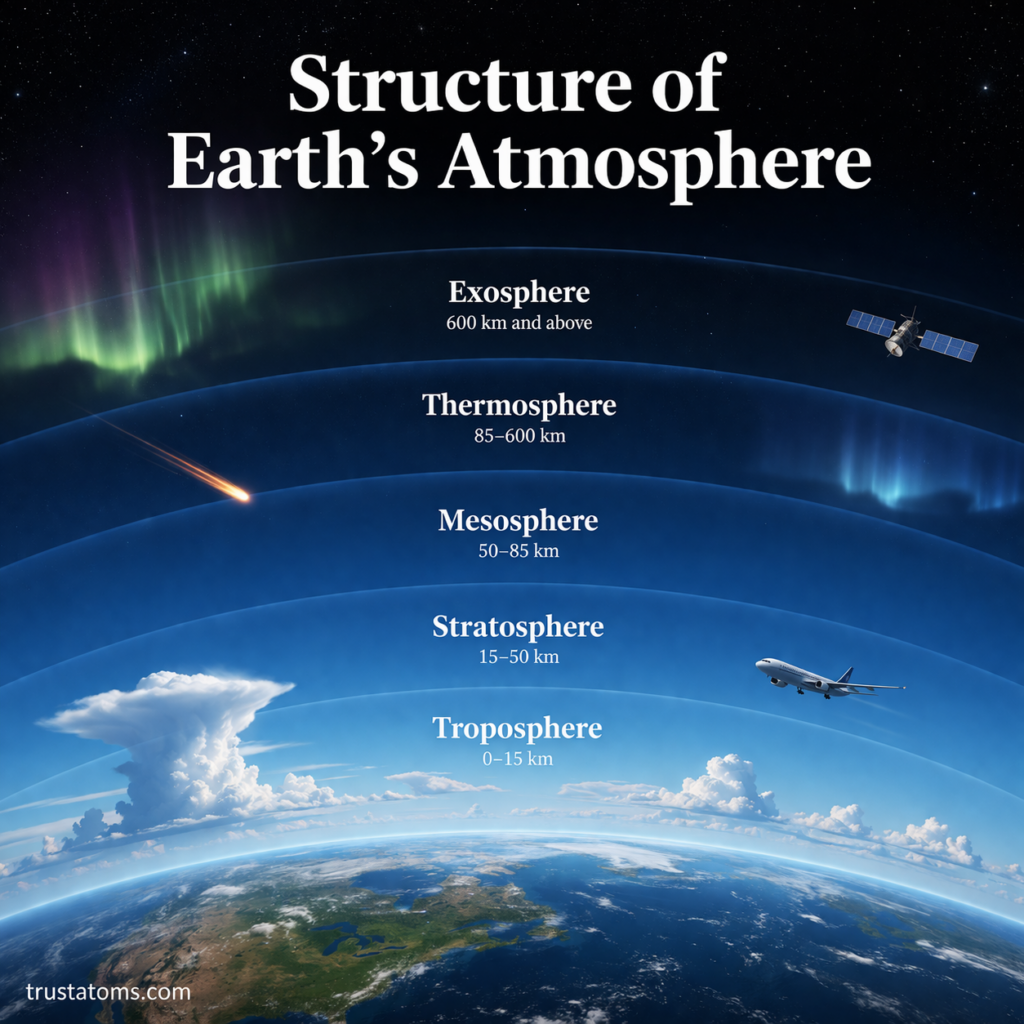
2. Protective Atmosphere
- Rich in oxygen and nitrogen
- Shields the planet from harmful solar radiation
- Helps regulate temperature
3. Magnetic Field
- Generated by Earth’s molten core
- Protects the planet from solar wind
4. Stable Climate System
- Moderated by oceans and atmosphere
- Supports long-term environmental balance
Earth’s Orbit and Rotation
Earth is constantly moving in two main ways:
Rotation (Spinning on its Axis)
- Takes about 24 hours
- Causes day and night
Revolution (Orbiting the Sun)
- Takes about 365.25 days
- Defines a year
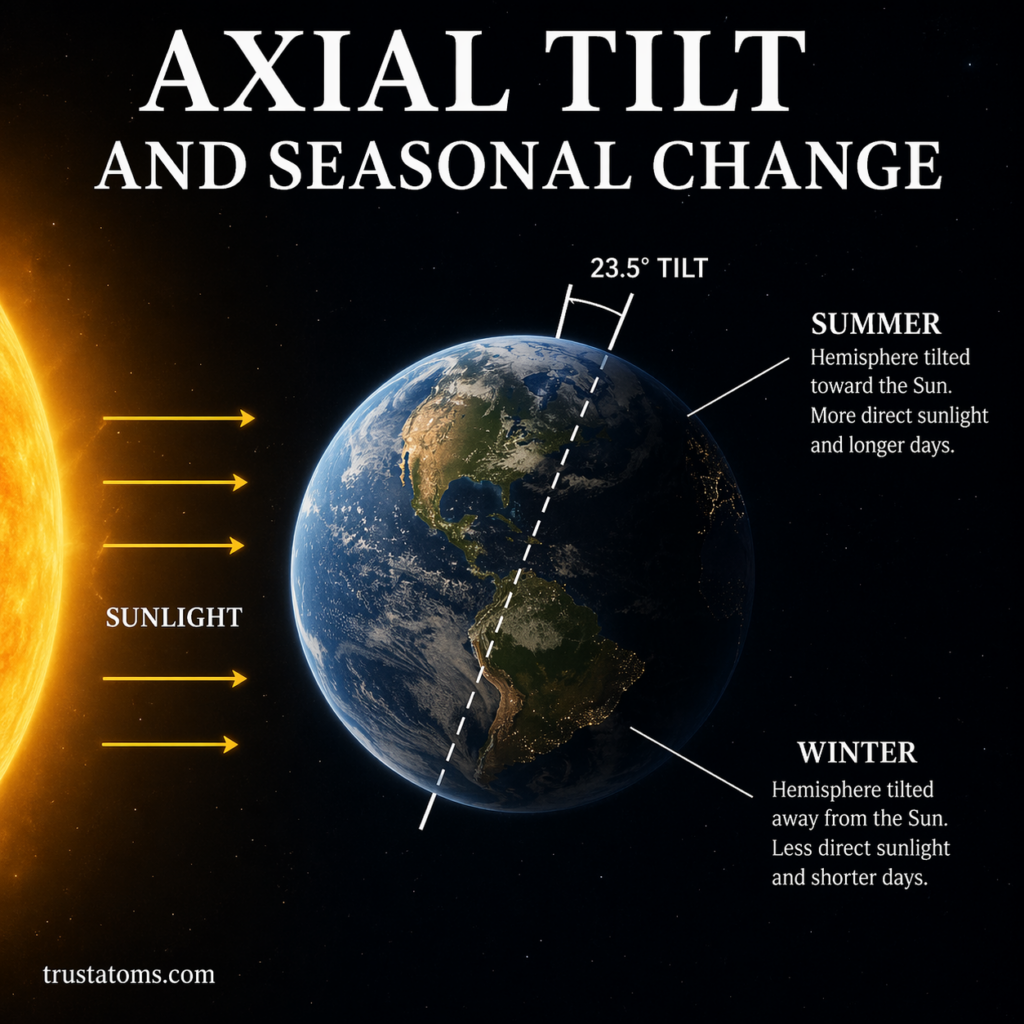
Earth’s axis is tilted at about 23.5 degrees, which leads to seasonal changes.
The Role of the Moon
Earth has one natural satellite: the Moon.
The Moon’s influence includes:
- Stabilizing Earth’s axial tilt
- Creating ocean tides through gravitational pull
- Contributing to long-term climate stability
Without the Moon, Earth’s environment would be far less stable.
Earth Compared to Other Planets
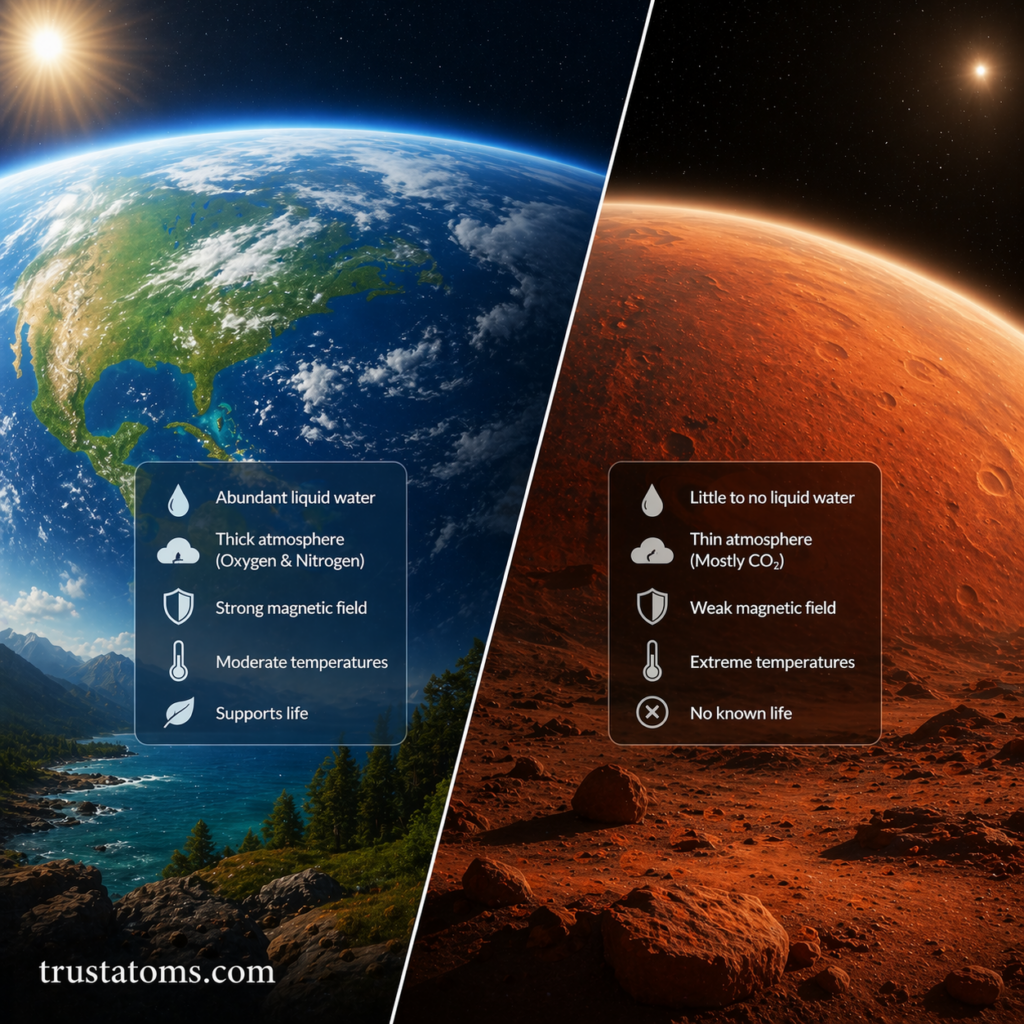
Earth is often compared to nearby planets to highlight its uniqueness:
Earth vs. Venus
- Similar size, but Venus has a thick, toxic atmosphere
- Surface temperatures on Venus are extremely high
Earth vs. Mars
- Mars is colder with a thin atmosphere
- Evidence suggests Mars once had water, but not stable conditions like Earth
These comparisons show how small differences in location and composition can lead to vastly different outcomes.
Why Earth Is Unique
Despite billions of planets likely existing in the universe, Earth remains special due to a combination of factors:
- Ideal distance from the Sun
- Presence of water in liquid form
- Balanced atmosphere
- Geological activity (plate tectonics)
- Stable orbit and rotation
These conditions work together to create a planet capable of supporting complex life.
Earth’s Place in the Universe
While Earth is part of the Solar System, the Solar System itself is just one small part of the Milky Way galaxy.
This perspective highlights two key ideas:
- Earth is incredibly small in the grand scale of the universe
- Yet it is uniquely suited for life as we know it
Final Thoughts
Earth’s position in the Solar System is not random—it plays a crucial role in making life possible. From its distance to the Sun to its atmosphere and magnetic field, every factor contributes to a delicate balance.
Studying Earth in the context of the Solar System not only helps us understand our planet better but also guides scientists in the search for life beyond it.