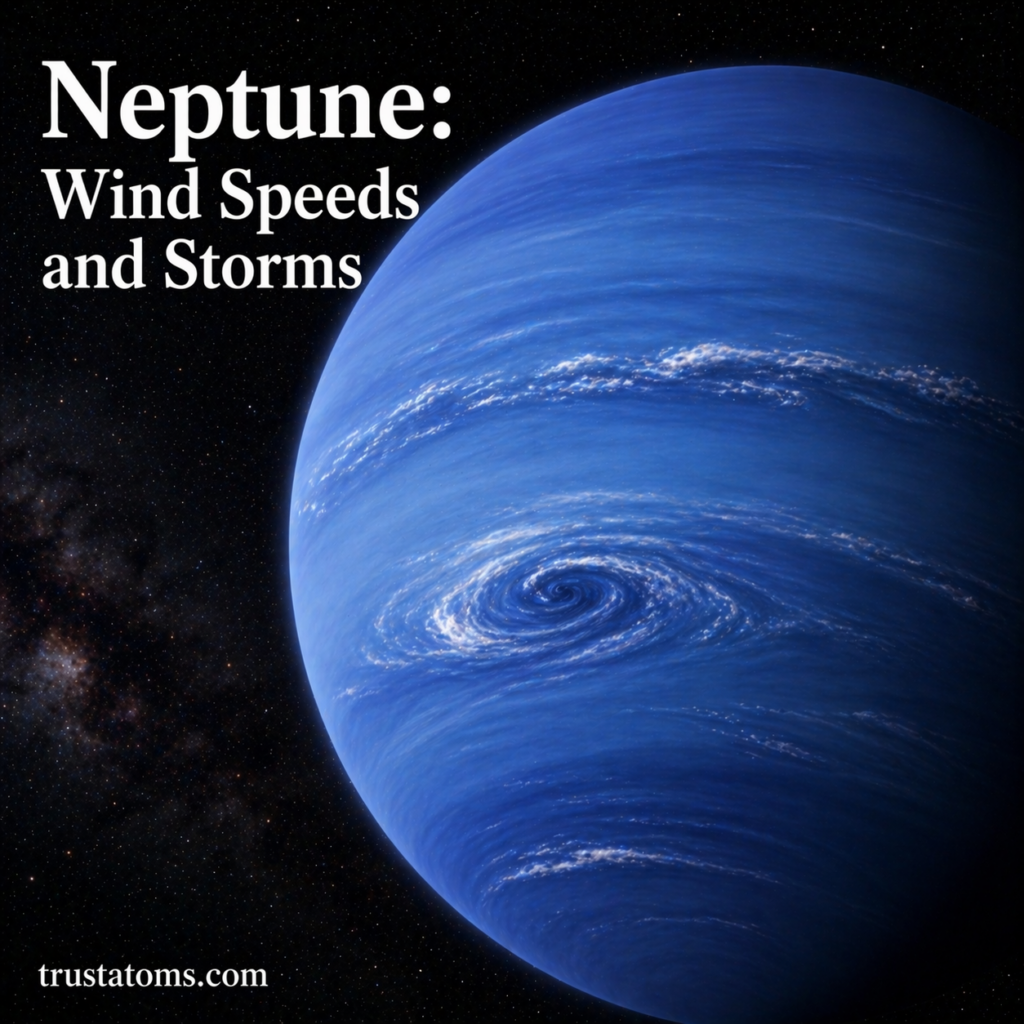
Neptune is the most distant major planet in the Solar System and one of the most dynamic. Despite receiving far less sunlight than Earth, Neptune is home to the fastest winds and some of the most powerful storms observed on any planet.
This article explores Neptune’s extreme weather, including its wind speeds, storm systems, and atmospheric behavior.
Overview of Neptune
Neptune is the eighth planet from the Sun and is classified as an ice giant, similar to Uranus.
Key facts about Neptune:
- Diameter: About 4 times that of Earth
- Composition: Water, ammonia, and methane ices
- Day length: About 16 hours
- Year length: About 165 Earth years
- Color: Deep blue due to atmospheric methane
Even though it is far from the Sun, Neptune is far more active than scientists once expected.
Neptune’s Atmosphere
Neptune’s atmosphere is composed mainly of hydrogen, helium, and methane.
Main components:
- Hydrogen (dominant gas)
- Helium
- Methane (absorbs red light, giving Neptune its blue color)
The atmosphere is layered and constantly in motion, producing visible cloud formations and storms.
Cloud Features
Neptune’s clouds are bright and dynamic.
- High-altitude methane ice clouds
- Fast-moving cloud streaks
- Bands similar to Jupiter but less defined
These clouds move rapidly due to the planet’s extreme wind speeds.
The Fastest Winds in the Solar System
Neptune holds the record for the highest wind speeds of any planet.
Wind speed facts:
- Winds can exceed 1,200 mph (2,000 km/h)
- Faster than the speed of sound on Earth
- Blow in the opposite direction of the planet’s rotation in some regions
Why Are Neptune’s Winds So Fast?
Despite its distance from the Sun, Neptune has powerful internal energy.
Contributing factors:
- Heat escaping from the planet’s interior
- Strong temperature differences in the atmosphere
- Rapid rotation (about 16 hours per day)
This internal heat helps drive atmospheric motion, leading to extreme wind speeds.
Storms on Neptune
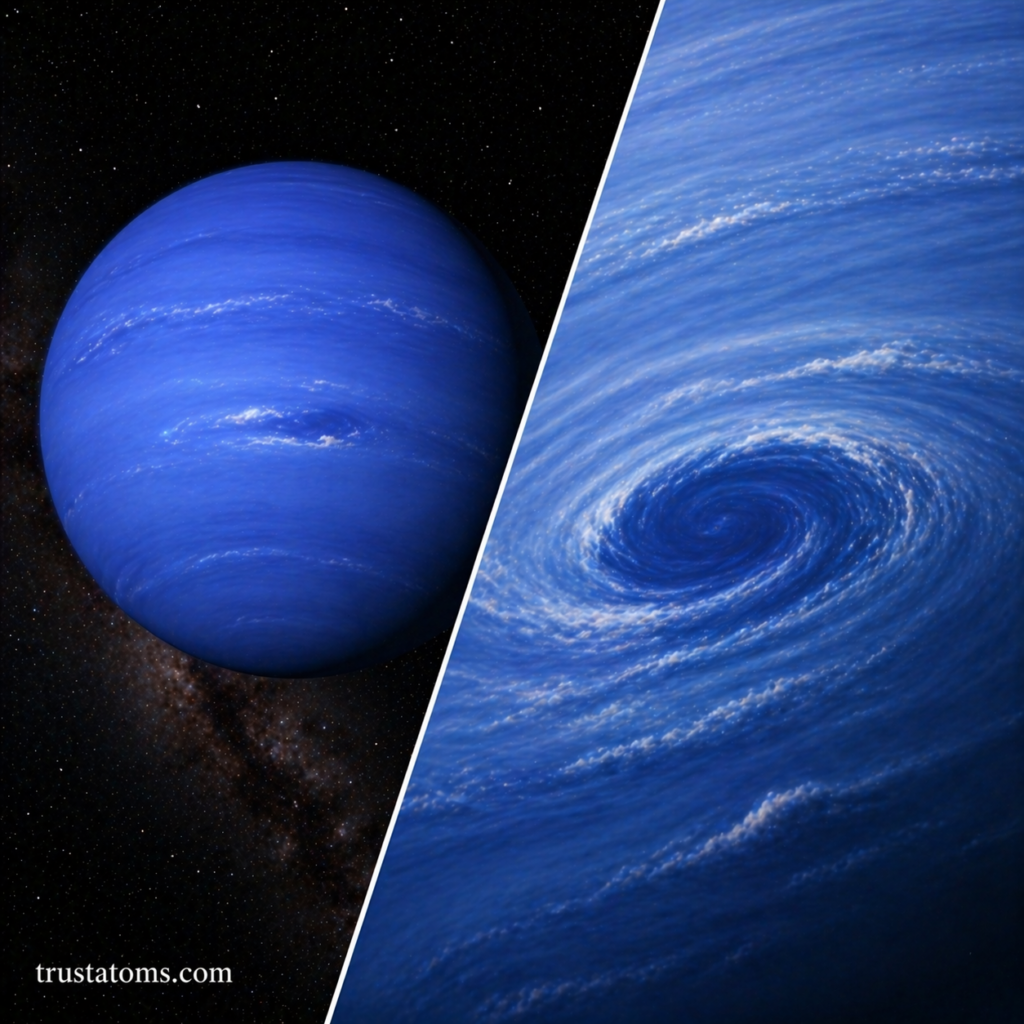
Neptune is known for large, dark storm systems that form and dissipate over time.
The Great Dark Spot
One of the most famous storms on Neptune is the Great Dark Spot.
- First observed by Voyager 2 in 1989
- Comparable in size to Earth
- A high-pressure storm system
Unlike Jupiter’s Great Red Spot, Neptune’s storms tend to appear and disappear over time.
Other Storm Systems
Neptune frequently develops new storm systems.
- Smaller dark spots form regularly
- Bright clouds often accompany storms
- Storms can shift in position and intensity
This constant change makes Neptune’s atmosphere highly dynamic.
Seasonal Changes on Neptune
Although Neptune’s year lasts 165 Earth years, it still experiences seasonal changes.
Seasonal characteristics:
- Long-lasting seasonal cycles
- Variations in storm activity
- Changes in cloud patterns over decades
Because of the long orbital period, these changes occur very slowly.
Internal Heat and Energy
One of Neptune’s biggest mysteries is its internal heat.
Key observations:
- Neptune emits more energy than it receives from the Sun
- This internal heat drives atmospheric activity
- Uranus, a similar planet, lacks this strong internal heat
Scientists are still studying why Neptune has such an active internal energy system.
Neptune Compared to Uranus
Neptune and Uranus are often compared, but they behave very differently.
Key differences:
- Neptune has stronger winds and storms
- Uranus appears calmer and less active
- Neptune emits more internal heat
These differences make Neptune one of the most extreme weather environments in the Solar System.
Exploration of Neptune
Neptune has been visited by only one spacecraft: Voyager 2.
Voyager 2 (1989):
- First and only close-up images of Neptune
- Discovered the Great Dark Spot
- Measured wind speeds and atmospheric composition
Future missions are being considered but have not yet been launched.
Why Neptune Matters
Neptune provides valuable insights into planetary weather and atmospheric physics.
Its importance includes:
- Understanding extreme wind systems
- Studying atmospheric dynamics far from the Sun
- Comparing ice giants across the Solar System
- Learning about similar planets around other stars
Final Thoughts
Neptune is a planet of extremes—home to the fastest winds and constantly changing storms. Its distance from the Sun does not limit its activity; instead, it fuels one of the most dynamic atmospheres in the Solar System.
As future exploration continues, Neptune may reveal even more about how planetary weather systems work under extreme conditions.