Dwarf planets are some of the most fascinating—and often misunderstood—objects in our solar system. Once considered the ninth planet, Pluto sparked a scientific debate that reshaped how we define planets altogether.
In this guide, you’ll learn what dwarf planets are, why Pluto was reclassified, and what makes these distant worlds so important to astronomy.
What Is a Dwarf Planet?
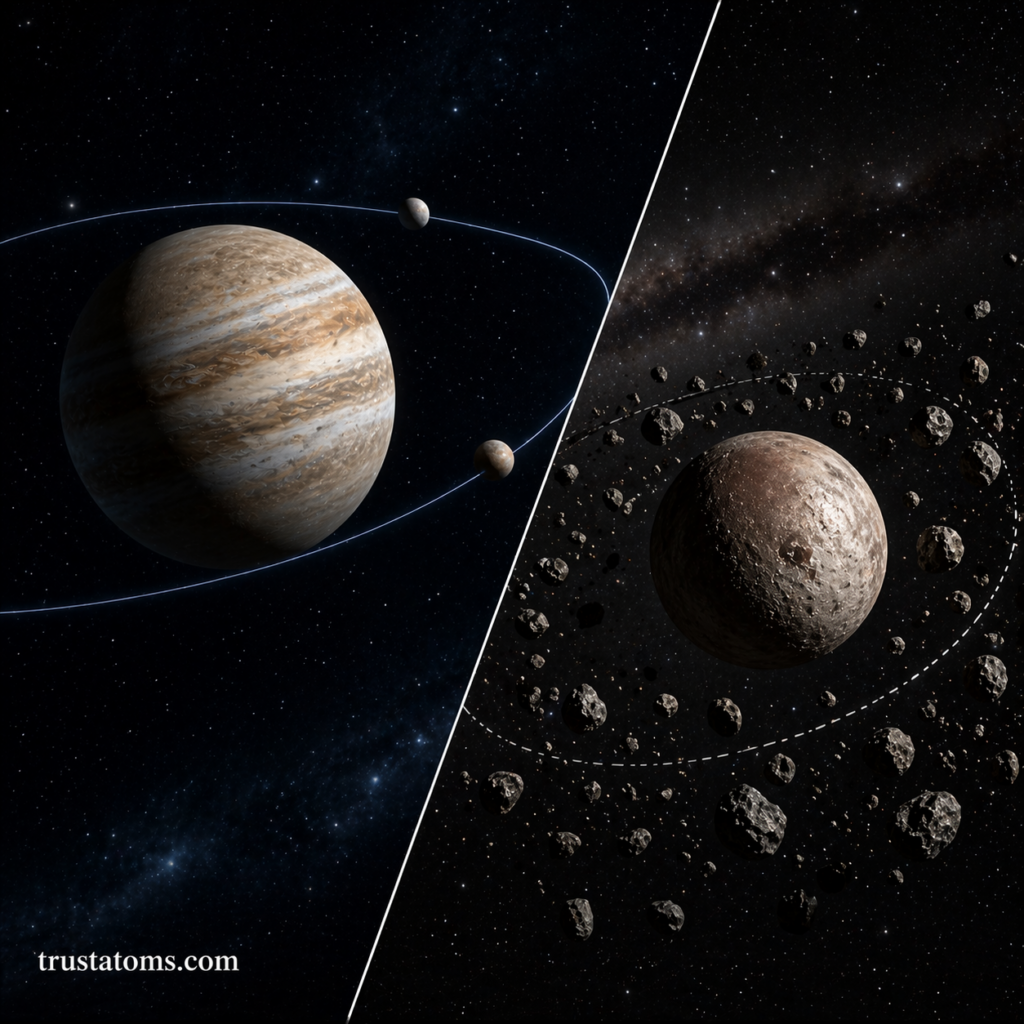
A dwarf planet is a celestial body that orbits the Sun and shares some characteristics with full-sized planets—but not all.
According to the International Astronomical Union (IAU), a dwarf planet must meet three criteria:
- It orbits the Sun
- It has enough mass to form a nearly round shape
- It has NOT cleared its orbital neighborhood of other debris
That last point is the key difference between planets and dwarf planets.
Key Difference from Planets
Planets dominate their orbits, meaning they have cleared away smaller objects nearby through gravity. Dwarf planets, on the other hand, share their space with other objects.
The Story of Pluto
Discovery and Early Classification
Pluto was discovered in 1930 by Clyde Tombaugh and quickly became known as the ninth planet.
For decades, Pluto held that title. However, as technology improved, astronomers began discovering similar objects beyond Neptune—raising an important question:
Was Pluto really unique?
The 2006 Reclassification
In 2006, the IAU officially redefined what qualifies as a planet. Pluto failed to meet one of the criteria—clearing its orbit—so it was reclassified as a dwarf planet.
This decision was controversial and is still debated today, but it reflects a more precise understanding of our solar system.
Characteristics of Pluto
Despite its smaller status, Pluto is a complex and intriguing world.
- Diameter: About 2,377 km (smaller than Earth’s Moon)
- Orbit: Highly elliptical and tilted compared to other planets
- Surface: Made of nitrogen ice, methane, and frozen carbon monoxide
- Moons: Five known moons, including Charon
Pluto’s relationship with Charon is especially unique—they orbit a common center of gravity, almost like a binary system.
Other Known Dwarf Planets
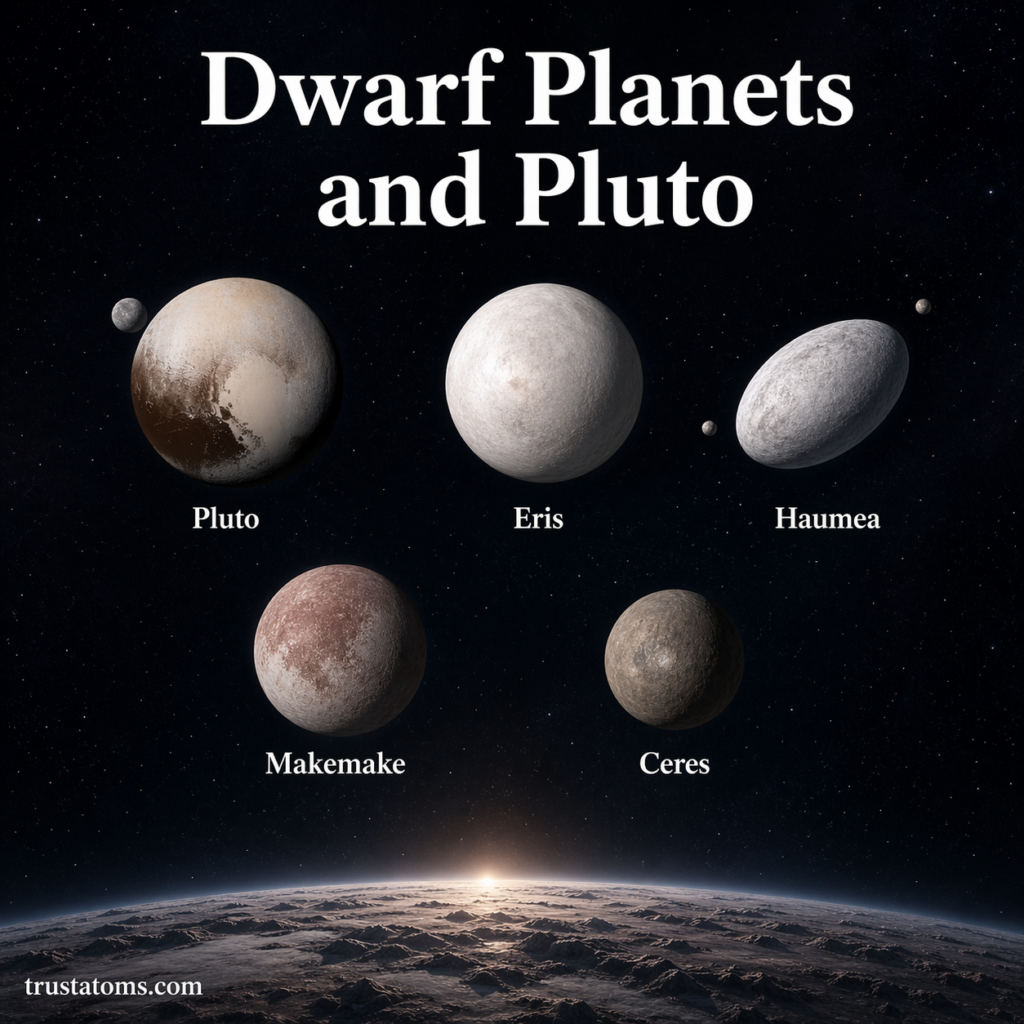
Pluto is not alone. Several other dwarf planets have been officially recognized:
- Ceres – Located in the asteroid belt between Mars and Jupiter
- Eris – Slightly smaller than Pluto but more massive
- Haumea – Known for its elongated shape and rapid rotation
- Makemake – Discovered in 2005 in the Kuiper Belt
These objects are mostly found in the Kuiper Belt, a region of icy bodies beyond Neptune.
Why the Reclassification Matters
The redefinition of Pluto wasn’t about “demoting” it—it was about improving scientific accuracy.
Benefits of the New Definition
- Provides clearer criteria for classifying celestial objects
- Helps astronomers categorize newly discovered bodies
- Reflects the complexity of the outer solar system
As more objects are discovered, this classification system helps maintain consistency.
What Makes Dwarf Planets Important?
Dwarf planets offer valuable insights into the early solar system.
Scientific Significance
- They are remnants of planetary formation
- Their composition reveals clues about the solar system’s origins
- Some may have subsurface oceans or geological activity
For example, data from NASA’s New Horizons mission showed that Pluto has mountains, glaciers, and possibly even a subsurface ocean.
Common Misconceptions About Pluto
“Pluto is no longer important”
False. Pluto remains one of the most studied objects in planetary science.
“The decision was arbitrary”
Not quite. The IAU based its decision on new discoveries and the need for a consistent definition.
“There are only a few dwarf planets”
Likely false. Scientists believe there could be dozens—possibly hundreds—waiting to be confirmed.
The Future of Dwarf Planet Research
As telescope technology advances, astronomers continue to discover new objects in the outer solar system.
Future missions and studies may:
- Identify additional dwarf planets
- Reveal more about their atmospheres and surfaces
- Improve our understanding of planetary formation
The story of dwarf planets is still unfolding—and Pluto is just the beginning.
Final Thoughts
Dwarf planets challenge our traditional view of what a planet should be. While Pluto may no longer hold its original title, its scientific importance has only grown.
Understanding these small worlds helps us piece together the history of our solar system—and reminds us that space is far more complex than simple labels.