Why does a day on Earth last 24 hours while a day on other planets can be much shorter—or far longer? The answer lies in planetary rotation, the spinning motion of a planet around its axis.
Understanding planetary rotation and day length helps explain not only timekeeping, but also weather patterns, climate behavior, and even the possibility of life on other worlds.
What Is Planetary Rotation?
Planetary rotation is the spinning of a planet around an imaginary line called its axis. This axis typically runs from the north pole to the south pole.
Key points:
- Rotation causes the cycle of day and night
- The side facing the Sun experiences daylight
- The opposite side experiences night
- Most planets rotate in the same direction as their orbit around the Sun
This continuous spinning defines how long a single day lasts on a planet.
What Determines Day Length?
A planet’s day length is the time it takes to complete one full rotation on its axis.
Factors that influence rotation speed:
- Initial formation conditions
- Collisions with other objects
- Gravitational interactions with nearby bodies
- Internal structure and mass distribution
These factors vary widely, leading to significant differences in day length across planets.
Rotation Period vs. Solar Day
There are two ways to measure a planet’s day.
Types of day measurements:
- Sidereal day
- Time it takes for a planet to complete one full rotation relative to distant stars
- Solar day
- Time it takes for the Sun to return to the same position in the sky
On Earth:
- Sidereal day ≈ 23 hours 56 minutes
- Solar day = 24 hours
The difference exists because Earth is also moving along its orbit around the Sun.
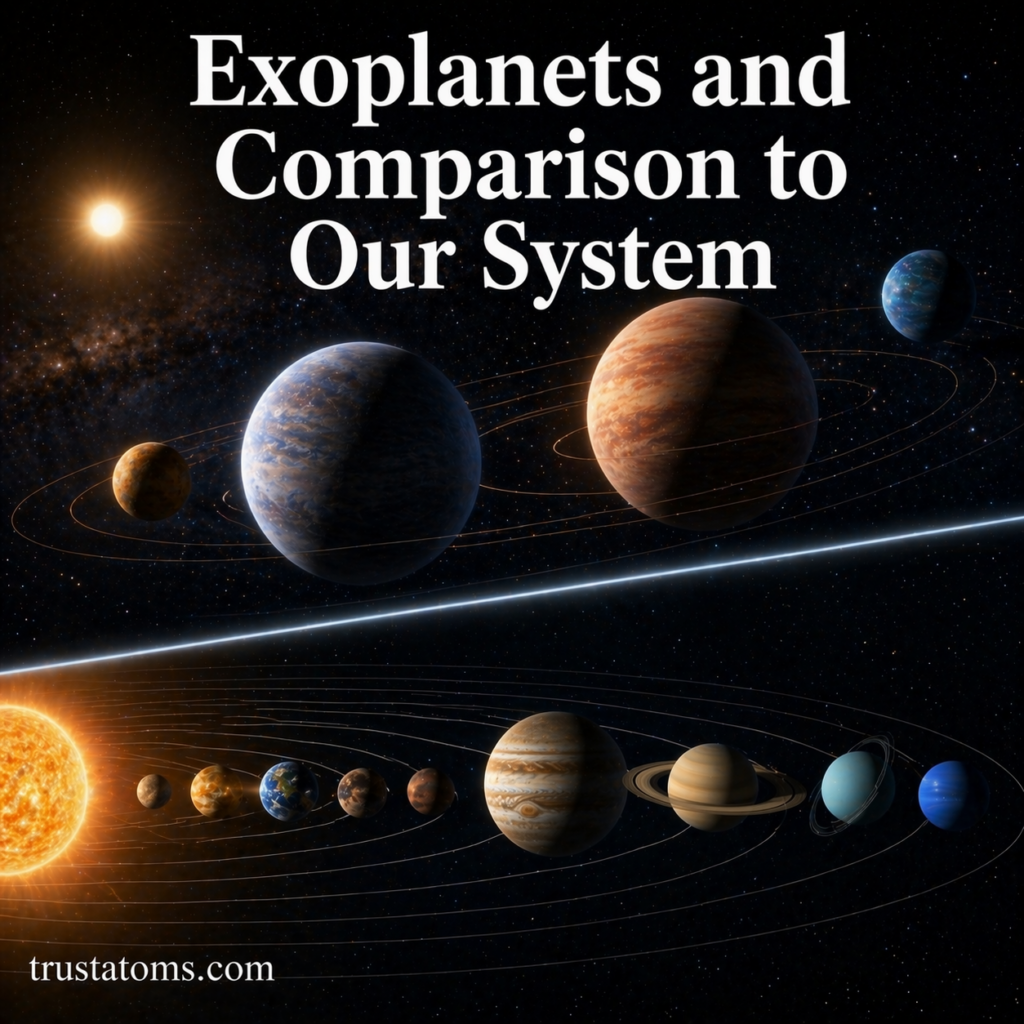
Day Length Across the Solar System
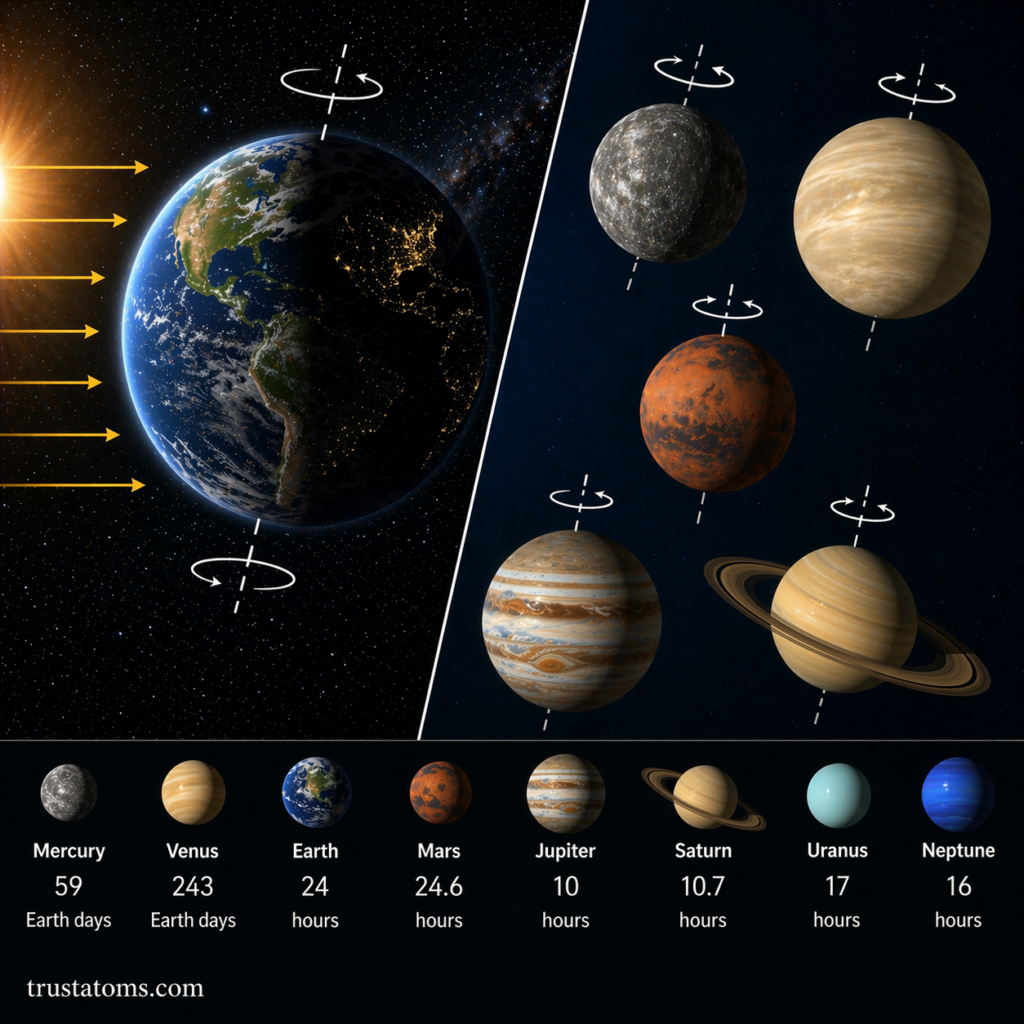
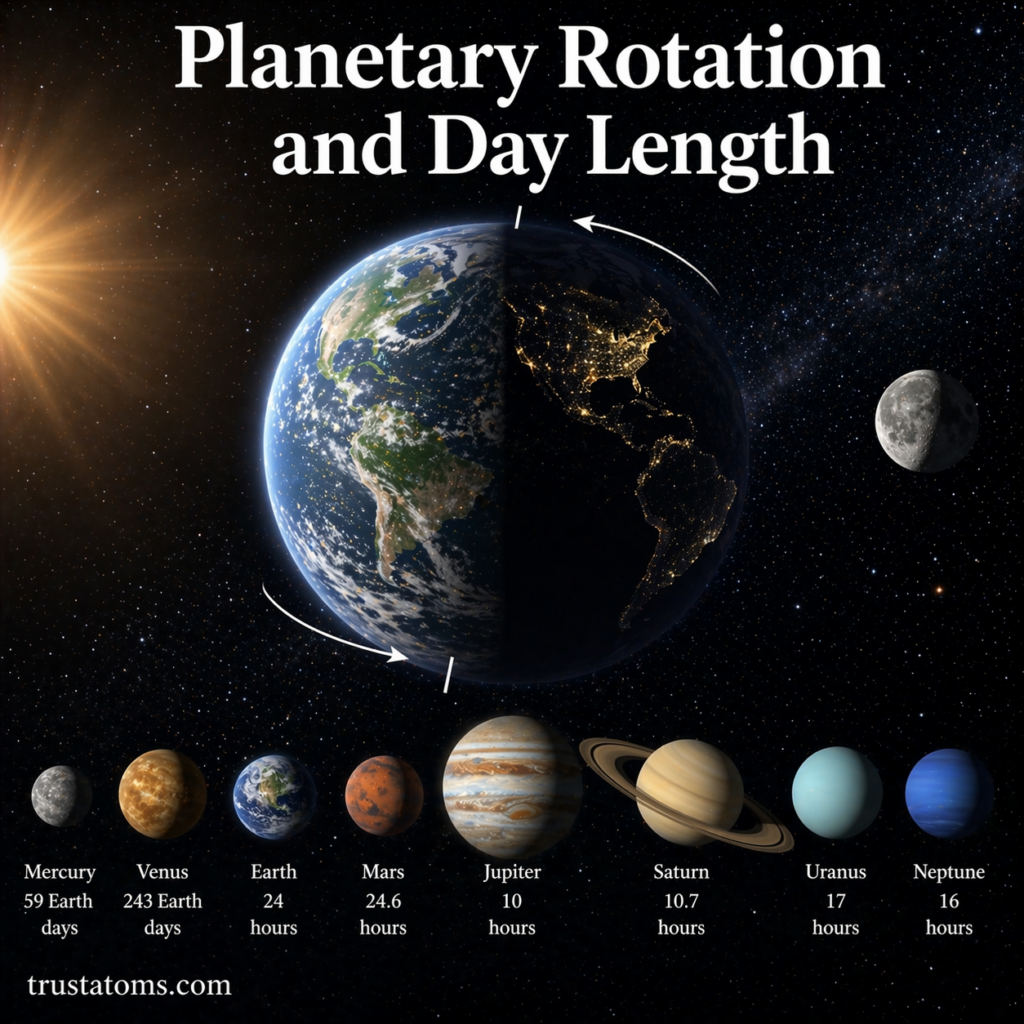
Planets in our solar system have dramatically different rotation speeds.
Examples:
- Mercury
- Very slow rotation; one day lasts about 59 Earth days
- Venus
- Extremely slow and rotates backward (retrograde); one day is longer than its year
- Earth
- 24-hour day
- Mars
- Similar to Earth; about 24.6 hours
- Jupiter
- Very fast rotation; about 10 hours
- Saturn
- Around 10.7 hours
- Uranus
- Rotates on its side; about 17 hours
- Neptune
- About 16 hours
These differences show how unique each planet’s rotational behavior is.
What Is Retrograde Rotation?
Most planets rotate in the same direction as they orbit the Sun, but some rotate in the opposite direction.
Retrograde rotation:
- Opposite spin direction compared to most planets
- The Sun appears to rise in the west and set in the east
- Common examples:
- Venus
- Uranus (tilted so extremely it appears to roll)
Retrograde motion is often the result of massive collisions early in a planet’s history.
Why Rotation Matters
Planetary rotation plays a major role in shaping a planet’s environment.
Key effects:
- Controls the length of day and night cycles
- Influences temperature differences between day and night
- Drives atmospheric circulation and weather patterns
- Affects wind speeds and storm systems
Faster rotation can lead to stronger winds, while slower rotation may cause extreme temperature contrasts.
Rotation and Habitability
Rotation speed can impact whether a planet is suitable for life.
Important considerations:
- Balanced day-night cycles help regulate temperature
- Extremely long days can lead to overheating or freezing
- Stable rotation supports predictable climate systems
- Magnetic fields (linked to rotation) help protect atmospheres
Earth’s relatively moderate rotation speed is one reason it supports life.
Tidal Locking: When Rotation Slows Down
Some celestial bodies become tidally locked, meaning one side always faces the object they orbit.
Examples:
- Earth’s Moon always shows the same face to Earth
- Some exoplanets are locked to their stars
Effects of tidal locking:
- One side experiences constant daylight
- The other side remains in permanent darkness
- Extreme temperature differences can occur
Tidal locking results from gravitational forces over long periods.
Why Planets Rotate at Different Speeds
No two planets rotate exactly the same way.
Reasons for variation:
- Collisions during early formation
- Differences in mass and size
- Distance from the Sun
- Gravitational influences from moons and other planets
These factors combine to create the diverse rotation patterns we observe today.
Final Thoughts
Planetary rotation is a fundamental property that shapes how planets behave and evolve. From determining day length to influencing climate and habitability, rotation plays a critical role in the structure of planetary systems.
By studying how and why planets rotate, scientists gain deeper insight into the formation of the solar system and the conditions that make life possible.