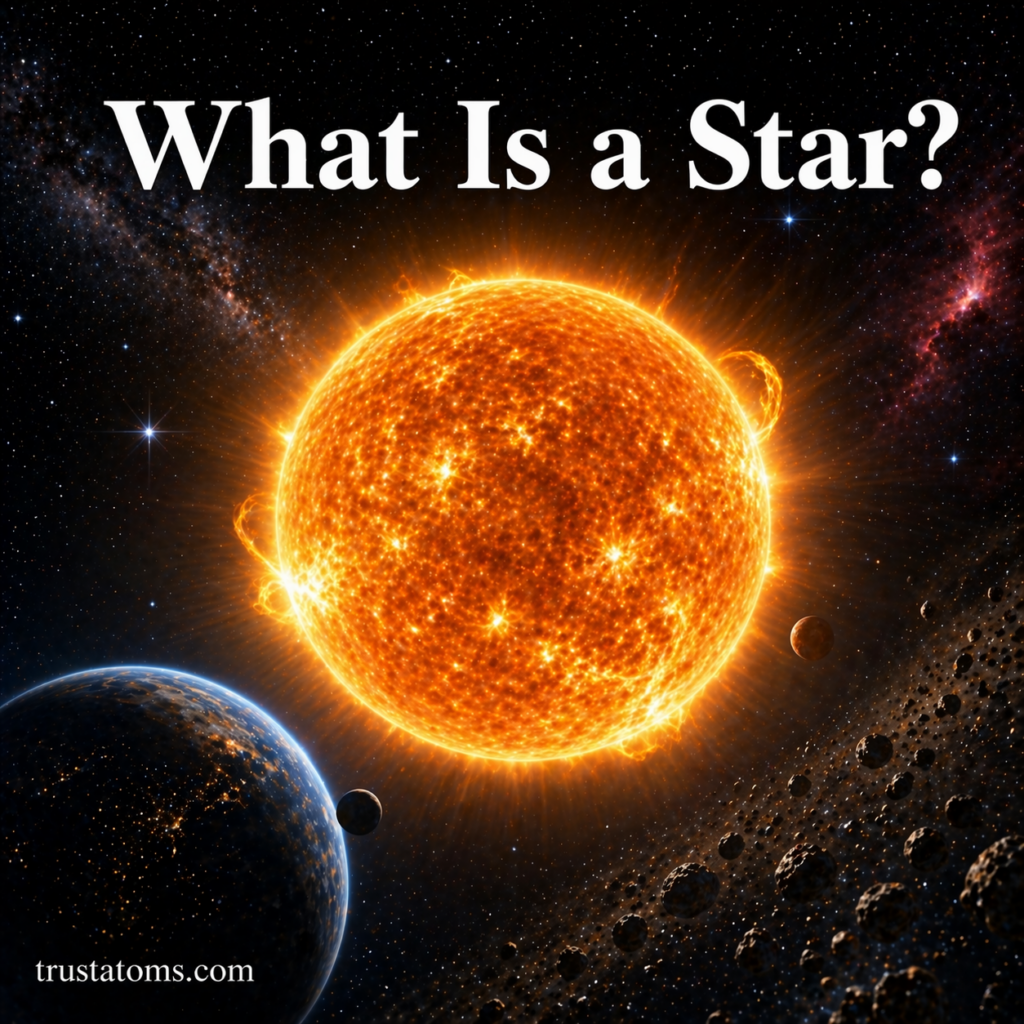
A star is a massive, glowing sphere of hot gas—primarily hydrogen and helium—held together by gravity and powered by nuclear fusion. Stars are the fundamental building blocks of galaxies and the engines that light up the universe.
Our own Sun is a star, and without it, life on Earth would not exist. Understanding what a star is helps explain everything from light and heat to the origins of elements and planetary systems.
The Basic Definition of a Star
A star is:
- A self-luminous object that produces its own energy
- Powered by nuclear fusion in its core
- Held together by its own gravity
Unlike planets, stars generate light and energy internally rather than reflecting it.
What Are Stars Made Of?
Stars are composed mostly of:
- Hydrogen (about 70%)
- Helium (about 28%)
- Small amounts of heavier elements (like carbon, oxygen, and iron)
These gases exist in a superheated state called plasma, where electrons are separated from atomic nuclei.
How Stars Produce Energy
Stars shine because of nuclear fusion happening in their cores.
The Fusion Process
- Hydrogen atoms collide under extreme pressure and temperature
- They fuse to form helium
- This process releases enormous amounts of energy
This energy travels outward and is emitted as light and heat.
The Life Cycle of a Star
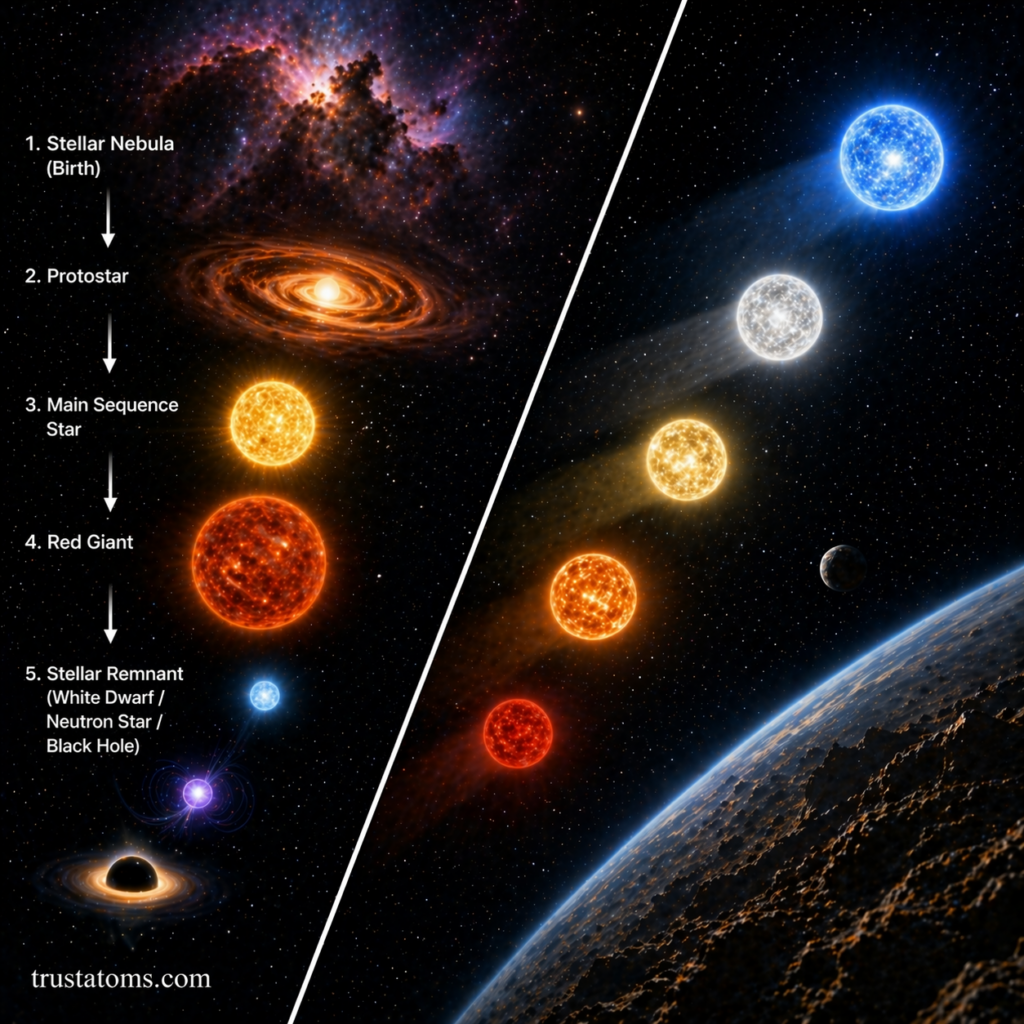
Stars are not permanent—they are born, evolve, and eventually die.
1. Stellar Birth (Nebula Stage)
- Stars form in clouds of gas and dust called nebulae
- Gravity pulls material together into a dense core
2. Main Sequence (Stable Phase)
- The star begins nuclear fusion
- Balance between gravity and outward pressure keeps it stable
- This is the longest stage of a star’s life
3. Red Giant or Supergiant
- The star expands as it runs out of hydrogen
- Fusion of heavier elements may begin
4. Final Stages
Depending on size:
- Small/medium stars: Become white dwarfs
- Massive stars: Explode as supernovae and may form neutron stars or black holes
Types of Stars
Stars come in many different sizes, temperatures, and brightness levels.
By Size and Mass
- Dwarf stars: Small and long-lasting (like red dwarfs)
- Giant stars: Larger and brighter
- Supergiants: Extremely large and luminous
By Temperature (Color)
- Blue stars: Hottest
- White/yellow stars: Medium temperature (like the Sun)
- Red stars: Cooler
Color is a direct indicator of a star’s surface temperature.
How Big Are Stars?
Stars vary enormously in size.
- The Sun is about 1.4 million kilometers wide
- Some supergiants are hundreds of times larger
- Some neutron stars are only about 20 kilometers across
Despite their differences, all stars follow the same basic physical principles.
Why Stars Are Important
Stars play a critical role in the universe.
Key Contributions
- Provide light and heat for planets
- Create elements through fusion
- Drive galaxy formation and structure
- Enable life by supporting habitable environments
Every atom heavier than hydrogen was formed inside stars or during stellar explosions.
How We Study Stars
Astronomers study stars using various tools and techniques.
Common Methods
- Telescopes: Observe brightness, color, and motion
- Spectroscopy: Analyze light to determine composition
- Space observatories: Capture data beyond Earth’s atmosphere
These methods allow scientists to understand stars even from vast distances.
Common Misconceptions About Stars
- Stars are not fixed—they move and evolve over time
- Not all stars are like the Sun—many are much larger or smaller
- Stars are not eternal—they have life cycles
- The Sun is an average star, not unique in size or brightness
Final Thoughts
Stars are the engines of the universe, transforming simple elements into the building blocks of planets, life, and everything we see around us. From their fiery births in nebulae to their dramatic endings, stars shape the cosmos in powerful and lasting ways.
By understanding what a star is, we gain insight into the origins of the universe—and our place within it.