Astronomical imaging is how scientists turn faint signals from space into detailed pictures of the universe. From breathtaking galaxy photos to precise scientific data, imaging methods allow astronomers to study objects that are billions of light-years away.
Modern techniques go far beyond simple photography—they combine physics, technology, and data processing to reveal what the human eye cannot see.
What Is Astronomical Imaging?
Astronomical imaging is the process of capturing and processing light (or other radiation) from celestial objects to create visual representations.
These images can include:
- Stars
- Planets
- Nebulae
- Galaxies
Unlike everyday photography, astronomical imaging often involves:
- Long exposure times
- Specialized sensors
- Advanced processing techniques
Why Imaging Matters in Astronomy
Imaging is essential because it allows scientists to:
- Study distant objects in detail
- Track motion and changes over time
- Identify new celestial bodies
- Analyze physical properties like temperature and composition
Images are not just for visuals—they are data-rich scientific tools.
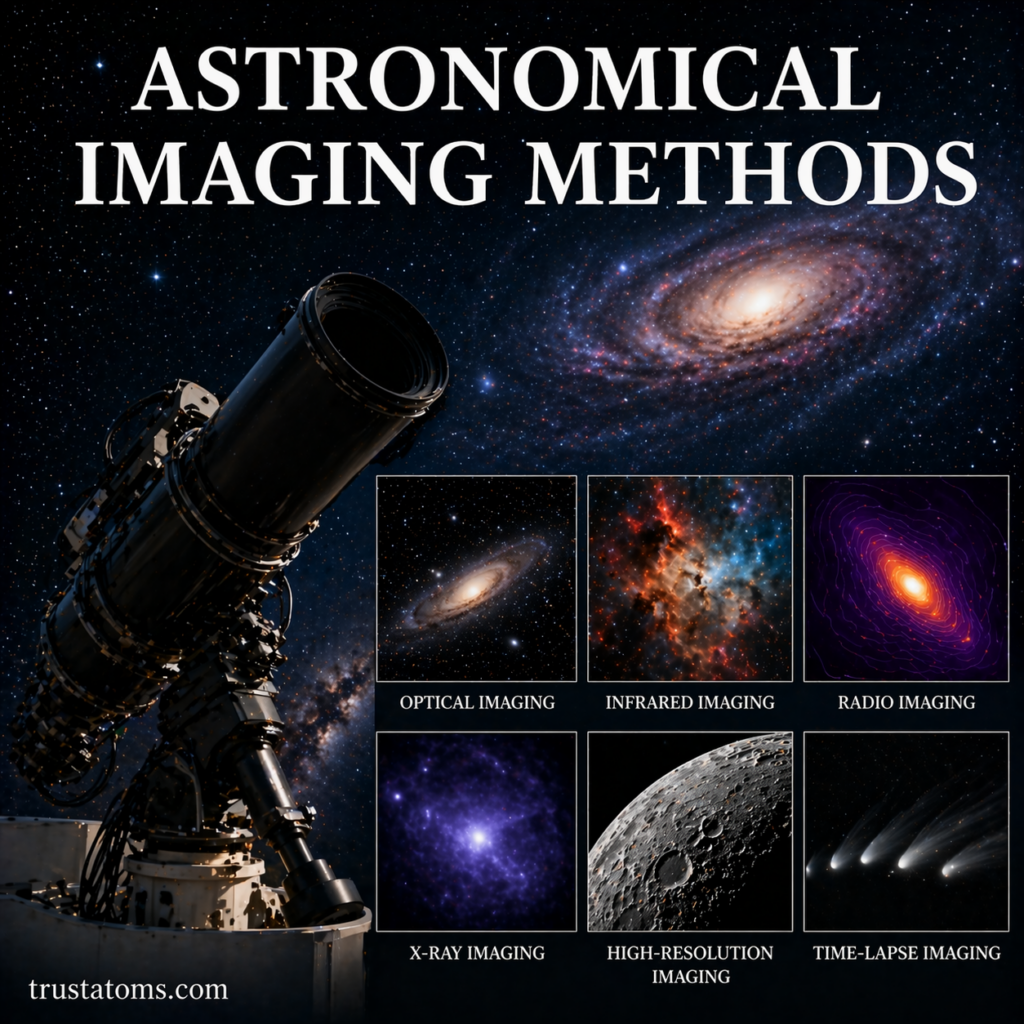
Types of Astronomical Imaging
Different imaging methods are used depending on the type of object and wavelength being observed.
Optical Imaging
- Captures visible light
- Similar to traditional photography
- Produces familiar “true-color” images
Example:
- Images from the Hubble Space Telescope
Infrared Imaging
- Detects heat radiation
- Reveals objects hidden by dust
- Useful for studying star formation
Example:
- Observations from the James Webb Space Telescope
Radio Imaging
- Uses radio waves instead of visible light
- Maps large-scale structures like galaxies
- Often produces non-visual data converted into images
X-ray and Gamma-ray Imaging
- Captures high-energy radiation
- Used to study extreme environments like black holes and supernovae
These images are typically:
- Color-coded (false color)
- Based on energy levels rather than visible light
CCD and Digital Sensors
Modern astronomical imaging relies heavily on digital sensors.
CCD (Charge-Coupled Device) sensors:
- Extremely sensitive to light
- Capture faint signals from distant objects
- Produce high-resolution data
Compared to traditional film:
- More efficient
- More accurate
- Easier to process
Long Exposure Imaging
Many objects in space are very faint, requiring long exposure times.
How it works:
- The telescope collects light over minutes or hours
- More light = clearer image
- Multiple exposures are often combined
Benefits:
- Reveals dim objects
- Improves image detail
- Reduces noise
Image Stacking and Processing
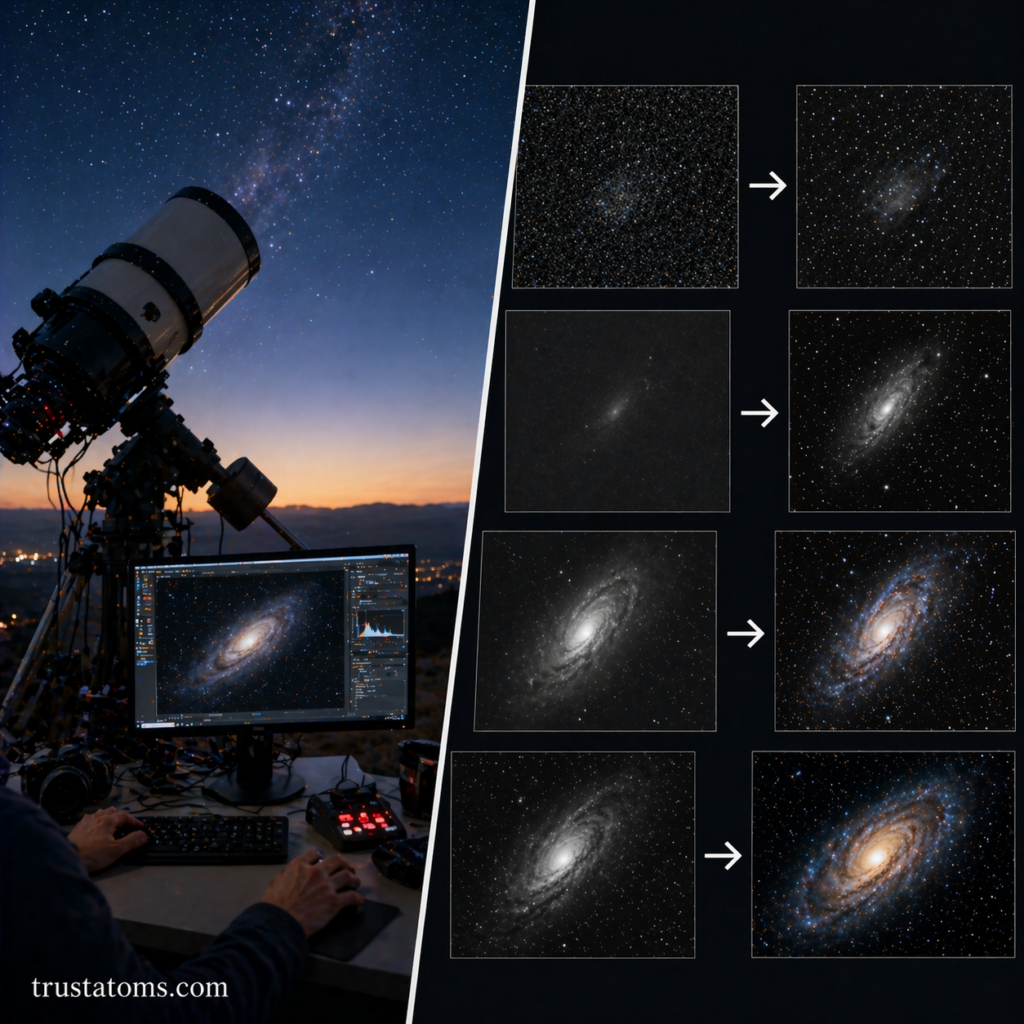
Raw astronomical images often need processing to become usable.
Common techniques include:
- Stacking
- Combining multiple images to improve clarity
- Noise reduction
- Removing unwanted signals
- Contrast enhancement
- Highlighting important features
- Color mapping
- Assigning colors to non-visible wavelengths
This is why many space images look vibrant—they are carefully processed representations of data.
False Color Imaging
Not all astronomical images represent true visible colors.
Why false color is used:
- Some wavelengths are invisible to the human eye
- Colors help distinguish different elements or energies
- Enhances scientific interpretation
For example:
- Red may represent infrared
- Blue may represent higher energy radiation
False color images are scientifically accurate, even if they don’t match human vision.
Adaptive Optics
Ground-based telescopes face distortion from Earth’s atmosphere.
Adaptive optics solves this by:
- Measuring atmospheric distortion in real time
- Adjusting mirrors to compensate
- Producing sharper images
This technology allows Earth-based observatories to rival space telescopes in some cases.
Interferometry
Interferometry combines data from multiple telescopes to act as one larger system.
Benefits:
- Higher resolution imaging
- Ability to observe fine details
- Improved accuracy
Used in:
- Radio astronomy
- Large telescope arrays
Challenges in Astronomical Imaging
Despite advanced technology, imaging still faces challenges:
- Light pollution
- Atmospheric interference
- Extremely faint signals
- Data processing complexity
Overcoming these challenges requires both advanced instruments and sophisticated software.
The Future of Astronomical Imaging
New technologies are pushing imaging capabilities even further.
Future advancements include:
- AI-assisted image processing
- Higher-resolution sensors
- Larger telescope arrays
- Improved space-based observatories
These innovations will allow astronomers to:
- See deeper into space
- Capture earlier stages of the universe
- Discover new celestial phenomena
Final Thoughts
Astronomical imaging is a powerful bridge between observation and understanding. It transforms invisible signals into meaningful visuals, helping scientists explore the universe in extraordinary detail.
From simple optical images to complex multi-wavelength data, these methods continue to expand our view of the cosmos—and our place within it.