Main sequence stars are the most common and stable type of stars in the universe. In fact, most stars you see in the night sky—including our Sun—are in this important phase of stellar evolution.
Understanding main sequence stars helps explain how stars produce energy, how long they live, and what ultimately determines their fate.
What Is a Main Sequence Star?
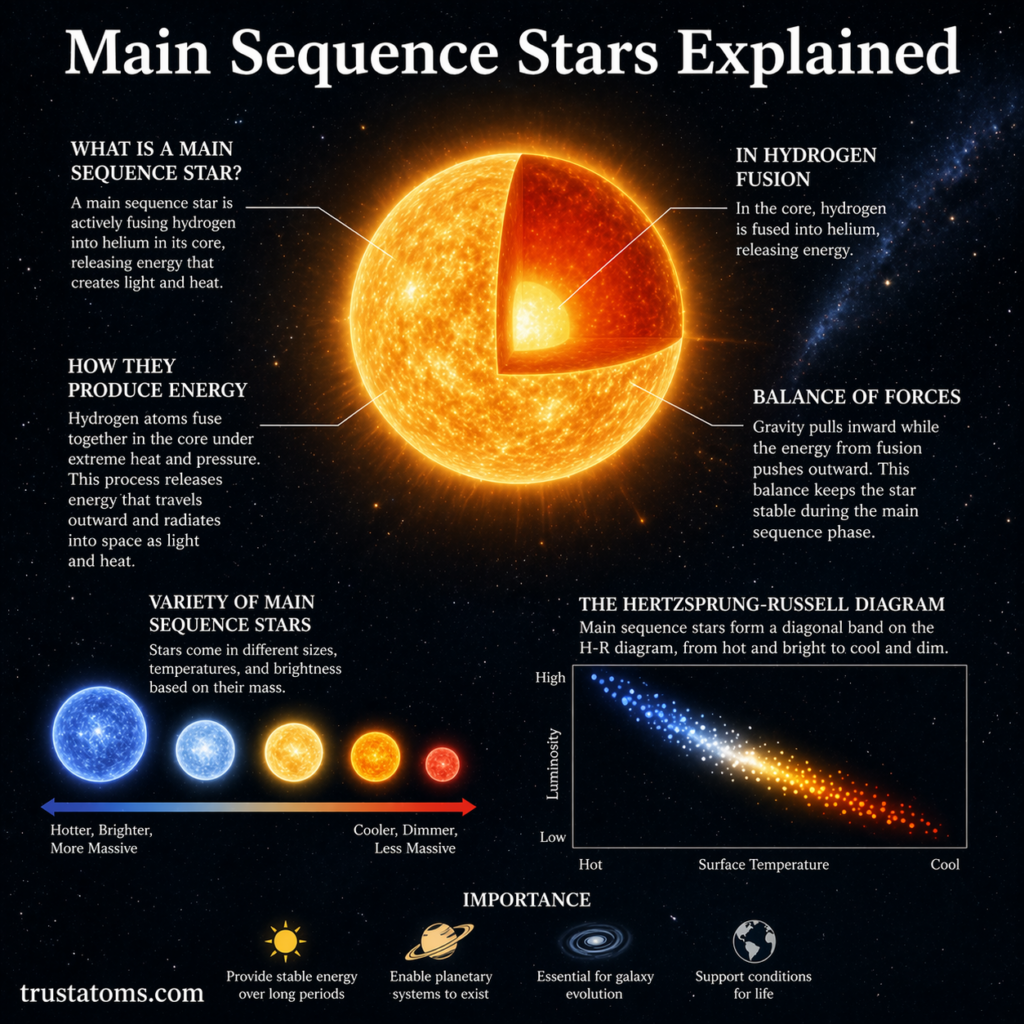
A main sequence star is a star that is actively fusing hydrogen into helium in its core. This process, called nuclear fusion, releases energy that creates light and heat.
What makes this stage unique is the balance between two powerful forces:
- Gravity pulling inward
- Energy from fusion pushing outward
When these forces are in equilibrium, the star remains stable—this is the defining characteristic of the main sequence phase.
Where Main Sequence Stars Fit in the Star Life Cycle
Main sequence stars represent the longest stage in a star’s life.
The basic sequence
- Stellar nebula forms
- Protostar develops
- Main sequence star begins (fusion starts)
- Star evolves into later stages (red giant, supernova, etc.)
Once fusion begins in the core, a star officially enters the main sequence phase.
How Main Sequence Stars Produce Energy
At the core of every main sequence star is nuclear fusion.
The process
- Hydrogen atoms combine under extreme pressure and temperature
- They form helium
- A small amount of mass is converted into energy
This energy travels outward and eventually radiates into space as light and heat.
Why it matters
- Powers the star’s brightness
- Determines temperature and color
- Sustains the star for millions to billions of years
The Role of Mass in Main Sequence Stars
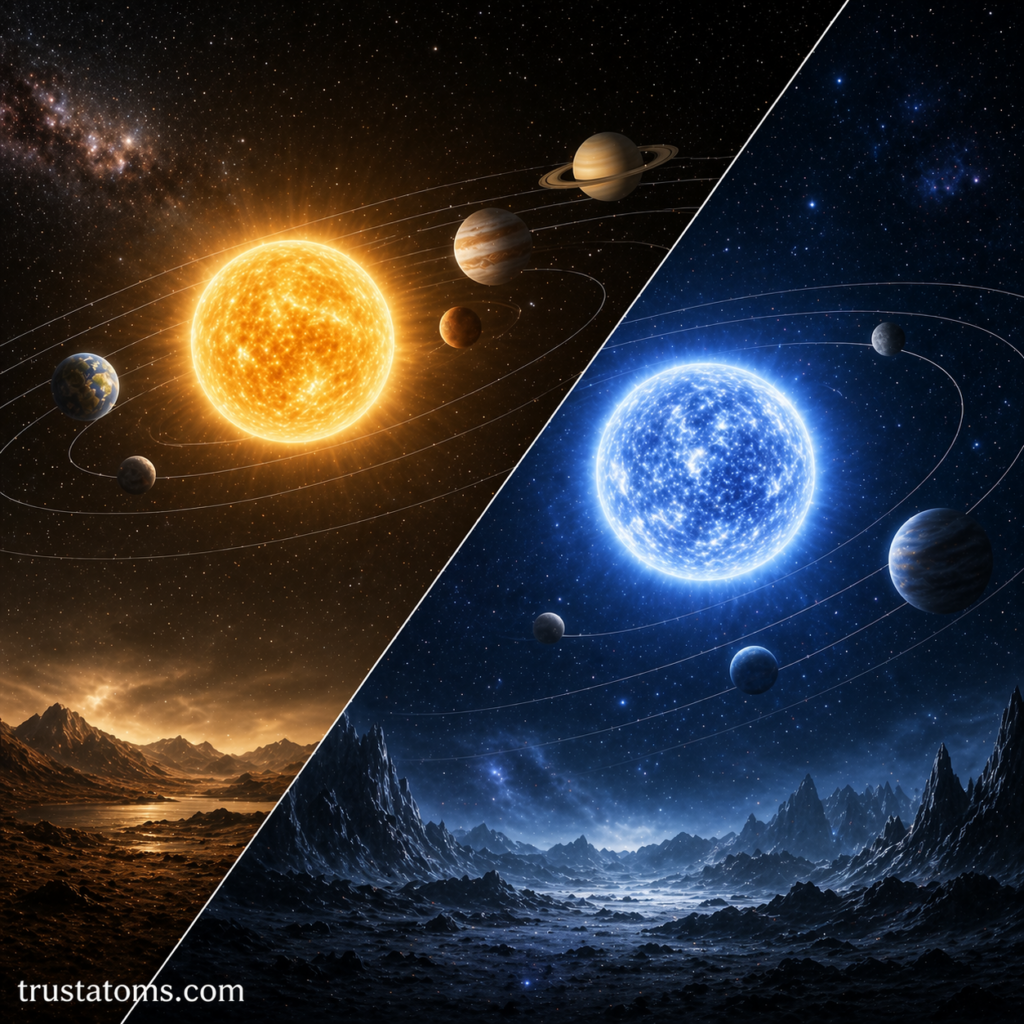
Mass is the most important factor that determines how a main sequence star behaves.
High-mass stars
- Much hotter and brighter
- Burn fuel very quickly
- Short lifespan (millions of years)
Low-mass stars
- Cooler and dimmer
- Burn fuel slowly
- Long lifespan (billions to trillions of years)
Medium-mass stars
- Balanced characteristics
- Lifespan of billions of years
- Example: the Sun
The Hertzsprung-Russell Diagram
The Hertzsprung-Russell (H-R) diagram is a key tool used in astronomy to classify stars.
What it shows
- Star brightness (luminosity)
- Surface temperature (color)
Main sequence stars form a distinct diagonal band on this chart.
Key insight
- Hot, bright stars appear at the upper left
- Cool, dim stars appear at the lower right
This pattern helps astronomers understand stellar evolution at a glance.
How Long Do Main Sequence Stars Last?
A star spends most of its life in the main sequence phase.
Lifespan estimates
- Massive stars: a few million years
- Sun-like stars: about 10 billion years
- Small stars: up to trillions of years
The more massive the star, the faster it uses its fuel—and the shorter its life.
What Happens After the Main Sequence?
Eventually, a star runs out of hydrogen in its core.
What changes
- Fusion slows or stops in the core
- Gravity causes the core to contract
- Outer layers expand
Next stages
- Low/medium stars → red giants → white dwarfs
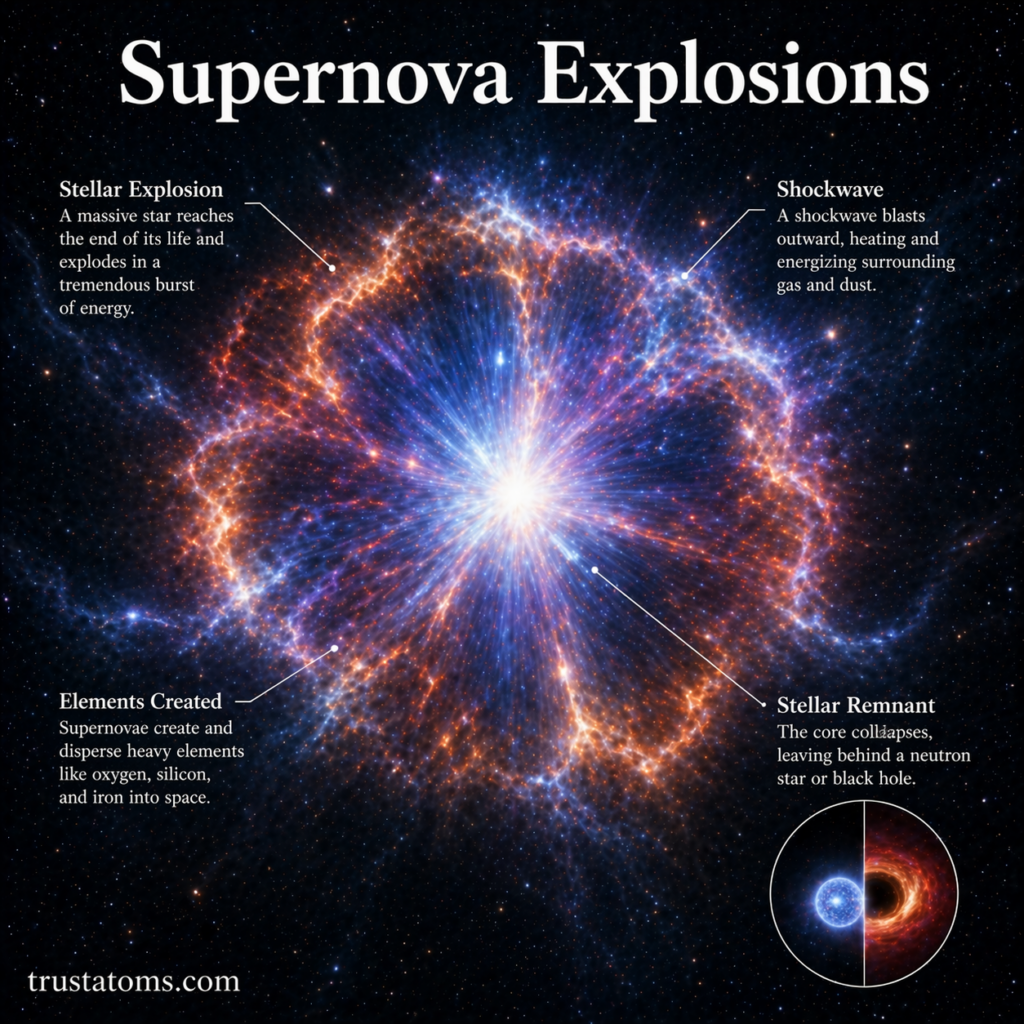
- Massive stars → supergiants → supernova → neutron star or black hole
Leaving the main sequence marks the beginning of a star’s final evolutionary stages.
Why Main Sequence Stars Matter
Main sequence stars are essential to understanding the universe.
Their importance
- Provide stable energy over long periods
- Enable planetary systems to form and exist
- Support the possibility of life (like on Earth)
Without long-lived main sequence stars, complex systems like galaxies—and life itself—would not develop the way they have.
Key Characteristics of Main Sequence Stars
- Stable balance between gravity and fusion
- Hydrogen fusion in the core
- Wide range of sizes, temperatures, and brightness
- Lifespan determined primarily by mass
Final Thoughts
Main sequence stars are the backbone of the universe’s stellar population. They represent a long, stable period in a star’s life where energy production is steady and predictable.
By studying them, scientists can better understand everything from galaxy formation to the conditions that allow life to exist. Our own Sun’s place in the main sequence is one of the key reasons Earth has remained habitable for billions of years.