The birth of a star is one of the most fascinating processes in astronomy. Before a star begins shining, it goes through an early stage known as a protostar. This phase represents the transition from a cold cloud of gas and dust to a fully formed, energy-producing star.
Understanding protostars helps explain how stars like our Sun came into existence and how planetary systems eventually form.
What Is a Protostar?
A protostar is a young, developing star that has not yet started nuclear fusion in its core.
It forms within dense regions of molecular clouds, often called stellar nurseries. These regions are rich in hydrogen gas and dust—the raw materials needed for star formation.
Key characteristics of protostars include:
- They are still gathering mass from surrounding material
- They emit energy primarily from gravitational contraction, not fusion
- They are often hidden within thick clouds of gas and dust
- They can be surrounded by a rotating disk of material
At this stage, the object is not yet a true star, but it is on its way.
How Protostars Form
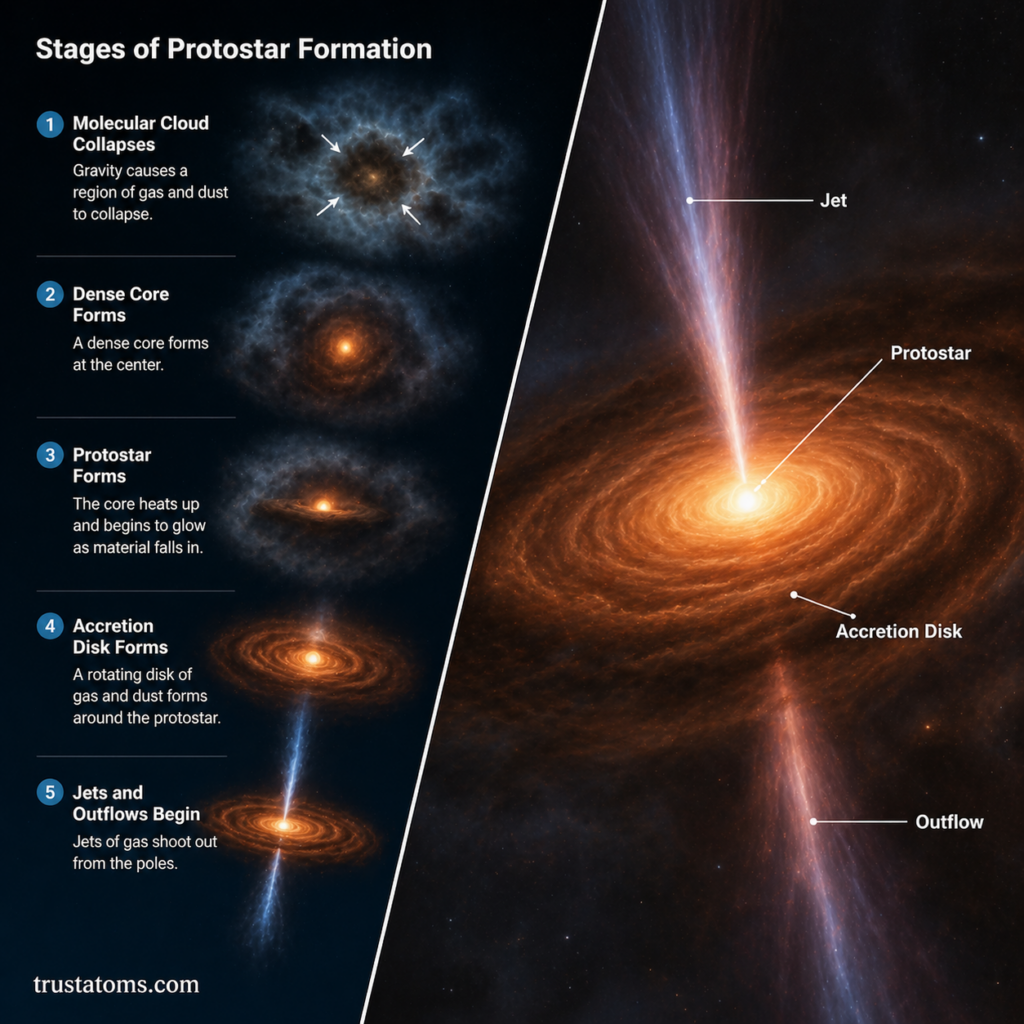
The formation of a protostar begins with the collapse of a molecular cloud under gravity.
Step-by-Step Formation Process
- Cloud Collapse Begins
A disturbance—such as a nearby supernova explosion or collision with another cloud—causes part of a molecular cloud to collapse. - Dense Core Formation
As gravity pulls material inward, a dense region forms at the center. This becomes the seed of the protostar. - Heating from Compression
The collapsing gas heats up due to increasing pressure, causing the core temperature to rise. - Accretion Phase
Surrounding material continues to fall inward, feeding the growing protostar. - Formation of a Disk
Conservation of angular momentum causes material to flatten into a rotating disk around the protostar.
The Role of Accretion Disks
One of the most important features of a protostar is its accretion disk.
This disk plays several critical roles:
- Supplies additional mass to the protostar
- Regulates the rate of growth
- Acts as the birthplace of future planets
- Helps channel material into jets
Over time, particles within the disk collide and stick together, eventually forming planetesimals and, later, planets.
Protostellar Jets and Outflows
Protostars often produce powerful jets of gas that shoot out from their poles.
These jets:
- Travel at high speeds (hundreds of kilometers per second)
- Help remove excess angular momentum
- Clear away surrounding gas and dust
- Make the protostar more visible over time
These outflows are a sign that the protostar is actively evolving.
Temperature and Energy Changes
As the protostar grows, its internal temperature steadily increases.
Important transitions include:
- Early Stage: Energy comes from gravitational contraction
- Mid Stage: Core temperature rises significantly
- Late Stage: Conditions approach those needed for nuclear fusion
When the core temperature reaches about 10 million Kelvin, hydrogen fusion can begin.
This marks the end of the protostar phase.
Transition to a Main Sequence Star
Once nuclear fusion starts in the core, the protostar becomes a true star and enters the main sequence stage.
This transition involves:
- Stabilization of internal pressure and gravity
- A steady output of energy
- A clear and visible stellar surface
From this point on, the star will spend most of its life in a stable state, burning hydrogen into helium.
Timescales of Protostar Formation
The time it takes for a protostar to form depends on its mass.
Typical timescales:
- Low-mass stars (like the Sun): ~1–10 million years
- High-mass stars: hundreds of thousands of years
More massive stars form faster because their stronger gravity accelerates the collapse process.
Why Protostars Matter
Protostars are essential to understanding the broader universe.
They help scientists:
- Study the origins of stars and planetary systems
- Understand how galaxies evolve
- Observe early stages of solar system formation
- Investigate the conditions that lead to habitable planets
By observing protostars in distant stellar nurseries, astronomers gain insight into the past—and future—of our own cosmic neighborhood.
Final Thoughts
Protostars represent the earliest chapter in a star’s life. Though hidden within dense clouds and often difficult to observe, they are the key to understanding how stars—and ultimately planets and life—come into existence.
From collapsing gas clouds to glowing young stars, this stage sets the foundation for everything that follows in the lifecycle of a star.