A protostar is a young, forming star that gathers gas and dust under gravity before sustained hydrogen fusion begins in its core. It develops inside a collapsing molecular cloud, gradually becoming hotter and denser as surrounding material falls inward.
Protostars help astronomers understand how stars like our Sun develop and how the material surrounding them can eventually produce planetary systems. Studying these early stages is an important part of the study of astronomy, particularly research into star formation and the structure of our galaxy.
What Is a Protostar?
A protostar is a developing stellar object that has not yet established sustained hydrogen fusion in its core. Unlike a main-sequence star, which produces most of its energy through nuclear fusion, a protostar shines primarily because gravitational contraction and incoming material release energy.
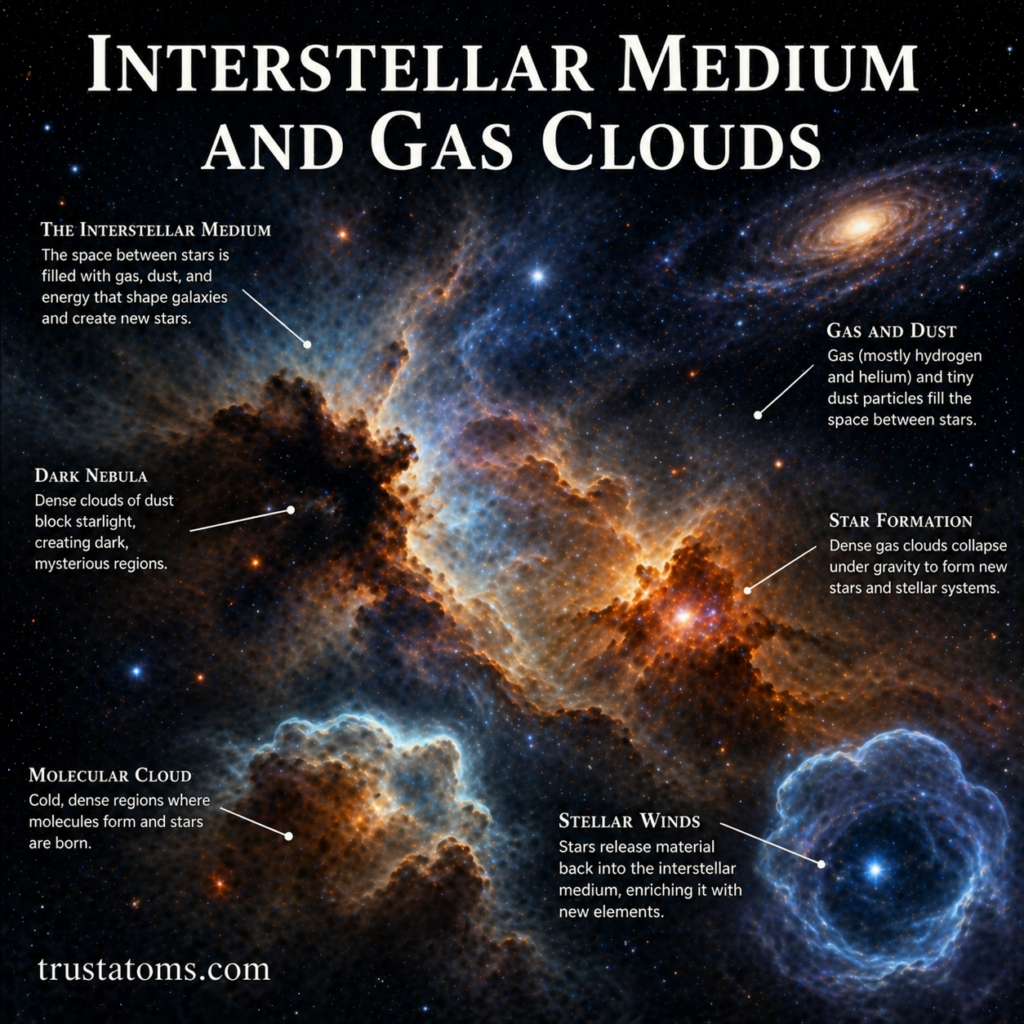
It forms within dense regions of molecular clouds, often called stellar nurseries. These regions are rich in hydrogen gas and dust—the raw materials needed for star formation.
These molecular clouds are part of the larger Interstellar Medium and Gas Clouds found throughout galaxies. When a sufficiently dense region becomes gravitationally unstable, it can begin collapsing into a new stellar system.
The process is closely related to Gravitational Collapse in Stars, which explains how gravity pulls matter inward and changes its density and temperature.
Protostars typically have several recognizable characteristics:
- They continue accumulating mass from surrounding gas and dust.
- Much of their energy comes from gravitational contraction and accretion.
- They are frequently hidden inside dense, dusty clouds.
- Many are surrounded by rotating disks and produce energetic outflows.
How Protostars Form From Molecular Clouds
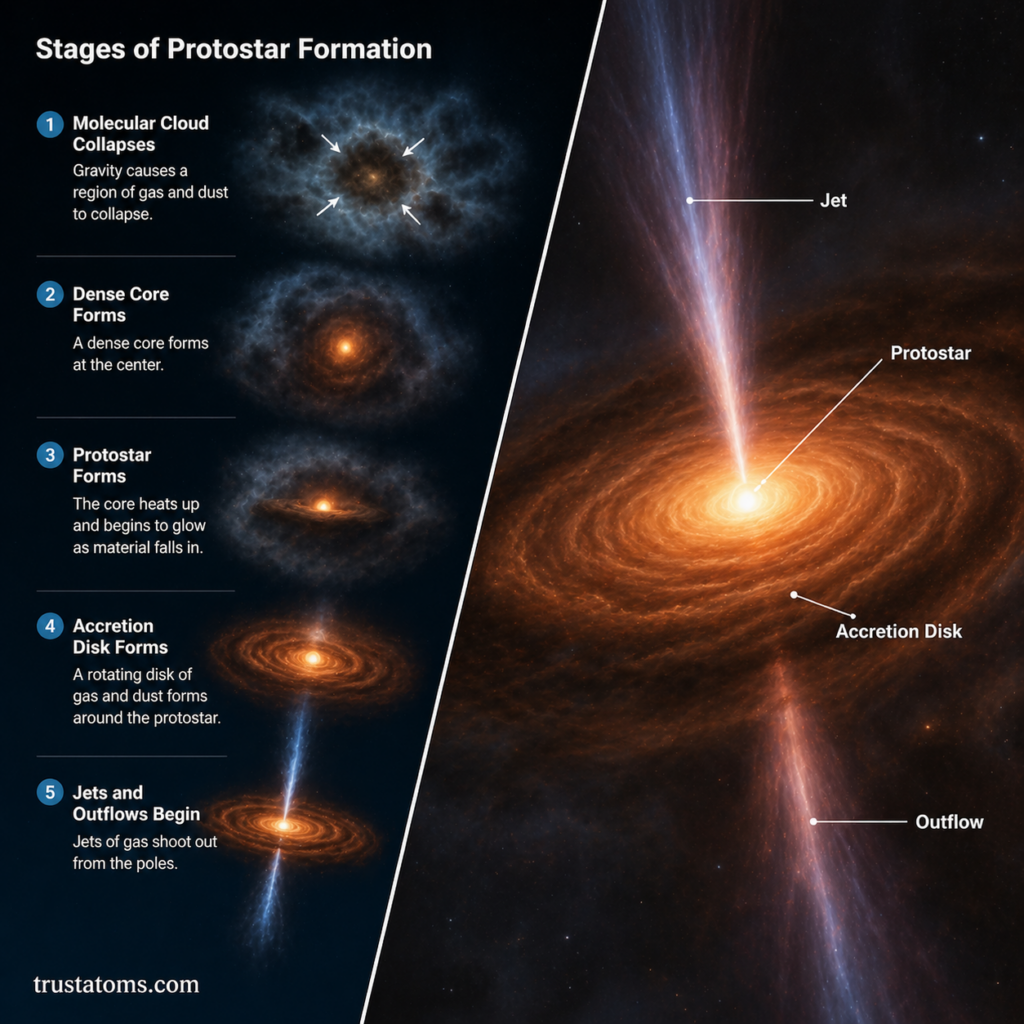
Star formation begins when gravity overcomes the forces supporting part of a cold molecular cloud against collapse. Turbulence, cloud collisions, or compression from nearby stellar activity can contribute to this process, although an external disturbance is not always necessary.
The Five Main Stages of Protostar Formation
- Gravitational collapse: A dense region of a molecular cloud becomes unstable, allowing gravity to pull gas inward.
- Dense core formation: Material concentrates toward the center, increasing pressure and density.
- Protostar development: A central object forms and heats as matter contracts and additional material falls onto it.
- Accretion disk formation: Rotating infalling material settles into a flattened disk around the developing star.
- Continued growth: The protostar gains mass while jets and outflows carry some material away from the system.
These stages can overlap. Accretion, disk development, and outflow activity often occur simultaneously rather than as completely separate events.
How Accretion Disks Feed Growing Stars
As a molecular cloud collapses, even a small amount of initial rotation becomes more noticeable. Conservation of angular momentum causes much of the infalling material to settle into a rotating disk instead of falling directly onto the protostar.
Within this accretion disk, gas gradually moves inward as angular momentum is transferred outward through processes involving turbulence and magnetic fields. Material reaching the protostar adds to its mass and releases energy.
Some disks eventually become environments where solid particles collide, grow into larger bodies, and potentially develop into planets. However, not every protostellar disk necessarily produces a planetary system.
Why Protostars Produce Jets and Outflows
Many protostars launch narrow jets of gas along their rotational axes. Magnetic fields interacting with the rotating disk help accelerate and direct this material away from the young star.
Protostellar jets can travel at speeds of hundreds of kilometers per second. As they strike surrounding gas, they may create shock waves and bright regions known as Herbig-Haro objects.
These jets and broader outflows remove angular momentum and help disperse surrounding material. Astronomers can observe their effects even when the protostar itself remains concealed by dust.
Temperature, Energy, and Nuclear Fusion
A protostar becomes hotter as gravity compresses its interior. Energy released during contraction and accretion travels outward, eventually escaping as radiation.
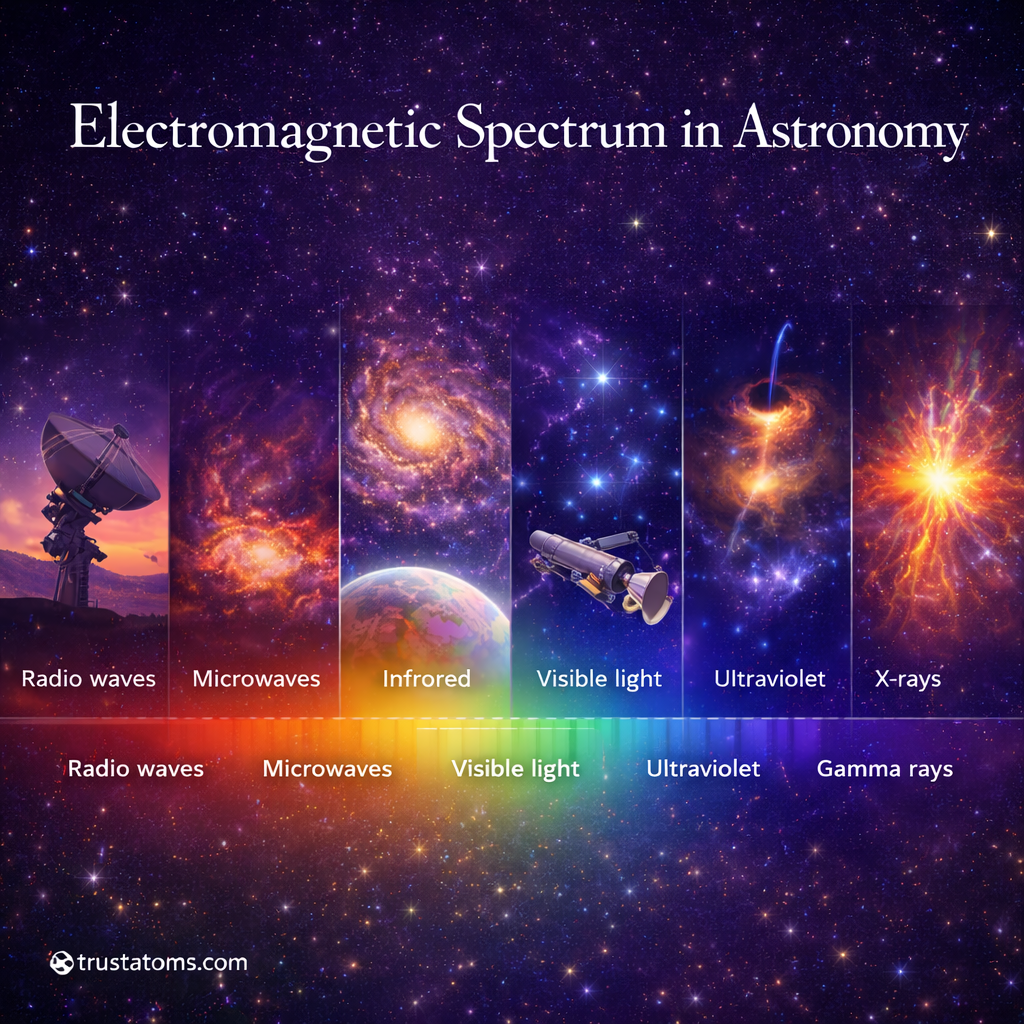
Young protostars often emit strongly at infrared wavelengths because surrounding dust absorbs shorter-wavelength radiation and reemits energy as infrared light. This makes infrared telescopes especially useful for studying embedded stellar objects.
As the central temperature increases, nuclear reactions become possible. Deuterium fusion may occur during early development, but sustained ordinary hydrogen fusion requires substantially higher temperatures.
For a star similar to the Sun, sustained hydrogen fusion becomes possible when the core reaches temperatures of roughly 10 million kelvin or higher. The exact conditions depend on stellar mass and internal structure.
Transition to a Main-Sequence Star
A developing star enters the main sequence when sustained hydrogen fusion becomes its dominant energy source and it reaches a relatively stable balance between inward gravity and outward pressure.
This transition does not happen immediately after the first nuclear reactions begin. A young star may continue contracting through a pre-main-sequence stage before reaching long-term stability.
The broader Life Cycle of a Star explains how stars progress from formation through their main-sequence lifetimes and eventually reach different endpoints depending on their mass.
How Long Does Protostar Formation Take?
The duration of early stellar development depends strongly on mass, the surrounding cloud, and the rate at which material accumulates. Astronomers also distinguish between the embedded protostellar phase and the longer period before a star reaches the main sequence.
For a Sun-like star, the deeply embedded protostellar stage typically lasts hundreds of thousands of years, while reaching the main sequence takes tens of millions of years. Massive stars develop much more rapidly and may begin sustained hydrogen fusion while still accreting material.
A Concrete Example: A Protostar Like the Young Sun
Imagine a dense cloud core containing enough material to form a star approximately as massive as the Sun. As gravity draws the gas inward, a central protostar develops while rotating material collects into a disk.
During its embedded stage, the protostar may gain much of its eventual mass over several hundred thousand years. Accretion gradually declines, but the young star continues contracting after much of its surrounding envelope has dispersed.
For a star with approximately one solar mass, reaching the main sequence takes roughly 30–50 million years from the beginning of its early development. This illustrates why the visible emergence of a young star and the beginning of stable hydrogen fusion are separate milestones.
How Astronomers Observe Protostars
Because dense dust clouds block much visible light, astronomers use infrared and radio observations to investigate protostars. Instruments such as the James Webb Space Telescope can reveal warm dust and young stellar structures, while the Atacama Large Millimeter/submillimeter Array (ALMA) can examine cold gas, dust, and disk motion.
By comparing observations of objects at different developmental stages, researchers reconstruct how material flows from molecular clouds into stars and their surrounding disks.
Frequently Asked Questions
Is a protostar already a star?
A protostar is a forming stellar object, but it has not yet reached the stable hydrogen-fusing main-sequence stage. It can produce substantial light and heat through gravitational contraction and accretion before becoming a mature star.
Can planets form around a protostar?
Planet formation can begin in the disk surrounding a young star. Dust grains may grow into larger solids while the central star is still developing, although the formation of complete planetary systems generally extends beyond the earliest protostellar phase.
Do all protostars become main-sequence stars?
No. An object must accumulate enough mass to sustain ordinary hydrogen fusion. Objects below approximately 0.075–0.08 solar masses cannot maintain this process and instead become brown dwarfs.
Protostars reveal how gravity transforms cold interstellar gas into young stellar objects surrounded by disks, jets, and evolving material. Their development also explains why star formation and the earliest stages of planetary formation are closely connected, even though stable hydrogen fusion begins much later for stars like the Sun.
Sources: Carroll and Ostlie, An Introduction to Modern Astrophysics; NASA, Imagine the Universe; European Southern Observatory, ALMA Science.