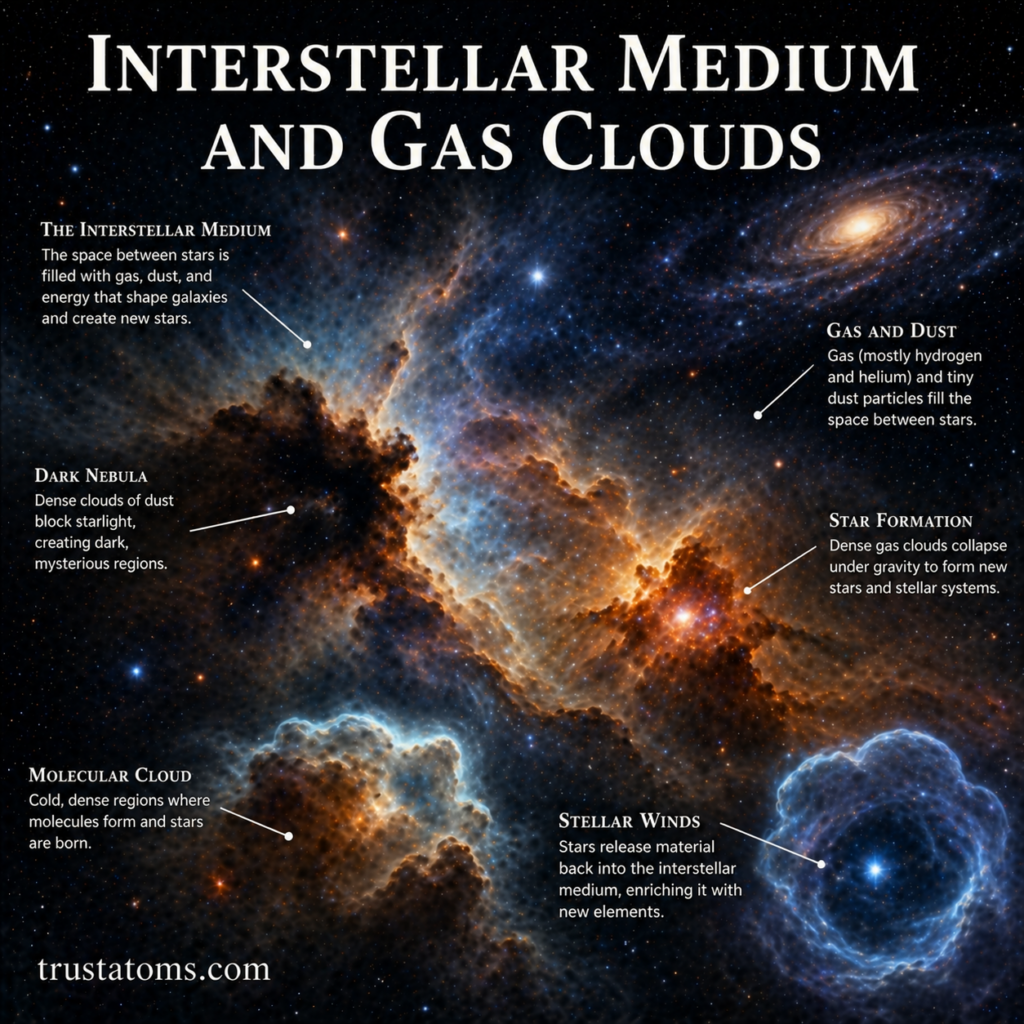
Between the stars lies a vast, often overlooked component of the universe: the interstellar medium (ISM). Far from being empty, this space is filled with gas, dust, and energetic particles that play a crucial role in the life cycle of stars and galaxies.
From star formation to cosmic recycling, the interstellar medium connects nearly every major process in astronomy.
What Is the Interstellar Medium?
The interstellar medium is the matter that exists in the space between stars within a galaxy.
Main Components:
- Gas (mostly hydrogen and helium)
- Dust particles (tiny solid grains)
- Cosmic rays (high-energy particles)
- Magnetic fields
Although extremely diffuse, the ISM spans enormous distances and contains enough material to form new stars and planetary systems.
Types of Gas in the Interstellar Medium
The ISM is not uniform—it exists in different phases depending on temperature and density.
Cold Neutral Medium
- Temperature: ~100 K
- Dense and cool
- Found in regions where stars can form
Warm Neutral Medium
- Temperature: ~6,000 K
- Less dense than cold regions
- More evenly distributed
Warm Ionized Medium
- Gas is partially ionized
- Influenced by nearby stars
- Emits faint light
Hot Ionized Medium
- Temperature: millions of degrees
- Extremely low density
- Created by supernova explosions
What Are Interstellar Gas Clouds?
Gas clouds are concentrations of material within the interstellar medium.
Key Features:
- Composed mostly of hydrogen
- Vary widely in size and density
- Can span light-years across
These clouds are the birthplaces of stars and the reservoirs of raw cosmic material.
Types of Interstellar Clouds
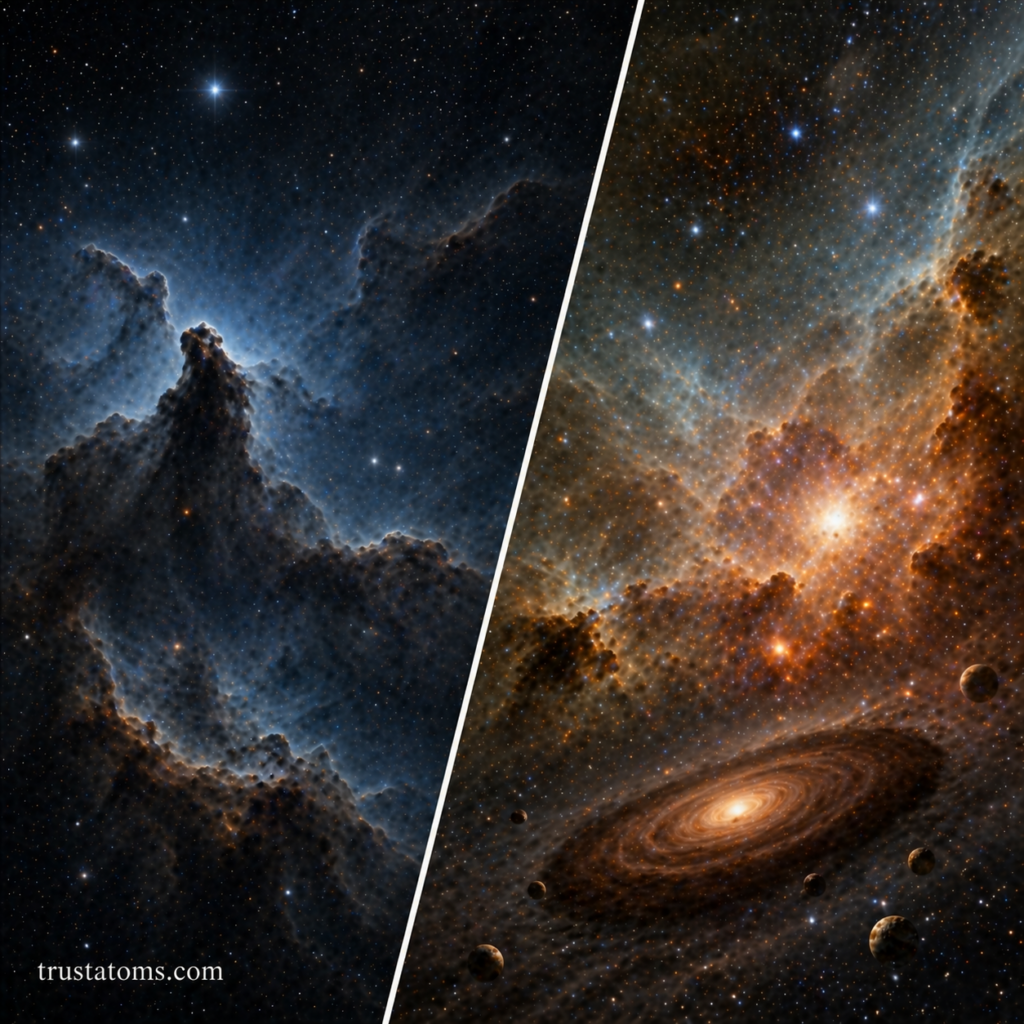
Different clouds have different roles in the universe.
Molecular Clouds
- Coldest and densest regions
- Contain molecules like hydrogen (H₂)
- Sites of star formation
These are often called stellar nurseries.
Nebulae
- Visible clouds of gas and dust
- Illuminated by nearby stars
- Can be emission, reflection, or dark nebulae
H II Regions
- Ionized hydrogen regions
- Formed around hot, young stars
- Glow brightly due to radiation
How Stars Form from Gas Clouds
Star formation begins when a region within a gas cloud collapses under gravity.
Step-by-Step Process:
- A dense region forms within a molecular cloud
- Gravity pulls material inward
- Temperature and pressure increase
- A protostar forms
- Nuclear fusion ignites, creating a new star
This process can take millions of years and often forms clusters of stars.
The Role of Dust in the Interstellar Medium
Dust may make up only a small portion of the ISM, but it has a big impact.
Functions of Dust:
- Absorbs and scatters light
- Helps cool gas clouds
- Provides surfaces for chemical reactions
- Contributes to molecule formation
Dust is also essential for forming planets and solid bodies.
How the Interstellar Medium Evolves
The ISM is constantly changing due to stellar activity.
Key Processes:
- Stellar winds push material outward
- Supernovae inject energy and elements
- Radiation alters gas conditions
- Gravity pulls material into new structures
This creates a dynamic cycle of formation and destruction.
Cosmic Recycling: From Stars Back to Space
Stars return material to the interstellar medium at the end of their lives.
Sources of Recycled Material:
- Red giant winds
- Planetary nebulae
- Supernova explosions
Result:
- Enriched gas clouds
- Formation of new stars and planets
This recycling process builds heavier elements over time.
Why the Interstellar Medium Matters
The ISM is essential for understanding how galaxies function.
Scientific Importance:
- Explains how stars are born
- Tracks the movement of matter in galaxies
- Provides raw material for planetary systems
- Helps map galactic structure
Without the ISM, galaxies would not be able to sustain star formation.
Observing the Interstellar Medium
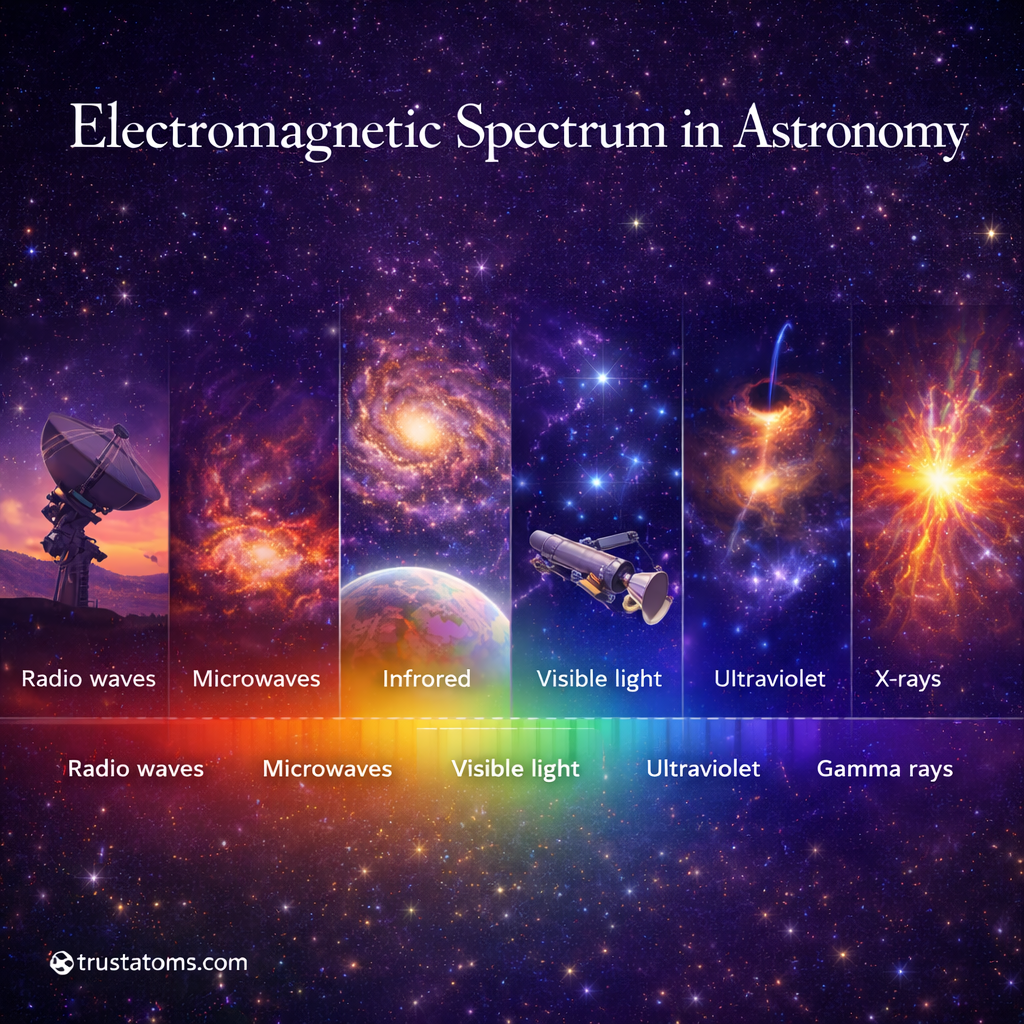
Astronomers study the ISM using multiple wavelengths of light.
Observation Methods:
- Radio waves to detect cold gas
- Infrared to observe dust and molecular clouds
- X-rays to study hot gas
- Spectroscopy to identify chemical composition
Each method reveals a different aspect of the interstellar environment.
Final Thoughts
The interstellar medium may seem empty at first glance, but it is one of the most important components of the universe. It serves as both the birthplace of stars and the repository of material from past stellar generations.
- It contains gas, dust, and energy
- It forms stars and planetary systems
- It evolves through stellar activity
- It drives the cycle of cosmic matter
In many ways, the interstellar medium is the universe’s connective tissue—linking stars, planets, and galaxies in an ongoing cycle of creation and transformation.