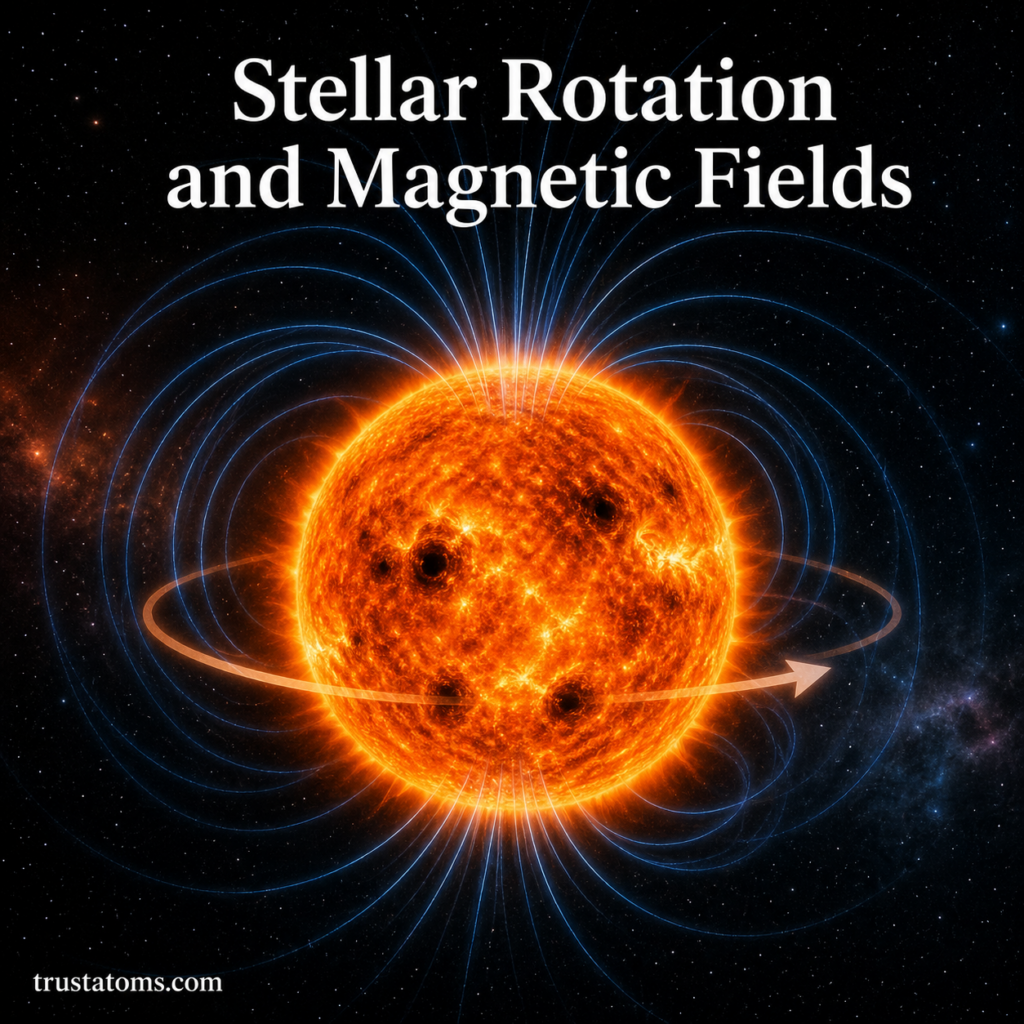
Stars are not static objects—they spin. This rotation plays a major role in shaping a star’s magnetic field, surface activity, and long-term evolution. From gentle spins like our Sun to rapidly rotating young stars, stellar rotation is deeply connected to phenomena like sunspots, stellar flares, and even space weather.
Understanding how rotation and magnetism interact helps astronomers explain everything from stellar lifecycles to the environments of surrounding planets.
What Is Stellar Rotation?
Stellar rotation refers to how fast a star spins around its axis. Just like Earth rotates once every 24 hours, stars also have rotation periods—but they vary widely.
Key characteristics of stellar rotation:
- Rotation speeds can range from a few hours to several months
- Younger stars tend to rotate faster
- Massive stars often spin more rapidly than smaller ones
- Rotation slows down over time due to energy loss
For example, the Sun rotates roughly once every 25 days at its equator, but more slowly near its poles—a phenomenon known as differential rotation.
How Rotation Generates Magnetic Fields
A star’s magnetic field is created by the movement of electrically charged plasma inside it. This process is called the stellar dynamo.
How the dynamo works:
- Hot plasma moves inside the star (convection)
- The star’s rotation twists and stretches magnetic field lines
- This motion amplifies and sustains magnetic fields
This mechanism is similar to how Earth generates its magnetic field, but on a much larger and more powerful scale.
Organizations like NASA and the European Space Agency actively study stellar magnetism to better understand solar storms and their effects on space and Earth.
Differential Rotation and Magnetic Complexity
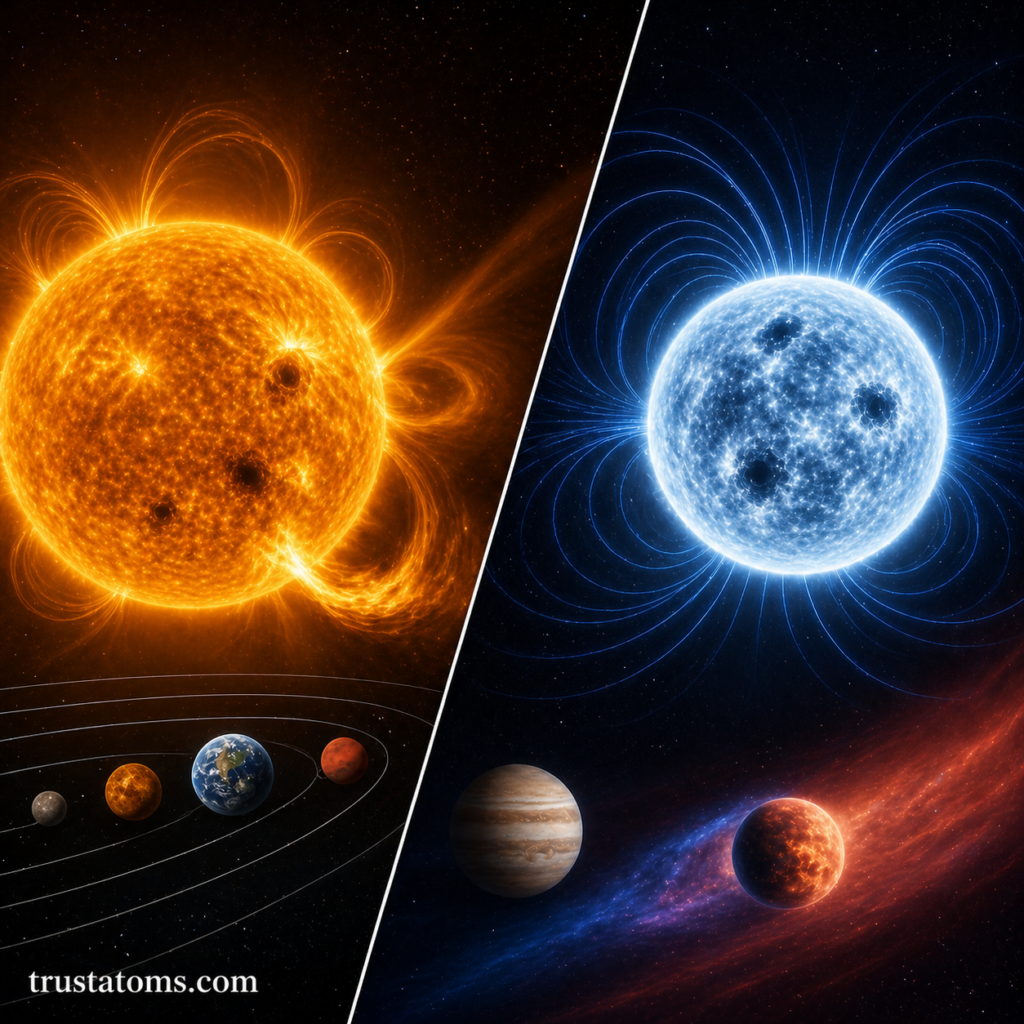
Unlike solid objects, stars are made of plasma, allowing different regions to rotate at different speeds.
Effects of differential rotation:
- Twists magnetic field lines over time
- Leads to complex magnetic structures
- Triggers magnetic reconnection events
These processes are responsible for powerful bursts of energy, such as:
- Solar flares
- Coronal mass ejections (CMEs)
- Starspots (similar to sunspots)
Starspots and Surface Activity
Magnetic fields strongly influence a star’s surface. One of the most visible effects is the formation of starspots—cooler, darker regions caused by intense magnetic activity.
Key features of starspots:
- Can be much larger than Earth
- Appear in cycles (like the Sun’s ~11-year cycle)
- Indicate magnetic field strength and activity
On highly active stars, starspots can cover a significant portion of the surface, dramatically affecting brightness.
Stellar Rotation Over Time
Stars don’t spin at the same rate forever. Over time, they lose angular momentum through a process called magnetic braking.
How magnetic braking works:
- Stellar winds carry charged particles away from the star
- Magnetic fields interact with these particles
- This gradually slows the star’s rotation
As a result:
- Young stars → fast rotation, strong magnetic fields
- Older stars → slower rotation, weaker activity
This relationship allows astronomers to estimate a star’s age—a method known as gyrochronology.
Rapid Rotators and Extreme Magnetism
Some stars rotate extremely fast, completing a full rotation in just hours.
These stars often exhibit:
- Intense magnetic fields
- Frequent and powerful flares
- High-energy radiation output
Examples include young stars and certain types of compact stars like neutron stars. A well-known extreme case is the Crab Pulsar, which spins dozens of times per second.
Impact on Surrounding Planets
A star’s magnetic activity directly affects nearby planets, especially in terms of habitability.
Key impacts:
- Strong stellar flares can strip planetary atmospheres
- Magnetic storms can disrupt planetary climates
- High radiation levels may affect the potential for life
Understanding stellar rotation and magnetism is crucial when studying exoplanets and their environments.
The Sun as a Case Study
Our Sun provides the best example of stellar rotation and magnetic behavior.
Observed solar phenomena:
- Sunspot cycles (~11 years)
- Solar flares and CMEs
- Magnetic polarity reversals
These cycles are closely tied to the Sun’s rotation and internal plasma dynamics, making it a key reference for studying other stars.
Why Stellar Rotation and Magnetism Matter
Studying stellar rotation and magnetic fields helps scientists:
- Predict solar and stellar activity
- Understand star aging and evolution
- Assess exoplanet habitability
- Model space weather effects on Earth
Research from institutions like Harvard-Smithsonian Center for Astrophysics continues to deepen our understanding of these powerful cosmic forces.
Final Thoughts
Stellar rotation is far more than a simple spin—it drives magnetic fields, fuels energetic events, and shapes the environments around stars. From quiet, aging stars to rapidly spinning cosmic dynamos, rotation and magnetism are fundamental to how stars live and evolve.
By studying these processes, astronomers gain critical insights into the universe—and our place within it.