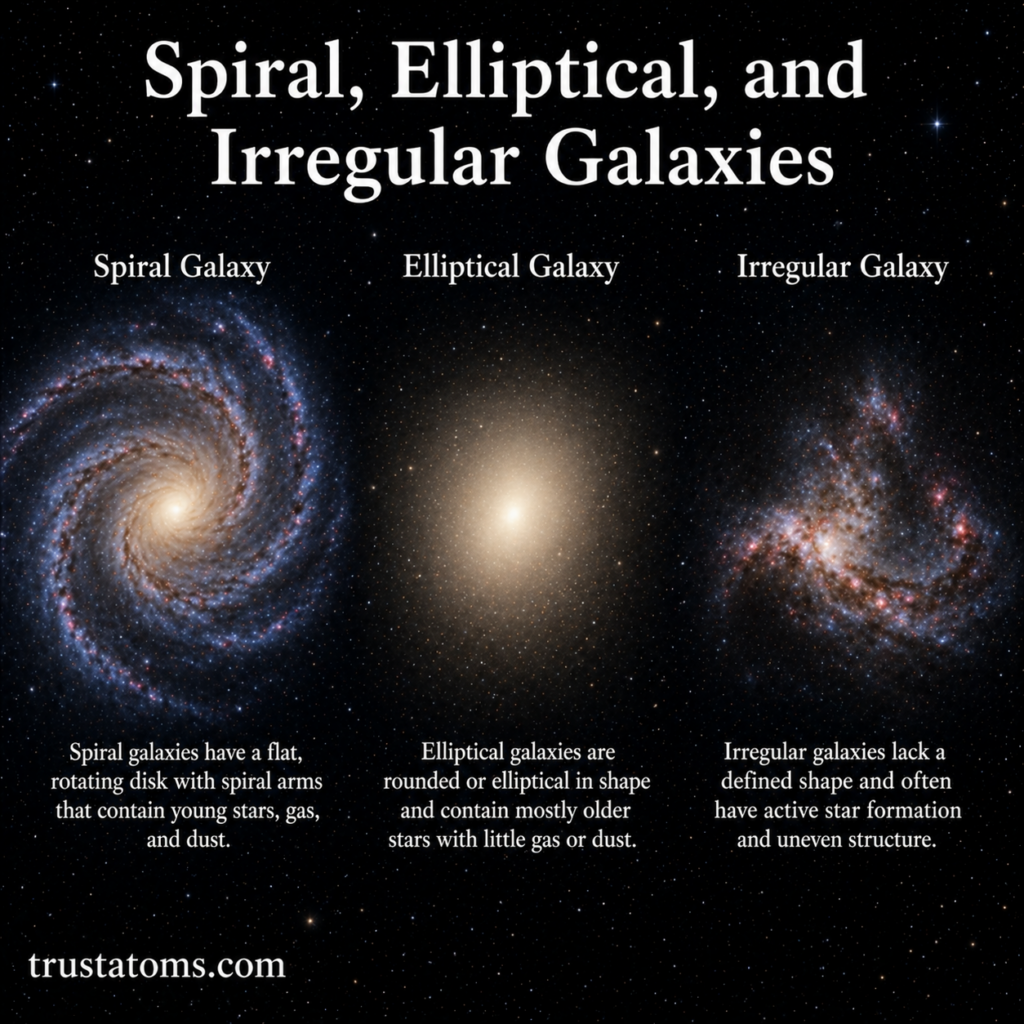
Galaxies come in a wide variety of shapes and sizes, but most fall into three main categories: spiral, elliptical, and irregular. These classifications help astronomers understand how galaxies form, evolve, and interact over time.
Each type has distinct features, stellar populations, and levels of activity, offering clues about its history and future.
What Defines a Galaxy Type?
Galaxy classification is primarily based on shape and structure, but other factors also play a role.
Key classification factors:
- Overall shape (disk, spherical, or irregular)
- Presence of spiral arms
- Amount of gas and dust
- Rate of star formation
- Age of stellar population
This system of classification was first organized by astronomer Edwin Hubble.
Spiral Galaxies
Spiral galaxies are among the most visually striking and well-structured types.
Key characteristics:
- Flat, rotating disk
- Distinct spiral arms
- Central bulge
- Rich in gas and dust
The Milky Way is a classic example of a spiral galaxy.
What makes spiral galaxies unique:
- Active star formation in spiral arms
- Mix of young and old stars
- Clearly defined structure
Spiral galaxies often appear bright and colorful due to ongoing star formation.
Elliptical Galaxies
Elliptical galaxies are more uniform in shape and lack the structure seen in spirals.
Key characteristics:
- Rounded or oval shape
- Smooth, featureless appearance
- Little gas or dust
- Minimal new star formation
What makes elliptical galaxies unique:
- Dominated by older, red stars
- Low levels of activity
- Can range from small to extremely large
Some of the largest galaxies in the universe are elliptical, containing trillions of stars.
Irregular Galaxies
Irregular galaxies do not fit into the spiral or elliptical categories.
Key characteristics:
- No defined shape
- Chaotic structure
- Often rich in gas and dust
- Active star formation
What makes irregular galaxies unique:
- Often formed through collisions or gravitational interactions
- Can appear distorted or fragmented
- Frequently found near larger galaxies
Irregular galaxies provide valuable insights into how galaxies evolve through interactions.
Comparing the Three Types
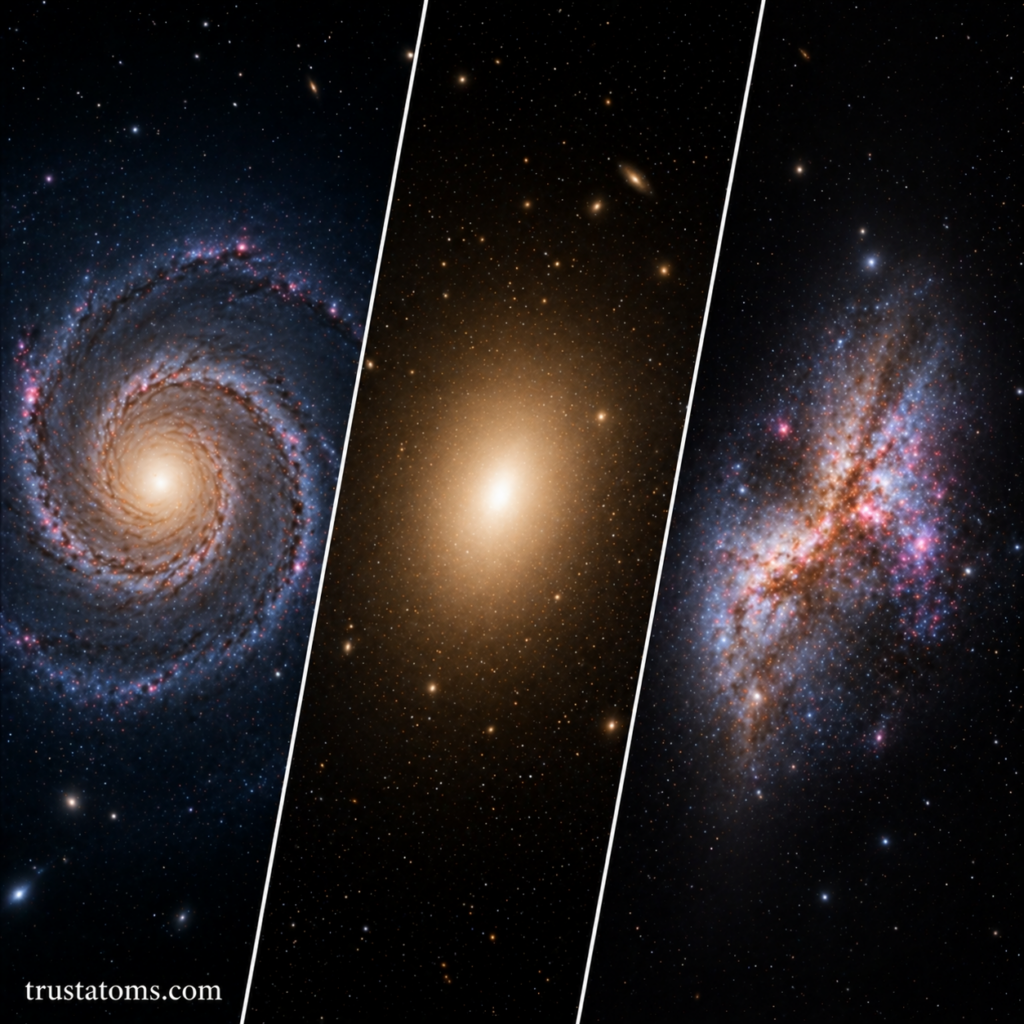
Understanding the differences between these galaxy types helps highlight their unique roles in the universe.
Structure:
- Spiral → organized, disk-shaped with arms
- Elliptical → smooth, rounded
- Irregular → chaotic and undefined
Star formation:
- Spiral → active
- Elliptical → minimal
- Irregular → often active
Gas and dust content:
- Spiral → abundant
- Elliptical → very little
- Irregular → variable but often high
How Galaxies Evolve
Galaxies don’t always stay in one category. Over time, they can change due to interactions and internal processes.
Common evolutionary processes:
- Galaxy mergers: Two galaxies collide and combine
- Gravitational interactions: Distort structure
- Star formation cycles: Use up available gas
- Central black hole activity: Influences growth
For example, spiral galaxies can merge and form elliptical galaxies.
Galaxy Interactions and Collisions
Galaxies frequently interact with one another, especially in dense regions of space.
Effects of interactions:
- Trigger bursts of star formation
- Distort shapes into irregular forms
- Create tidal streams of stars and gas
- Eventually merge into larger galaxies
These interactions play a major role in shaping galaxy types over time.
Why Galaxy Types Matter
Studying galaxy types helps astronomers:
- Understand the lifecycle of galaxies
- Trace the history of cosmic structure
- Study star formation across the universe
- Predict how galaxies will evolve
Organizations like NASA and the European Space Agency continue to explore galaxies using powerful telescopes and space missions.
Final Thoughts
Spiral, elliptical, and irregular galaxies represent the diversity of structures in the universe. From elegant spirals filled with new stars to quiet ellipticals and chaotic irregular systems, each type tells a unique story about cosmic evolution.
By comparing these galaxy types, we gain a deeper understanding of how the universe has changed—and how it will continue to evolve.