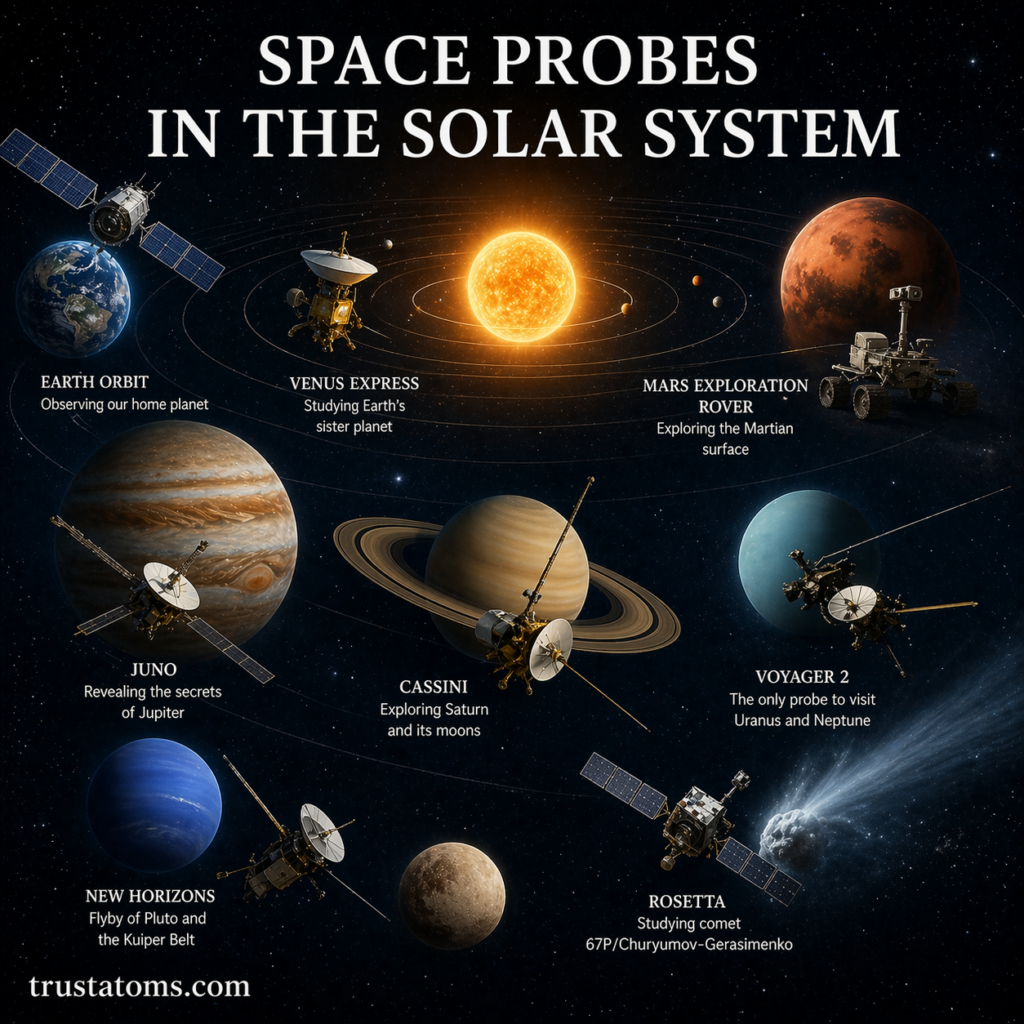
Space probes have transformed our understanding of the solar system. These robotic explorers travel vast distances, sending back data, images, and discoveries that would otherwise be impossible to obtain.
From the first missions to modern interplanetary explorers, space probes have revealed the true nature of planets, moons, asteroids, and the space between them.
What Is a Space Probe?
A space probe is an uncrewed spacecraft designed to explore space beyond Earth. Unlike satellites that orbit Earth, probes travel to other destinations such as:
- Planets
- Moons
- Asteroids and comets
- The outer solar system
They are equipped with scientific instruments to collect and transmit data back to Earth.
Types of Space Probes
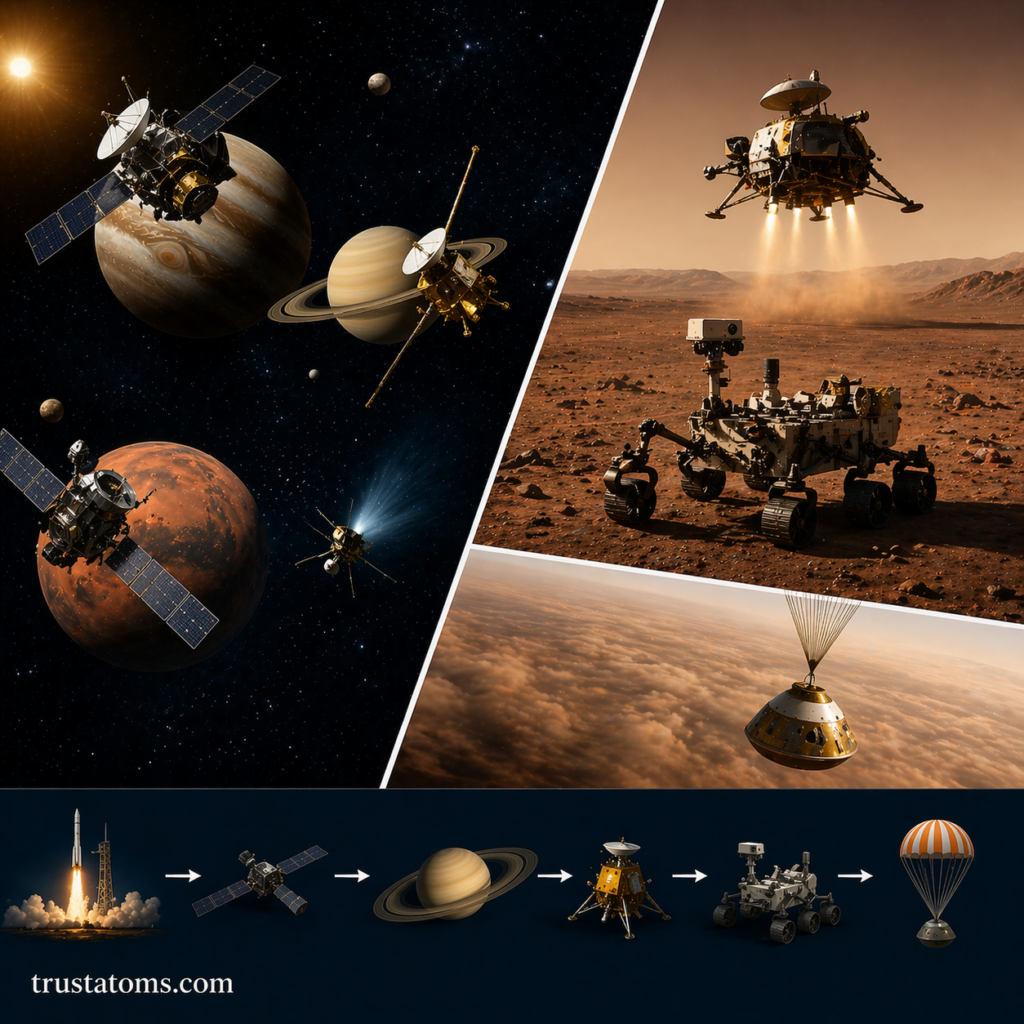
Different missions require different types of probes, each designed for specific objectives.
Flyby Probes
- Pass by a planet or object once
- Collect data during a brief encounter
- Continue traveling through space
Example: Voyager 1
Orbiter Probes
- Enter orbit around a planet or moon
- Study the object over long periods
- Capture detailed images and measurements
Example: Mars Reconnaissance Orbiter
Lander Probes
- Land on the surface of a planet or moon
- Perform experiments directly on the ground
- Analyze soil, atmosphere, and conditions
Example: Viking 1
Rover Probes
- Mobile landers that move across surfaces
- Explore terrain over time
- Collect and analyze samples
Example: Curiosity Rover
Atmospheric Probes
- Enter a planet’s atmosphere
- Measure temperature, pressure, and composition
- Often destroyed after descent
Example: Galileo Probe
Key Milestones in Space Probe Exploration
Space exploration has progressed rapidly since the mid-20th century.
Early Missions
- Sputnik 1 (1957) – First human-made object in space
- Luna 2 – First probe to reach the Moon
Exploring the Inner Planets
- Mariner 4 – First close-up images of Mars
- Magellan – Mapped Venus’s surface
Outer Solar System Discoveries
- Voyager 2 – Only probe to visit Uranus and Neptune
- Cassini–Huygens – Studied Saturn and landed on Titan
Modern Exploration
- Perseverance Rover – Searching for signs of ancient life
- New Horizons – First close-up images of Pluto
What Do Space Probes Study?
Space probes are equipped with advanced instruments to analyze many aspects of space environments.
Common research areas include:
- Surface composition and geology
- Atmospheric conditions
- Magnetic fields
- Radiation levels
- Presence of water or ice
- Signs of past or present life
These findings help scientists understand how planets form and evolve.
How Space Probes Communicate
Despite traveling millions or even billions of miles away, probes can send data back to Earth.
Communication methods:
- Radio signals transmitted through space
- Large antennas on Earth receive data
- Signals can take minutes to hours to arrive
For example:
- Signals from Mars take about 5–20 minutes
- Signals from distant probes like Voyager 1 can take over 20 hours
Challenges of Space Probe Missions
Exploring space comes with significant challenges.
Major obstacles include:
- Extreme temperatures
- High radiation levels
- Long travel times
- Limited power supply
- Communication delays
Engineers must design probes to operate autonomously, as real-time control is often impossible.
Power Sources for Space Probes
Space probes rely on different energy sources depending on their mission.
Common power systems:
- Solar panels (used near the Sun)
- Radioisotope thermoelectric generators (RTGs) for deep space
RTGs allow probes like Voyager 1 to operate far beyond the reach of sunlight.
Why Space Probes Matter
Space probes have revolutionized astronomy and planetary science.
They help us:
- Explore distant worlds without human risk
- Discover new planetary features
- Understand the origins of the solar system
- Search for signs of life
- Prepare for future human missions
Without probes, our knowledge of the solar system would be extremely limited.
The Future of Space Probes
The next generation of space probes will push exploration even further.
Upcoming goals include:
- Returning samples from Mars
- Exploring icy moons like Europa and Enceladus
- Studying asteroids for planetary defense
- Sending probes beyond the solar system
Advances in technology may also allow probes to travel faster and operate longer.
Final Thoughts
Space probes are humanity’s eyes and ears in the solar system. They venture where humans cannot yet go, gathering crucial data and expanding our understanding of the universe.
As exploration continues, these robotic pioneers will remain at the forefront of discovery—revealing new worlds and answering fundamental questions about our place in space.