At the centers of many galaxies lie incredibly energetic regions known as Active Galactic Nuclei (AGN). These cosmic powerhouses outshine entire galaxies and are driven by some of the most extreme physics in the universe.
From blazing quasars to powerful jets of radiation, AGN provide crucial insight into how galaxies evolve and how supermassive black holes influence their surroundings.
What Is an Active Galactic Nucleus?
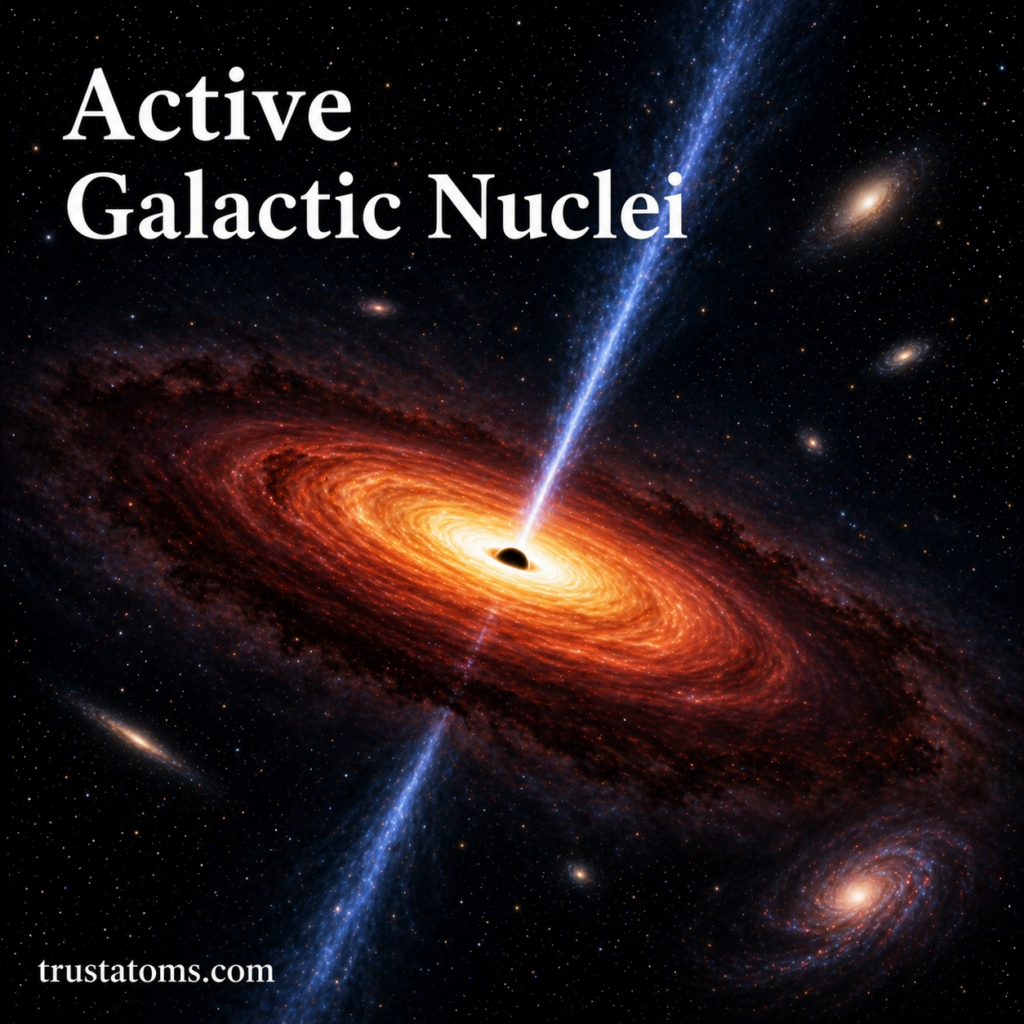
An Active Galactic Nucleus (AGN) is a compact, highly luminous region at the center of a galaxy. It is powered by matter falling into a supermassive black hole, releasing enormous amounts of energy.
Unlike normal galactic centers, AGN emit radiation across the entire electromagnetic spectrum, including:
- Radio waves
- Infrared
- Visible light
- Ultraviolet
- X-rays
- Gamma rays
One of the most famous AGN types is the quasar, which can shine brighter than hundreds of billions of stars combined.
How Active Galactic Nuclei Work
The energy from an AGN comes from a process called accretion.
Step-by-Step Process
- Gas and dust fall toward the central black hole
- Material forms a rotating accretion disk
- Friction and gravity heat the disk to extreme temperatures
- Energy is released as intense radiation
- Some material is ejected as high-speed jets
This process converts gravitational energy into light, making AGN some of the brightest objects in the universe.
Key Components of an AGN
AGN are made up of several distinct structures working together.
Central Black Hole
- Mass ranges from millions to billions of times the Sun
- Acts as the engine powering the AGN
Accretion Disk
- A swirling disk of superheated gas
- Emits most of the visible and ultraviolet radiation
Relativistic Jets
- Narrow beams of particles traveling near the speed of light
- Extend thousands of light-years into space
Dusty Torus
- A donut-shaped ring of gas and dust surrounding the nucleus
- Can obscure the AGN depending on viewing angle
Types of Active Galactic Nuclei
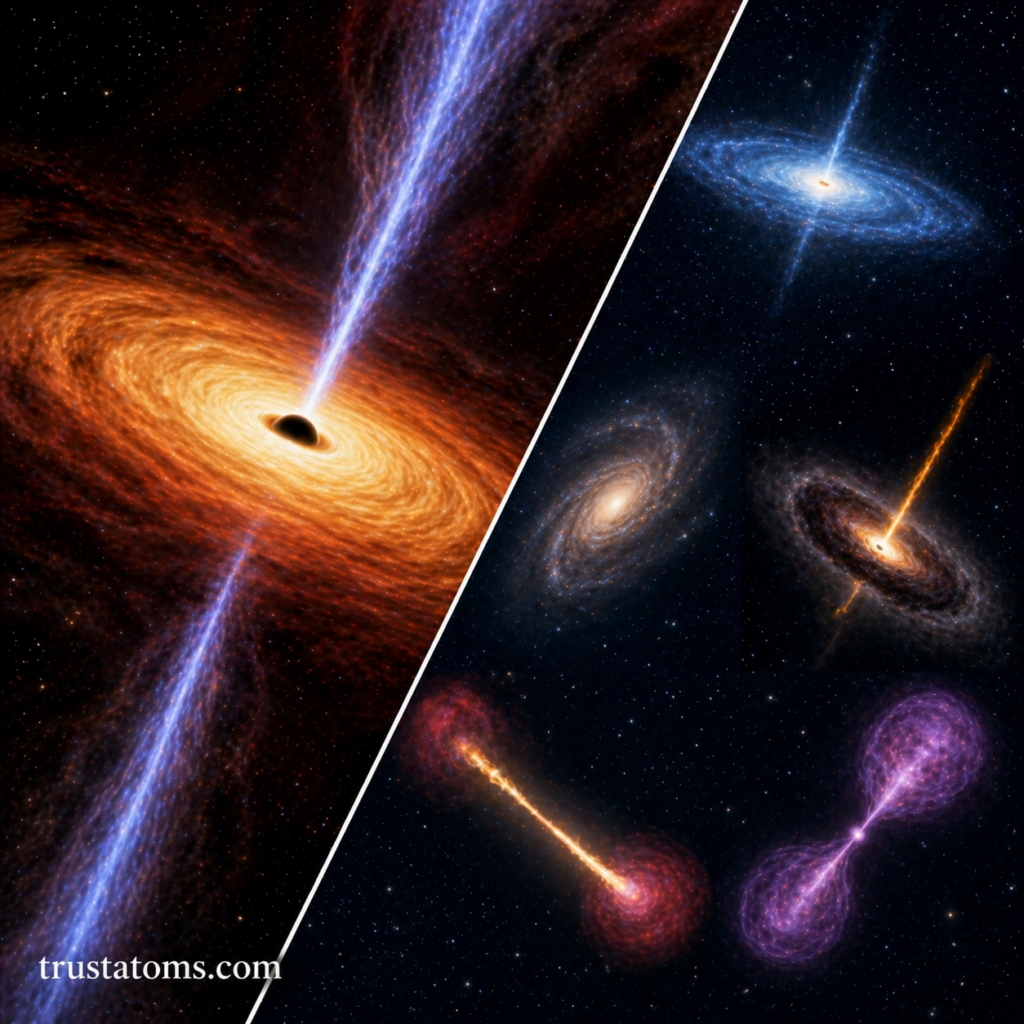
AGN come in several forms, depending on their brightness and how we observe them.
Major AGN Types
- Quasar
- Extremely bright and distant
- Among the most luminous objects in the universe
- Seyfert Galaxy
- Found in spiral galaxies
- Moderately bright with strong emission lines
- Blazar
- Jets pointed directly toward Earth
- Highly variable and energetic
- Radio Galaxies
- Emit strong radio waves
- Often have large, visible jets
Why Active Galactic Nuclei Are Important
AGN play a major role in shaping galaxies and the universe.
Scientific Significance
- Help regulate star formation in galaxies
- Provide evidence for supermassive black holes
- Influence galaxy growth through feedback processes
- Serve as beacons for studying the early universe
Because AGN are so bright, astronomers can observe them from billions of light-years away, offering a glimpse into the distant past.
AGN and Galaxy Evolution
Active Galactic Nuclei are not just bright—they are transformative.
How AGN Affect Their Host Galaxies
- Heat and expel gas needed for star formation
- Trigger or suppress new star creation
- Reshape galactic structure over time
This interaction is known as AGN feedback, a key concept in modern astronomy.
How Astronomers Study AGN
Studying AGN requires observing multiple wavelengths of light.
Observation Methods
- Optical telescopes for visible light
- Radio telescopes for jet detection
- X-ray observatories for high-energy emissions
- Infrared instruments for dust-obscured regions
Famous observatories like the Hubble Space Telescope and the Chandra X-ray Observatory have provided groundbreaking insights into AGN behavior.
Interesting Facts About Active Galactic Nuclei
- Some AGN can outshine their entire host galaxy
- Quasars are visible from billions of light-years away
- Jets from AGN can extend far beyond the galaxy itself
- Not all galaxies have active nuclei—many are dormant
Final Thoughts
Active Galactic Nuclei are among the most powerful and mysterious phenomena in the universe. Powered by supermassive black holes, they illuminate the cosmos and reveal the dynamic processes shaping galaxies.
By studying AGN, scientists gain a deeper understanding of how galaxies form, evolve, and interact over cosmic time—making them a key piece of the universe’s grand puzzle.