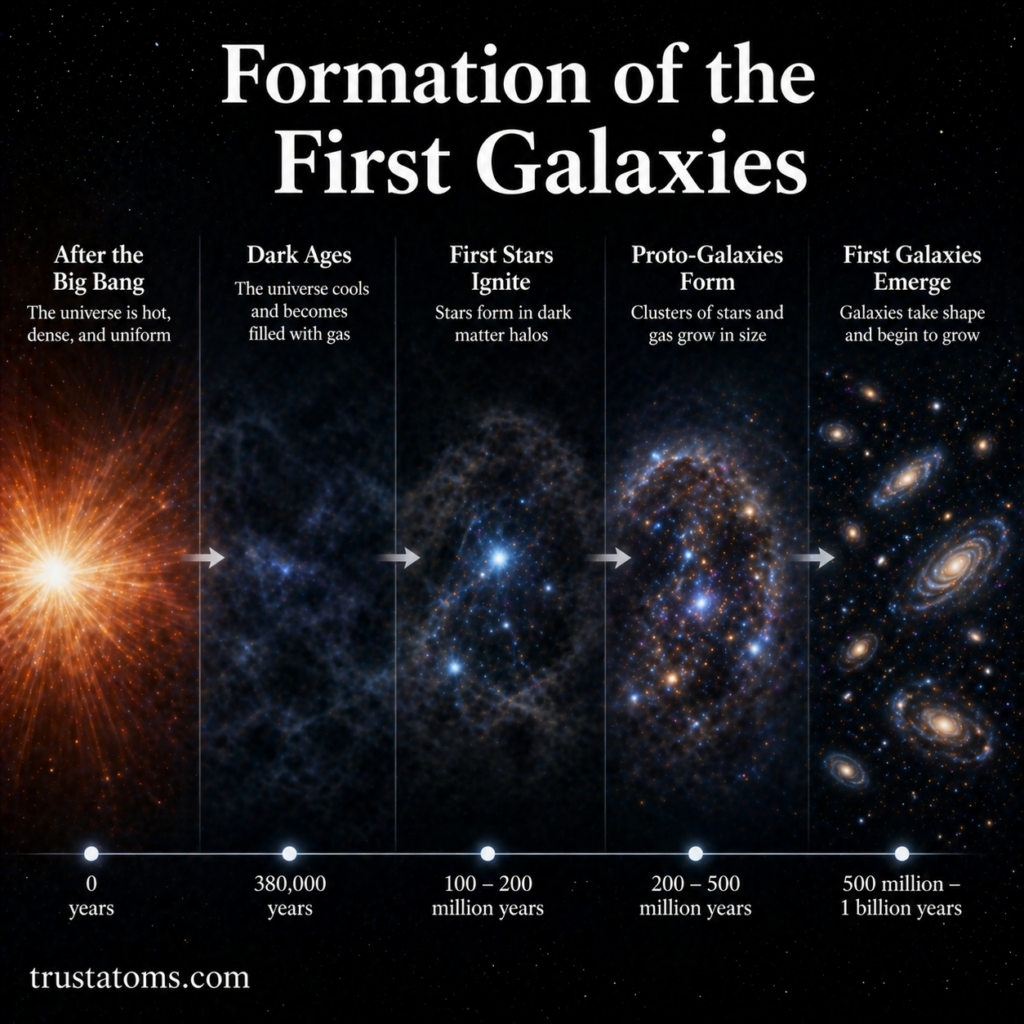
The first galaxies formed when gravity drew primordial gas into dense regions of dark matter, allowing stars to develop and assemble into early galactic systems. According to modern cosmological models and observations, this process was underway within the first few hundred million years after the Big Bang, gradually transforming a universe without stars into one filled with luminous structures.
Understanding these early systems is a major goal of modern astronomy research. By examining ancient galactic light, scientists investigate how the first stars formed, how galaxies accumulated matter, and how the universe developed the structures visible today.
The Early Universe Before Galaxies Existed
According to the Big Bang model, the observable universe evolved from an extremely hot, dense early state and expanded as it cooled. During its earliest stages, ordinary matter existed as a hot plasma containing charged particles.
Approximately 380,000 years after the Big Bang, temperatures had fallen enough for electrons and atomic nuclei to combine into neutral atoms. This transition, called recombination, allowed radiation to travel much more freely through space.
The radiation released during this period is observed today as the cosmic microwave background. Its tiny temperature variations provide evidence of slight differences in the density of matter in the early universe.
Before stars formed, much of the universe consisted of neutral hydrogen and helium gas. This period is commonly called the cosmic dark ages because there were not yet stars producing visible light.
Gas outside developing galaxies eventually became part of the intergalactic medium, which continues to occupy the space between galaxies.
Over time, gravity amplified the early density differences, producing the connected filaments and dense regions described by the cosmic web structure. The densest regions became favorable locations for the formation of stars and galaxies.
How Dark Matter Helped the First Galaxies Form
Dark matter played a crucial role in galaxy formation.
Dark matter does not emit, absorb, or reflect light in ways that make it directly visible through ordinary telescopes. Scientists infer its presence primarily from gravitational effects on visible matter, radiation, and large-scale cosmic structures.
In the standard cosmological model, dark matter began forming gravitational concentrations before ordinary gas could efficiently collapse into galaxies. These concentrations developed into structures called dark matter halos.
As gas accumulated inside the halos, it could cool, become denser, and eventually form stars. The halos provided gravitational environments in which early galaxies could assemble.
Computer simulations show that the distribution of dark matter strongly influences where galaxies form and how they grow. However, the exact physical nature of dark matter remains unknown.
The Birth of the First Stars
Before the first mature galaxies developed, dense regions of primordial gas began producing stars. Astronomers refer to the hypothetical earliest generation as Population III stars.
Unlike later stars, Population III stars formed from material containing almost entirely hydrogen and helium, with only trace amounts of other primordial elements.
Because this gas lacked the heavier elements that help modern clouds cool, simulations suggest that many early stars may have been unusually massive. Their exact mass distribution remains uncertain because no individual Population III star has been conclusively identified.
These stars would have affected their surroundings in several ways:
- Producing ultraviolet radiation capable of ionizing nearby hydrogen gas.
- Creating heavier elements through nuclear fusion.
- Returning enriched material to surrounding space through stellar winds or explosions.
- Changing how later generations of stars could form.
According to stellar evolution models, some massive early stars would have lived only a few million years before exhausting their nuclear fuel.
How Gas Clouds Developed Into Early Galaxies
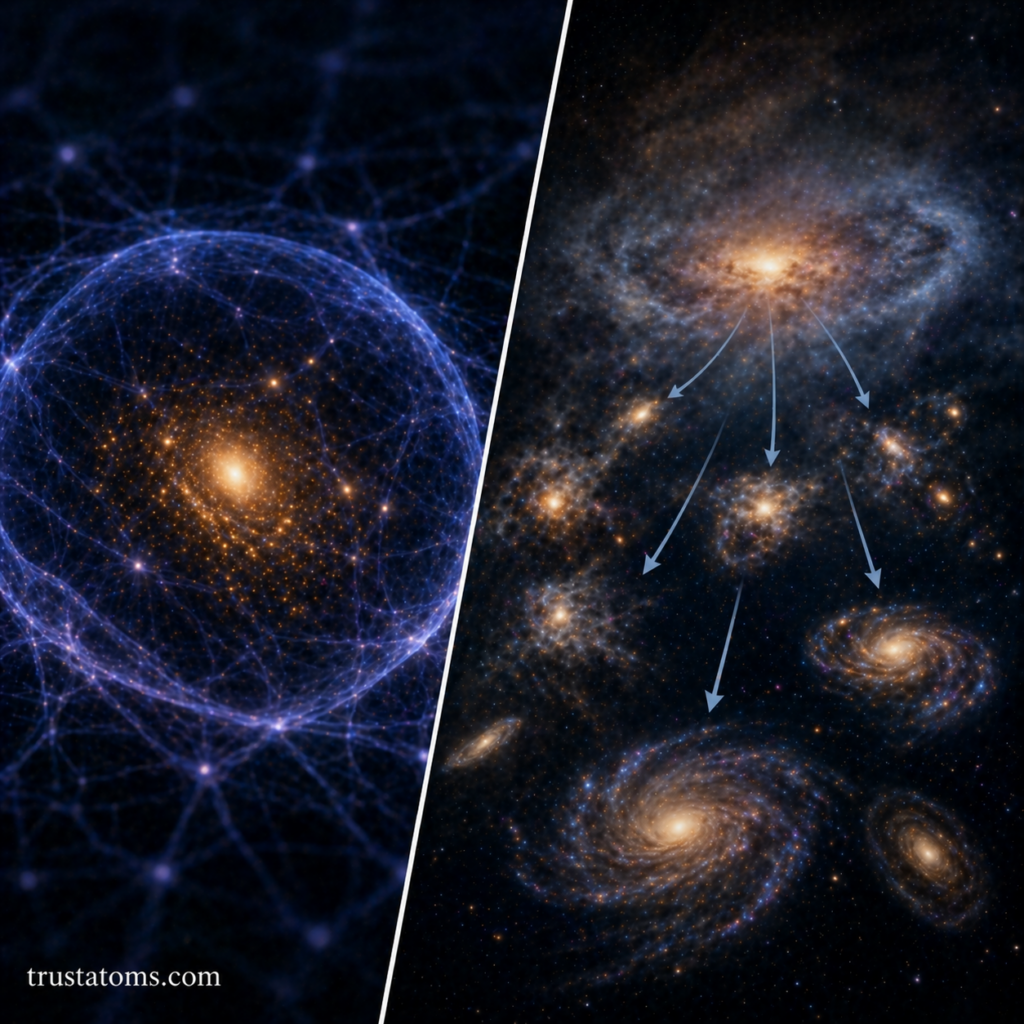
Galaxy formation was a gradual process rather than a single event. As gravity gathered matter into dark matter halos, gas accumulated, cooled, and formed increasingly dense clouds.
Within suitable regions, collapsing clouds produced stars. Groups of stars, gas, and dark matter developed into early galactic systems that continued gaining material from their surroundings.
The process can be summarized in four stages:
- Small density variations grew through gravitational attraction.
- Dark matter halos accumulated gas from their surroundings.
- Cooling gas collapsed into dense regions where stars formed.
- Star-forming systems gained additional gas and sometimes merged with neighboring structures.
Many early galaxies were relatively small and irregular compared with large, well-developed galaxies observed nearby today. Their growth depended on gas availability, star formation, and interactions with surrounding structures.
Cosmic Reionization Changed the Gas Between Galaxies
The first generations of stars and galaxies emitted energetic ultraviolet radiation. This radiation could remove electrons from neutral hydrogen atoms, producing ionized hydrogen.
As more luminous sources formed, expanding regions of ionized gas began overlapping. Scientists call this extended transformation the epoch of reionization.
Reionization changed how ultraviolet radiation traveled through intergalactic space. It did not mark the first time the universe became transparent to all light; the earlier recombination era had already allowed the cosmic microwave background radiation to travel freely.
Observations of distant galaxies, quasars, and the cosmic microwave background indicate that reionization occurred over hundreds of millions of years and was largely complete by roughly one billion years after the Big Bang.
How Early Galaxies Grew Through Mergers
Early galaxies continued evolving as they attracted surrounding gas and interacted gravitationally with neighboring systems.
When galaxies approached one another, their gravitational forces could distort their shapes, redistribute gas, and sometimes cause them to merge.
Fresh gas supplied material for additional star formation. Meanwhile, mergers could increase galactic mass and alter the distribution of stars.
This gradual buildup of larger structures from smaller ones is called hierarchical structure formation. It is a central feature of the standard cosmological model and helps explain the development of massive galaxies over cosmic time.
How Astronomers Observe the Earliest Galaxies
The first galaxies are extremely distant, so their light has traveled through expanding space for billions of years before reaching Earth.
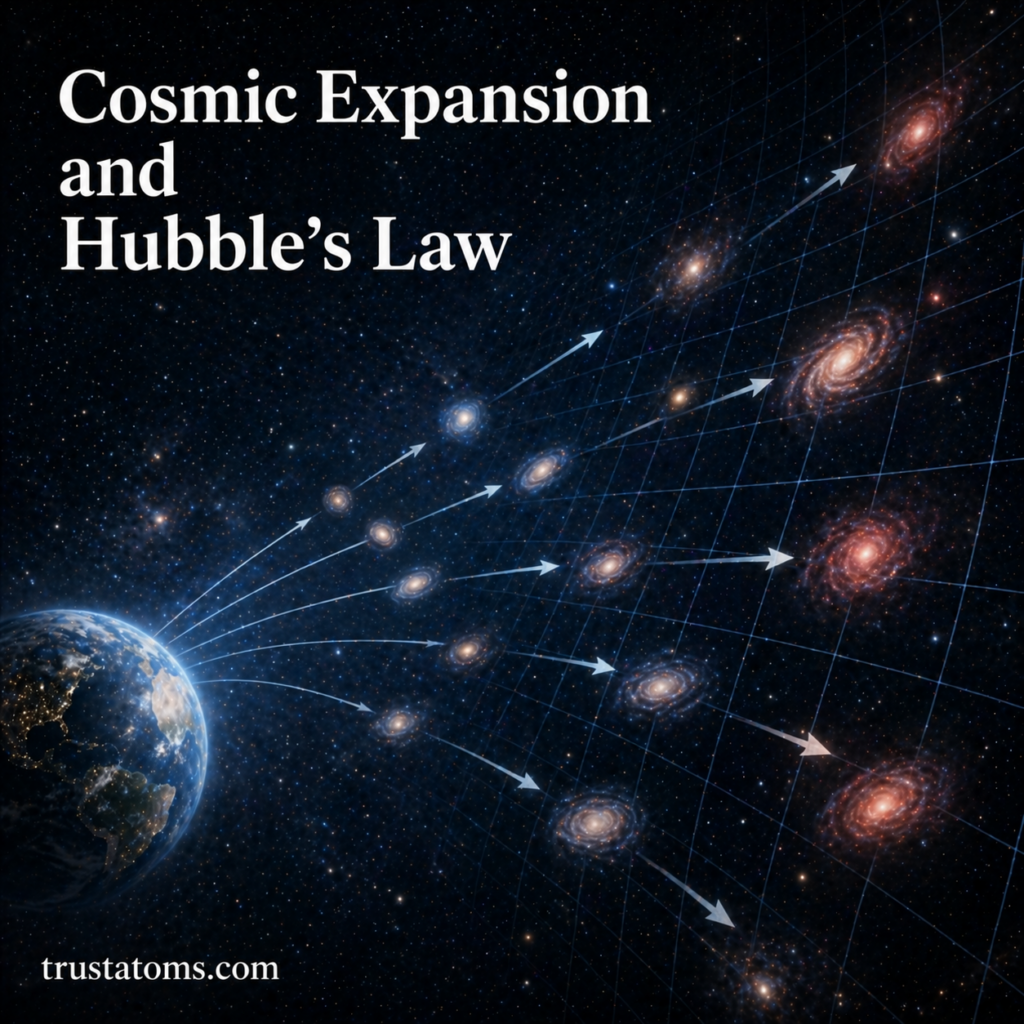
As space expands, the wavelengths of traveling light are stretched toward the red end of the electromagnetic spectrum. This effect is called cosmological redshift.
For example, a galaxy observed at a redshift of 10 emitted the light we detect when the universe was only about 500 million years old, according to standard cosmological calculations. Its observed wavelengths have been stretched by a factor of 11 compared with their emitted wavelengths.
The James Webb Space Telescope is particularly useful for studying these distant galaxies because much of their originally ultraviolet and visible light now reaches us at infrared wavelengths.
Webb’s infrared instruments can detect faint galactic light and obtain spectra that help astronomers estimate distances, investigate star formation, and examine chemical composition.
Researchers combine these observations with computer simulations to test how quickly galaxies assembled during the universe’s earliest stages.
Timeline of Early Galaxy Formation
Scientists reconstruct the early universe using evidence from cosmic background radiation, galaxy observations, and theoretical models. The following timeline gives approximate stages rather than exact dates for every galaxy.
| Time After the Big Bang | Major Development |
|---|---|
| Approximately 380,000 years | Neutral atoms formed during recombination, allowing background radiation to travel more freely. |
| Tens to hundreds of millions of years | Dark matter halos grew and primordial gas accumulated in dense regions. |
| Within the first few hundred million years | The first stars formed and early galactic systems began assembling. |
| Several hundred million years | Young galaxies formed stars, accumulated gas, and contributed to cosmic reionization. |
| By approximately one billion years | Reionization was largely complete, while galaxies continued growing and merging. |
These early developments eventually contributed to the formation of larger structures. The processes explored in galaxy clusters and superclusters describe how gravitational interactions organize galaxies into increasingly extensive cosmic structures.
What Scientists Still Do Not Know About the First Galaxies
Despite major observational advances, several questions remain unresolved.
- Exactly when did the first stars begin forming?
- How massive were the earliest galaxies?
- How efficiently did primordial gas turn into stars?
- Which sources contributed most strongly to cosmic reionization?
- How rapidly did early galaxies acquire heavier chemical elements?
Answering these questions requires observations of increasingly distant galaxies, more precise spectral measurements, and improved models of early cosmic structure.
Frequently Asked Questions
When did the first galaxies form?
According to modern cosmological models and observations, the first galaxies began assembling within the first few hundred million years after the Big Bang. The precise timing of the earliest galactic systems remains an active area of research.
Did stars or galaxies form first?
The earliest stars likely formed within collapsing gas clouds inside dark matter halos before fully developed galaxies existed. As star-forming regions accumulated additional matter, they developed into the first galactic systems.
Can the James Webb Space Telescope see the first galaxies?
The James Webb Space Telescope can observe galaxies from extremely early periods of cosmic history. However, astronomers have not conclusively established that any observed galaxy was the very first to form, and detecting the earliest systems remains challenging.
The first galaxies emerged as gravity concentrated dark matter and primordial gas into regions where stars could form. Their radiation helped transform the surrounding universe during reionization, while continued gas accumulation and mergers produced increasingly complex galactic systems. Observations of these ancient structures now allow scientists to test how the universe developed from small density variations into the galaxies visible today.
Sources: NASA Science, James Webb Space Telescope and Early Galaxies; European Space Agency, Webb Observations of the Early Universe; Barbara Ryden, Introduction to Cosmology.