An active galactic nucleus (AGN) is an unusually luminous central region of a galaxy powered by matter falling toward a supermassive black hole. As gas spirals inward, it releases enormous amounts of energy, sometimes making the galactic center brighter than the combined light of its stars.
From blazing quasars to powerful jets of radiation, AGN provide insight into how galaxies evolve and how supermassive black holes influence their surroundings. Studying these objects is an important part of modern astronomy because their radiation reveals conditions that cannot be reproduced in ordinary laboratories.
Not every galaxy contains an active nucleus. Many central black holes, including the one in the Milky Way, currently accrete relatively little material and produce much less radiation than the brightest AGN.
What Is an Active Galactic Nucleus?
An active galactic nucleus is a compact region surrounding a galaxy’s central black hole where infalling matter produces unusually intense electromagnetic radiation. The black hole itself does not emit this light from within its event horizon. Instead, radiation comes from gas outside the black hole as gravitational energy is converted into heat and other forms of energy.
The relationship between central black holes and their host galaxies is examined in Black Holes at Galactic Centers. The central black hole’s mass and the rate at which surrounding gas reaches it influence the nucleus’s activity.
Many AGN contain rotating gas structures. The physics of Accretion Disks in Space explains how orbiting material gradually transfers angular momentum and moves inward.
Some active nuclei also launch narrow outflows of plasma. The mechanisms and observations associated with these structures are discussed in Relativistic Jets from Black Holes, although not every AGN produces a prominent jet.
How Active Galactic Nuclei Produce Energy
The primary energy source of an AGN is accretion. Gas approaching a central black hole usually retains angular momentum, preventing it from falling directly inward. Instead, it can form a rotating disk.
- Gas approaches the center: Gravity draws surrounding material toward the supermassive black hole.
- An accretion disk develops: Gas orbits the black hole while internal stresses redistribute angular momentum.
- Material moves inward: Gravitational energy is released and converted into heat and radiation.
- Radiation escapes: The surrounding material emits energy across wavelengths that can include infrared, visible, ultraviolet, and X-ray radiation.
- Outflows may form: Magnetic processes can drive winds or, in some systems, highly collimated jets.
Accretion can release a substantial fraction of the infalling matter’s rest-mass energy. This makes actively feeding black holes exceptionally efficient sources of radiation compared with ordinary chemical processes.
The Main Components of an Active Galactic Nucleus
Central Supermassive Black Hole
The central black hole commonly contains millions to billions of solar masses. Its gravity governs the motion of matter close to the nucleus, although the surrounding gas produces the radiation that identifies the system as active.
Accretion Disk and Hot Gas
The accretion disk consists of orbiting material that gradually moves inward. In luminous AGN, the disk can emit strongly in visible and ultraviolet wavelengths, while extremely hot gas above or around it can produce X-rays.
Dusty Torus and Surrounding Clouds
Dusty material may surround the central region in a thick, uneven distribution often described as a torus. This dust absorbs shorter-wavelength radiation and re-emits energy in the infrared. Depending on the viewing angle, it can obscure the central engine.
Jets and Outflows
Some AGN produce jets containing magnetized plasma moving at relativistic speeds. These structures can extend far beyond the central region and, in powerful radio galaxies, beyond the visible stellar body of the host galaxy.
Types of Active Galactic Nuclei
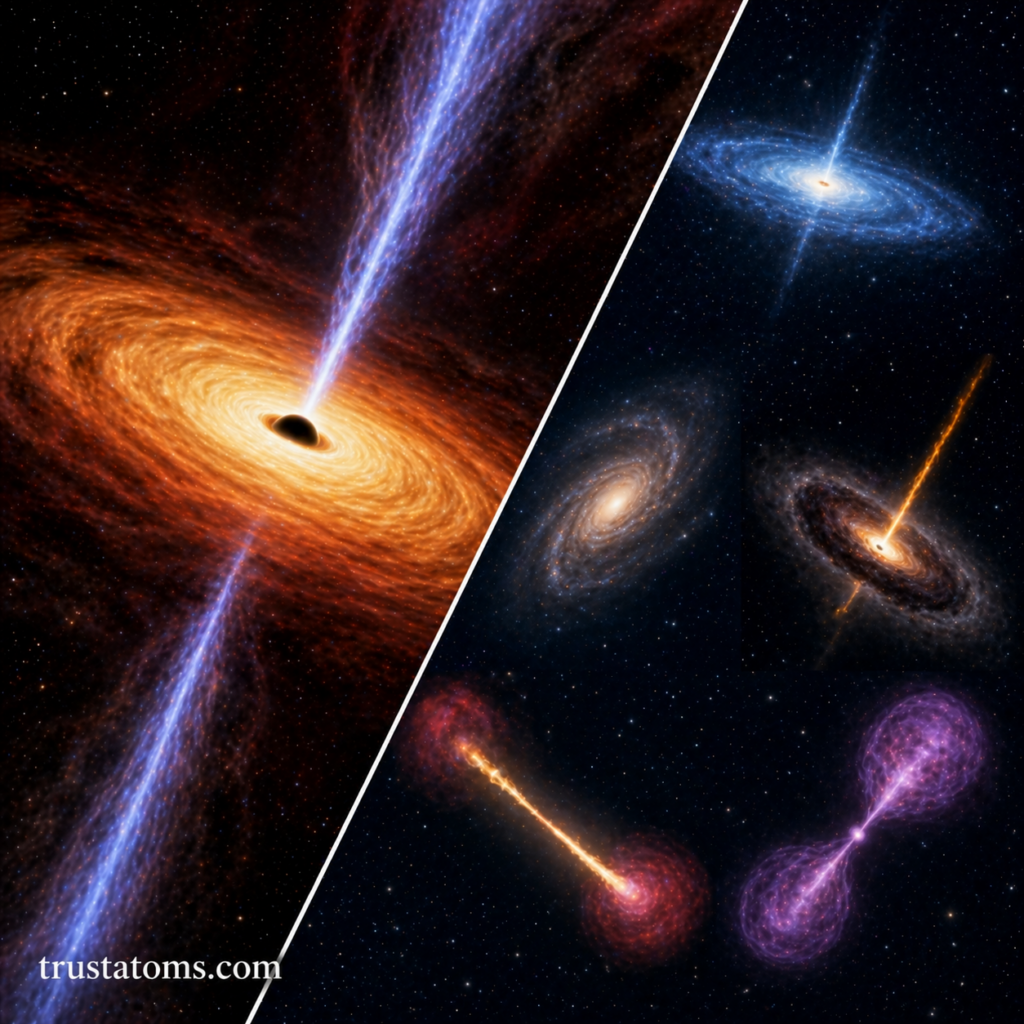
Astronomers distinguish several AGN classes using their luminosity, spectra, radio emission, variability, and orientation relative to Earth.
Quasars
Quasars are exceptionally luminous active nuclei that can outshine their host galaxies. Many are observed at great distances, allowing astronomers to investigate galaxies during earlier periods of cosmic history.
Seyfert Galaxies
Seyfert galaxies have bright active nuclei surrounded by detectable host galaxies. Their spectra contain strong emission lines, and astronomers distinguish major subclasses partly by whether broad emission lines are directly visible.
Blazars
Blazars are AGN with relativistic jets directed approximately toward Earth. Relativistic beaming makes their emission appear especially bright and variable, sometimes across much of the electromagnetic spectrum.
Radio Galaxies
Radio galaxies contain active nuclei associated with strong radio emission, frequently from jets and extended lobes. These structures can reach far beyond the host galaxy’s visible boundaries.
How Viewing Angle Changes an AGN’s Appearance
Some AGN classes may represent similar underlying systems observed from different directions. Dust can hide the central region when viewed through obscuring material, while a jet aimed toward Earth can appear unusually bright because of relativistic beaming.
This idea is part of the unified model of active galactic nuclei. It helps explain why certain objects have different observed properties even when they contain comparable central components.
Orientation does not explain every difference. Black hole mass, accretion rate, surrounding gas, and jet strength also vary among active galaxies.
A Concrete Example: How Powerful Can an AGN Be?
Consider an actively accreting black hole that converts 10% of the rest-mass energy of incoming material into radiation. This is a commonly used illustrative efficiency for black hole accretion, although the actual value depends on the system.
Suppose one kilogram of matter is accreted. Einstein’s equation, E = mc², gives a rest-mass energy of approximately 9 × 10¹⁶ joules for that kilogram.
- Begin with one kilogram of matter and a rest-mass energy of approximately 9 × 10¹⁶ joules.
- Multiply by an assumed radiative efficiency of 0.10.
- The resulting radiation energy is approximately 9 × 10¹⁵ joules.
This calculation illustrates how accretion can produce intense radiation without requiring the black hole itself to emit light. The luminosity of an actual AGN depends on how much matter reaches the central region over time.
How AGN Influence Their Host Galaxies
Energy released by an active nucleus can affect gas throughout its host galaxy. Radiation, winds, and jets may heat surrounding material or push it away from regions where stars would otherwise form.
These interactions are called AGN feedback. In some circumstances, feedback can reduce star formation by removing or heating cold gas. In others, pressure from an outflow may compress gas and encourage localized star formation.
Feedback is one reason astronomers study central black holes alongside the growth of galaxies. The relationship is complex, and scientists continue investigating how strongly AGN activity affects different galaxy populations.
How Astronomers Detect and Study AGN
Active nuclei emit radiation across a broad range of wavelengths, so astronomers combine observations from different instruments to study their components.
- Optical and ultraviolet telescopes: Measure emission from hot accretion disks and surrounding gas.
- Infrared instruments: Detect radiation from dust heated by the central source.
- X-ray observatories: Study extremely energetic regions close to the black hole.
- Radio telescopes: Map jets, lobes, and other structures associated with energetic particles and magnetic fields.
Astronomers also monitor changes in brightness. Variability over short periods can indicate that radiation comes from a relatively compact region, helping constrain the size of the emitting area.
Frequently Asked Questions
What powers an active galactic nucleus?
An AGN is powered primarily by matter accreting toward a supermassive black hole. As orbiting gas moves inward, gravitational energy is converted into heat and radiation, making the central region unusually luminous.
Is every supermassive black hole an active galactic nucleus?
No. Many galaxies contain supermassive black holes that currently accrete too little material to produce a luminous AGN. A black hole becomes associated with an active nucleus when surrounding accretion generates substantial observable emission.
What is the difference between a quasar and a blazar?
A quasar is a highly luminous active galactic nucleus, while a blazar is an AGN whose relativistic jet points approximately toward Earth. These categories can overlap because they describe different aspects of an active nucleus.
Active galactic nuclei reveal how accreting supermassive black holes release energy and interact with surrounding galaxies. Their radiation, obscuring dust, and occasional jets explain much of the diversity seen among quasars, Seyfert galaxies, blazars, and radio galaxies. Observing these systems across multiple wavelengths helps astronomers investigate black hole growth and its effects on galactic gas.
Sources: NASA Science; European Space Agency; Bradley W. Carroll and Dale A. Ostlie, An Introduction to Modern Astrophysics.