The idea that our universe might not be the only one is both fascinating and controversial. In modern cosmology, this concept is explored through multiverse hypotheses, which suggest that multiple—possibly infinite—universes may exist beyond our own.
While still theoretical, multiverse ideas arise naturally from several areas of physics and cosmology, offering possible explanations for some of the universe’s deepest mysteries.
What Is the Multiverse?
The multiverse refers to a collection of universes, often called “parallel universes,” that may exist independently of each other.
Each universe could have:
- Different physical laws
- Different constants (like gravity or particle masses)
- Different structures and outcomes
Our observable universe would be just one part of this much larger system.
Why Scientists Consider the Multiverse
Multiverse hypotheses are not just science fiction—they emerge from attempts to solve real scientific problems.
Key Motivations
- Explaining why the universe’s physical constants appear finely tuned
- Understanding the outcomes of early-universe processes like Cosmic Inflation
- Exploring implications of quantum physics
- Addressing unresolved questions in fundamental physics
These ideas push the boundaries of what can be observed and tested.
Types of Multiverse Theories
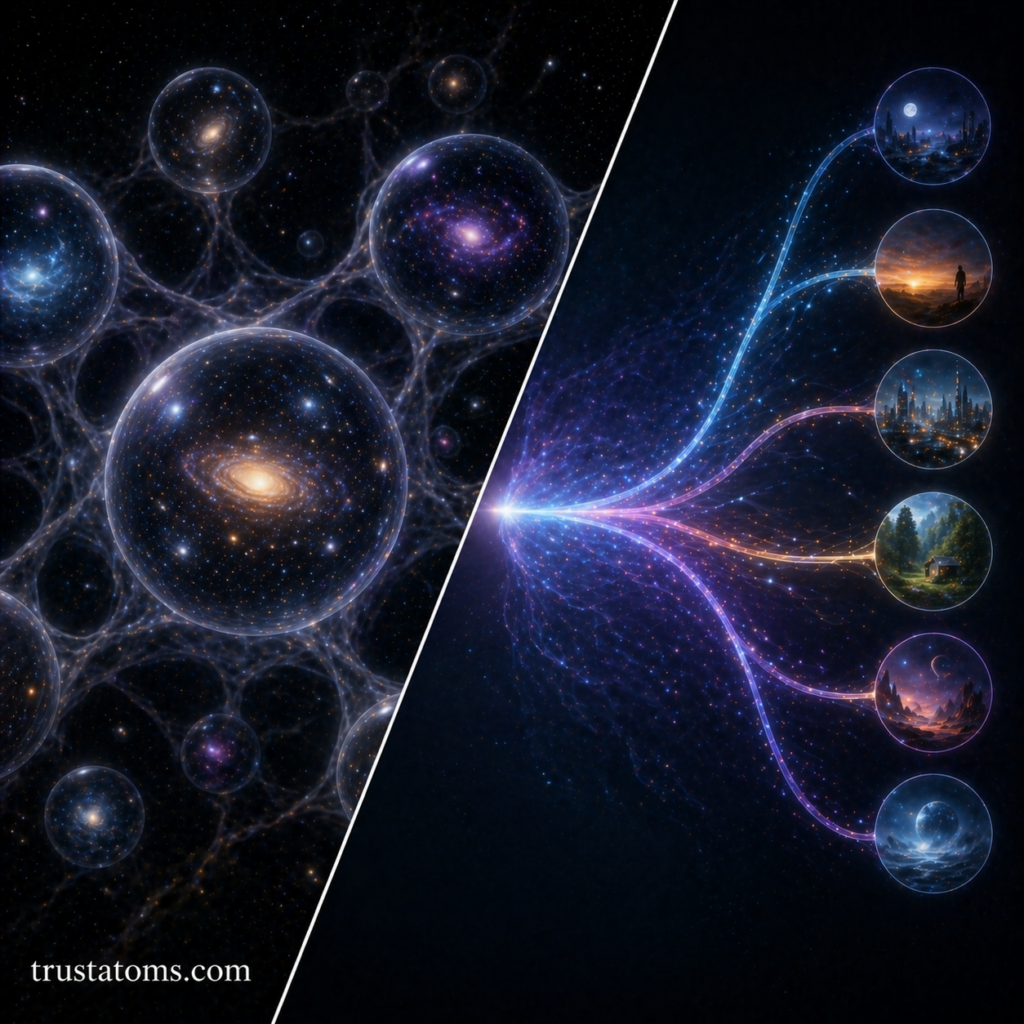
There isn’t just one multiverse idea—there are several competing models.
1. Inflationary Multiverse
This model is linked to cosmic inflation.
- Different regions of space stop inflating at different times
- Each region becomes its own “bubble universe”
- These universes may have different physical properties
This is one of the most widely discussed scientific multiverse models.
2. Quantum Multiverse (Many-Worlds Interpretation)
Based on quantum mechanics:
- Every possible outcome of a quantum event occurs
- Each outcome exists in its own separate universe
- Reality constantly “branches” into multiple paths
This interpretation is associated with the many-worlds view of quantum theory.
3. String Theory Multiverse
Emerging from String Theory:
- Predicts a vast number of possible vacuum states
- Each state could correspond to a different universe
- These universes may have entirely different laws of physics
This leads to what’s sometimes called the “landscape” of universes.
4. Mathematical Multiverse
A more abstract idea:
- All mathematically possible universes exist
- Reality is fundamentally mathematical in nature
- Our universe is just one of many consistent structures
This is one of the most speculative multiverse concepts.
Evidence and Challenges
One of the biggest issues with multiverse theories is the lack of direct evidence.
Current Situation
- No confirmed observations of other universes
- Some models make indirect predictions
- Testing is extremely difficult, if not impossible with current technology
Possible Clues
Scientists have proposed potential signs, such as:
- Unusual patterns in the Cosmic Microwave Background
- Collisions between “bubble universes”
- Statistical patterns in physical constants
However, none of these have been definitively confirmed.
Multiverse and the Fine-Tuning Problem
The universe appears to be finely tuned for the existence of matter, stars, and life.
The Puzzle
- Small changes in constants could prevent galaxies from forming
- The strength of forces appears precisely balanced
Multiverse Explanation
- If many universes exist, each with different constants
- We simply exist in one where conditions allow life
- This idea is sometimes called the “anthropic principle”
This doesn’t prove the multiverse, but it offers one possible explanation.
Scientific Debate
The multiverse remains a topic of active debate among scientists.
Supporters Argue
- It naturally arises from established theories
- It explains fine-tuning without special assumptions
- It may unify different areas of physics
Critics Argue
- It may not be testable or falsifiable
- It stretches the limits of scientific methodology
- It risks becoming more philosophical than scientific
This debate highlights the boundary between science and speculation.
Why the Multiverse Matters
Even without direct evidence, multiverse ideas influence modern physics.
Key Impacts
- Expands our understanding of reality
- Challenges assumptions about uniqueness
- Encourages new theoretical developments
- Connects cosmology with quantum physics
It pushes scientists to rethink what “the universe” really means.
Final Thoughts
The multiverse hypotheses represent one of the most intriguing frontiers in cosmology. While still unproven, they offer bold explanations for some of the universe’s deepest mysteries—from its origins to its apparent fine-tuning.
As science advances, future discoveries may either support, refine, or rule out these ideas. Until then, the multiverse remains a powerful concept that challenges our understanding of existence itself.