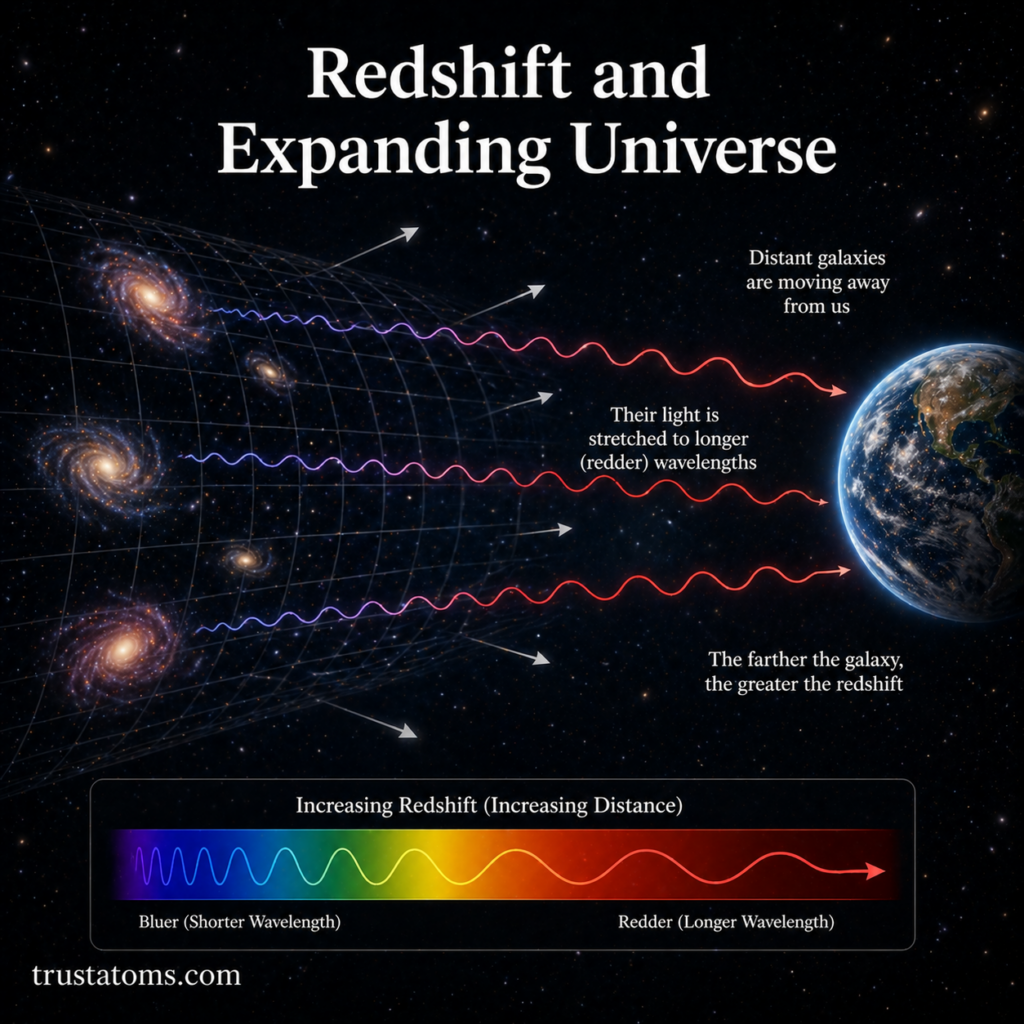
Redshift provides strong evidence that the universe is expanding because light from distant galaxies is stretched to longer wavelengths as it travels through expanding space. Astronomers measure this stretching to investigate how cosmic distances change, how quickly the universe expands, and what galaxies looked like billions of years ago.
One of the strongest pieces of evidence for this comes from a phenomenon known as redshift, which shows that distant galaxies are generally receding from us. In modern observational astronomy, redshift measurements help connect the light collected by telescopes with the history of the universe.
What Is Redshift?
Redshift occurs when light is observed at a longer wavelength than the wavelength at which it was emitted. Although its name refers to red visible light, the effect applies throughout the electromagnetic spectrum, including infrared and radio waves.
Astronomers measure redshift by comparing recognizable spectral lines with their known laboratory wavelengths. The amount of redshift is represented by the symbol z.
For example, if a spectral line originally emitted at 500 nanometers is observed at 600 nanometers, its wavelength has increased by 20%. The resulting redshift is z = 0.2.
Redshift does not necessarily mean an object visibly changes color. Instead, it describes a measurable displacement of its electromagnetic spectrum.
A familiar comparison is how sound changes pitch when a moving vehicle passes by, known as the Doppler effect. Light also experiences wavelength changes associated with relative motion, although cosmic expansion introduces another mechanism.
Three Types of Redshift and Their Causes
Astronomers distinguish three major causes of redshift. Identifying the mechanism matters because the same observed wavelength change can have different physical explanations.
Doppler Redshift
Doppler redshift occurs when a light source moves away from an observer. Motion toward the observer produces the opposite effect, called blueshift.
This mechanism helps astronomers measure the line-of-sight motion of stars, gas clouds, and nearby galaxies.
Cosmological Redshift
Cosmological redshift results from the expansion of the universe during a light wave’s journey. As the cosmic scale factor increases, the wavelength of freely traveling light increases with it.
This is the principal explanation for the redshift observed from sufficiently distant galaxies. It is not simply the ordinary Doppler effect applied across enormous distances.
Gravitational Redshift
Gravitational redshift occurs when light travels from a region of stronger gravity to one of weaker gravity. According to general relativity, an observer farther from the gravitational source measures a lower frequency.
The effect is measurable in gravitational fields and becomes especially significant near compact objects such as neutron stars and black holes.
How Redshift Shows the Universe Is Expanding
When astronomers compare the spectra of galaxies at different distances, they find a consistent pattern: on large scales, more distant galaxies generally have greater redshifts.
This relationship supports a universe in which distances between widely separated, gravitationally unbound regions increase over time. It does not imply that Earth occupies the center of cosmic expansion.
The observations behind this conclusion are examined in Observational Evidence for Expansion, including how astronomers combine galaxy spectra with independent distance measurements.
The mathematical connection between expanding space and stretched wavelengths is explained in Cosmological Redshift in Expanding Universes.
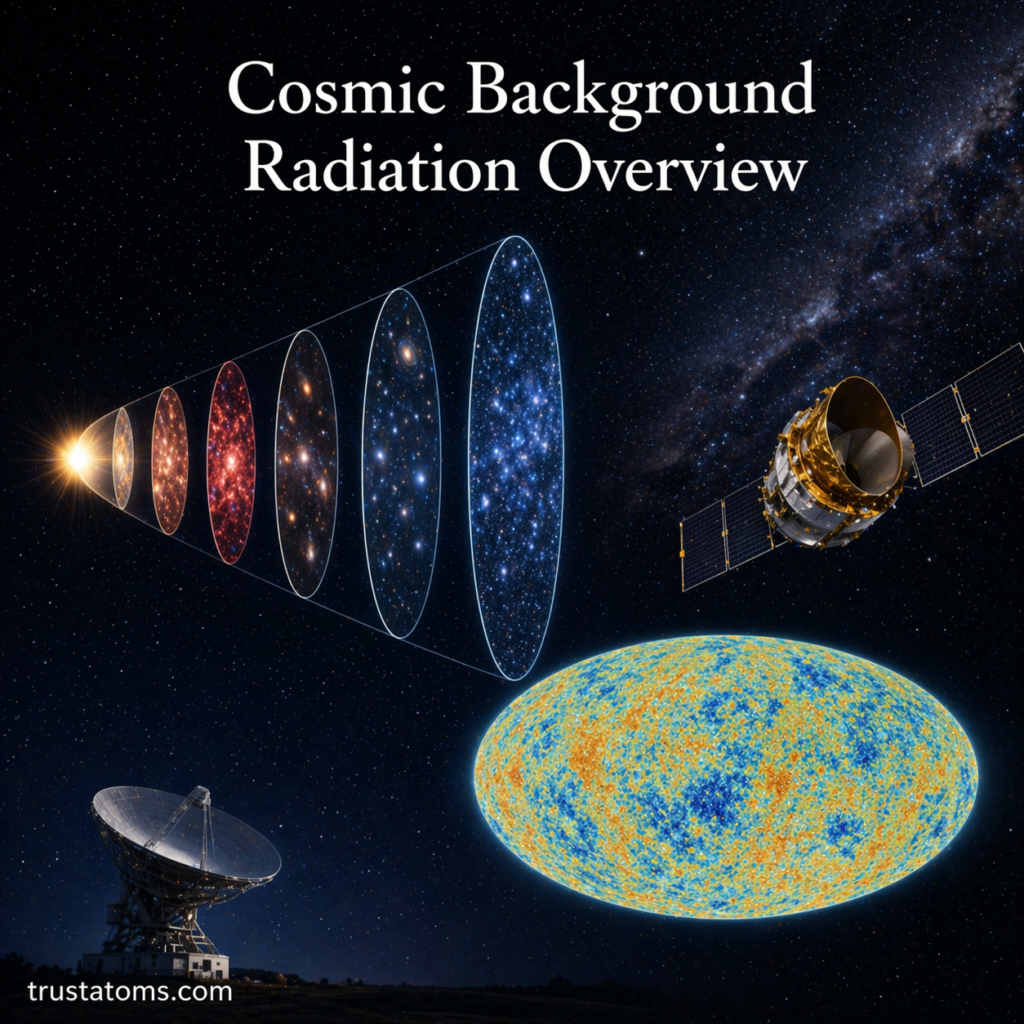
According to the standard Big Bang model, the universe evolved from an earlier hot, dense state. Galaxy redshifts, the cosmic microwave background, and measured abundances of light elements provide mutually supporting evidence for this scientific explanation.
Hubble’s Law Explained
Hubble’s law describes the relationship between distance and recession speed for relatively nearby galaxies participating in cosmic expansion.
It is commonly written as velocity equals the Hubble constant multiplied by distance. Under this approximation, a galaxy twice as distant has approximately twice the expansion-related recession speed.
The historical observations and mathematics are explored in Cosmic Expansion and Hubble’s Law.
At large redshifts, the simple velocity-distance relationship is insufficient. Astronomers instead use cosmological models that account for how the expansion rate has changed throughout cosmic history.
What Cosmic Expansion Actually Means
Cosmic expansion means that the average distances between sufficiently distant, unbound galaxies increase over time. It does not mean that galaxies, stars, planets, or atoms must expand along with the universe.
Gravity holds galaxies and galaxy clusters together, while electromagnetic forces maintain the sizes of ordinary objects. These bound systems do not simply stretch as the cosmic scale factor increases.
A useful analogy is a pattern of dots on an inflating balloon. As its surface expands, the distances between dots increase without any one dot serving as the center of expansion on the surface.
The analogy is limited because the universe is not known to be expanding into an external space like a balloon expanding into a room.
How Redshift Reveals the Cosmic Timeline
Light takes time to travel. When astronomers observe a distant galaxy, they see light emitted in the past rather than a direct view of the galaxy’s present condition.
In the standard cosmological model, higher cosmological redshifts generally correspond to earlier periods in cosmic history. This allows researchers to compare galaxies across different stages of development.
Scientists use these observations to investigate when galaxies formed stars, how their structures changed, and how matter became distributed across the universe.
Redshift alone does not provide an exact lookback time. Converting it into an age or distance requires a model of cosmic expansion and its underlying parameters.
How Astronomers Measure Galaxy Redshift
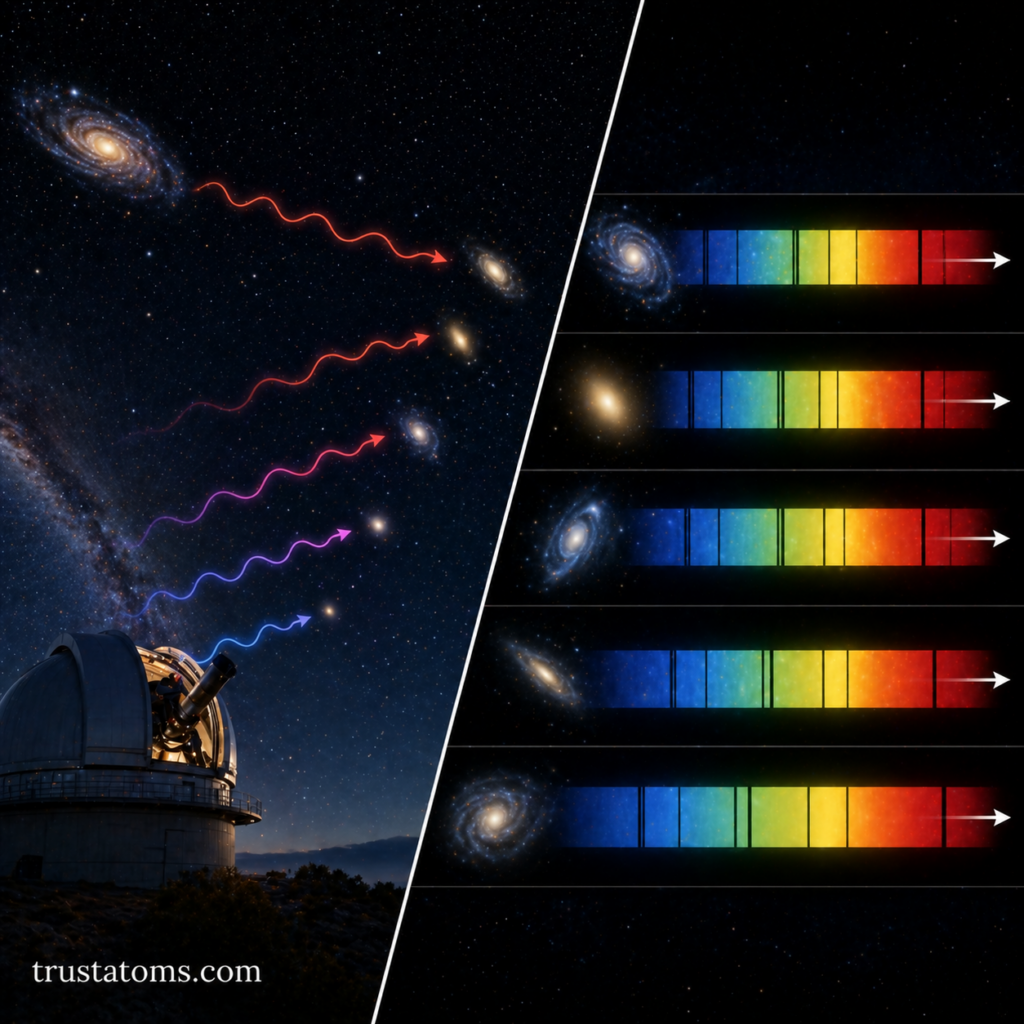
Accurate redshift measurements usually rely on spectroscopy, which separates collected light into its component wavelengths.
- A telescope collects light from a distant galaxy.
- A spectrograph separates the light into a spectrum.
- Astronomers identify known emission or absorption lines.
- They compare the observed wavelengths with laboratory reference values.
- The wavelength differences reveal the galaxy’s measured redshift.
Some surveys also estimate redshift using brightness measurements through several filters. These photometric estimates are useful for large numbers of faint galaxies but generally have greater uncertainty than reliable spectroscopic measurements.
Redshift and Dark Energy
Observations of distant Type Ia supernovae, combined with other cosmological measurements, indicate that cosmic expansion has been accelerating during the universe’s more recent history.
Scientists use the term dark energy for the unknown component or physical explanation associated with this acceleration. Its underlying nature remains unresolved.
The main possibilities and unanswered questions are discussed in Dark Energy Theories.
By comparing the redshifts and independently estimated distances of supernovae and galaxies, researchers test whether expansion has changed over time. Redshift is therefore an observational measurement used to investigate dark energy, not a direct detection of dark energy itself.
What Redshift Cannot Tell Us by Itself
Redshift measurements require careful interpretation. Nearby galaxies can have additional motion caused by gravitational interactions, sometimes producing blueshift despite the overall expansion of the universe.
At extreme distances, converting redshift into recession speed or distance requires cosmological assumptions. Astronomers also distinguish between several distance definitions because an expanding universe does not have a single universally applicable measure of separation.
These limitations are addressed by combining redshift measurements with other observations rather than treating a single spectrum as a complete description of cosmic history.
The Big Bang and Different Views of Creation
Scientific observations support the Big Bang model, which describes the universe evolving from a hot, dense early state. Based on measurements including cosmic expansion and the cosmic microwave background, scientists estimate that the universe is approximately 13.8 billion years old.
Many religious traditions hold that God created the universe and life. Young-earth creationists generally believe that Earth and the universe are thousands of years old and interpret scientific evidence differently. Old-earth creationists accept scientific estimates of cosmic and geological ages while believing God created the universe. Theistic evolution accepts scientific ages and biological evolution as processes through which God created life.
Science investigates testable natural explanations for how the universe operates and develops, while religious perspectives also address questions of purpose and meaning. People hold different views about how scientific explanations and faith commitments relate, and those differences do not change what the observational evidence supports scientifically.
Frequently Asked Questions
Does redshift prove that every galaxy is moving away?
No. Most sufficiently distant galaxies show cosmological redshift, but nearby galaxies can move toward us because of local gravitational interactions. The Andromeda Galaxy, for example, has an observed blueshift.
Can redshift tell astronomers how old the universe is?
Redshift contributes to measurements of cosmic expansion, which scientists combine with other observations and cosmological models to estimate the universe’s age. Redshift alone does not determine that age independently.
Is the Big Bang compatible with belief in God?
Many religious believers consider the Big Bang model compatible with belief in God as creator, while others interpret creation differently. The Big Bang is a scientific model describing the universe’s early physical development; questions about divine purpose or agency fall outside what scientific measurements can directly test.
Redshift measurements show that light from distant galaxies has been stretched during its journey through an expanding universe. Combined with galaxy distances, supernova observations, and the cosmic microwave background, these measurements help scientists reconstruct cosmic history and test models of expansion. Continued observations will refine estimates of how expansion has changed and what may be driving its acceleration.
Sources: NASA, Imagine the Universe; ESA/Hubble, Cosmological Redshift educational resources; Ryden, Introduction to Cosmology.