How old is the universe? This question has fascinated scientists for centuries. Today, thanks to modern astronomy and physics, scientists have a well-supported estimate: the universe is approximately 13.8 billion years old.
This estimate comes from multiple independent methods, all pointing to a consistent timeline for the history of the cosmos.
What Does “Age of the Universe” Mean?
The age of the universe refers to the time that has passed since the Big Bang—the moment when space, time, and energy began expanding.
This doesn’t mean the universe has an “edge” or a single starting point in space. Instead:
- The Big Bang happened everywhere at once
- Time itself began at that moment
- The universe has been evolving ever since
How Scientists Estimate the Age
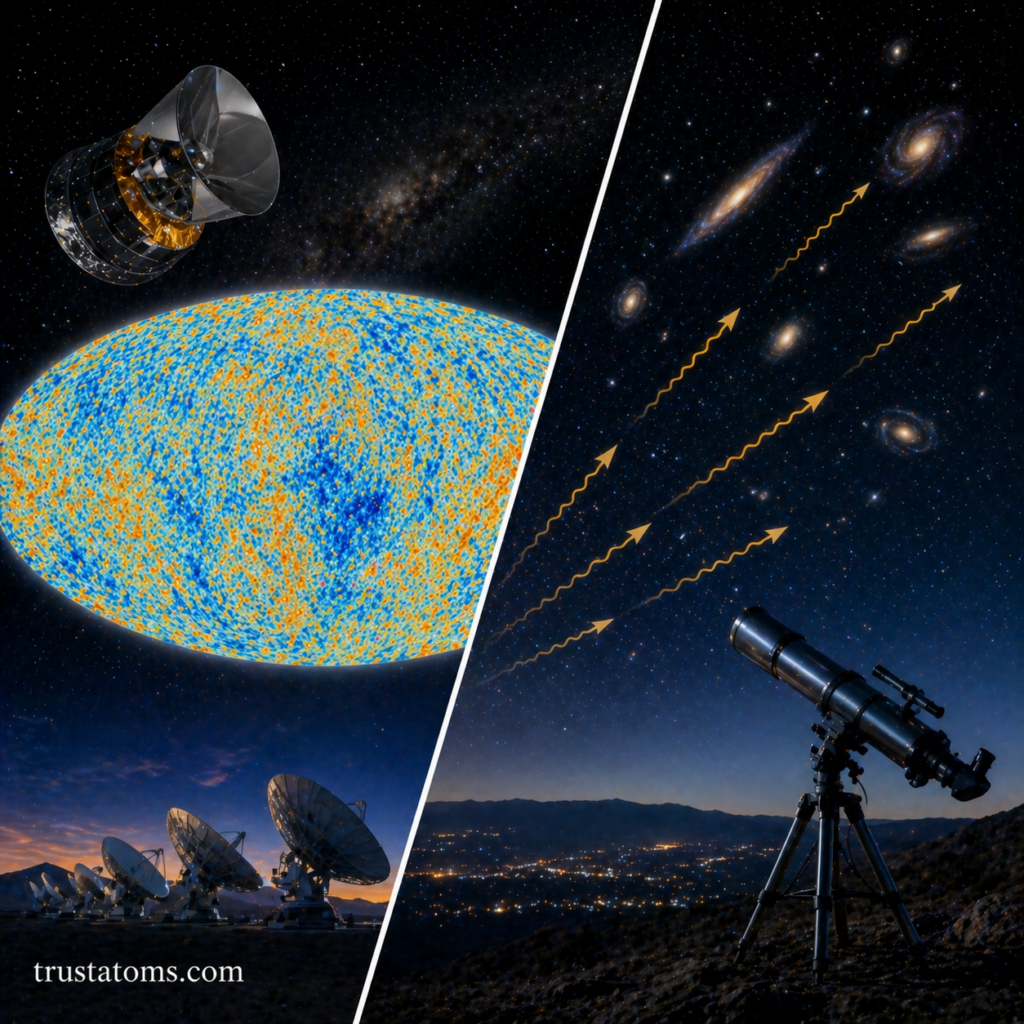
Astronomers don’t rely on just one method. Instead, they use several approaches that cross-check each other.
1. Cosmic Microwave Background (CMB)
The Cosmic Microwave Background is the oldest light we can observe.
- It was emitted about 380,000 years after the Big Bang
- Its temperature and patterns reveal early conditions
- Detailed measurements help calculate the universe’s age
Data from space missions has made this one of the most precise methods.
2. Expansion Rate of the Universe
The universe is expanding, and the rate of expansion helps determine its age.
This is described by the Hubble constant, discovered by Edwin Hubble.
How It Works
- Measure how fast galaxies are moving away
- Compare this speed to their distance
- Estimate how long expansion has been occurring
If you reverse the expansion, you can estimate when everything was once extremely close together.
3. Ages of the Oldest Stars
Some stars are incredibly old—nearly as old as the universe itself.
Scientists estimate their ages by:
- Studying their brightness and temperature
- Modeling how stars evolve over time
- Measuring chemical composition
The oldest known stars are about 13–13.5 billion years old, which aligns with other estimates.
4. Globular Clusters
Globular clusters are dense groups of ancient stars.
- Found in the halos of galaxies
- Contain some of the oldest stars in the universe
- Provide a lower limit for the universe’s age
If these clusters are over 13 billion years old, the universe must be at least that old.
Why the Current Estimate Is 13.8 Billion Years
Modern measurements combine data from:
- Cosmic microwave background observations
- Galaxy surveys
- Mathematical models of cosmic evolution
These converge on an age of about 13.8 billion years.
This estimate is considered highly reliable because:
- Multiple independent methods agree
- Observations are increasingly precise
- Models are consistent with known physics
Challenges and Ongoing Debates
Even with strong agreement, scientists continue refining the estimate.
The Hubble Tension
Different methods of measuring expansion produce slightly different results.
- Early-universe measurements (CMB) suggest one value
- Nearby galaxy measurements suggest another
This discrepancy is known as the Hubble tension and is an active area of research.
Why Knowing the Universe’s Age Matters
Understanding the universe’s age helps place everything in context.
Key Insights
- Determines the timeline of galaxy formation
- Helps test cosmological theories
- Provides a framework for studying cosmic evolution
- Connects observations across different scales
It’s a cornerstone of modern astronomy.
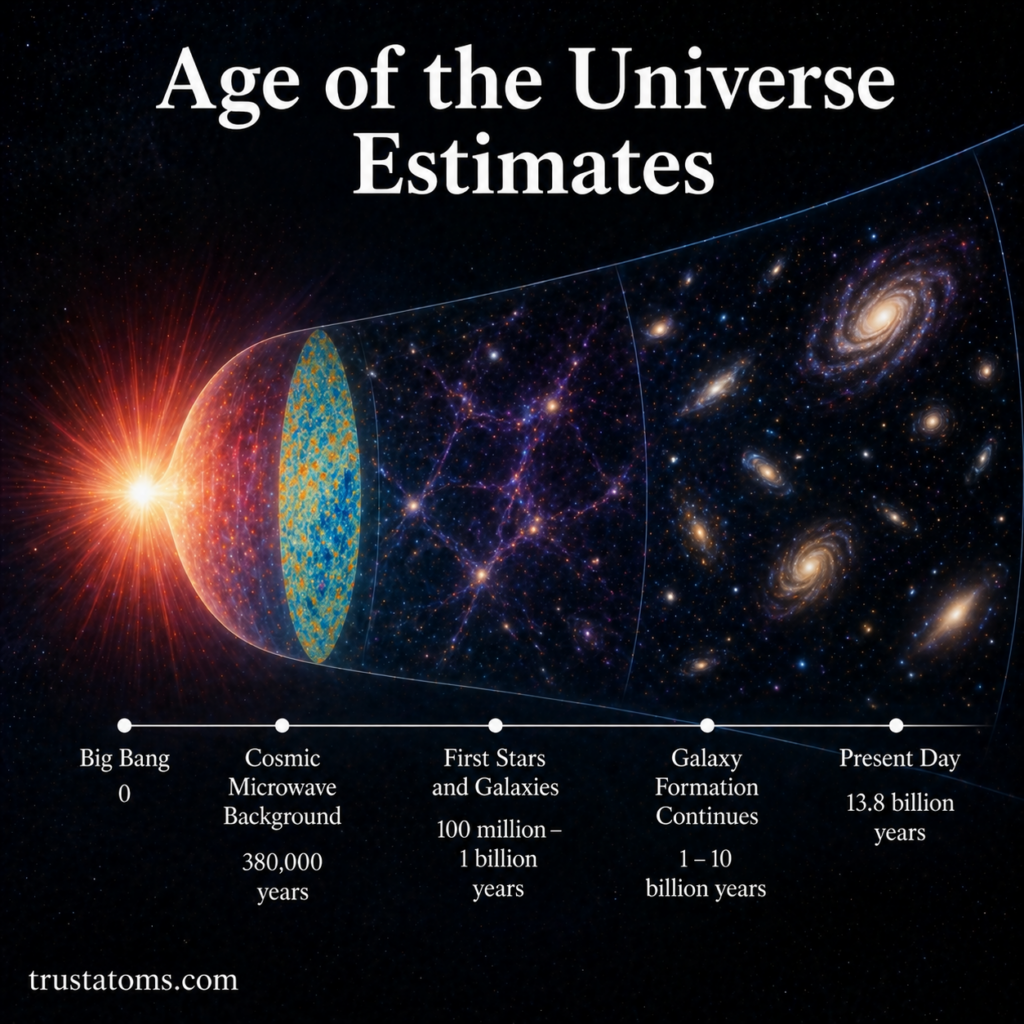
A Timeline of the Universe
Here’s a simplified timeline of major events:
- Big Bang – Beginning of expansion (~13.8 billion years ago)
- First atoms form – ~380,000 years later
- First stars and galaxies – Hundreds of millions of years later
- Galaxy formation continues – Over billions of years
- Present day – Expanding and evolving universe
Final Thoughts
The age of the universe is one of the most remarkable achievements of modern science. By combining observations, theory, and technology, scientists have built a consistent picture of a universe that began nearly 13.8 billion years ago and continues to evolve today.
As new discoveries emerge, this estimate may be refined—but it already stands as a powerful example of how far our understanding of the cosmos has come.