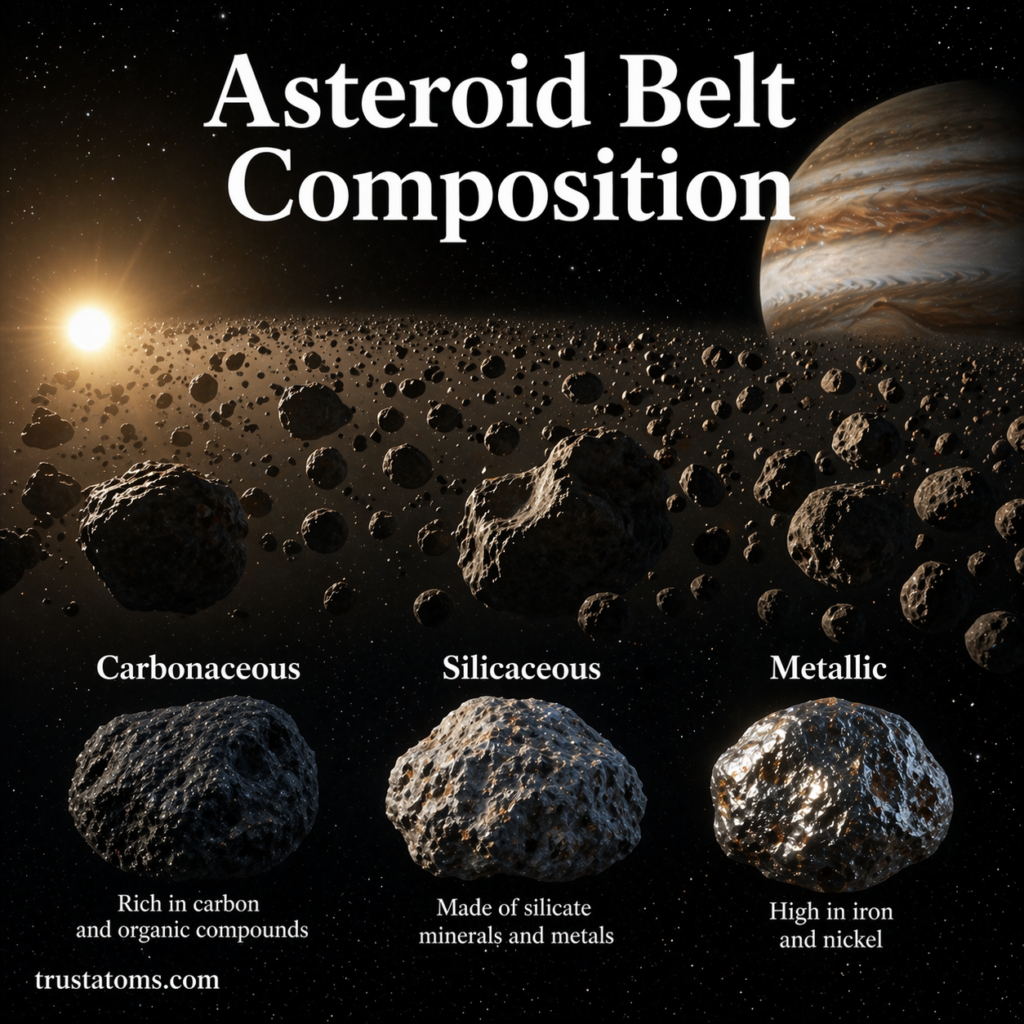
The asteroid belt is one of the most intriguing regions in our solar system. Located between Mars and Jupiter, this vast zone contains millions of rocky objects that never formed into a planet.
But what exactly are these asteroids made of? And why does their composition matter?
In this guide, you’ll learn about the materials found in the asteroid belt, the different asteroid types, and what they reveal about the early solar system.
What Is the Asteroid Belt?
The asteroid belt is a region filled with rocky and metallic objects orbiting the Sun. It sits between the orbits of Mars and Jupiter and acts as a boundary between the inner and outer planets.
The largest object in the belt is Ceres, which is classified as a dwarf planet rather than a typical asteroid.
Despite common depictions, the asteroid belt is not densely packed—spacecraft can pass through it with minimal risk of collision.
What Are Asteroids Made Of?
Asteroids are composed of materials left over from the formation of the solar system about 4.6 billion years ago. Their composition varies widely depending on where and how they formed.
Main Materials Found in Asteroids
- Rock (silicate minerals)
- Metals (primarily iron and nickel)
- Carbon-rich compounds
- Ice (in some outer-belt objects)
These materials provide clues about the conditions present during the early solar system.
The Three Main Types of Asteroids
Astronomers classify asteroids into three primary types based on their composition and appearance.
1. C-Type (Carbonaceous) Asteroids
C-type asteroids are the most common, making up about 75% of known asteroids.
Key characteristics:
- Rich in carbon and organic compounds
- Dark in color (low reflectivity)
- Likely formed in cooler, outer regions of the belt
These asteroids are especially important because they may contain water-bearing minerals and organic molecules—key ingredients for life.
2. S-Type (Silicaceous) Asteroids
S-type asteroids are composed mainly of rock and metal.
Key characteristics:
- Made of silicate minerals and some iron
- Brighter than C-type asteroids
- Found more commonly in the inner asteroid belt
These are the types most often associated with meteorites that reach Earth.
3. M-Type (Metallic) Asteroids
M-type asteroids are rich in metals, particularly iron and nickel.
Key characteristics:
- High metal content
- Brighter and more reflective
- Possibly remnants of ancient planetary cores
These asteroids are of interest for both scientific study and potential future space mining.
Why Didn’t the Asteroid Belt Form a Planet?
The materials in the asteroid belt could have formed a planet—but they didn’t. The main reason is the gravitational influence of Jupiter.
Jupiter’s Role
- Its strong gravity disrupted the formation process
- It prevented smaller bodies from merging into a larger planet
- It continues to influence asteroid orbits today
As a result, the asteroid belt remained a collection of smaller bodies instead of forming a single planet.
Distribution of Materials in the Asteroid Belt
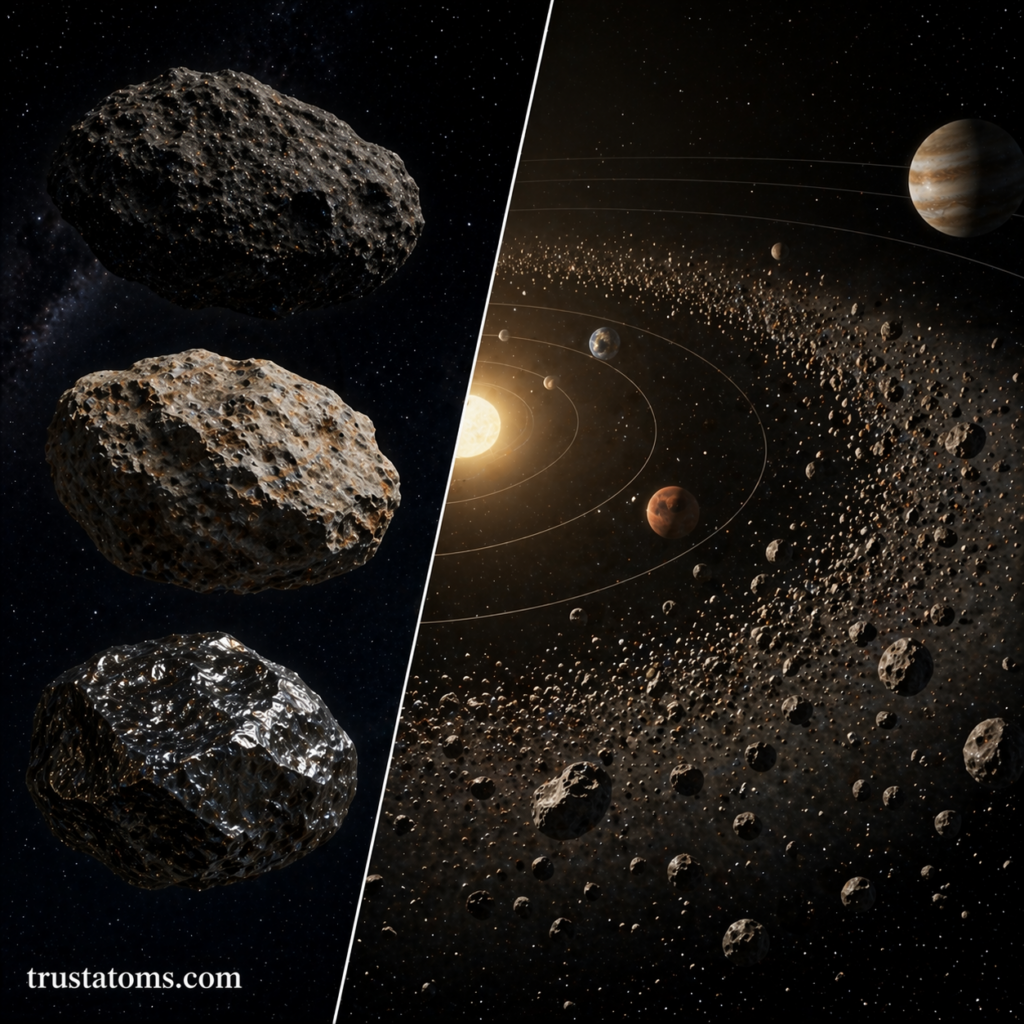
The composition of asteroids is not random—it varies depending on distance from the Sun.
Inner Belt
- Dominated by S-type (rocky) asteroids
- Warmer conditions during formation
Middle Belt
- Mix of S-type and C-type asteroids
- Transitional zone
Outer Belt
- Dominated by C-type (carbon-rich) asteroids
- Cooler environment allowed volatile compounds to survive
This gradient helps scientists understand temperature and chemical conditions in the early solar system.
What Asteroids Tell Us About the Early Solar System
Asteroids are often described as “time capsules” because they have remained largely unchanged for billions of years.
Key Insights
- Reveal the building blocks of planets
- Provide evidence of early solar system chemistry
- Help scientists study how planets formed and evolved
Missions like OSIRIS-REx have even collected samples from asteroids, allowing scientists to analyze their composition directly on Earth.
Potential Resources in the Asteroid Belt
Asteroids are not just scientifically valuable—they may also be economically important in the future.
Possible Resources
- Metals like iron, nickel, and platinum
- Water (which can be converted into fuel)
- Rare elements used in technology
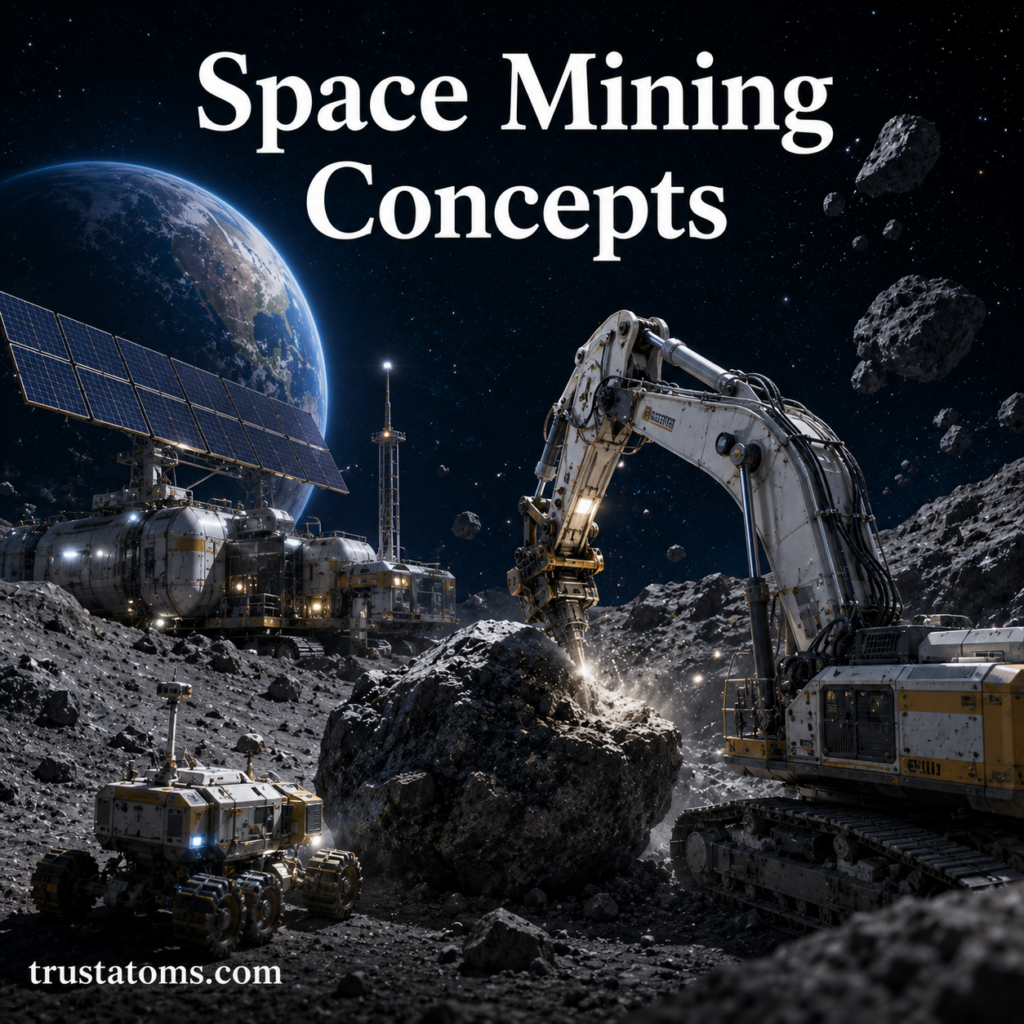
While asteroid mining is still in early stages, it could play a role in future space exploration and industry.
Common Misconceptions About the Asteroid Belt
“Asteroids are all the same”
In reality, their composition varies widely depending on type and location.
“The asteroid belt is densely packed”
Objects are actually very far apart, making collisions relatively rare.
“Asteroids are just space debris”
They are valuable scientific records of the solar system’s formation.
Final Thoughts
The asteroid belt is more than just a collection of space rocks—it’s a window into the origins of our solar system. From carbon-rich compounds to metallic cores, the diversity of asteroid composition tells a story billions of years in the making.
As technology advances and exploration continues, these small bodies may hold the key to understanding our past—and shaping our future in space.