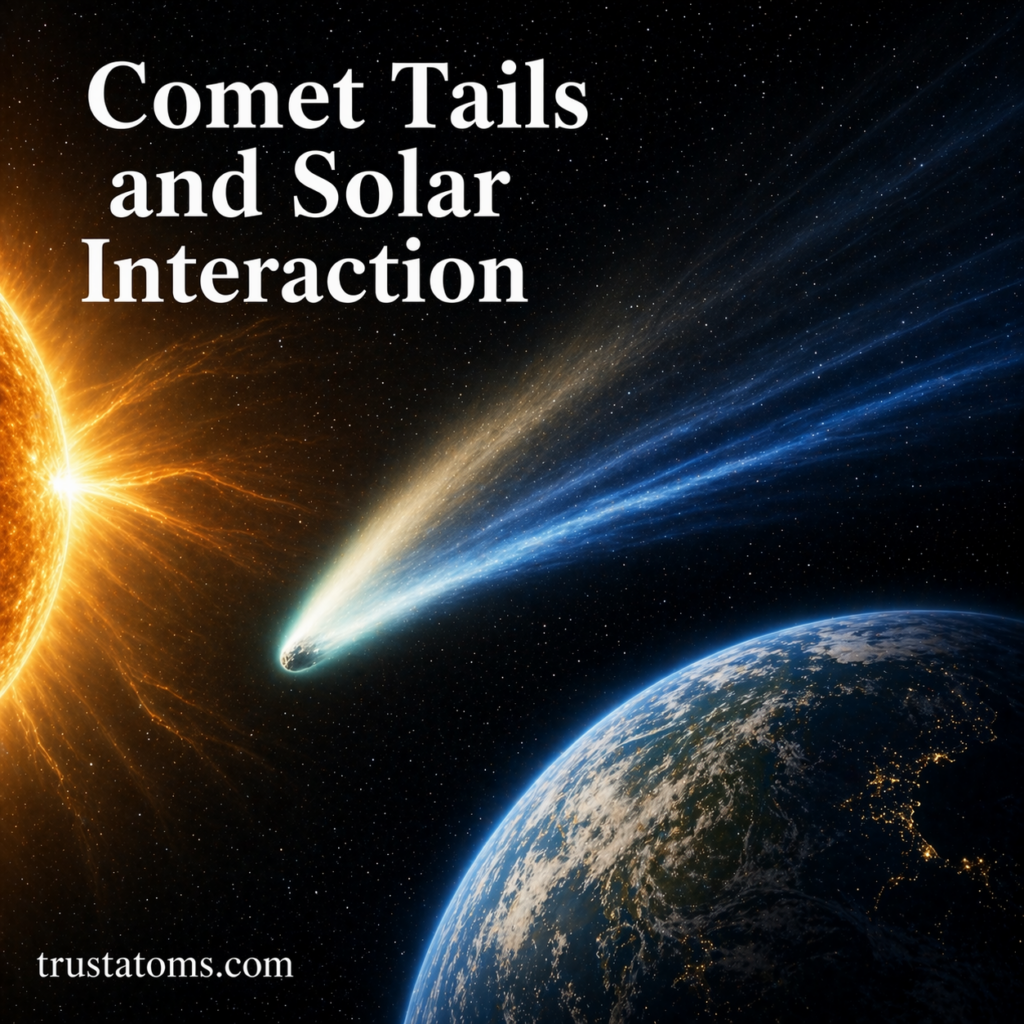
Comets are among the most visually striking objects in the night sky, often appearing as glowing spheres with long, luminous tails stretching across space. But these tails aren’t permanent features—they form only when comets interact with the Sun.
As a comet travels through the solar system, solar radiation and charged particles transform it, creating the iconic tails we observe from Earth. Understanding this process reveals how the Sun actively shapes even the smallest bodies in space.
What Is a Comet?
A comet is a small celestial body made primarily of:
- Ice (water, carbon dioxide, methane)
- Dust and rocky material
- Organic compounds
Comets originate mainly from two distant regions:
- Kuiper Belt: Beyond Neptune, source of short-period comets
- Oort Cloud: A distant spherical region, source of long-period comets
When far from the Sun, comets remain frozen and inactive. Activity begins only as they move closer to the inner solar system.
The Structure of a Comet
A comet has several distinct parts:
Nucleus
- The solid core
- Typically a few kilometers wide
- Composed of ice, rock, and dust
Coma
- A glowing cloud surrounding the nucleus
- Forms as ice vaporizes into gas
- Can grow thousands of kilometers wide
Tails
- Streams of gas and dust extending away from the Sun
- Formed through interaction with solar energy and solar wind
Why Comets Develop Tails
Comet tails form due to two main solar influences:
- Solar Radiation (Sunlight)
- Solar Wind (Charged particles from the Sun)
As a comet approaches the Sun:
- Heat causes ice to sublimate (turn directly into gas)
- Gas and dust escape from the nucleus
- Solar forces push this material outward, forming tails
Without the Sun, comets would remain frozen and invisible.
The Two Types of Comet Tails
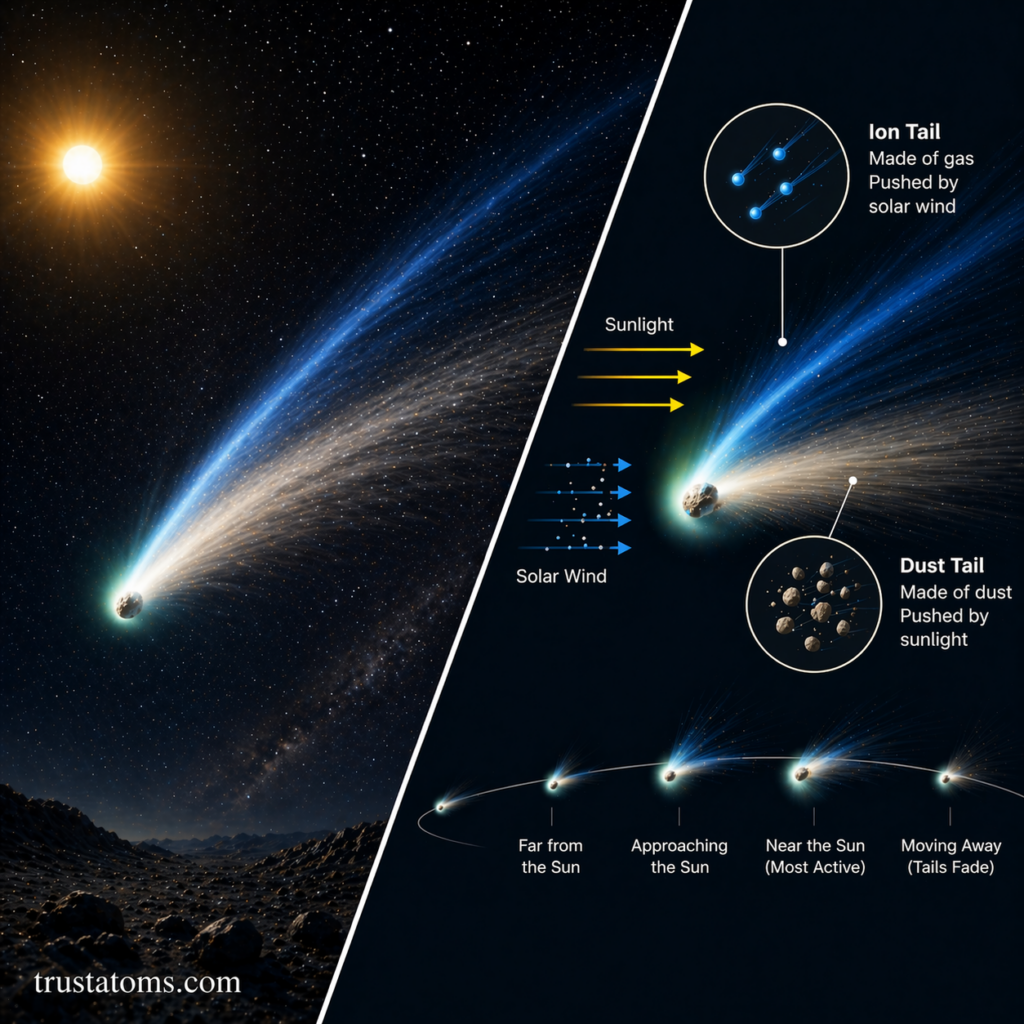
Most comets develop two distinct tails, each shaped differently by solar interaction.
Dust Tail
- Made of tiny solid particles
- Appears white or yellowish due to reflected sunlight
- Curved shape due to the comet’s motion
Ion Tail (Gas Tail)
- Made of ionized gas (charged particles)
- Often appears blue
- Points directly away from the Sun
- Shaped by the solar wind
These tails can stretch millions of kilometers into space.
Why Tails Always Point Away from the Sun
A common misconception is that a comet’s tail trails behind it like a wake. In reality:
- Tails always point away from the Sun, regardless of the comet’s direction of travel
- As the comet moves, the tail can appear to shift or even lead the comet briefly
This happens because:
- Solar radiation pushes dust particles outward
- Solar wind carries ionized gas directly away from the Sun
Solar Wind and Its Role
The solar wind is a continuous stream of charged particles emitted by the Sun.
Effects on Comets
- Strips gas from the comet’s coma
- Creates and shapes the ion tail
- Can cause rapid changes in tail structure
Tail Disruptions
Strong solar events can even cause:
- Tail disconnection events, where part of the ion tail breaks off
- Sudden changes in brightness or shape
These events provide valuable insights into solar activity.
Comet Orbits and Activity Cycles
Comets follow highly elliptical orbits around the Sun.
Activity Levels
- Far from the Sun: Frozen, inactive
- Approaching the Sun: Increasing activity and tail formation
- Near the Sun (perihelion): Maximum brightness and tail length
- Moving away: Activity decreases, tails fade
Some comets return regularly, while others may only pass through once.
Famous Examples of Comet Tails
Halley’s Comet
- One of the most well-known periodic comets
- Visible from Earth approximately every 76 years
- Displays both dust and ion tails
Comet NEOWISE
- Bright comet visible in 2020
- Showed a long, clearly defined dust tail
- Provided a striking modern example of solar interaction
What Comet Tails Reveal About the Solar System
Studying comet tails helps scientists understand:
- The composition of early solar system material
- How solar radiation affects small bodies
- The behavior of the solar wind
- The origins of water and organic molecules on Earth
Comets are often considered “time capsules” from the early solar system.
Common Misconceptions
- Comets do not always have tails—only when near the Sun
- Tails are not permanent features
- A comet can have multiple tails, not just one
- Tails do not necessarily follow behind the comet
Understanding these details helps clarify how dynamic these objects really are.
Final Thoughts
Comet tails are a direct result of the Sun’s influence, transforming frozen, inactive bodies into some of the most beautiful objects in space. Through solar radiation and the solar wind, the Sun actively sculpts these glowing trails, revealing both the nature of comets and the power of our star.
As we continue to observe and study comets, they offer a unique window into the early solar system—and a vivid reminder of the dynamic forces at work in space.