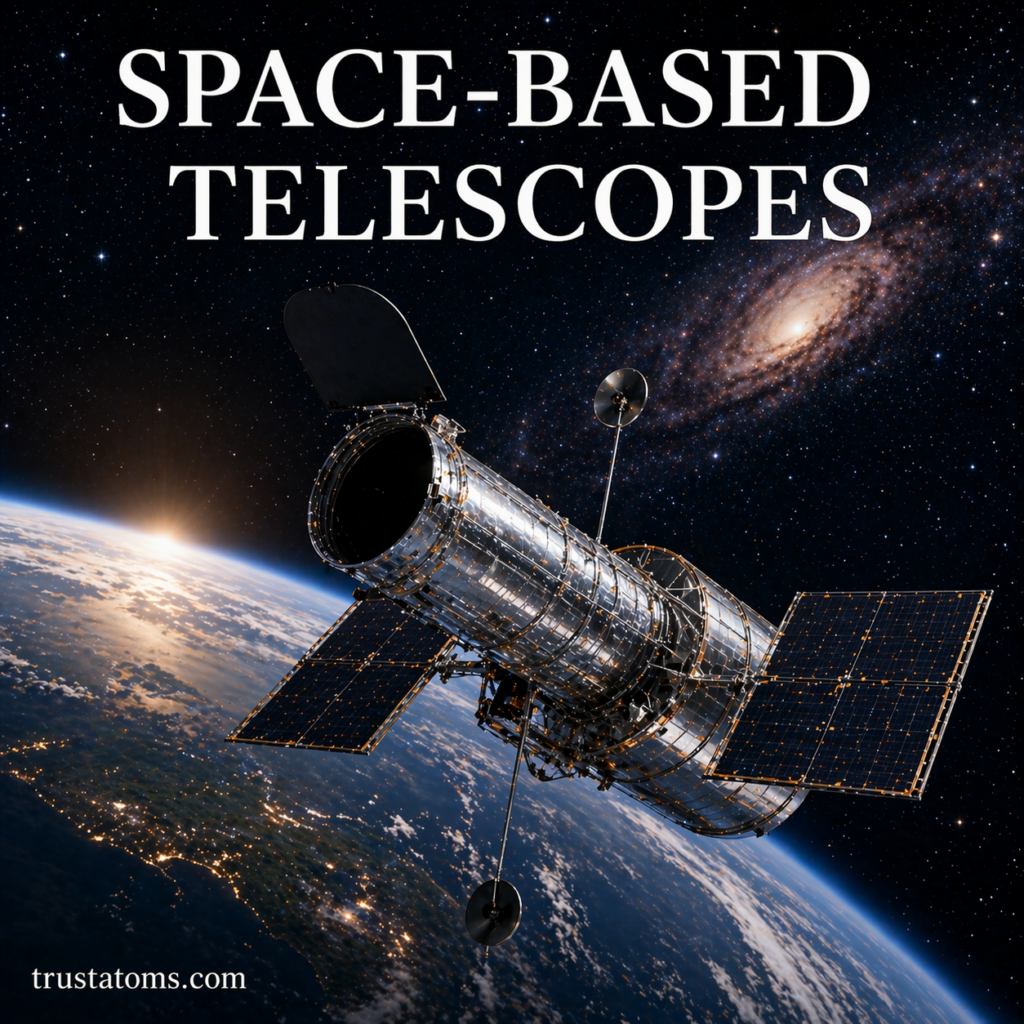
Space-based telescopes have transformed our understanding of the universe by allowing astronomers to observe space without the limitations of Earth’s atmosphere. By operating above the planet, these powerful instruments capture clearer, more detailed data across a wide range of wavelengths.
From stunning galaxy images to insights into the early universe, space telescopes play a critical role in modern astronomy.
What Are Space-Based Telescopes?
Space-based telescopes are observatories placed outside Earth—usually in orbit or at stable points in space—to observe celestial objects.
Unlike ground-based telescopes, they:
- Avoid atmospheric distortion
- Detect wavelengths blocked by Earth’s atmosphere
- Provide continuous, uninterrupted observations
They are essentially high-tech observatories operating in space.
Why Put Telescopes in Space?
Earth’s atmosphere, while essential for life, creates challenges for astronomy.
Major limitations of ground-based observation:
- Atmospheric turbulence → blurs images
- Light pollution → reduces visibility
- Absorption of wavelengths → blocks X-rays, gamma rays, and most infrared
By placing telescopes in space, scientists eliminate these issues.
Benefits of space-based telescopes:
- Sharper images
- Access to the full electromagnetic spectrum
- More accurate data collection
Key Types of Space Telescopes
Different space telescopes are designed to observe different types of radiation.
Optical Telescopes
- Observe visible light
- Capture detailed images of stars and galaxies
Example:
- Hubble Space Telescope
Infrared Telescopes
- Detect heat and dust
- Reveal star formation and distant galaxies
Example:
- James Webb Space Telescope
X-ray and Gamma-ray Telescopes
- Observe high-energy phenomena
- Study black holes, neutron stars, and supernovae
These telescopes must operate in space because Earth’s atmosphere blocks high-energy radiation.
Radio Telescopes in Space
- Less common but used for specialized observations
- Avoid interference from Earth-based signals
How Space Telescopes Work
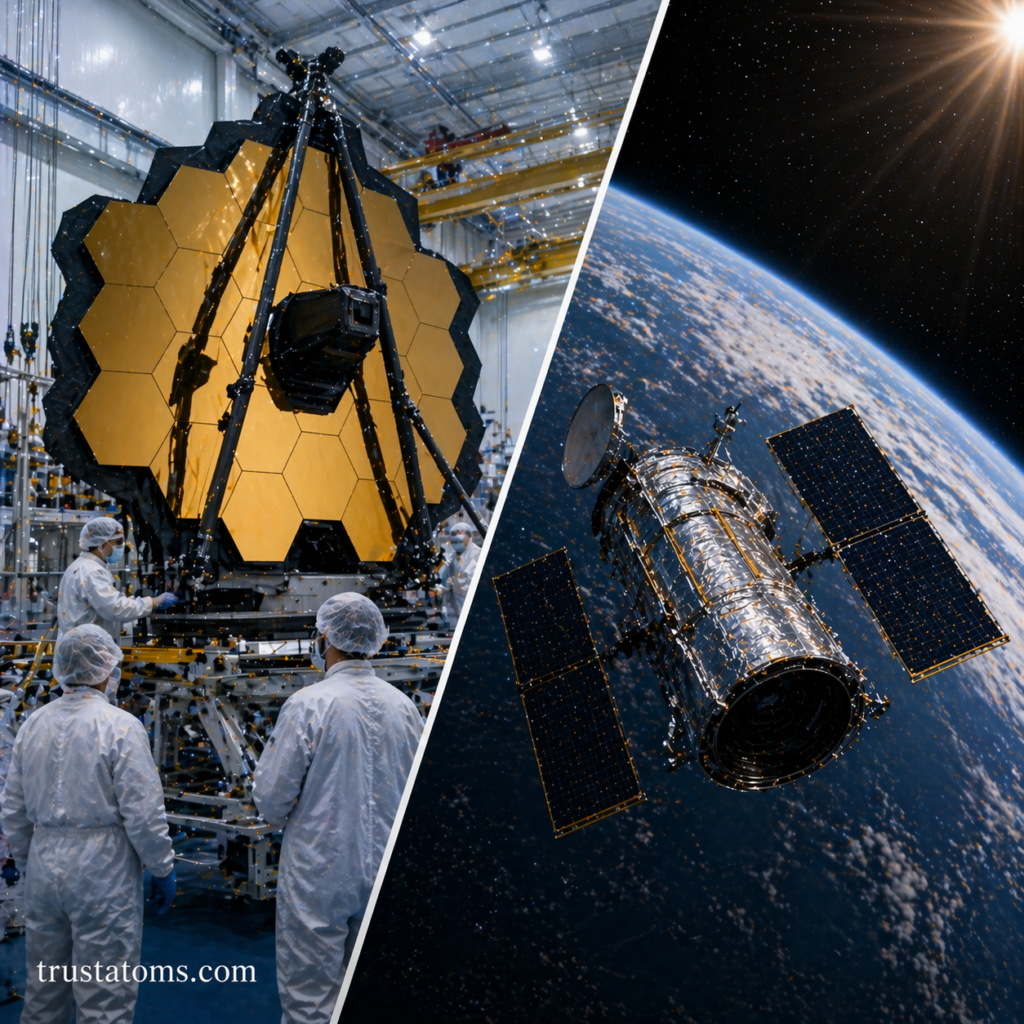
Despite being in space, these telescopes follow a similar process to ground-based ones.
Basic operation:
- Light collection
- Mirrors or detectors gather radiation
- Signal detection
- Instruments convert light into data
- Data transmission
- Information is sent back to Earth
- Analysis
- Scientists process and interpret the data
Where Are Space Telescopes Located?
Space telescopes are placed in specific locations to maximize efficiency.
Common positions include:
- Low Earth Orbit (LEO)
- Close to Earth
- Easier communication and maintenance
- Lagrange Points
- Stable positions where gravity balances
- Ideal for long-term observation
Example:
- L2 Lagrange Point (used by the James Webb Space Telescope)
Advantages of Space-Based Telescopes
Space telescopes offer several major advantages over ground-based systems:
- No atmospheric distortion
- Access to all wavelengths of light
- Continuous observation without weather interruptions
- Higher resolution imaging
These advantages allow scientists to observe distant and faint objects with incredible precision.
Challenges and Limitations
Despite their benefits, space telescopes come with challenges.
Key drawbacks:
- Extremely high cost
- Difficult to repair or upgrade
- Limited lifespan due to fuel and hardware constraints
- Dependence on remote operation
For example, repairing the Hubble Space Telescope required multiple space shuttle missions.
Major Discoveries from Space Telescopes
Space telescopes have revolutionized astronomy with groundbreaking discoveries.
Notable contributions:
- Deep field images revealing thousands of distant galaxies
- Evidence supporting the expansion of the universe
- Detailed observations of exoplanets
- Insights into the early universe
The James Webb Space Telescope is currently providing unprecedented views of the first galaxies formed after the Big Bang.
The Future of Space Telescopes
The next generation of space telescopes will push exploration even further.
Future goals include:
- Detecting Earth-like planets
- Studying dark matter and dark energy
- Observing the earliest moments of the universe
- Searching for signs of life beyond Earth
Advances in technology will lead to:
- Larger mirrors
- More sensitive instruments
- Longer mission lifespans
Final Thoughts
Space-based telescopes have opened a new window into the universe. By escaping Earth’s atmospheric limitations, they provide clearer, deeper, and more comprehensive views of space.
As technology continues to evolve, these observatories will remain at the forefront of discovery—helping humanity explore the cosmos with greater precision than ever before.