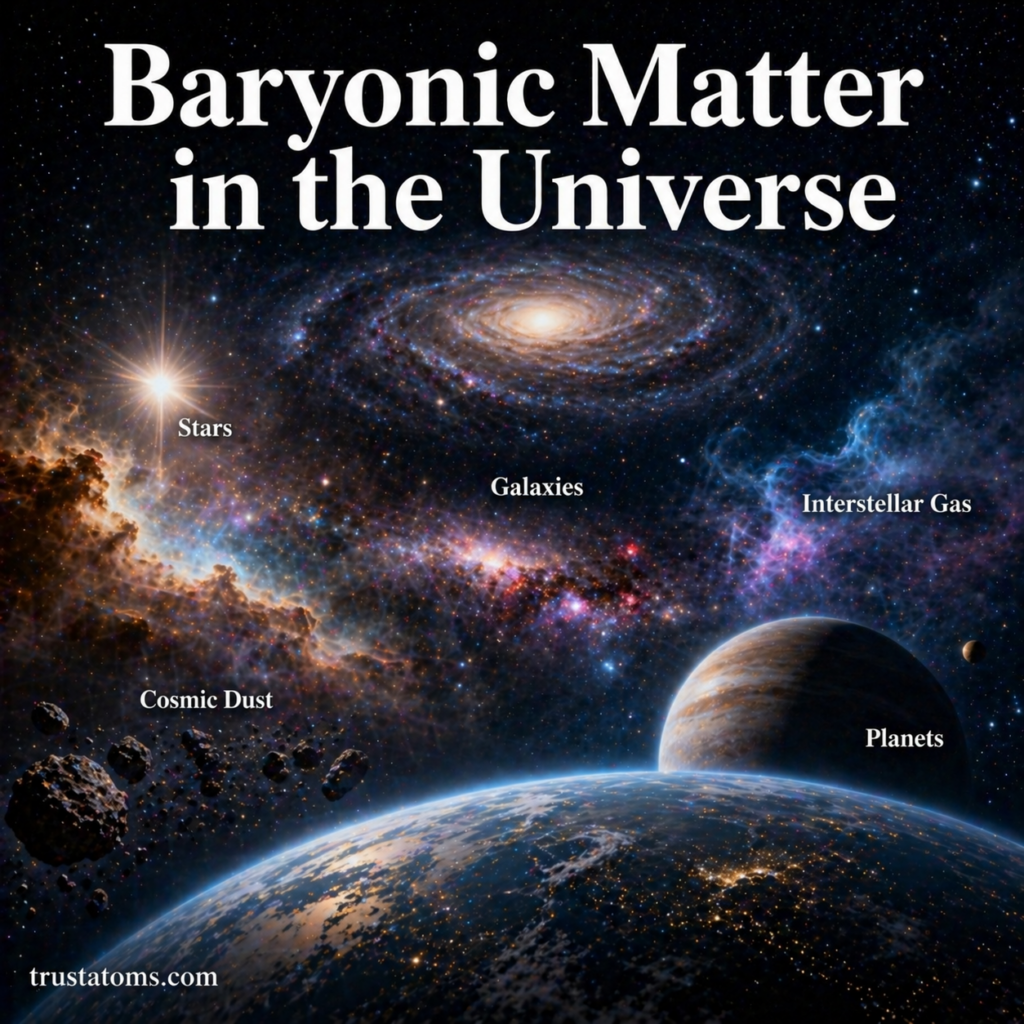
When we look at stars, planets, and galaxies, we’re seeing only a small fraction of what the universe contains. That visible portion is made of baryonic matter—the “normal” matter that forms everything we can directly observe.
Despite its importance, baryonic matter makes up only a small percentage of the universe’s total mass-energy content. Understanding it is essential for explaining how cosmic structures form and evolve.
What Is Baryonic Matter?
Baryonic matter is the type of matter composed of particles known as baryons, primarily protons and neutrons. These particles combine to form atoms, which then build all familiar objects in the universe.
Examples of Baryonic Matter
- Stars
- Planets
- Gas and dust in galaxies
- Living organisms
- Interstellar and intergalactic gas
In simple terms, if it’s made of atoms, it’s baryonic matter.
How Much Baryonic Matter Exists?
Surprisingly, baryonic matter represents only a small fraction of the universe.
Composition of the Universe
- About 5% baryonic matter
- About 27% dark matter
- About 68% dark energy
This means most of the universe is made of components we cannot directly observe.
The Building Blocks of Baryonic Matter
Baryonic matter is structured from the smallest particles to large cosmic systems.
Hierarchy of Structure
- Protons and neutrons
- Atomic nuclei
- Atoms
- Molecules
- Stars and planets
- Galaxies
This layered structure allows baryonic matter to form complex systems, including life.
Baryonic Matter in Galaxies
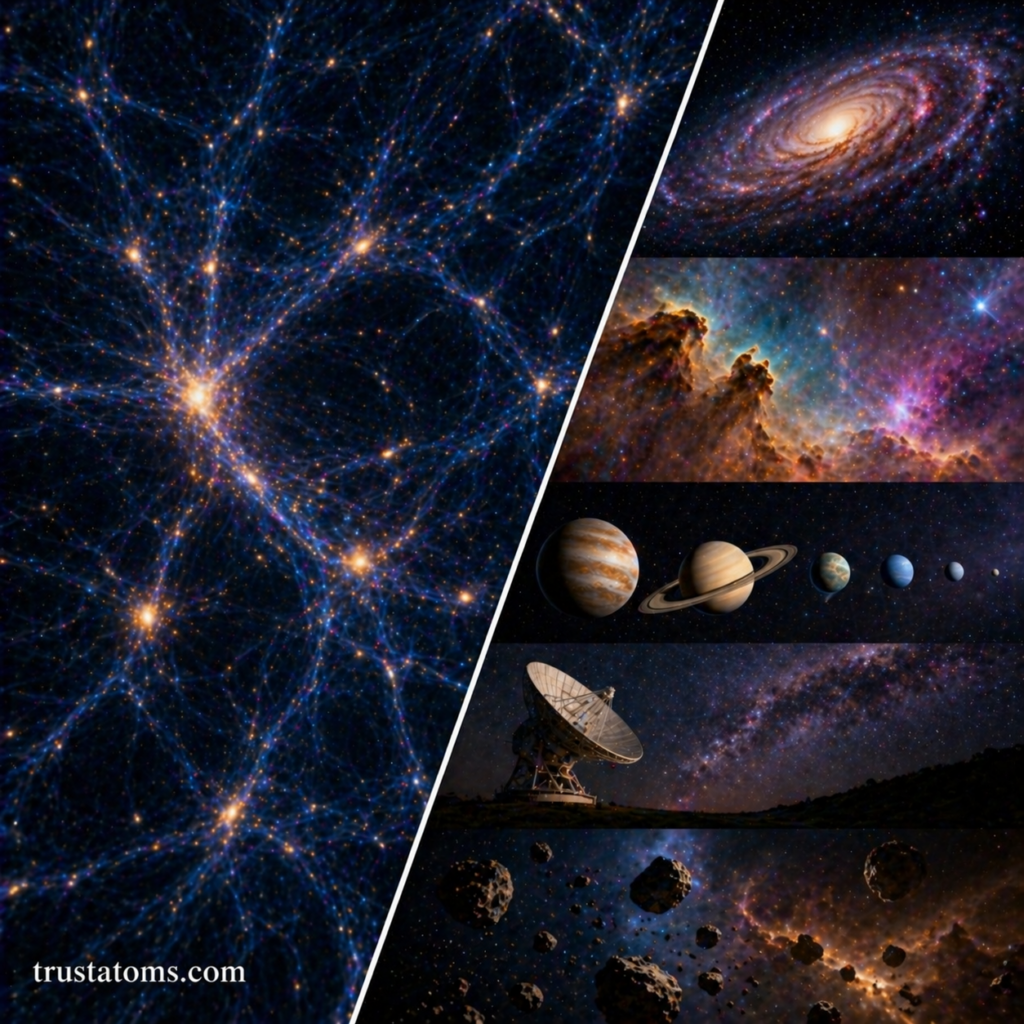
Within galaxies, baryonic matter plays a visible and dynamic role.
Where It’s Found
- Stars (the most visible component)
- Interstellar gas clouds
- Dust and molecular clouds
- Stellar remnants like white dwarfs and neutron stars
This matter is responsible for emitting light, making galaxies observable.
The Missing Baryon Problem
Even though baryonic matter is well understood, scientists discovered that a significant portion of it seemed to be missing.
What Happened?
Observations suggested that:
- Only about half of the expected baryonic matter was detected
- The rest was not visible in stars or galaxies
Where It Was Found
Recent research indicates that missing baryons exist in:
- Hot, diffuse gas between galaxies
- Filaments of the cosmic web
- Intergalactic medium at very high temperatures
This matter is difficult to detect because it emits very little light.
Baryonic Matter and the Early Universe
Baryonic matter played a key role in the formation of the first structures.
After the Big Bang
- Protons and neutrons formed within minutes
- Hydrogen and helium atoms formed as the universe cooled
- Gravity pulled gas into dense regions
These processes eventually led to the formation of the first stars and galaxies.
How Baryonic Matter Interacts
Unlike dark matter, baryonic matter interacts through multiple forces.
Key Interactions
- Gravity – pulls matter together
- Electromagnetic force – governs atomic structure and light emission
- Nuclear forces – bind protons and neutrons
These interactions allow baryonic matter to form complex and observable structures.
Baryonic Matter vs. Dark Matter
Understanding baryonic matter requires comparing it with dark matter.
Key Differences
- Baryonic matter emits and absorbs light; dark matter does not
- Baryonic matter forms visible structures; dark matter forms invisible scaffolding
- Baryonic matter interacts electromagnetically; dark matter primarily interacts through gravity
Both are essential for explaining how galaxies form and behave.
Role in Star and Planet Formation
Baryonic matter is responsible for creating stars and planetary systems.
Formation Process
- Gas clouds collapse under gravity
- Dense regions form protostars
- Nuclear fusion begins in stars
- Surrounding material forms planets
Without baryonic matter, stars and life as we know it would not exist.
Observing Baryonic Matter
Astronomers use various methods to study baryonic matter across the universe.
Observation Techniques
- Optical telescopes to detect visible light
- Radio telescopes to observe hydrogen gas
- X-ray observations for hot gas in galaxy clusters
- Spectroscopy to analyze chemical composition
These tools help map where baryonic matter is located and how it behaves.
Key Takeaways
- Baryonic matter is the “normal” matter made of atoms
- It includes stars, planets, gas, and living organisms
- It makes up only about 5% of the universe
- Some baryonic matter exists as hard-to-detect intergalactic gas
- It plays a central role in forming stars, galaxies, and life
Final Thoughts
Baryonic matter may represent only a small portion of the universe, but it is the part we experience directly. From the smallest atoms to the largest galaxies, it forms the visible structure of the cosmos.
As astronomers continue to refine their observations, they are uncovering more about where baryonic matter resides and how it interacts with the universe’s unseen components—bringing us closer to a complete picture of cosmic reality.