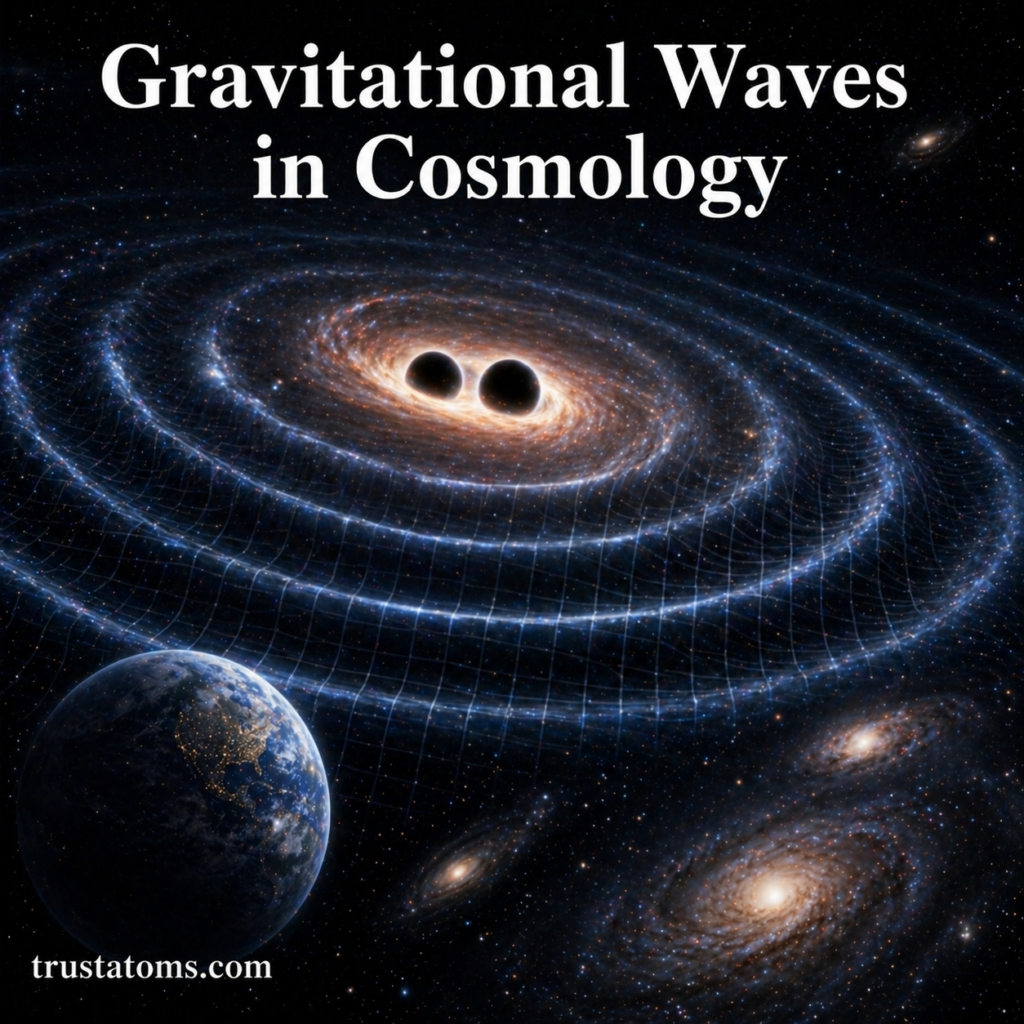
Gravitational waves are one of the most groundbreaking discoveries in modern astronomy. These faint ripples in the fabric of space-time allow scientists to observe cosmic events that were once completely invisible.
From colliding black holes to the echoes of the early universe, gravitational waves have opened an entirely new way to study cosmology—giving us a deeper understanding of how the universe forms, evolves, and behaves on the largest scales.
What Are Gravitational Waves?
Gravitational waves are disturbances in space-time caused by massive objects accelerating through space. They travel outward at the speed of light, stretching and compressing space as they pass.
Key Features
- Produced by extremely massive and energetic events
- Travel across the universe without being easily absorbed
- Carry information about their origins
- Extremely weak by the time they reach Earth
These waves were first predicted by General Relativity, developed by Albert Einstein in 1915.
How Are Gravitational Waves Detected?
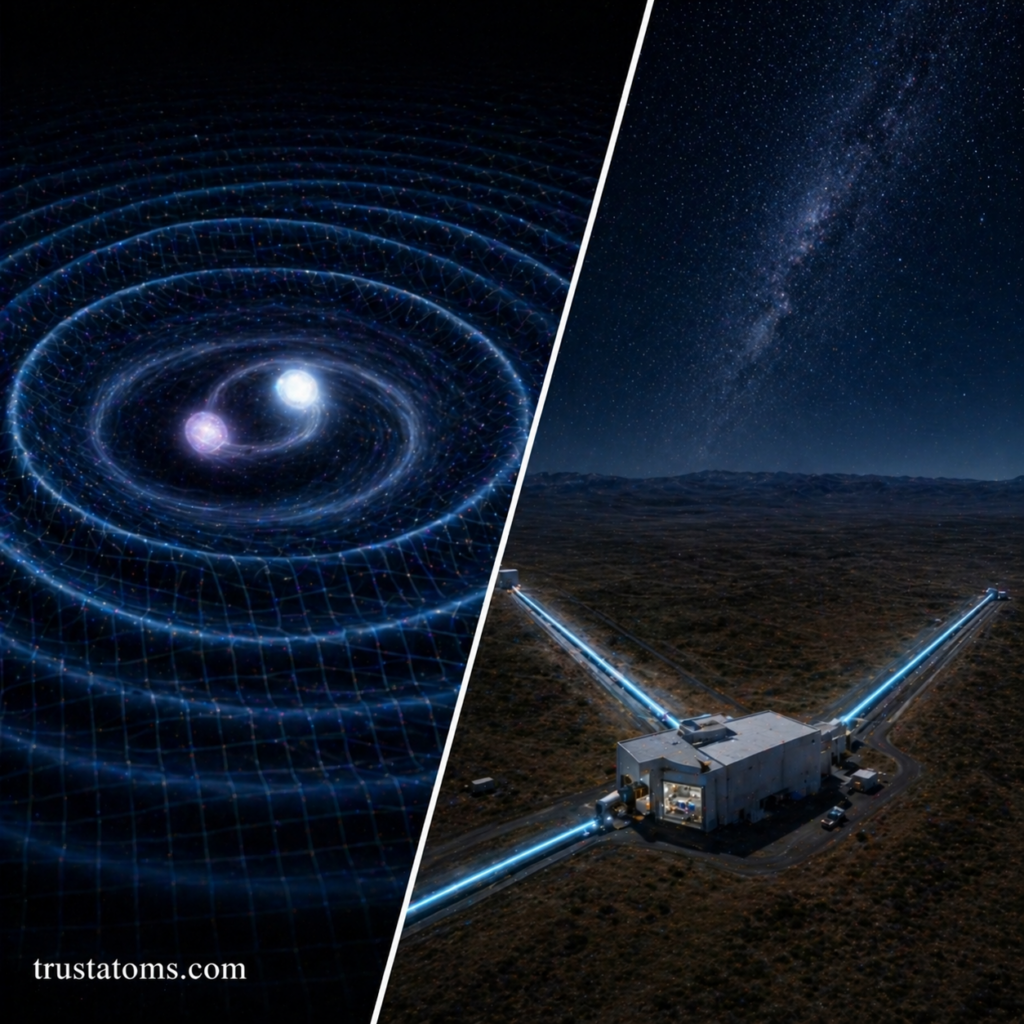
Detecting gravitational waves is incredibly challenging because their effects are so small. Specialized observatories measure tiny changes in distance caused by passing waves.
Major Detection Methods
- Laser interferometry using detectors like LIGO
- Observations from Virgo
- Future space-based detectors like LISA
These instruments can detect distortions smaller than the width of a proton.
Sources of Gravitational Waves
Gravitational waves are generated by some of the most extreme events in the universe.
Common Sources
- Merging black holes
- Colliding neutron stars
- Supernova explosions
- Rapidly rotating dense stars
The Most Powerful Signals
The strongest signals detected so far come from:
- Binary black hole mergers
- Neutron star collisions
- Black hole–neutron star systems
These events release enormous amounts of energy in a very short time.
Why Gravitational Waves Matter in Cosmology
Gravitational waves provide a completely different way to observe the universe compared to traditional light-based astronomy.
Unique Advantages
- Can pass through dust and gas without obstruction
- Reveal events that emit little or no light
- Provide direct measurements of cosmic distances
- Offer insights into extreme gravity environments
This makes them essential for understanding the structure and evolution of the universe.
Gravitational Waves and the Early Universe
One of the most exciting areas of research is using gravitational waves to study the early universe.
What Scientists Hope to Learn
- Conditions just after the Big Bang
- Evidence of cosmic inflation
- Formation of the first structures
- Behavior of fundamental forces at high energies
Gravitational waves could act as a “fossil record” of the universe’s earliest moments.
Multi-Messenger Astronomy
Gravitational waves are part of a broader approach called multi-messenger astronomy.
What It Means
Scientists combine data from:
- Gravitational waves
- Light (radio, optical, X-ray, gamma-ray)
- Neutrinos
This approach provides a more complete picture of cosmic events.
Example
When neutron stars collide, scientists can detect:
- Gravitational waves from the merger
- Light from the explosion
- Heavy elements formed in the process
Measuring the Expansion of the Universe
Gravitational waves can help measure how fast the universe is expanding.
“Standard Sirens”
Similar to how astronomers use “standard candles,” gravitational waves act as “standard sirens.”
They allow scientists to:
- Measure distances directly
- Compare with redshift data
- Refine estimates of the universe’s expansion rate
This helps improve our understanding of dark energy and cosmic evolution.
Challenges and Limitations
Despite their potential, gravitational wave research faces several challenges.
Key Challenges
- Signals are extremely weak
- Detection requires highly sensitive equipment
- Limited number of observed events so far
- Data interpretation can be complex
As technology improves, these limitations are gradually being overcome.
The Future of Gravitational Wave Astronomy
The field is rapidly advancing, with new detectors and missions planned.
What’s Next
- Space-based observatories like LISA
- Improved ground-based detectors
- Detection of lower-frequency waves
- Mapping gravitational wave backgrounds
These developments will expand our ability to study the universe in unprecedented ways.
Key Takeaways
- Gravitational waves are ripples in space-time caused by massive cosmic events
- They were predicted by Einstein’s theory of general relativity
- Detected using advanced observatories like LIGO and Virgo
- Provide new insights into black holes, neutron stars, and cosmic history
- Play a key role in modern cosmology and future discoveries
Final Thoughts
Gravitational waves have transformed our understanding of the universe by allowing us to “hear” cosmic events rather than just see them. This new perspective is reshaping cosmology, revealing hidden phenomena, and unlocking mysteries that were once beyond reach.
As detection methods improve and more signals are observed, gravitational waves will continue to deepen our knowledge of the universe—from its violent present to its mysterious beginnings.