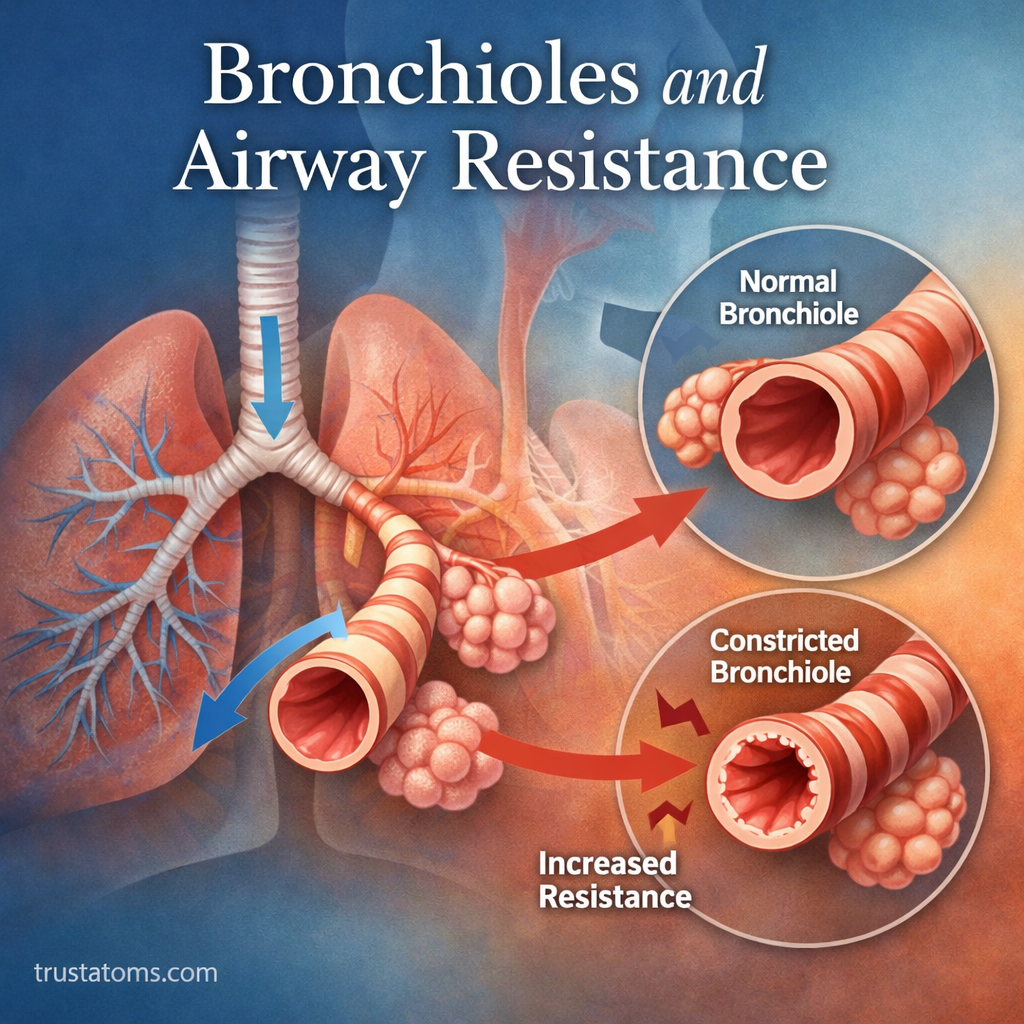
Bronchioles are small, branching airways that carry air toward the alveoli and help regulate airflow through changes in their diameter. Airway resistance increases when these passages narrow, making it harder to move air into and out of the lungs.
Bronchioles are among the smallest conducting airways in the respiratory system, regulating airflow to the lungs. While they are tiny compared to the trachea and bronchi, their structure and function have a major impact on airflow distribution, especially during airway narrowing. Understanding these passages is an important part of human anatomy and respiratory physiology.
What Are Bronchioles?
Bronchioles are small air passages that branch repeatedly from the bronchi inside the lungs. They form an extensive network that distributes inhaled air toward the regions where oxygen and carbon dioxide are exchanged.
Unlike the larger bronchi, bronchioles lack cartilage in their walls. They contain smooth muscle, epithelial lining, and supporting connective tissue, allowing their diameter to change in response to physiological signals.
Bronchioles are generally less than about 1 millimeter in diameter, although their size varies along the branching airway tree.
The airway branches include several important regions:
- Conducting bronchioles: Transport air through the lungs without directly participating in gas exchange.
- Terminal bronchioles: Form the final portion of the conducting airway system.
- Respiratory bronchioles: Contain occasional alveoli in their walls and mark the beginning of the respiratory zone.
Airflow behavior changes as the airways branch and their combined cross-sectional area increases. Airflow patterns and turbulence explains how airway geometry and flow conditions influence resistance.
Air distribution also affects how efficiently oxygen enters the blood. Ventilation–perfusion matching principles describes the relationship between air reaching the alveoli and blood flowing through nearby capillaries.
What Is Airway Resistance?
Airway resistance is the opposition to airflow as air travels through the respiratory passages. It can be expressed as the pressure difference driving airflow divided by the resulting flow rate.
Greater resistance means that a larger pressure difference is needed to produce the same airflow. Lower resistance allows air to move more easily.
Resistance depends on airway diameter, length, airflow characteristics, and the properties of the gas being moved. The arrangement of the entire airway tree also matters. Airway anatomy from nose to alveoli shows how air passes through progressively branching respiratory passages.
Why Airway Radius Has Such a Strong Effect
For steady, laminar flow through an ideal rigid cylindrical tube, Poiseuille’s law states that resistance is inversely proportional to the fourth power of the tube’s radius.
This relationship illustrates why narrowing can have a large effect. If the radius of a single ideal tube decreases by half, its resistance increases sixteenfold, assuming the other conditions remain unchanged.
Real airways are more complicated because they branch, change shape, and may contain turbulent or transitional airflow. The fourth-power relationship is therefore a useful physical model, not an exact prediction for every bronchiole in a living lung.
How Smooth Muscle Changes Bronchiole Diameter
Smooth muscle surrounds the walls of bronchioles and can contract or relax. This changes the airway opening and influences the resistance encountered by moving air.
Bronchoconstriction Narrows the Airways
Bronchoconstriction occurs when airway smooth muscle contracts. The smaller opening increases resistance and can restrict airflow, especially during exhalation.
Contraction may be triggered by parasympathetic nerve activity, inhaled irritants, cold air, or inflammatory substances released during allergic reactions.
Bronchodilation Widens the Airways
Bronchodilation occurs when smooth muscle relaxes, increasing airway diameter and reducing resistance. Activation of beta-2 adrenergic receptors promotes this relaxation.
Circulating adrenaline and medications that stimulate beta-2 receptors can produce bronchodilation. These mechanisms are especially relevant when airway smooth muscle is excessively constricted.
Why Small Bronchioles Do Not Normally Create the Most Resistance
Although individual bronchioles have narrow openings, the lungs contain enormous numbers of them arranged in parallel. Together, their combined cross-sectional area is much larger than that of the central airways.
As a result, healthy small peripheral airways normally contribute relatively little to total airway resistance. Much of the measurable resistance occurs in larger and medium-sized conducting airways.
This distinction matters because small-airway disease can develop before obvious abnormalities appear in conventional measurements of overall airflow. When many bronchioles narrow or become obstructed, their combined effect can become substantial.
How Inflammation and Mucus Increase Airway Resistance
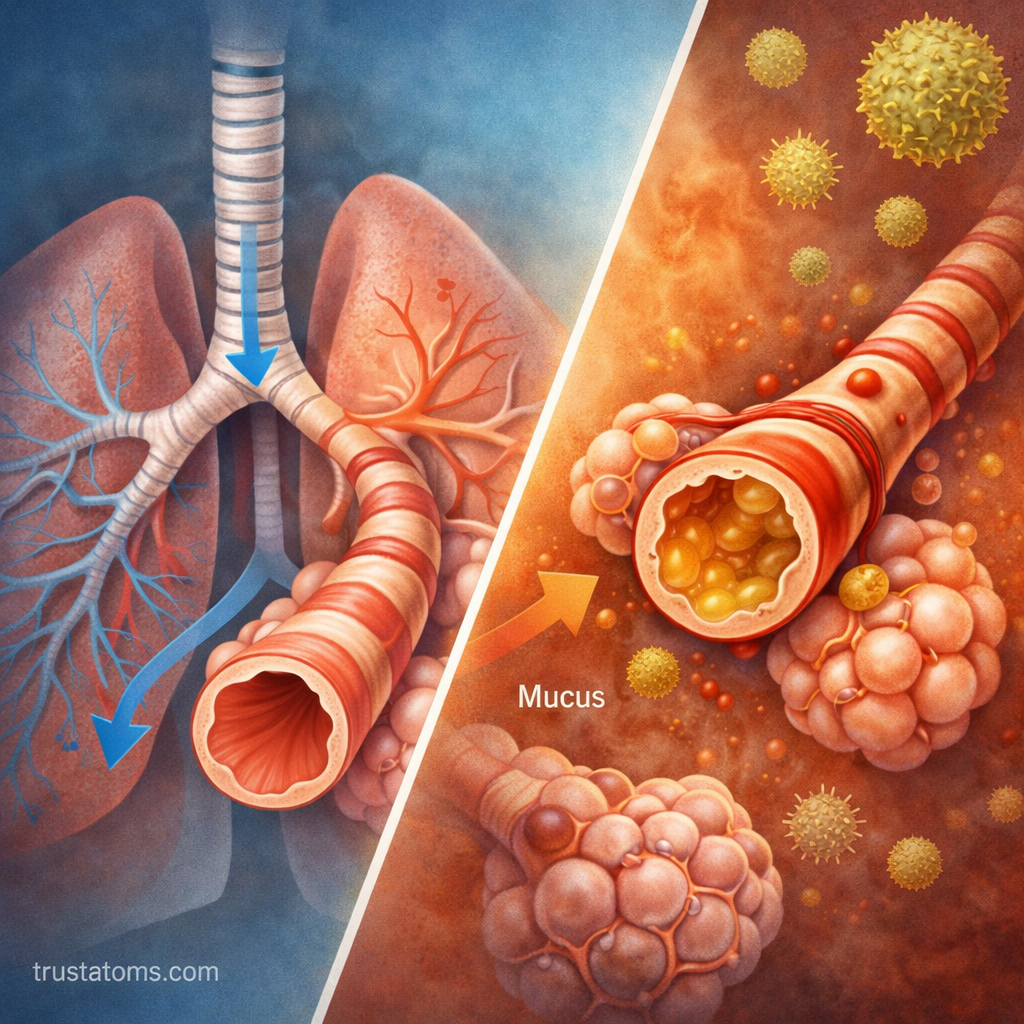
Airway resistance can rise even without strong smooth muscle contraction. Swelling of the airway lining, increased mucus production, and structural changes can also narrow bronchioles.
- Inflammation: Swollen airway tissue reduces the space available for airflow.
- Mucus accumulation: Thick secretions can partially or completely obstruct narrow passages.
- Airway remodeling: Persistent inflammation may cause structural changes that contribute to long-term narrowing.
- Loss of elastic support: Damage to surrounding lung tissue can allow small airways to collapse more readily during exhalation.
These processes can occur together, making airflow limitation more pronounced than any single mechanism would produce alone.
Bronchioles in Asthma, COPD, and Bronchiolitis
Several respiratory disorders affect the small airways, but they do so through different mechanisms.
| Condition | Effect on bronchioles | Typical consequence |
|---|---|---|
| Asthma | Variable smooth muscle constriction, inflammation, and mucus production | Episodes of wheezing, coughing, and airflow limitation |
| Chronic obstructive pulmonary disease (COPD) | Small-airway narrowing, inflammation, and sometimes loss of surrounding elastic support | Persistent airflow limitation and difficulty exhaling |
| Bronchiolitis | Inflammation and obstruction of small airways, commonly associated with viral infection in infants | Wheezing, rapid breathing, and increased breathing effort |
Asthma often causes variable airflow obstruction that can improve with treatment. COPD typically involves more persistent airflow limitation, while acute viral bronchiolitis is particularly common in young children.
How Bronchioles Respond During Exercise and Exhalation
During exercise, ventilation increases to meet the body’s metabolic demands. Airway smooth muscle may relax, while changes in lung volume and surrounding tissue forces help keep many airways open.
During exhalation, pressure around intrathoracic airways can contribute to narrowing. In healthy lungs, elastic recoil and surrounding tissue attachments help support small airways.
In conditions such as emphysema, loss of elastic recoil and tissue support can promote airway collapse during exhalation. Air becomes harder to expel, contributing to air trapping and increased breathing effort.
Frequently Asked Questions
Do bronchioles contain cartilage?
No. Unlike the trachea and larger bronchi, bronchioles lack cartilage. Their walls contain smooth muscle and are supported partly by the surrounding lung tissue.
Why does narrowing a bronchiole make breathing harder?
Narrowing reduces the space available for airflow and increases resistance. When many airways narrow, the respiratory muscles must generate greater pressure differences to move air through the lungs.
Are bronchioles the main source of airway resistance?
Not in healthy lungs. Because numerous small airways are arranged in parallel, they normally contribute relatively little to total resistance. However, widespread narrowing or obstruction of bronchioles can substantially impair airflow.
Bronchioles regulate airflow through changes in smooth muscle tone, airway diameter, and the condition of their lining. Their extensive parallel arrangement keeps resistance relatively low in healthy lungs, but inflammation, mucus, and loss of structural support can make small-airway obstruction a serious problem. Understanding these mechanisms helps explain airflow limitation in asthma, COPD, and bronchiolitis.
This article is for general education and is not medical advice. Talk to a qualified health professional about any medical concern.
Sources: West’s Respiratory Physiology: The Essentials; Guyton and Hall Textbook of Medical Physiology; National Heart, Lung, and Blood Institute.