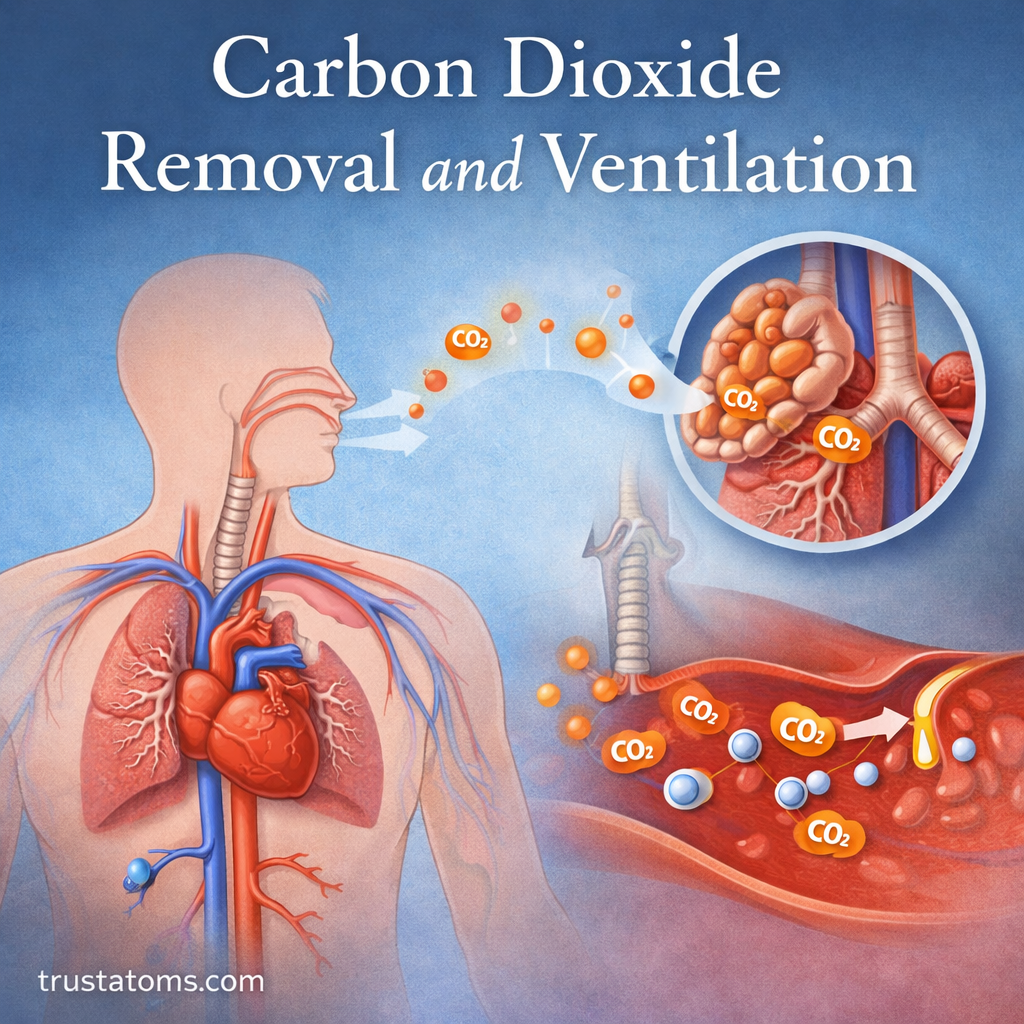
Carbon dioxide (CO₂) is removed from the body when blood carries it from metabolically active tissues to the lungs, where it diffuses into the alveoli and is exhaled. Ventilation continually replaces alveolar air, helping prevent excessive CO₂ accumulation and maintain normal blood pH.
Ventilation—the process of breathing—plays a central role in clearing carbon dioxide from the body and maintaining acid-base balance. Understanding this process connects respiratory physiology with human anatomy, showing how the lungs, blood, heart, and nervous system cooperate to regulate internal conditions.
Overview of Carbon Dioxide Removal
Carbon dioxide is produced continuously during cellular metabolism. Removing it requires a coordinated sequence involving tissues, blood vessels, the heart, and lungs.
- Cells produce CO₂ while breaking down nutrients for energy.
- CO₂ diffuses from tissues into nearby blood capillaries.
- Blood transports CO₂ toward the right side of the heart and pulmonary circulation.
- CO₂ diffuses from pulmonary capillary blood into the alveoli.
- Ventilation removes CO₂ from the alveoli during exhalation.
These processes also help regulate blood acidity. Acid–base balance and CO₂ regulation explains how changes in carbon dioxide influence hydrogen ion concentration and blood pH.
The connection between pulmonary blood flow and breathing is equally important. Respiratory system integration with circulation describes how these systems coordinate oxygen delivery and carbon dioxide elimination.
Step 1: Carbon Dioxide Is Produced During Cellular Metabolism
Cells generate carbon dioxide during metabolic reactions that extract energy from nutrients. Much of this production occurs in mitochondria during reactions such as pyruvate oxidation and the citric acid cycle.
CO₂ is a normal metabolic product rather than simply a harmful substance. Problems arise when its production exceeds the body’s ability to eliminate it or when abnormal breathing removes too much.
During exercise, working muscles increase their energy use and produce more CO₂. Ventilation normally rises to match this greater demand for gas removal.
Step 2: Carbon Dioxide Moves From Tissues Into Blood
Carbon dioxide moves primarily by diffusion, traveling from regions of higher CO₂ partial pressure toward regions of lower partial pressure.
Because active tissues produce CO₂, its partial pressure is generally higher within tissues than in the blood arriving through systemic capillaries. CO₂ therefore diffuses into the bloodstream.
The thin walls of capillaries allow this exchange to occur over short distances. Once in the blood, CO₂ can be carried in several chemical forms.
Step 3: Carbon Dioxide Transport in Blood
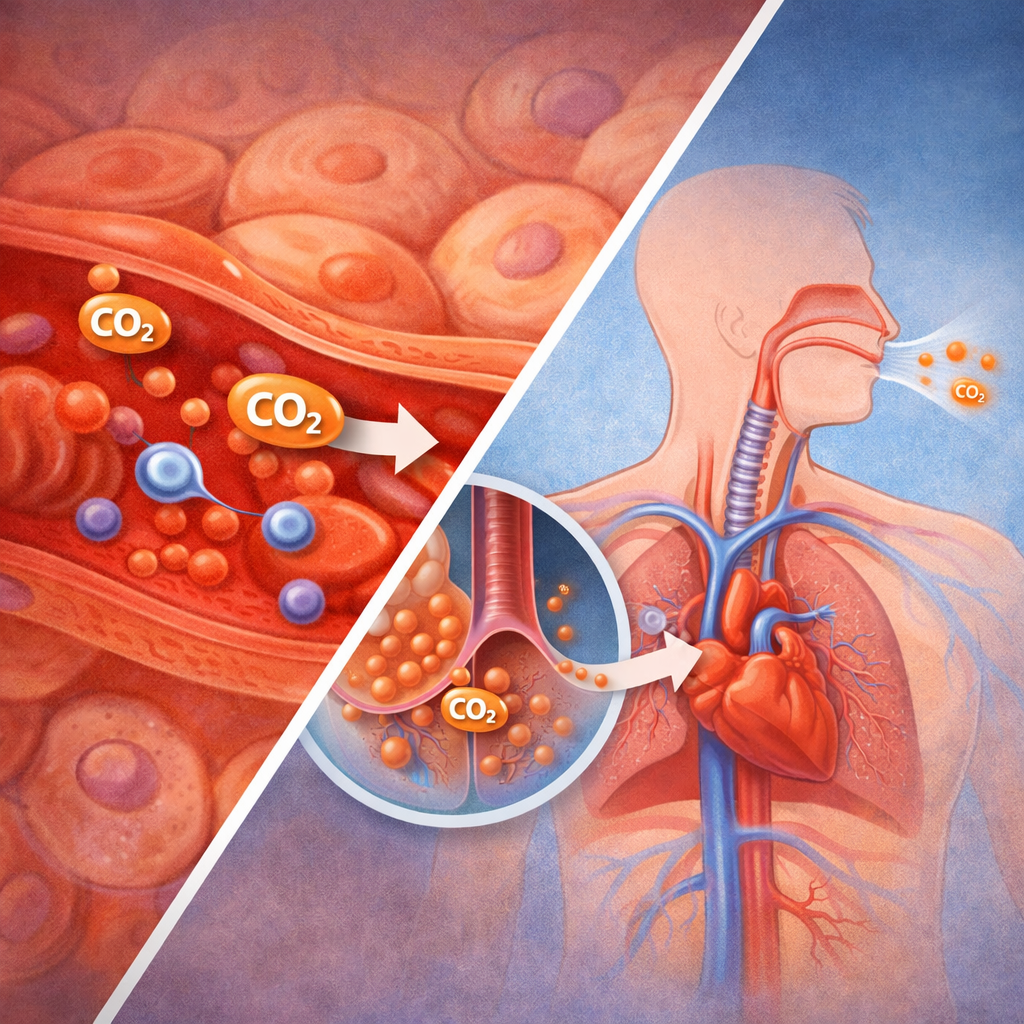
Blood carries carbon dioxide in three main forms. Their relative proportions vary with physiological conditions, but bicarbonate accounts for most CO₂ transport.
| Transport form | Approximate proportion | How it works |
|---|---|---|
| Bicarbonate ions | About 70% | CO₂ is converted into bicarbonate, much of which travels in plasma. |
| Bound to proteins | About 20–25% | CO₂ binds to proteins, especially hemoglobin, forming carbamino compounds. |
| Dissolved CO₂ | About 5–10% | CO₂ remains dissolved directly in blood. |
Inside red blood cells, the enzyme carbonic anhydrase accelerates the reaction between CO₂ and water. Carbonic acid forms briefly and dissociates into bicarbonate and hydrogen ions.
Many bicarbonate ions move into plasma in exchange for chloride ions, a process called the chloride shift. Hemoglobin helps buffer hydrogen ions, limiting changes in blood acidity.
Carbon dioxide transport in blood explains these chemical reactions and how red blood cells carry CO₂ between tissues and lungs.
Step 4: Carbon Dioxide Returns to the Lungs
Blood carrying CO₂ from systemic tissues flows through venules and veins into the right atrium of the heart. It then enters the right ventricle, which pumps blood through the pulmonary arteries toward the lungs.
In pulmonary capillaries, CO₂ partial pressure is generally higher in arriving blood than in alveolar air. This pressure difference drives CO₂ from blood into the alveoli.
Bicarbonate is converted back into CO₂ through reactions involving carbonic anhydrase, allowing the gas to diffuse across the respiratory membrane.
Step 5: Carbon Dioxide Leaves During Exhalation
Once carbon dioxide enters the alveoli, it becomes part of the air that is removed during exhalation.
During quiet breathing, the diaphragm relaxes and elastic recoil of the lungs helps push air outward. CO₂-containing air travels through the airways and leaves through the nose or mouth.
This process completes the cycle of gas exchange. Oxygen moves into pulmonary blood while carbon dioxide moves in the opposite direction.
Why Alveolar Ventilation Matters More Than Breathing Rate Alone
Not every breath reaches the alveoli. Some inhaled air remains in conducting airways, including the trachea and bronchi, where little gas exchange occurs. This volume is called anatomical dead space.
Alveolar ventilation describes the amount of fresh air reaching the gas-exchanging regions of the lungs each minute. It depends on breathing frequency and the volume of each breath that reaches the alveoli.
For example, consider an adult taking 12 breaths per minute, with approximately 500 milliliters per breath and 150 milliliters of anatomical dead space. The estimated alveolar ventilation is 12 multiplied by 350 milliliters, or 4.2 liters per minute.
This illustrates why rapid, shallow breathing may remove CO₂ less effectively than slower, deeper breathing with the same total volume of air moved per minute.
How the Brain Regulates Carbon Dioxide Removal
Breathing is regulated by neural circuits in the brainstem, particularly within the medulla and pons. These circuits adjust respiratory activity in response to chemical signals and other inputs.
Central chemoreceptors respond primarily to changes in the acidity of brain extracellular fluid associated with CO₂. Peripheral chemoreceptors in the carotid and aortic bodies respond to changes in blood oxygen, carbon dioxide, and acidity.
When arterial CO₂ rises, ventilation usually increases, helping eliminate the excess. When CO₂ falls, respiratory drive may decrease, although breathing regulation also depends on oxygen levels and other factors.
How Carbon Dioxide Affects Blood pH
Carbon dioxide is closely connected to the bicarbonate buffer system, which helps regulate blood acidity.
When CO₂ increases, the chemical equilibrium shifts toward producing more hydrogen ions, tending to lower blood pH. When CO₂ decreases, hydrogen ion concentration tends to fall and pH rises.
The lungs can adjust CO₂ elimination within minutes, while the kidneys regulate bicarbonate and acid excretion over longer periods. Both systems contribute to maintaining acid-base balance.
What Can Interfere With Carbon Dioxide Removal?
Effective CO₂ elimination requires adequate alveolar ventilation, functioning respiratory muscles, unobstructed airways, and sufficient blood flow through the lungs.
- Hypoventilation: Insufficient alveolar ventilation can cause CO₂ retention and respiratory acidosis.
- Chronic obstructive pulmonary disease: Airflow obstruction and ventilation-perfusion abnormalities can impair CO₂ elimination, particularly in advanced disease.
- Neuromuscular disorders: Weak respiratory muscles may prevent adequate ventilation.
- Excessive ventilation: Breathing beyond metabolic needs can lower arterial CO₂ and produce respiratory alkalosis.
- Severe circulatory disturbances: Reduced pulmonary blood flow can interfere with the transport and elimination of CO₂.
Abnormal CO₂ levels can affect brain function, blood pH, and other physiological processes. Severe disturbances require medical assessment and treatment directed at the underlying cause.
Frequently Asked Questions
How does the body remove carbon dioxide?
Cells produce carbon dioxide during metabolism. Blood carries it to the lungs, where CO₂ diffuses into the alveoli and leaves the body during exhalation.
Why does breathing increase when carbon dioxide rises?
Higher CO₂ increases the chemical drive to breathe through chemoreceptor pathways. The brainstem responds by increasing ventilation, helping remove additional CO₂ and stabilize blood pH.
Can breathing too quickly lower carbon dioxide too much?
Yes. When alveolar ventilation exceeds the body’s CO₂ production, arterial CO₂ can fall. This may cause respiratory alkalosis and symptoms such as lightheadedness or tingling, depending on the circumstances.
Carbon dioxide removal depends on continuous cooperation between cellular metabolism, blood transport, pulmonary gas exchange, and ventilation. Most CO₂ travels through blood as bicarbonate before being converted back into gas and exhaled. By adjusting alveolar ventilation to match CO₂ production, the body helps maintain stable blood chemistry during rest and activity.
This article is for general education and is not medical advice. Talk to a qualified health professional about any medical concern.
Sources: Guyton and Hall Textbook of Medical Physiology; West’s Respiratory Physiology: The Essentials; OpenStax Anatomy and Physiology 2e.