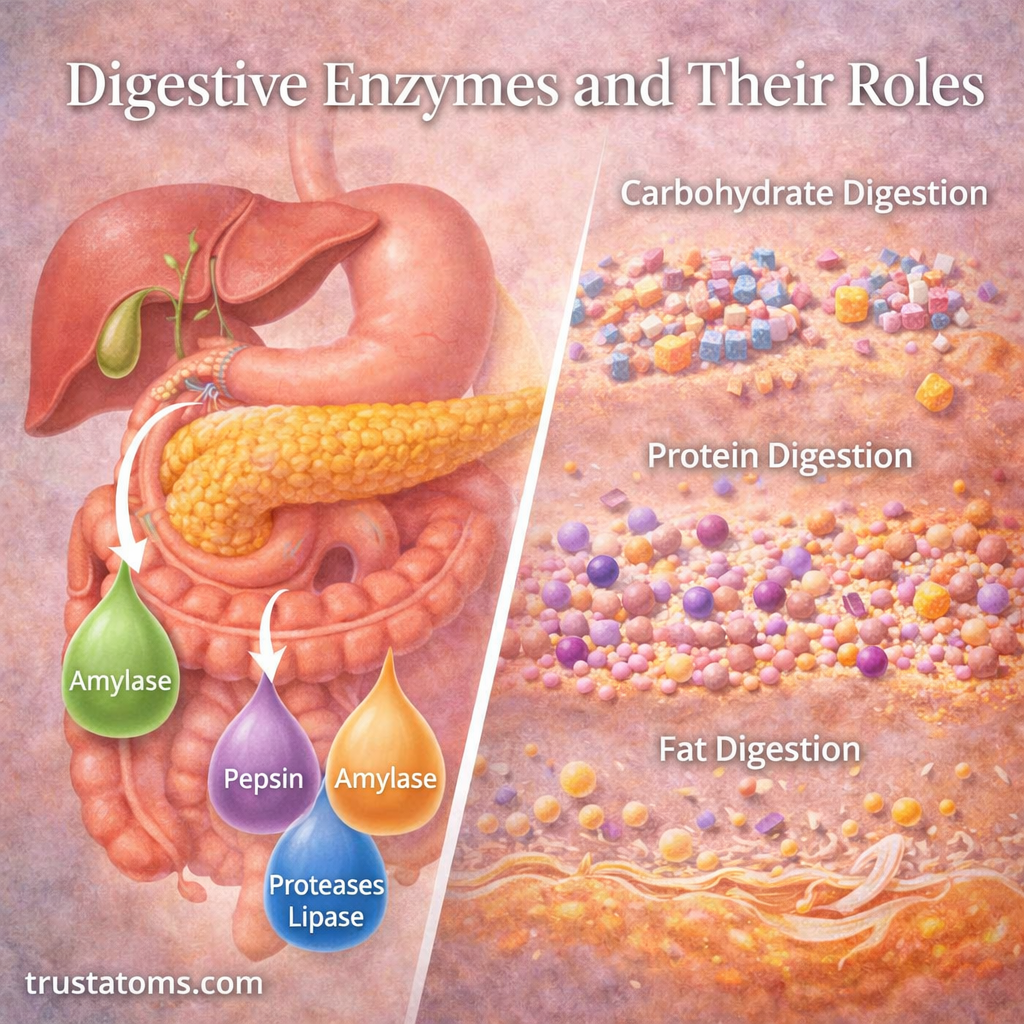
Digestive Enzymes and Their Roles

Illustration showing digestive enzymes breaking down carbohydrates, proteins, and fats in the human digestive system.
Diagram showing how digestive enzymes break down different nutrients during digestion. trustatoms.com.

Digestive enzymes are essential for breaking down the food we eat into nutrients the body can absorb and use. Without these specialized proteins, digestion would be incomplete, and the body would struggle to obtain energy and vital building blocks for growth and repair.

These enzymes work at different stages of digestion, each targeting specific nutrients such as carbohydrates, proteins, and fats.

Continue reading “Digestive Enzymes and Their Roles”
Pancreas Function in Digestion

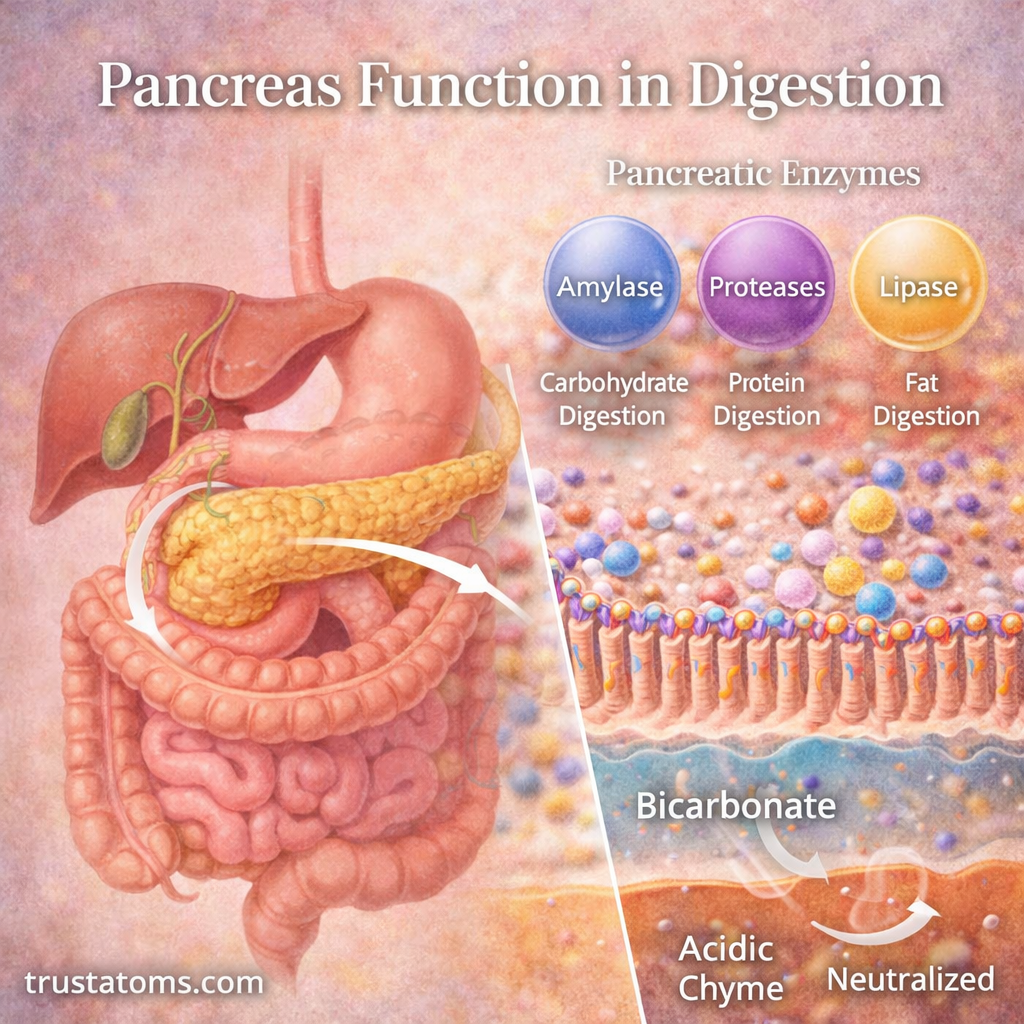
Illustration showing pancreas function in digestion with enzymes breaking down carbohydrates, proteins, and fats and bicarbonate neutralizing acid.
Diagram showing how the pancreas releases enzymes and bicarbonate to support digestion in the small intestine. trustatoms.com.

The pancreas is a vital organ in the digestive system, playing a key role in breaking down food and regulating blood sugar. While often associated with insulin production, the pancreas also produces powerful digestive enzymes that are essential for processing carbohydrates, proteins, and fats.

Understanding how the pancreas functions in digestion helps explain how the body efficiently converts food into usable nutrients.

Continue reading “Pancreas Function in Digestion”

Villi and Microvilli in Nutrient Uptake

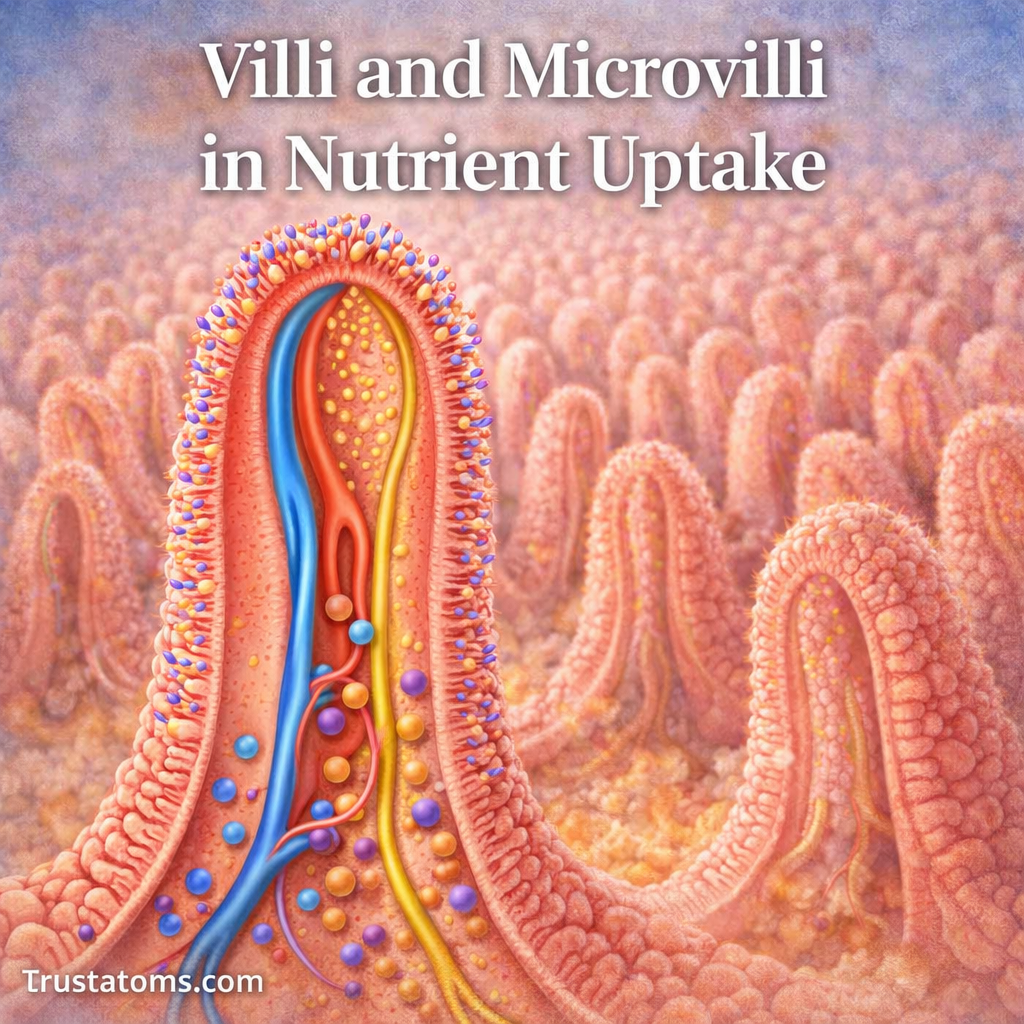
Illustration showing villi and microvilli in the small intestine absorbing nutrients into blood and lymph vessels.
Diagram showing how villi and microvilli absorb nutrients in the small intestine. trustatoms.com.

The human body relies on efficient nutrient absorption to maintain energy, growth, and overall health. At the center of this process are villi and microvilli, tiny structural adaptations in the small intestine that dramatically increase the surface area available for absorption.

Without these specialized features, the body would struggle to absorb enough nutrients from food.

Continue reading “Villi and Microvilli in Nutrient Uptake”

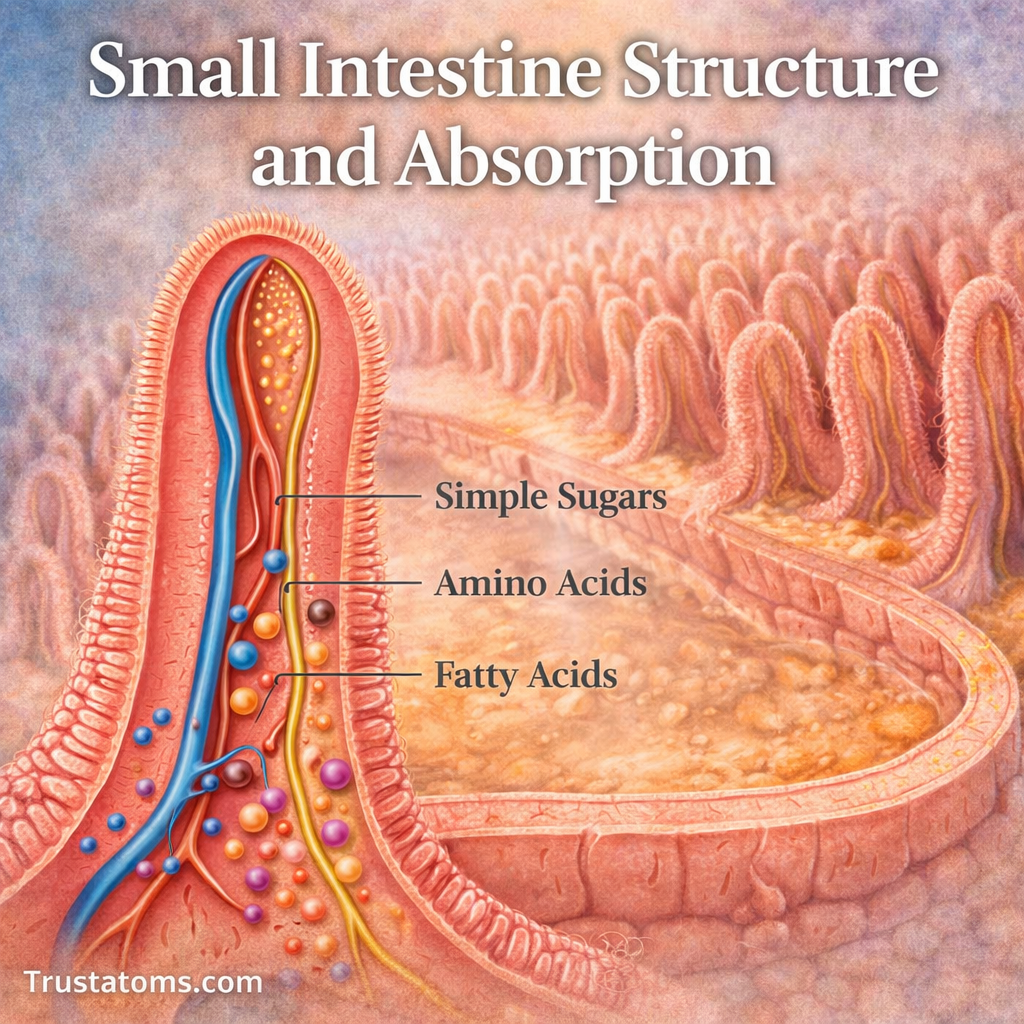
Small Intestine Structure and Absorption

Illustration of small intestine structure showing villi and nutrient absorption of sugars, amino acids, and fatty acids.
Diagram showing how the small intestine absorbs nutrients through villi and microvilli. trustatoms.com.

The small intestine is the primary site of nutrient absorption in the human body. While digestion begins in the mouth and stomach, it is in the small intestine where most nutrients are finally broken down and absorbed into the bloodstream.

Its structure is uniquely designed to maximize surface area and efficiency, allowing the body to extract essential nutrients from food.

Continue reading “Small Intestine Structure and Absorption”

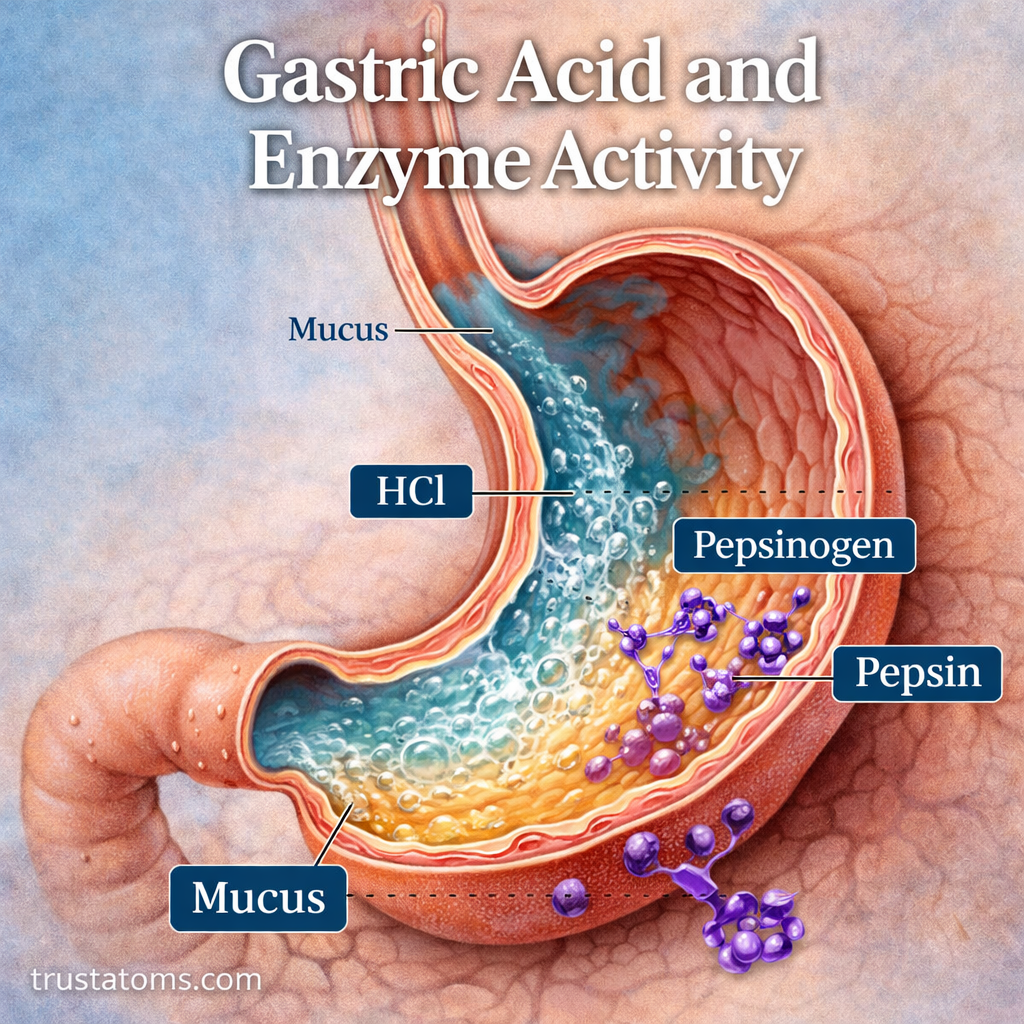
Gastric Acid and Enzyme Activity

Illustration showing gastric acid and enzyme activity in the stomach including hydrochloric acid and pepsin breaking down food.
Diagram showing how gastric acid and enzymes work together in the stomach during digestion. trustatoms.com.

The stomach is not only a muscular organ for mixing food—it is also a powerful chemical environment where digestion truly begins. Central to this process are gastric acid and digestive enzymes, which work together to break down food, especially proteins, into forms the body can absorb.

Understanding how gastric acid and enzymes function provides insight into one of the most important stages of digestion.

Continue reading “Gastric Acid and Enzyme Activity”

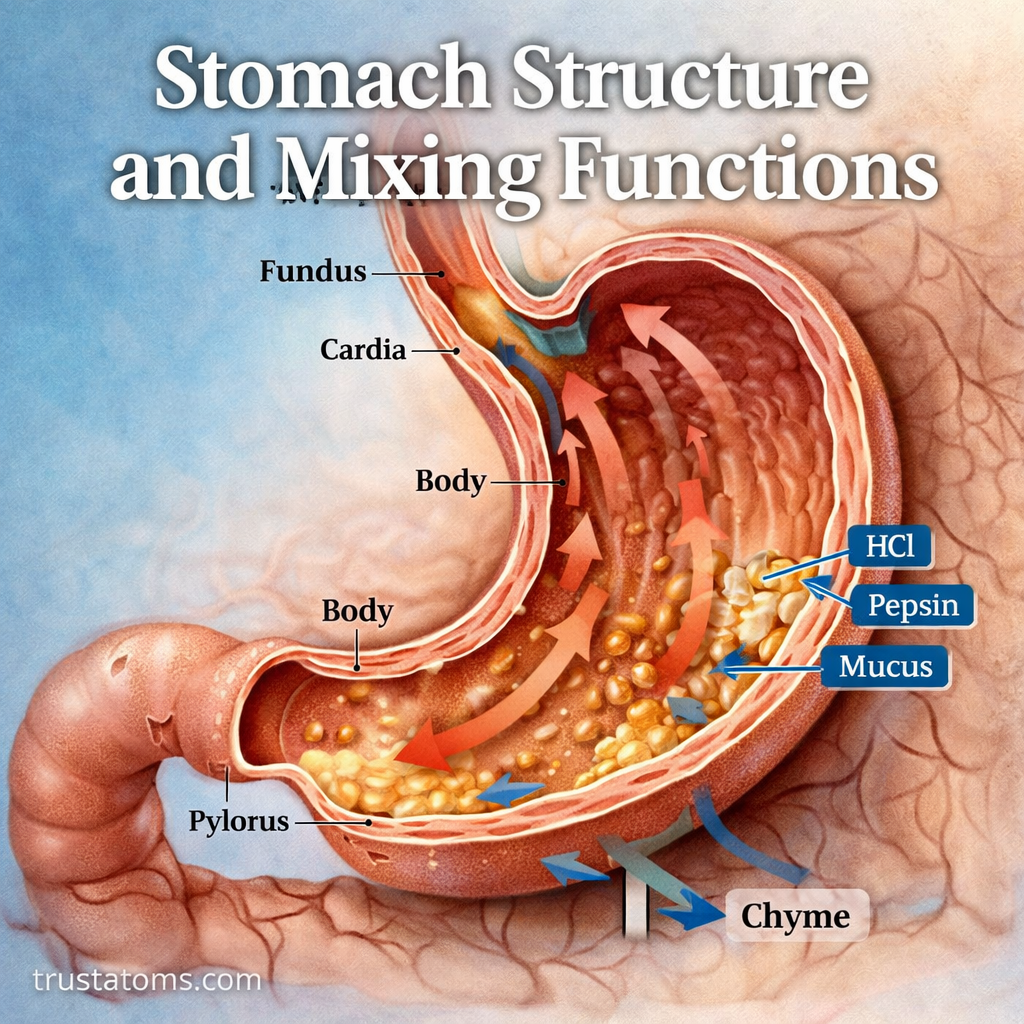
Stomach Structure and Mixing Functions

Illustration of stomach structure showing regions and mixing of food with digestive juices to form chyme.
Diagram showing stomach regions and how food is mixed with digestive juices during digestion. trustatoms.com.

The stomach plays a central role in digestion, acting as both a storage chamber and a powerful mixing organ. While it may seem like a simple sac, the stomach is a highly specialized structure designed to break down food mechanically and chemically before it enters the small intestine.

Understanding how the stomach is built—and how it mixes and processes food—reveals how the body efficiently prepares nutrients for absorption.

Continue reading “Stomach Structure and Mixing Functions”

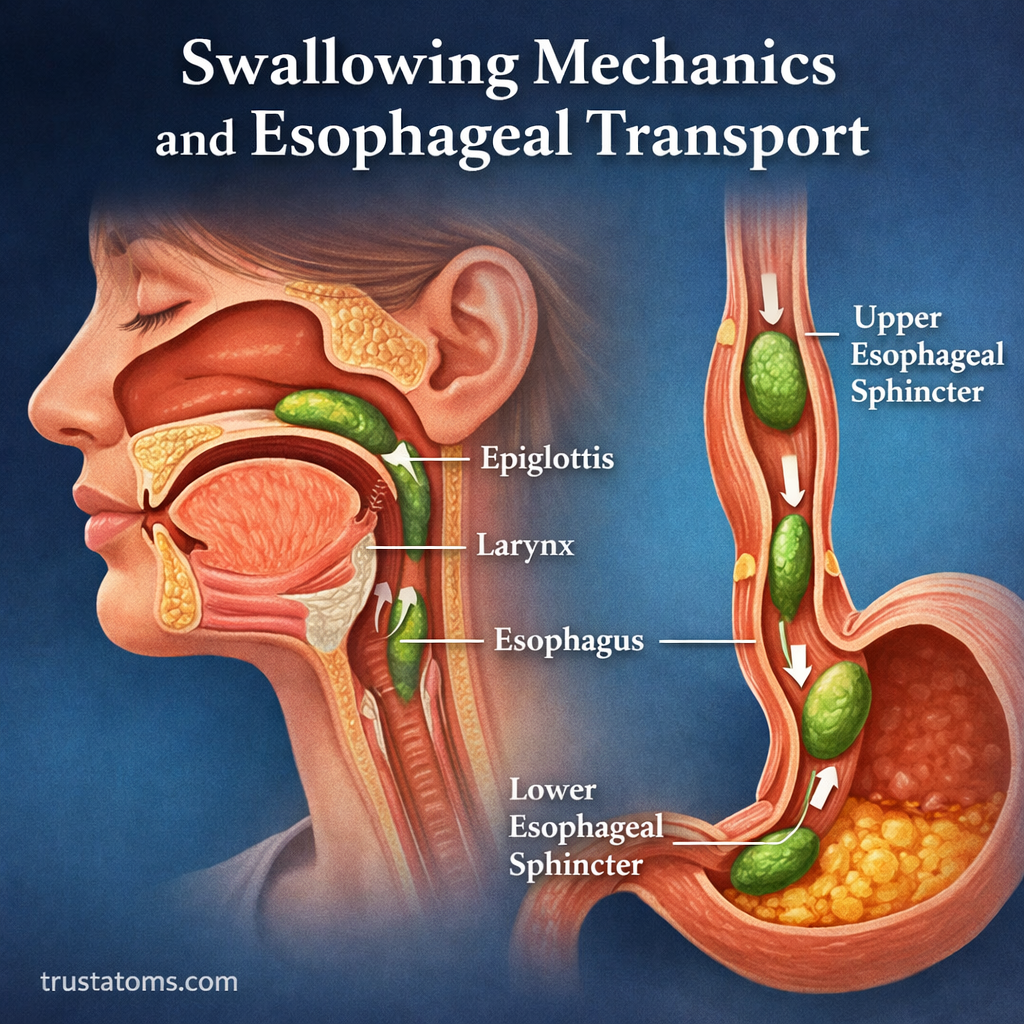
Swallowing Mechanics and Esophageal Transport

Illustration showing swallowing mechanics and esophageal transport with bolus movement from mouth to stomach.
Diagram illustrating how food moves through the throat and esophagus during swallowing. trustatoms.com.

Swallowing is something most people do hundreds of times a day without thinking. Behind this simple action is a highly coordinated sequence of muscular movements and reflexes that move food and liquids safely from the mouth to the stomach.

This process, known as deglutition, involves the mouth, throat (pharynx), and esophagus working together in precise timing to prevent choking and ensure efficient transport.

Continue reading “Swallowing Mechanics and Esophageal Transport”

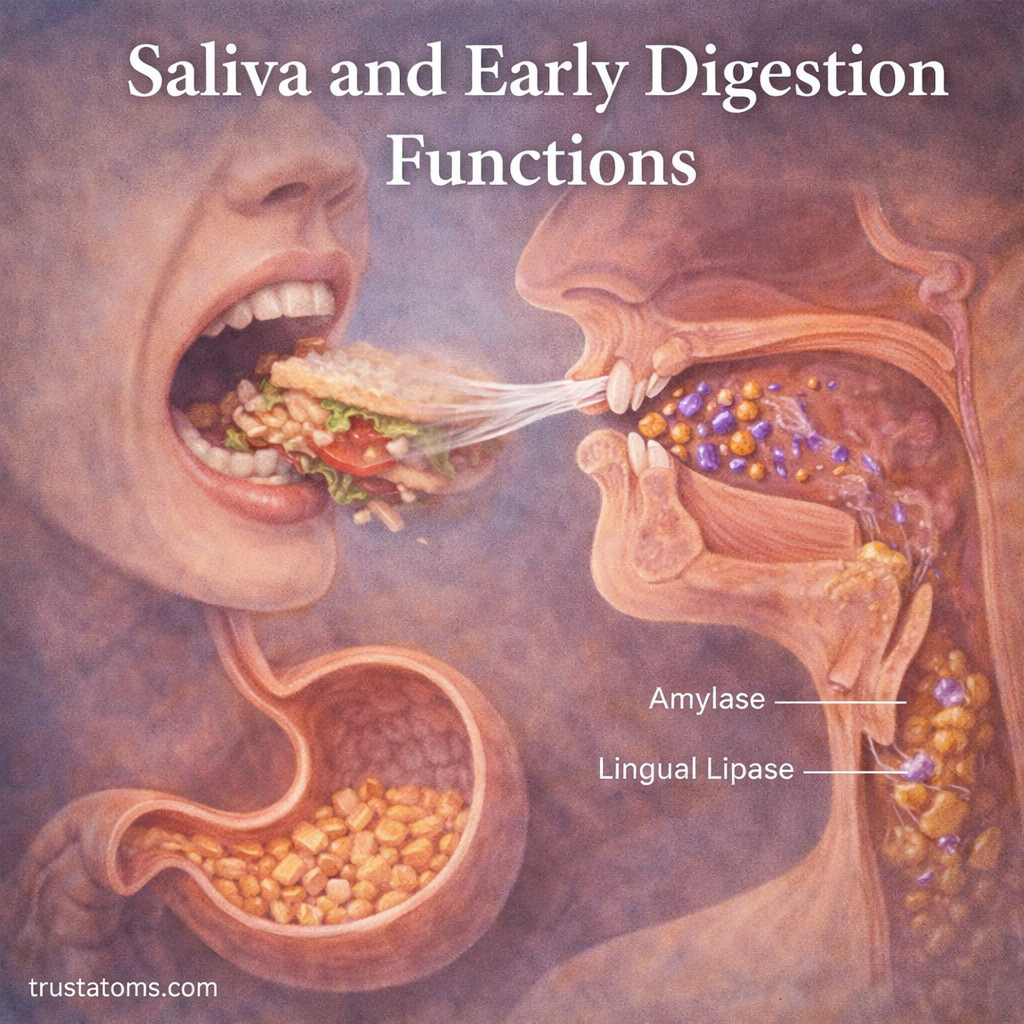
Saliva and Early Digestion Functions

Illustration showing saliva mixing with food in the mouth and beginning digestion before reaching the stomach.
Diagram showing how saliva starts the digestion process in the mouth. trustatoms.com.

Digestion begins the moment food enters your mouth. While it may seem simple, the early stages of digestion are essential for preparing food for the rest of the digestive process. One of the key players in this stage is saliva.

Saliva is more than just moisture—it contains enzymes and compounds that begin breaking down food, making swallowing easier and supporting overall digestive efficiency.

Continue reading “Saliva and Early Digestion Functions”

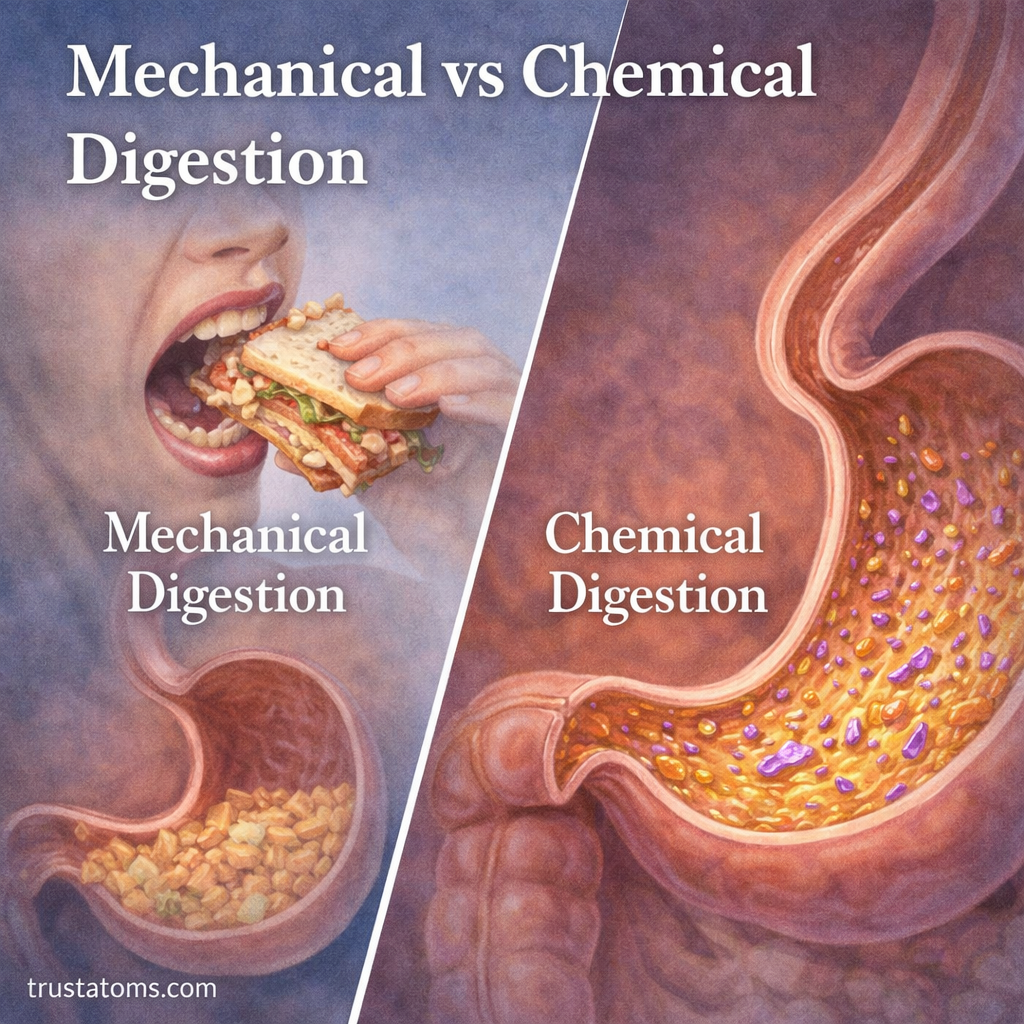
Mechanical vs Chemical Digestion

Split illustration comparing mechanical digestion in the mouth and stomach with chemical digestion in the stomach and intestines.
Visual comparison of mechanical and chemical digestion processes in the human digestive system. trustatoms.com.

Digestion is the process by which the body breaks down food into nutrients that can be absorbed and used for energy, growth, and repair. This process occurs in two main ways: mechanical digestion and chemical digestion.

While both work together seamlessly, they serve different roles. Mechanical digestion physically breaks food into smaller pieces, while chemical digestion uses enzymes and acids to break food down at the molecular level.

Understanding the difference between these two processes helps explain how the body efficiently extracts nutrients from everything you eat.

Continue reading “Mechanical vs Chemical Digestion”

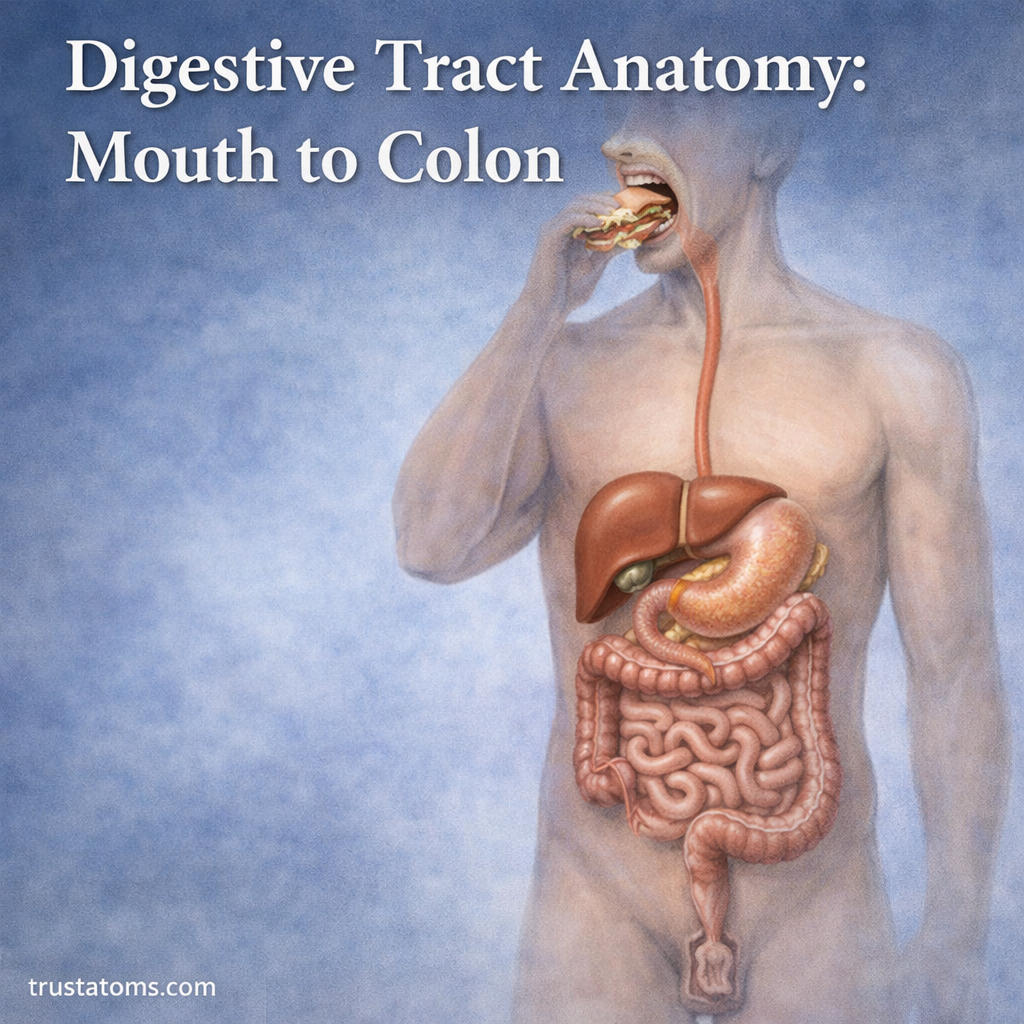
Digestive Tract Anatomy: Mouth to Colon

Illustration of digestive tract anatomy from mouth to colon showing major organs including stomach, small intestine, and large intestine.
Diagram of the digestive tract from mouth to colon highlighting the flow of food through key organs. trustatoms.com.

The digestive tract, also known as the gastrointestinal (GI) tract, is a continuous tube that runs from the mouth to the colon. Its primary role is to process food, absorb nutrients, and eliminate waste.

Each section of the digestive tract has a specialized structure and function, working together in a coordinated system that supports overall health and energy production.

Continue reading “Digestive Tract Anatomy: Mouth to Colon”