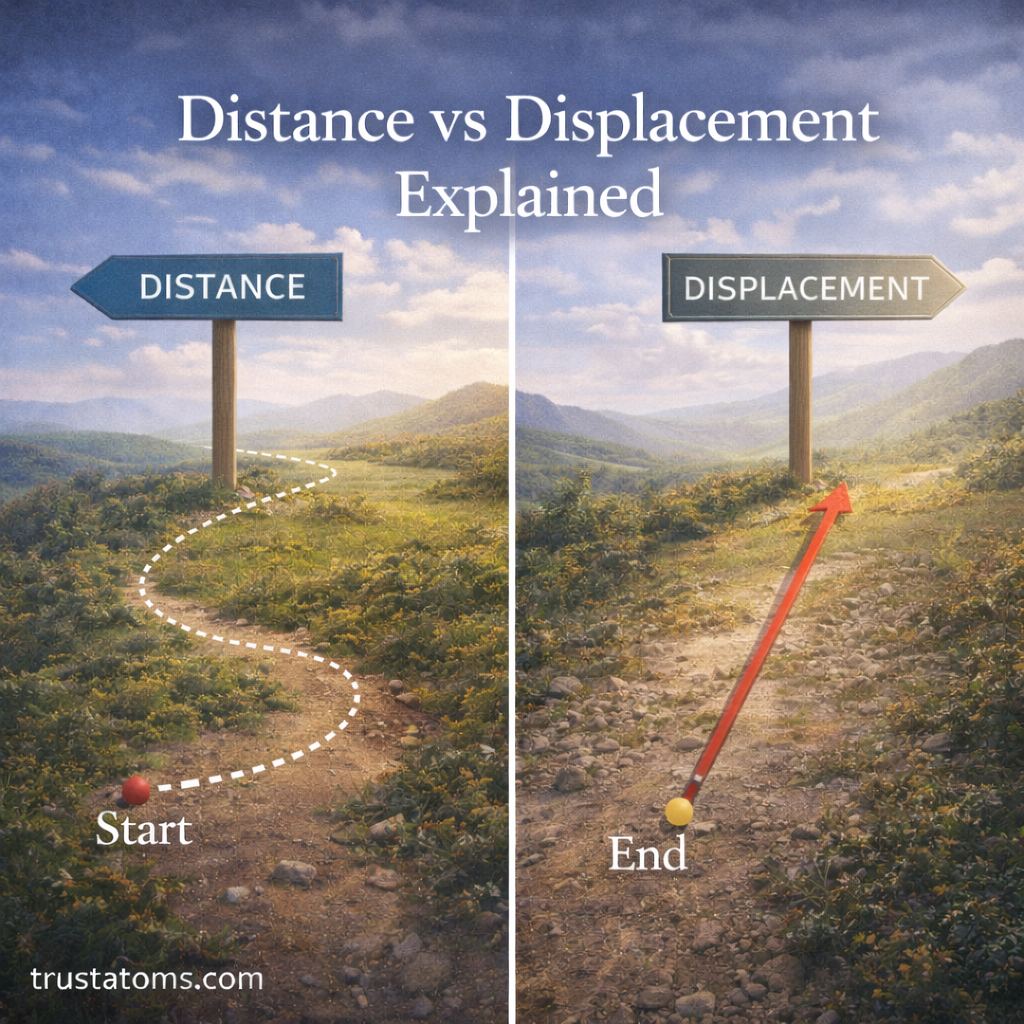
Distance vs Displacement Explained

Educational illustration comparing distance and displacement using a winding path versus a straight arrow from start to end.
Illustration comparing distance and displacement, showing a curved path traveled versus the straight-line direction between start and end points. trustatoms.com.

In physics, describing motion accurately requires understanding two closely related concepts: distance and displacement. Although these terms may seem similar in everyday conversation, they have distinct meanings in scientific measurements.

Distance refers to how far an object travels, while displacement describes how far an object moves from its starting point in a specific direction.

Understanding the difference between these two concepts is essential for studying motion, velocity, and many other topics in physics.

Continue reading “Distance vs Displacement Explained”
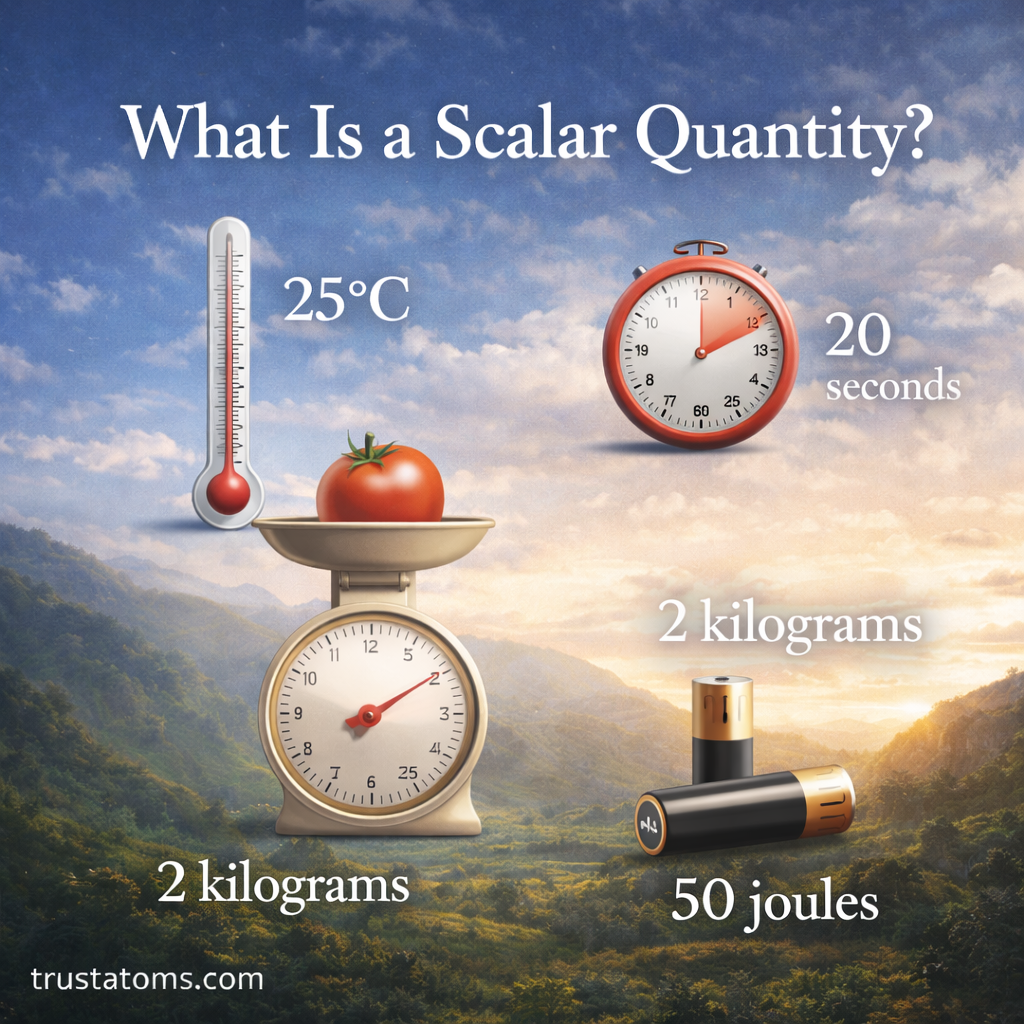
What Is a Scalar Quantity?

Educational illustration showing examples of scalar quantities such as temperature, time, mass, and energy.
Illustration showing common scalar quantities in physics including temperature, time, mass, and energy measurements. trustatoms.com.

In physics, many quantities are used to describe how objects behave and interact. Some quantities only require a number to fully describe them, while others require both a number and a direction.

A scalar quantity is a physical quantity that has magnitude only and no direction.

Scalars are among the most common quantities used in physics and everyday measurements. Examples include temperature, mass, energy, and time. Understanding scalar quantities is an important step toward learning how scientists measure and describe the physical world.

Continue reading “What Is a Scalar Quantity?”

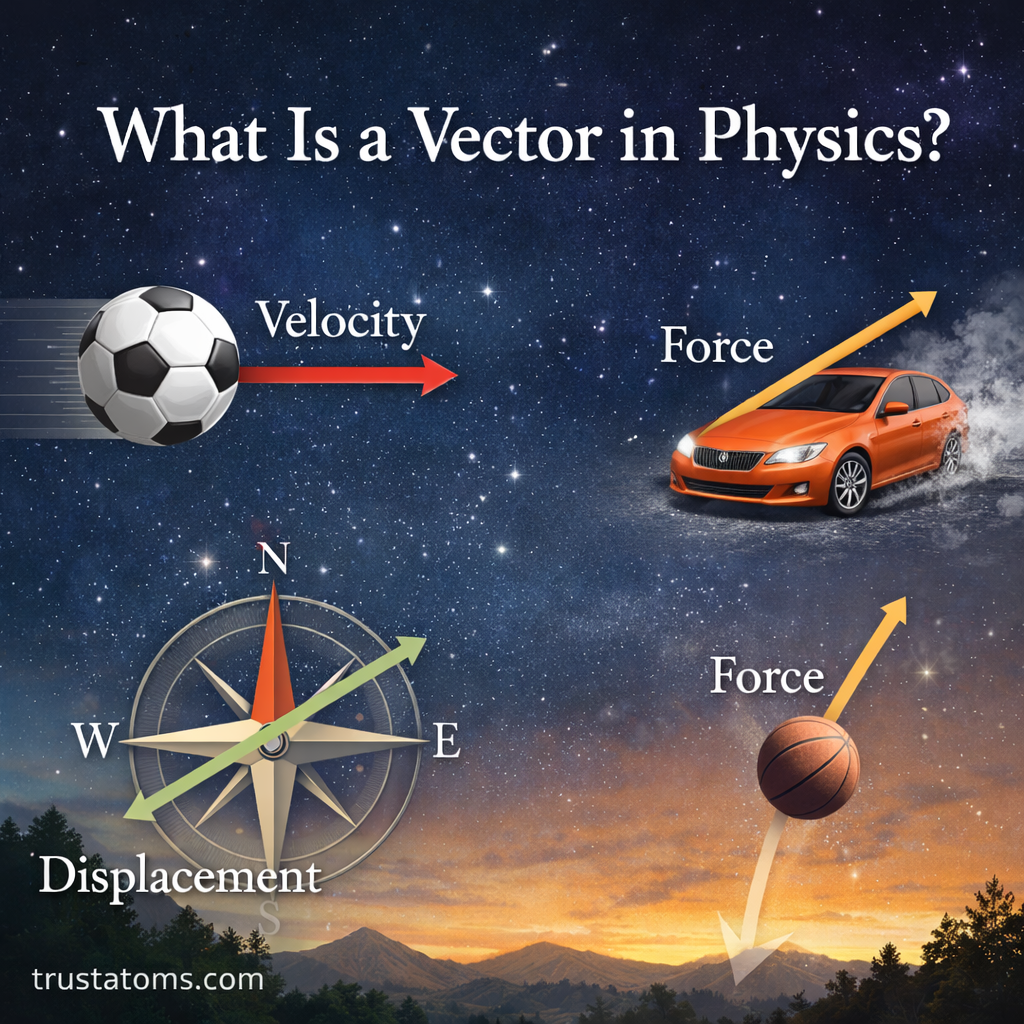
What Is a Vector in Physics?

Educational illustration showing arrows representing velocity, force, and displacement to explain vectors in physics.
Illustration showing examples of vectors in physics such as velocity, force, and displacement represented with directional arrows. trustatoms.com.

In physics, many quantities describe how things move, interact, and change. Some of these quantities only require a number to describe them, while others require both a number and a direction.

A vector is a physical quantity that has both magnitude and direction.

Vectors are essential in physics because many real-world phenomena—such as motion, forces, and fields—depend not only on how strong something is but also which direction it acts.

Understanding vectors is fundamental to studying mechanics, electromagnetism, and many other areas of physics.

Continue reading “What Is a Vector in Physics?”

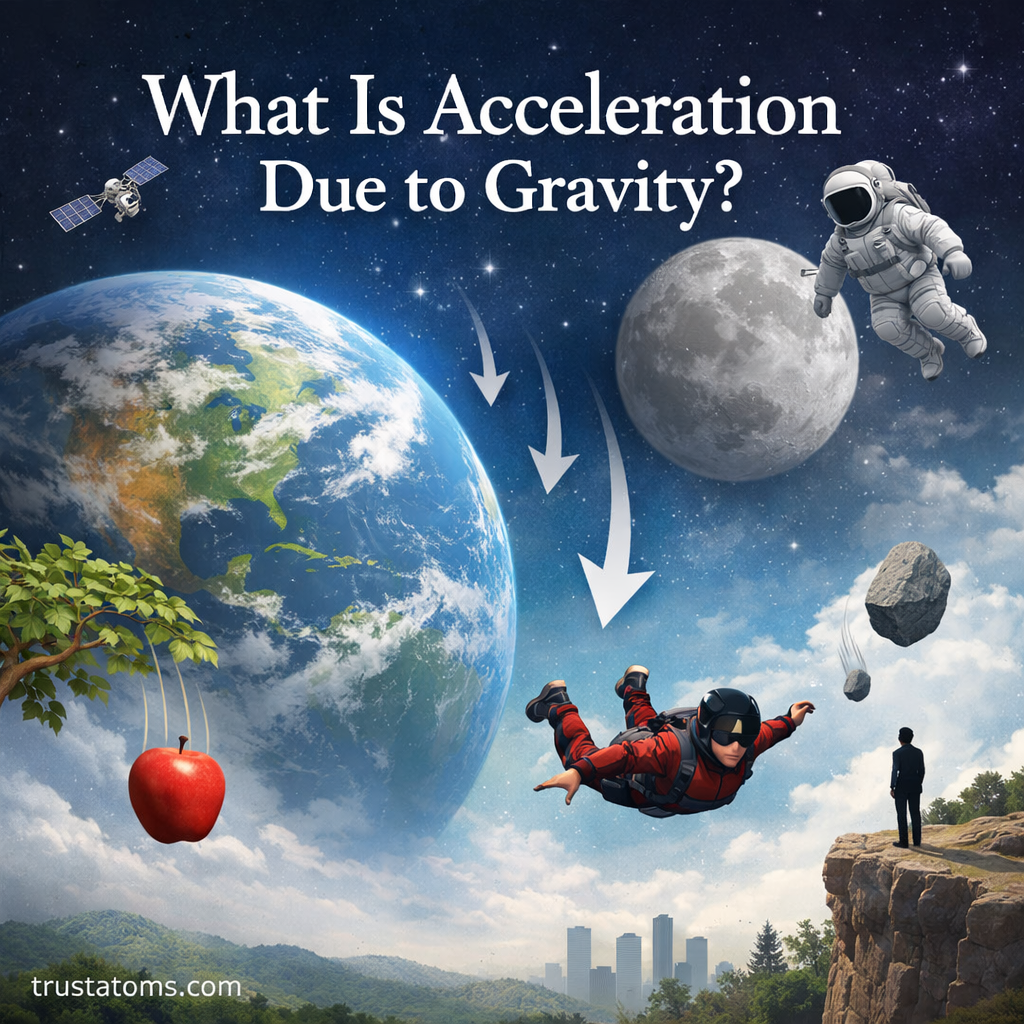
What Is Acceleration Due to Gravity?

Educational illustration showing objects falling toward Earth to explain acceleration due to gravity.
Illustration demonstrating how gravity pulls objects toward Earth, explaining the concept of acceleration due to gravity. trustatoms.com.

Acceleration due to gravity is one of the most fundamental concepts in physics. It describes how objects accelerate when they fall toward a massive body, such as Earth. Whether you drop a ball, jump into the air, or watch rain fall, the motion you see is controlled by gravity.

Understanding acceleration due to gravity helps explain everything from everyday motion on Earth to the movement of planets, satellites, and spacecraft.

Continue reading “What Is Acceleration Due to Gravity?”

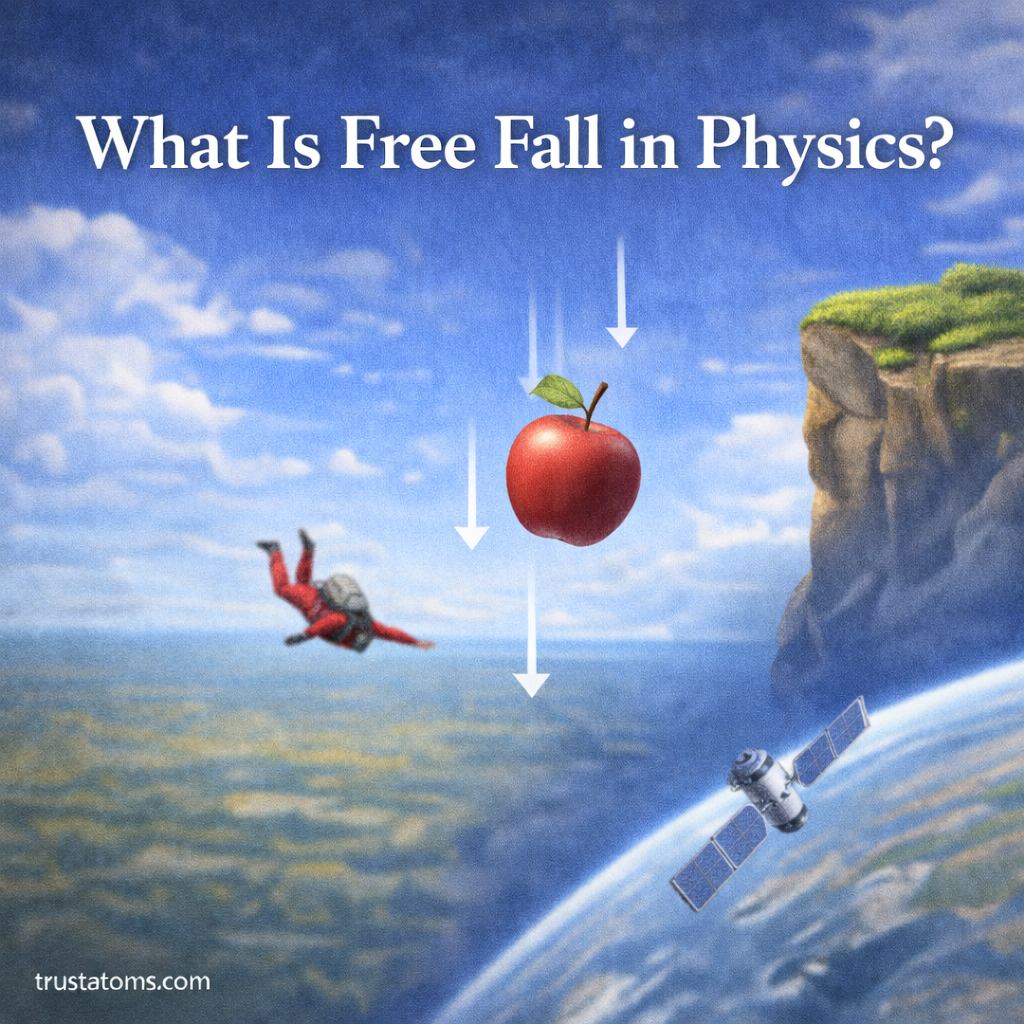
What Is Free Fall in Physics?

Educational illustration showing an apple falling from a cliff, a skydiver descending, and a satellite orbiting Earth to demonstrate free fall in physics.
Illustration demonstrating free fall in physics with examples including a falling apple, a skydiver in descent, and a satellite orbiting Earth. trustatoms.com.

Free fall is a fundamental concept in physics that describes the motion of an object when gravity is the only force acting on it. When an object is in free fall, it accelerates toward Earth due to gravity alone, without interference from forces such as air resistance.

This concept helps scientists and students understand how objects move under the influence of gravity. Free fall explains phenomena ranging from a dropped ball to the motion of objects in space and the behavior of falling bodies on Earth.

Continue reading “What Is Free Fall in Physics?”

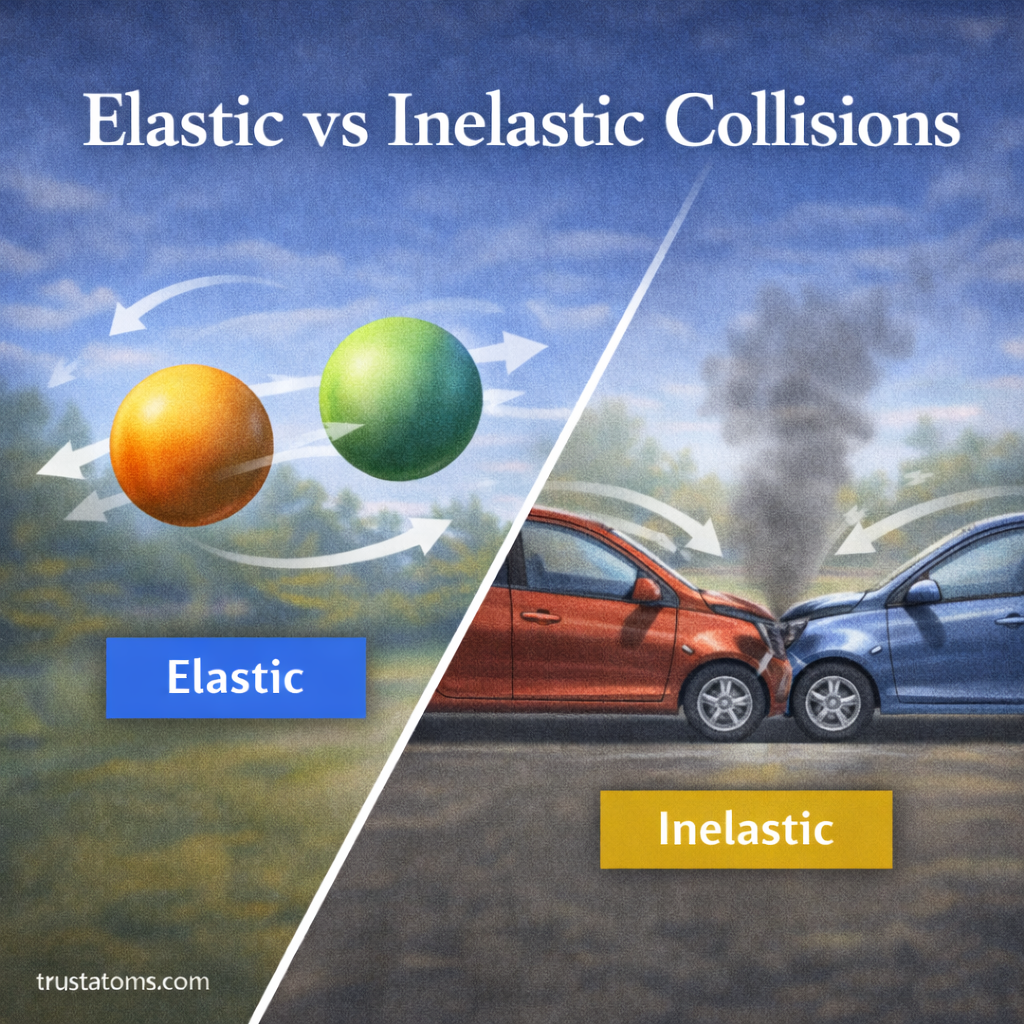
Elastic vs Inelastic Collisions

Educational illustration comparing elastic and inelastic collisions with bouncing balls on one side and a car crash on the other.
Illustration comparing elastic and inelastic collisions, showing bouncing balls and a car crash to demonstrate different collision outcomes. trustatoms.com.

Collisions are a fundamental part of physics and occur whenever two objects come into contact and exert forces on each other. From bouncing balls to car crashes and atomic particle interactions, collisions help scientists understand how energy and motion behave.

Two major types of collisions studied in physics are elastic collisions and inelastic collisions. The key difference between them lies in how kinetic energy behaves during the interaction.

Understanding the distinction between elastic and inelastic collisions helps explain many everyday phenomena and plays an important role in fields such as engineering, transportation safety, and particle physics.

Continue reading “Elastic vs Inelastic Collisions”

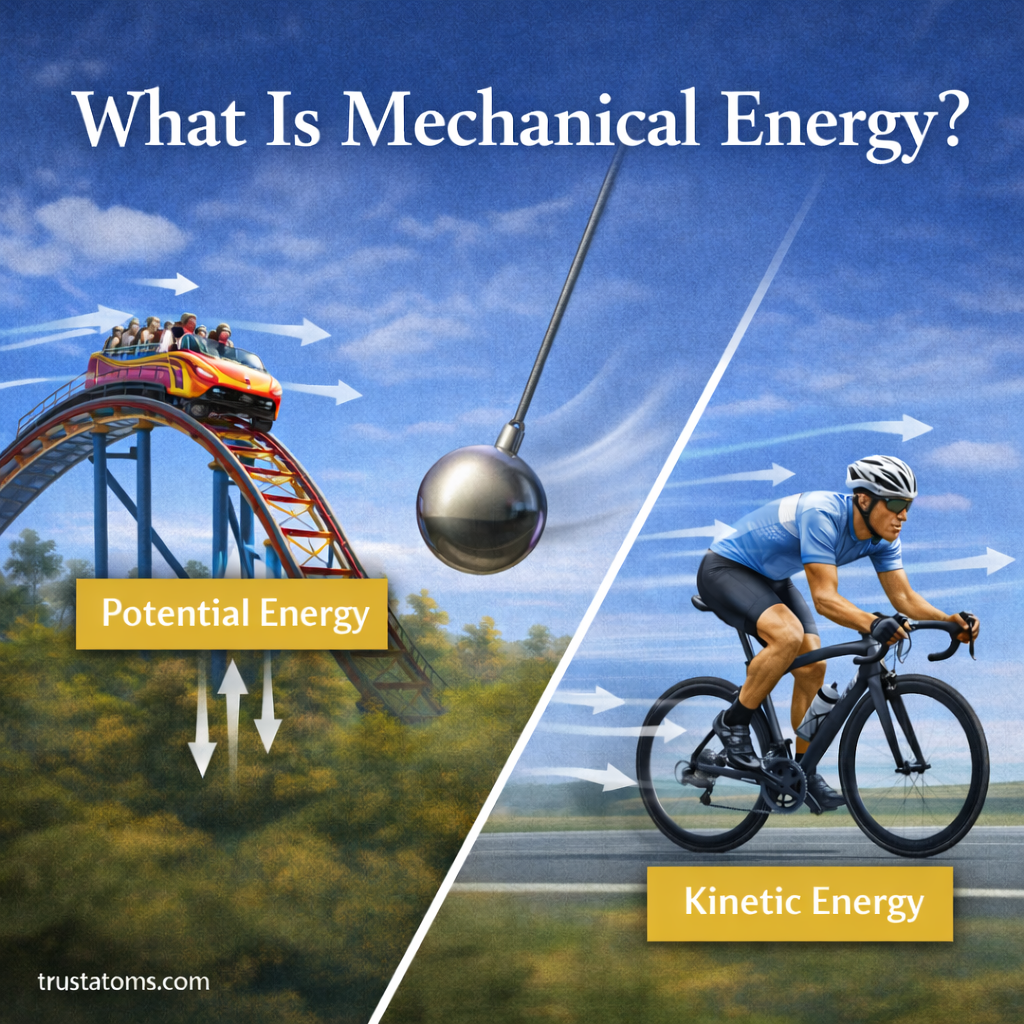
What Is Mechanical Energy?

Educational illustration showing a roller coaster at the top of a hill, a swinging pendulum, and a cyclist moving to demonstrate mechanical energy.
Illustration showing examples of mechanical energy with a roller coaster, pendulum, and cyclist representing potential and kinetic motion. trustatoms.com.

Mechanical energy is the energy associated with the motion and position of objects. It is one of the most fundamental concepts in physics and plays a major role in how objects move, interact, and perform work.

In simple terms, mechanical energy is the sum of two main types of energy:

  • Kinetic energy (energy of motion)
  • Potential energy (stored energy due to position or configuration)

Whenever an object moves, falls, stretches, or compresses, mechanical energy is involved.

Understanding mechanical energy helps explain many everyday phenomena—from a swinging pendulum and a rolling ball to roller coasters and moving vehicles.

Continue reading “What Is Mechanical Energy?”

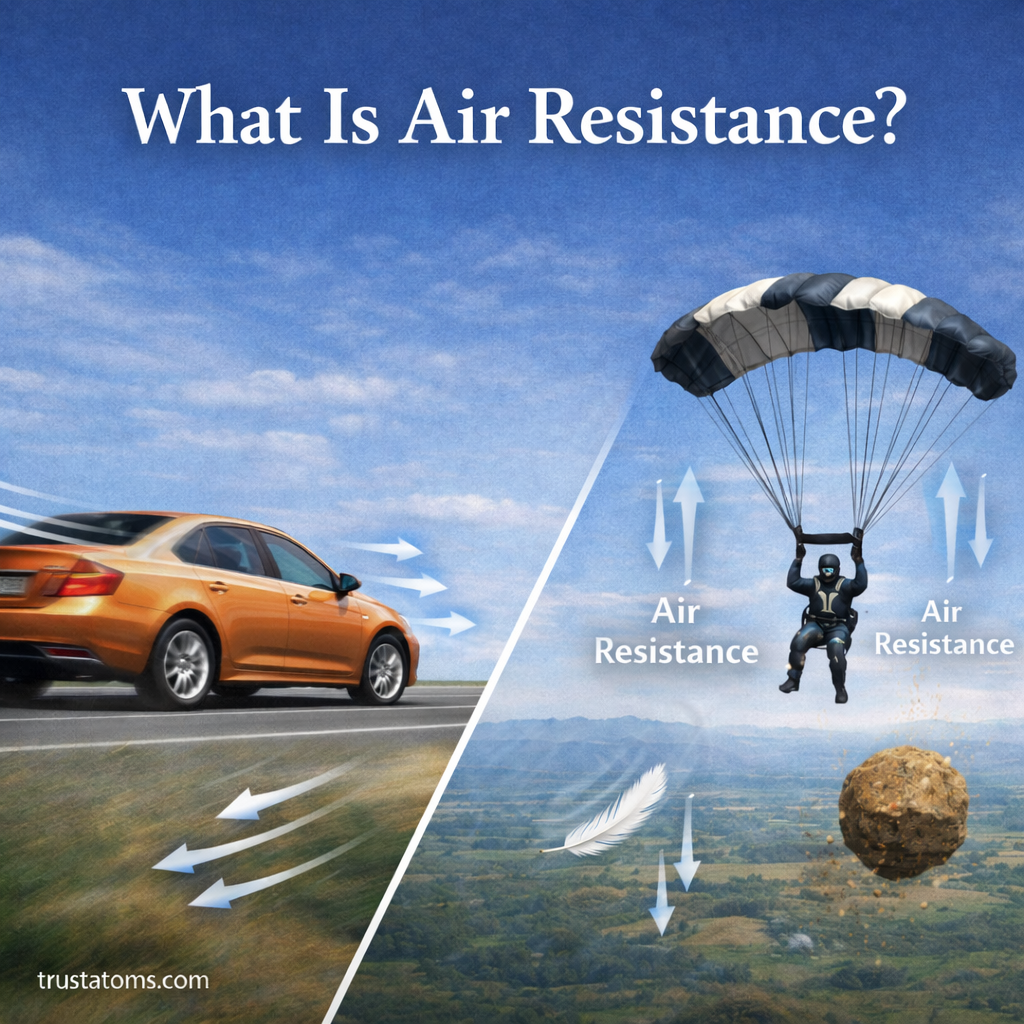
What Is Air Resistance?

Educational illustration showing a car driving and a skydiver falling to demonstrate air resistance acting against motion through the atmosphere.
Illustration demonstrating air resistance with examples of a moving car and falling skydiver experiencing drag from the surrounding air. trustatoms.com.

Air resistance is the force that opposes the motion of objects moving through air. It acts in the opposite direction of movement and slows objects down as they travel through the atmosphere.

In physics, air resistance is a type of drag force, which occurs whenever an object moves through a fluid. Although we often think of fluids as liquids like water, air is also a fluid, meaning it can flow and exert forces on moving objects.

Air resistance plays a major role in everyday situations—from falling leaves and parachutes to cars driving on highways and airplanes flying through the sky.

Continue reading “What Is Air Resistance?”

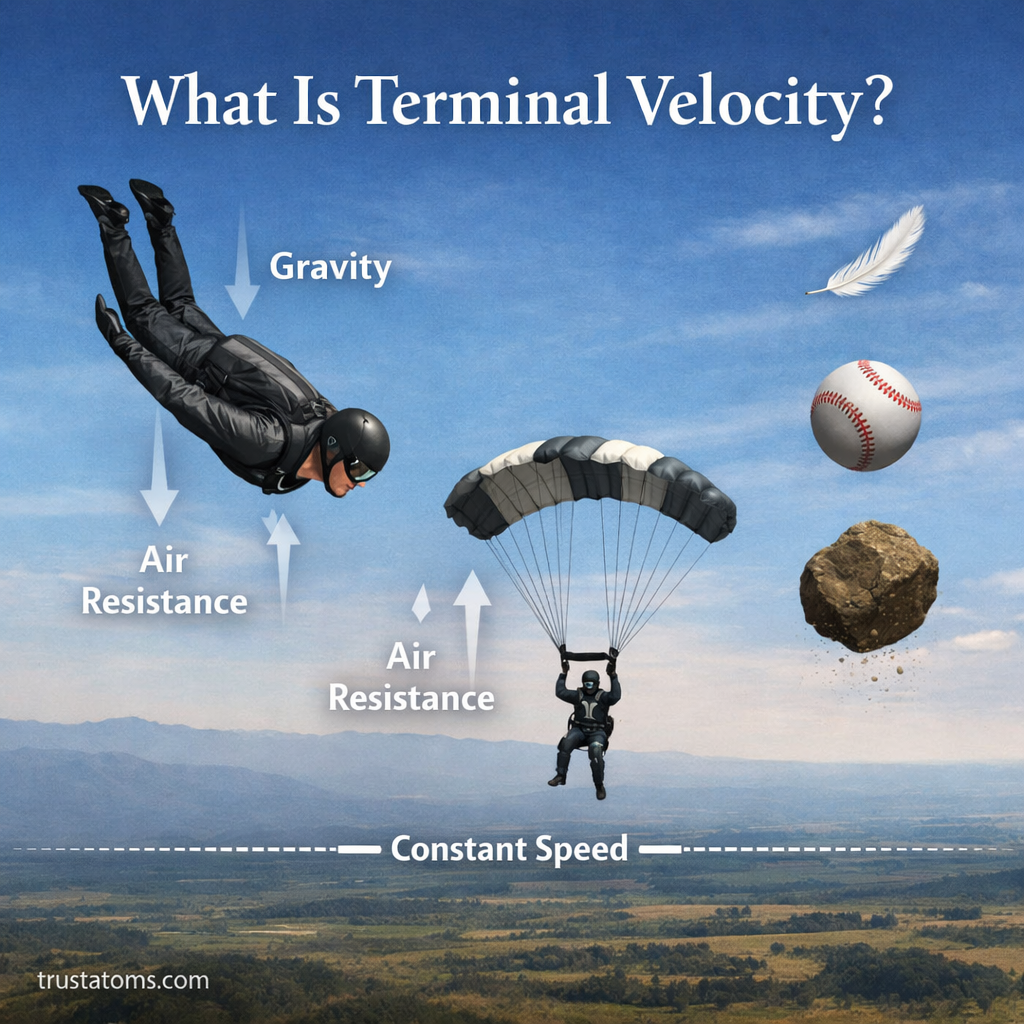
What Is Terminal Velocity?

Illustrated diagram of a skydiver and falling objects demonstrating terminal velocity with gravity and air resistance in the atmosphere.
Simple educational illustration explaining terminal velocity with a skydiver and falling objects in the atmosphere. trustatoms.com.

Terminal velocity is the maximum speed an object reaches while falling through a fluid, usually air, when the downward pull of gravity is balanced by the upward force of drag (air resistance). Once this balance occurs, the object stops accelerating and continues falling at a constant speed.

Understanding terminal velocity helps explain everyday phenomena such as why raindrops fall at limited speeds, how parachutes work, and why different objects fall at different rates in the atmosphere.

Continue reading “What Is Terminal Velocity?”

Integrated Biological Network Systems

Scientific illustration showing interconnected biological networks including DNA, proteins, signaling pathways, and organs representing integrated biological systems.
Illustration showing how genes, proteins, signaling pathways, and organ systems connect to form integrated biological networks. trustatoms.com.

Living organisms function through vast interconnected systems rather than isolated biological processes. Cells, tissues, organs, and entire organisms rely on integrated biological network systems to coordinate complex activities such as metabolism, growth, communication, and adaptation.

These networks link genes, proteins, signaling molecules, and cellular pathways into dynamic systems that exchange information and regulate biological functions. Instead of operating independently, biological components interact continuously, forming networks that maintain stability and allow organisms to respond to internal and external changes.

Understanding integrated biological networks has become a central focus of modern biology, especially in fields like systems biology, bioinformatics, and biomedical research.

Continue reading “Integrated Biological Network Systems”