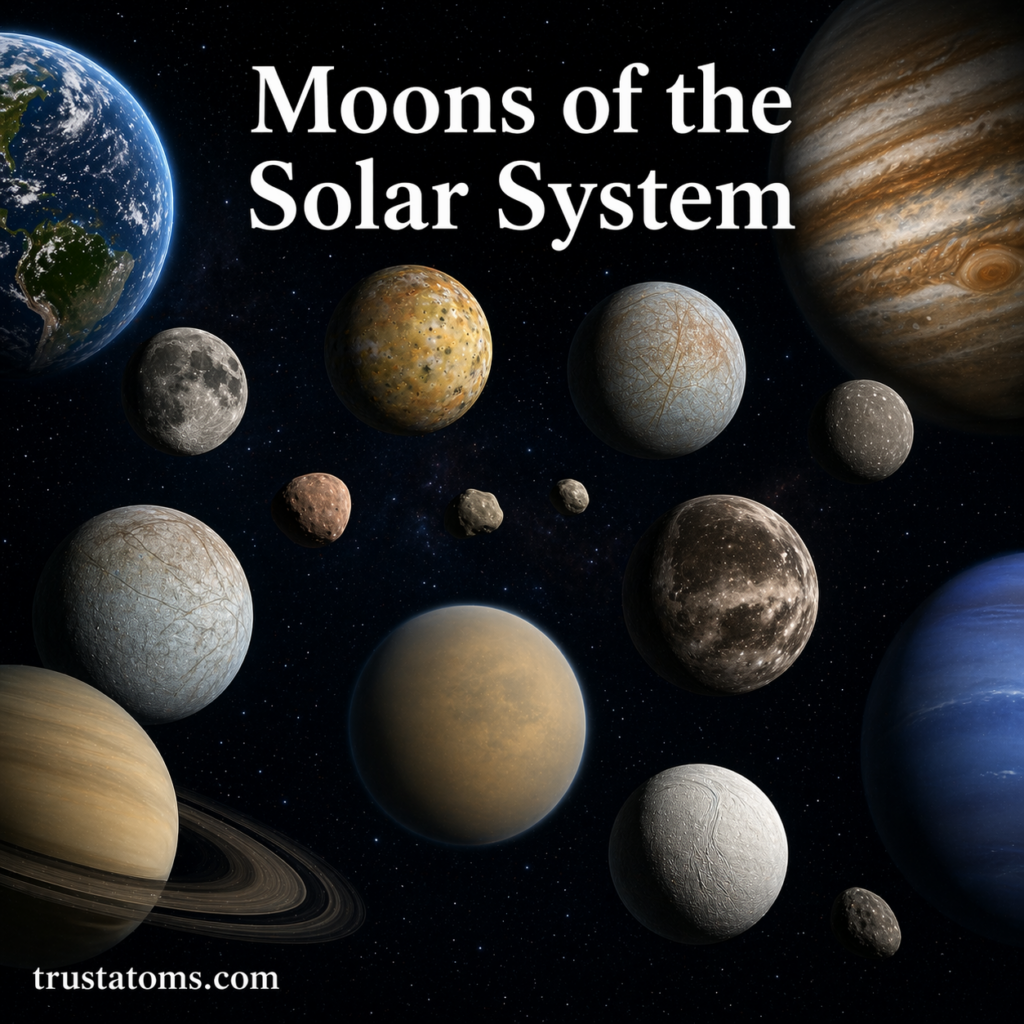
Moons—also called natural satellites—are some of the most fascinating objects in our solar system. They orbit planets, dwarf planets, and even asteroids, and they come in a wide range of sizes, compositions, and environments.
From Earth’s familiar Moon to icy worlds like Europa and Titan, these celestial bodies play a key role in shaping planetary systems and may even hold clues about extraterrestrial life.
What Is a Moon?
A moon is a natural object that orbits a larger celestial body, typically a planet or dwarf planet.
Unlike artificial satellites, moons form naturally through processes such as:
- Accretion (gradual buildup of material)
- Capture (gravitational trapping of passing objects)
- Giant impacts (debris from collisions forming into orbiting bodies)
Moons are found throughout the solar system, with some planets hosting dozens—or even hundreds—of them.
How Many Moons Are in the Solar System?
As of today, there are over 200 confirmed moons orbiting planets in our solar system.
Breakdown by Planet
- Mercury: 0 moons
- Venus: 0 moons
- Earth: 1 moon
- Mars: 2 moons
- Jupiter: 90+ moons
- Saturn: 140+ moons
- Uranus: 25+ moons
- Neptune: 14+ moons
Gas giants dominate in terms of moon count due to their strong gravity and large size.
Types of Moons
Moons vary widely in origin and characteristics.
Regular Moons
- Orbit close to their planet
- Follow circular, predictable paths
- Formed alongside their planet
Examples: Earth’s Moon, Jupiter’s Galilean moons
Irregular Moons
- Have distant, elliptical orbits
- Often tilted or retrograde (orbiting backward)
- Likely captured objects
Shepherd Moons
- Help maintain planetary rings
- Use gravity to shape and stabilize ring systems
Example: Saturn’s ring moons
Notable Moons of the Solar System
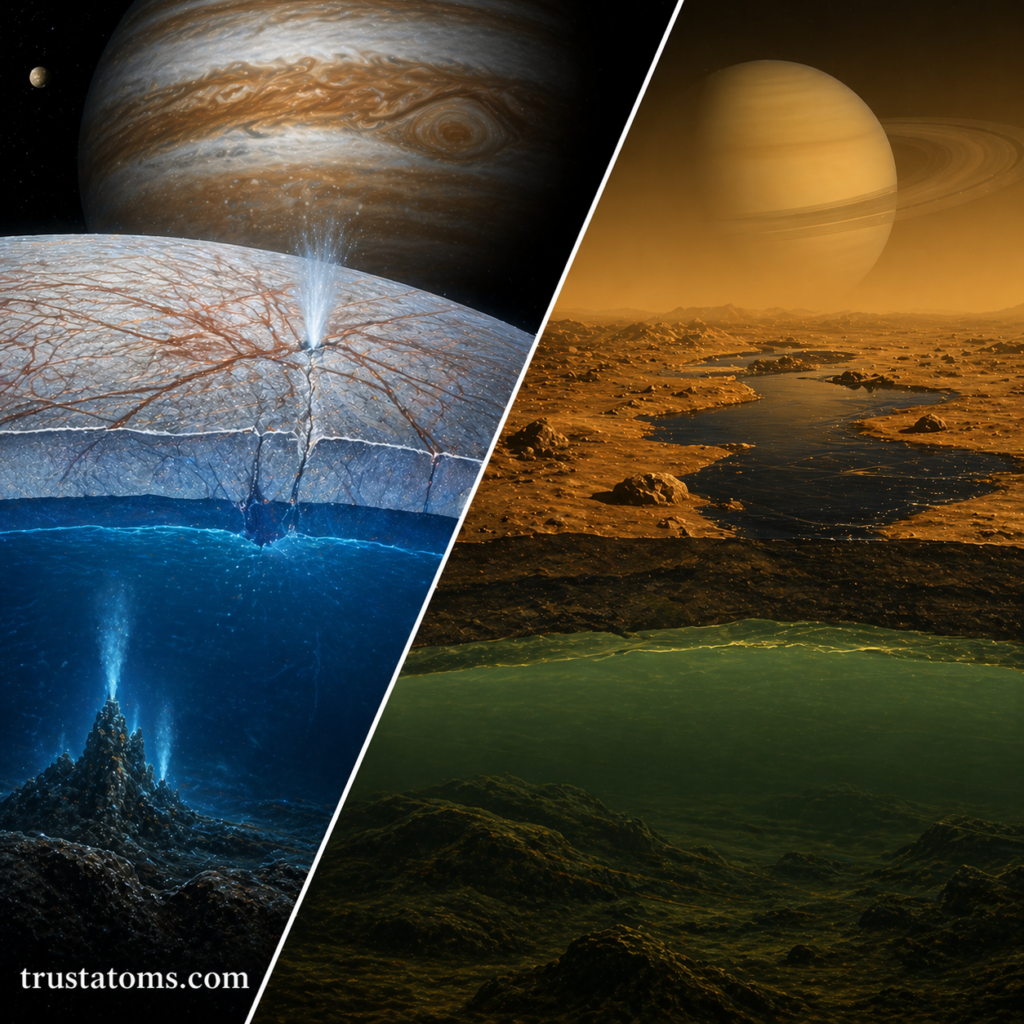
Some moons stand out due to their unique features and scientific importance.
Earth’s Moon
- The fifth-largest moon in the solar system
- Stabilizes Earth’s axial tilt
- Influences tides and climate patterns
Europa (Jupiter)
- Covered in ice with a subsurface ocean
- One of the top candidates for extraterrestrial life
Ganymede (Jupiter)
- The largest moon in the solar system
- Larger than the planet Mercury
- Has its own magnetic field
Titan (Saturn)
- Thick atmosphere rich in nitrogen
- Lakes and rivers of liquid methane
- Complex chemistry similar to early Earth
Enceladus (Saturn)
- Spews water vapor from icy geysers
- Evidence of a subsurface ocean
Triton (Neptune)
- Orbits in the opposite direction of Neptune’s rotation
- Likely a captured object
- Has active geysers
Why Moons Matter
Moons are more than just companions to planets—they influence planetary systems in powerful ways.
Gravitational Effects
Moons can:
- Stabilize a planet’s rotation
- Affect tides and ocean movement
- Influence long-term climate patterns
Geological Activity
Some moons are geologically active due to tidal forces:
- Volcanism (e.g., Io)
- Ice geysers (e.g., Enceladus)
- Subsurface oceans (e.g., Europa)
Potential for Life
Several moons are considered promising locations for life beyond Earth due to:
- Liquid water beneath icy surfaces
- Energy sources from tidal heating
- Organic chemical presence
How Moons Form
There are three main theories explaining moon formation.
1. Co-Formation
Moons form alongside their planet from the same disk of material.
2. Capture
A planet’s gravity captures a passing object, pulling it into orbit.
3. Giant Impact
A large collision ejects debris into orbit, which later forms a moon.
Earth’s Moon is believed to have formed through a giant impact event.
Moons vs Planets: Key Differences
While moons and planets may look similar, they have key distinctions.
Moons
- Orbit planets or dwarf planets
- Usually smaller
- Do not clear their orbital path
Planets
- Orbit the Sun directly
- Have stronger gravitational dominance
- Clear debris from their orbit
Moons Beyond the Solar System
Scientists are actively searching for exomoons—moons orbiting planets outside our solar system.
Why They Matter
- Could expand our understanding of planetary systems
- May increase the number of habitable environments
- Help explain planet formation processes
Although none have been definitively confirmed yet, candidates are being studied using advanced telescopes.
Future Exploration of Moons
Moons are a major focus of modern space missions.
Upcoming and Ongoing Missions
- Exploring Europa’s subsurface ocean
- Studying Titan’s atmosphere and surface
- Analyzing icy plumes from Enceladus
These missions aim to answer fundamental questions about habitability and the origins of life.
Final Thoughts
Moons of the solar system are diverse, dynamic, and scientifically valuable. From shaping planetary environments to offering potential habitats for life, they are essential to understanding the broader universe.
As exploration continues, moons may hold some of the most important discoveries in astronomy—including the possibility that life exists beyond Earth.