Measuring the distance to stars is one of the most important tasks in astronomy. Before astronomers can understand how bright, large, or old a star is, they first need to know how far away it is.
One of the most reliable and fundamental methods for doing this is parallax. It’s a simple concept based on geometry, yet it forms the foundation of modern stellar measurement.
What Is Parallax?
Parallax is the apparent shift in position of an object when viewed from different angles.
You’ve likely experienced this yourself:
- Hold your finger in front of your face
- Close one eye, then switch
- Your finger appears to move
That shift is parallax—and astronomers use the same idea to measure distances to nearby stars.
How Parallax Works in Astronomy
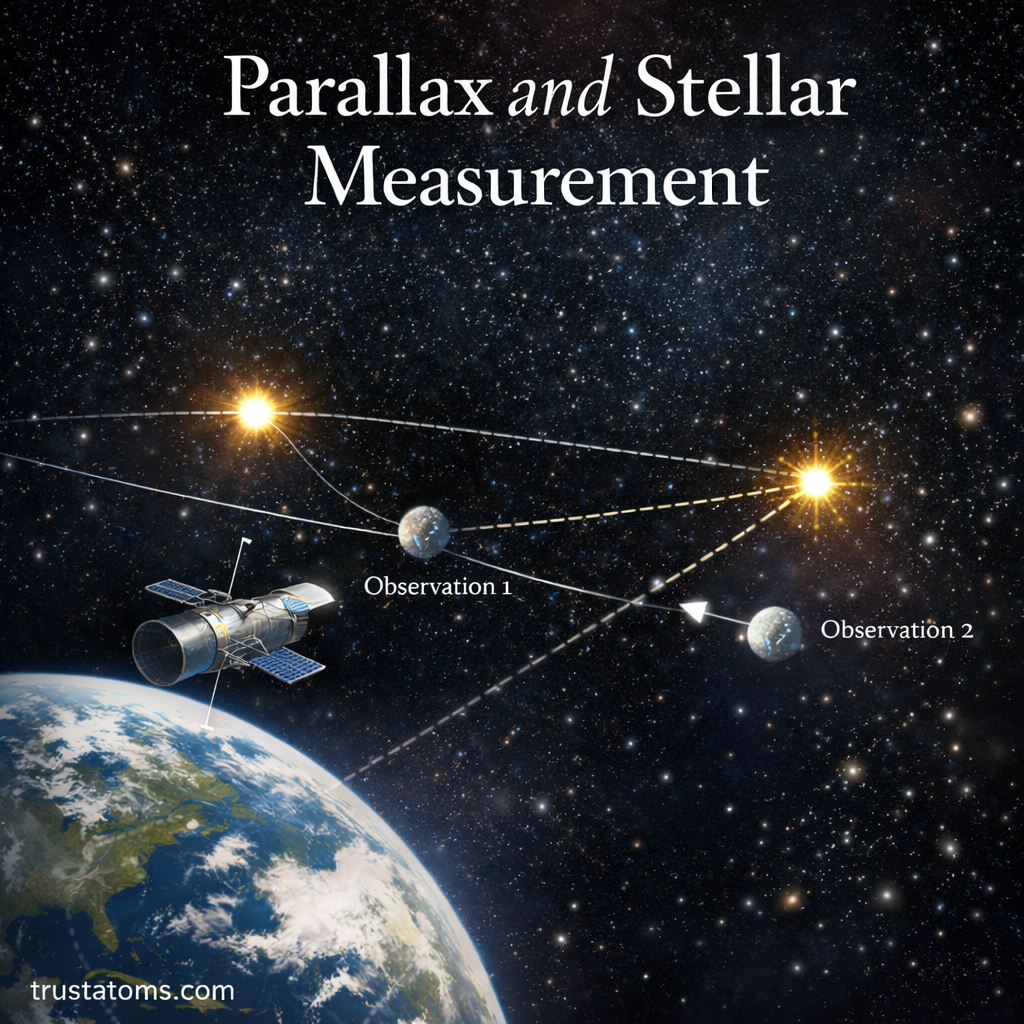
Instead of using two eyes, astronomers use Earth’s orbit around the Sun to create two viewing points.
The Process
- Observe a nearby star from Earth at one point in its orbit
- Observe the same star six months later from the opposite side of the orbit
- Measure how much the star appears to shift against distant background stars
- Use geometry to calculate the distance
The greater the shift, the closer the star is to Earth.
Understanding the Parallax Angle
The key measurement in this method is the parallax angle.
- It is half of the total observed shift
- Measured in arcseconds (a very small unit of angle)
- Even the closest stars have extremely tiny parallax angles
Because these angles are so small, precise instruments are required to measure them accurately.
What Is a Parsec?
Parallax leads directly to one of astronomy’s most important units: the parsec.
Definition
A parsec is the distance at which a star has a parallax angle of one arcsecond.
Conversion
- 1 parsec ≈ 3.26 light-years
- Widely used by astronomers instead of light-years in calculations
Why Parallax Is So Important
Parallax is often called the first rung of the cosmic distance ladder.
It matters because:
- It provides direct distance measurements (no assumptions needed)
- It is highly accurate for nearby stars
- It helps calibrate other distance methods
- It forms the basis for understanding stellar properties
Without parallax, many other measurement techniques wouldn’t be reliable.
Limitations of Parallax
Despite its accuracy, parallax has limits.
Distance Range
- Effective only for relatively nearby stars
- Beyond a few thousand light-years, the shift becomes too small to measure easily
Measurement Challenges
- Requires extremely precise instruments
- Earth’s atmosphere can distort observations
- Tiny errors can lead to large distance inaccuracies
Modern Advancements in Parallax Measurement
Technology has significantly improved parallax measurements.
Space-Based Observatories
Telescopes in space avoid atmospheric distortion and can measure much smaller angles.
Key advancements include:
- Highly precise star-mapping missions
- Measurement of billions of stars
- Improved accuracy across larger distances
These tools have expanded the reach of parallax far beyond what was possible from Earth alone.
How Parallax Helps Measure Stars
Once distance is known, astronomers can determine many other stellar properties.
With Distance, We Can Calculate:
- True brightness (luminosity)
- Size and radius
- Energy output
- Stellar classification
- Position within the galaxy
Distance is the key that unlocks nearly everything we know about stars.
Parallax vs Other Distance Methods
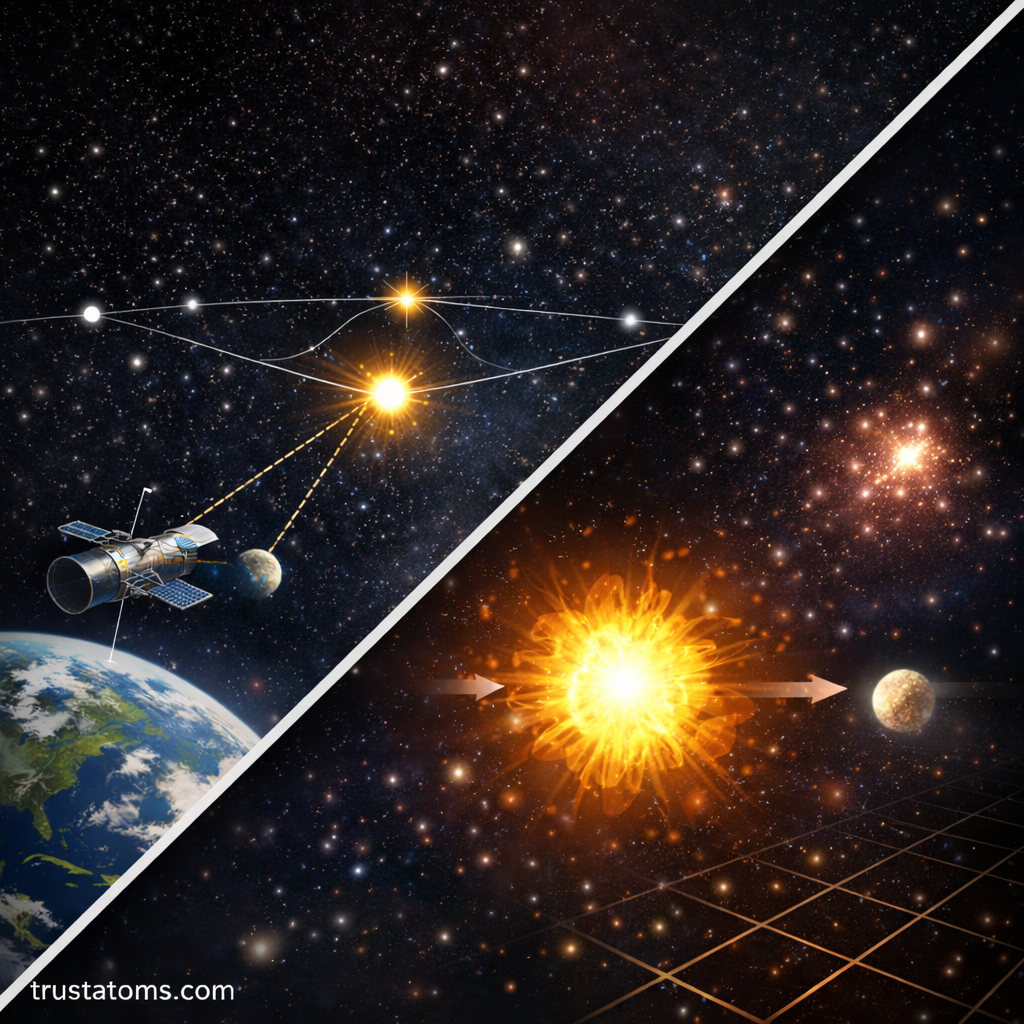
Parallax is just one method among many, but it plays a unique role.
Comparison
- Parallax: Direct and geometric, best for nearby stars
- Standard Candles: Use brightness patterns for distant objects
- Redshift: Measures expansion of the universe for very distant galaxies
Each method builds on the accuracy of the previous one, starting with parallax.
Real-World Example of Parallax
The nearest star system to Earth, Proxima Centauri, has a measurable parallax.
- Its relatively large parallax angle indicates it is close to Earth
- This measurement confirms its distance at just over 4 light-years
Even for the closest stars, the shift is incredibly small—highlighting the precision required in astronomy.
Why Parallax Still Matters Today
Even with advanced techniques, parallax remains essential.
It continues to:
- Serve as the baseline for all distance measurements
- Improve models of our galaxy
- Support discoveries of new stars and planetary systems
- Refine our understanding of the universe’s structure
As technology advances, parallax measurements are becoming more precise and far-reaching.
Final Thoughts
Parallax may seem like a simple concept, but it is one of the most powerful tools in astronomy. By observing tiny shifts in a star’s position, scientists can measure vast distances across space.
This method forms the foundation of stellar measurement and plays a crucial role in unlocking the secrets of the universe.