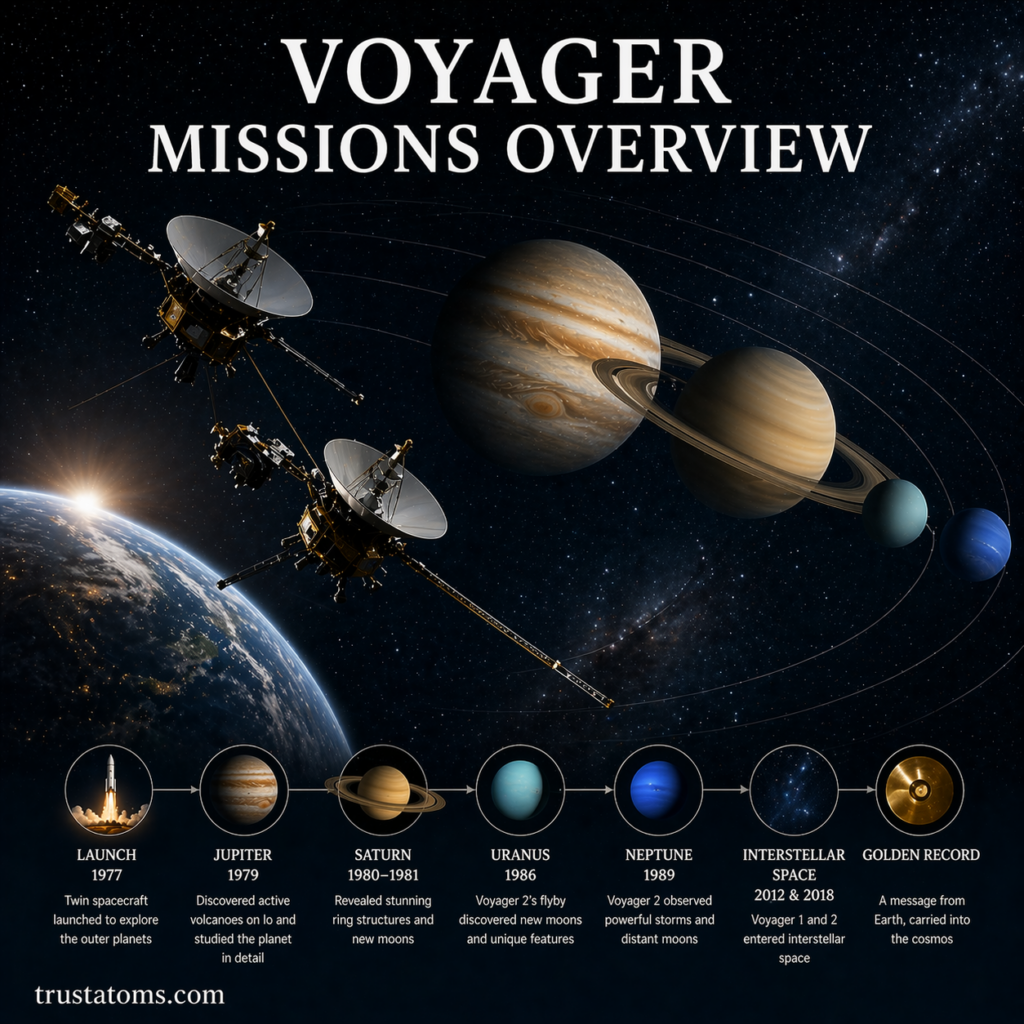
The Voyager missions are among the most ambitious and successful space exploration projects ever undertaken. Launched in 1977, the twin spacecraft—Voyager 1 and Voyager 2—were designed to explore the outer planets and have since traveled farther than any human-made objects in history.
Decades later, both probes continue to send data back to Earth, offering a rare glimpse into the edge of our solar system and beyond.
What Are the Voyager Missions?
The Voyager program was a NASA initiative aimed at studying the outer planets—Jupiter, Saturn, Uranus, and Neptune—during a rare planetary alignment that occurs roughly every 176 years.
This alignment allowed the spacecraft to use gravitational assists (planetary flybys) to gain speed and travel farther using less fuel.
Mission objectives included:
- Studying planetary atmospheres
- Imaging moons and rings
- Measuring magnetic fields
- Investigating the outer solar system
Launch and Early Journey
Both spacecraft were launched in 1977:
- Voyager 2 launched on August 20
- Voyager 1 launched on September 5
Despite launching later, Voyager 1 took a faster trajectory and eventually overtook Voyager 2.
Key Discoveries of the Voyager Missions
The Voyager probes revolutionized our understanding of the outer planets.
Jupiter
- Discovered active volcanoes on Io
- Revealed complex cloud patterns
- Detected Jupiter’s faint ring system
Saturn
- Provided detailed images of Saturn’s rings
- Discovered new moons
- Studied Titan’s thick atmosphere
Uranus (Voyager 2 only)
- First and only close-up visit
- Discovered 10 new moons
- Observed unusual sideways rotation
Neptune (Voyager 2 only)
- Revealed the Great Dark Spot (a massive storm)
- Measured strong winds—the fastest in the solar system
- Discovered additional moons and rings
The Golden Record
Each Voyager spacecraft carries a Golden Record, a time capsule intended for any potential extraterrestrial civilization.
It includes:
- Sounds of Earth (wind, thunder, animals)
- Greetings in multiple languages
- Music from different cultures
- Images representing human life
The record serves as a message from humanity to the cosmos.
Entering Interstellar Space
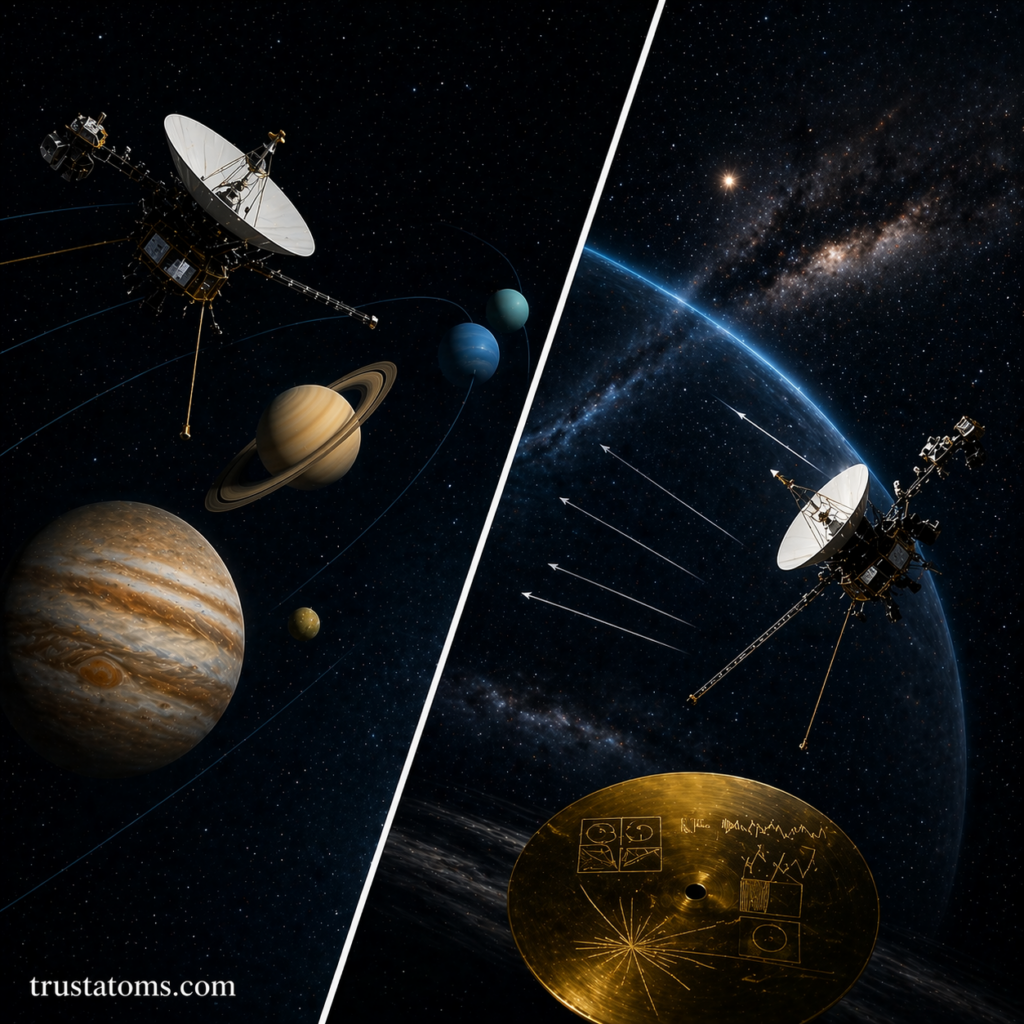
One of the most remarkable achievements of the Voyager missions is their journey beyond the solar system.
- Voyager 1 entered interstellar space in 2012
- Voyager 2 followed in 2018
This means they have crossed the heliopause, the boundary where the Sun’s influence ends and interstellar space begins.
How Far Have the Voyagers Traveled?
The Voyagers are incredibly distant from Earth.
As of today:
- Voyager 1 is over 14 billion miles away
- Voyager 2 is over 12 billion miles away
Communication delay:
- Signals from Voyager 1 take over 20 hours to reach Earth
- Data transmission is slow but still ongoing
Despite the distance, scientists continue to receive valuable information.
Power and Longevity
The Voyager spacecraft are powered by radioisotope thermoelectric generators (RTGs), which convert heat from radioactive decay into electricity.
Why this matters:
- Solar panels wouldn’t work far from the Sun
- RTGs provide long-lasting power
- Systems are gradually shutting down to conserve energy
NASA expects the spacecraft to continue operating into the 2030s, though instruments will slowly go offline.
Why the Voyager Missions Matter
The Voyager missions have had a lasting impact on science and exploration.
Their contributions include:
- Expanding knowledge of outer planets
- Discovering new moons and planetary features
- Providing the first close-up images of distant worlds
- Exploring the boundary of the solar system
They also represent humanity’s farthest reach into space.
The Future of the Voyagers
Even after their instruments stop functioning, the Voyager spacecraft will continue drifting through space.
Long-term future:
- They will travel through interstellar space indefinitely
- The Golden Record may one day be discovered
- They will outlast Earth itself as artifacts of human civilization
Final Thoughts
The Voyager missions stand as a testament to human curiosity, engineering, and ambition. What began as a mission to study distant planets has evolved into an ongoing journey into the unknown.
As they continue their silent voyage through interstellar space, Voyager 1 and Voyager 2 carry with them the story of Earth—exploring, discovering, and reaching beyond the limits of our solar system.