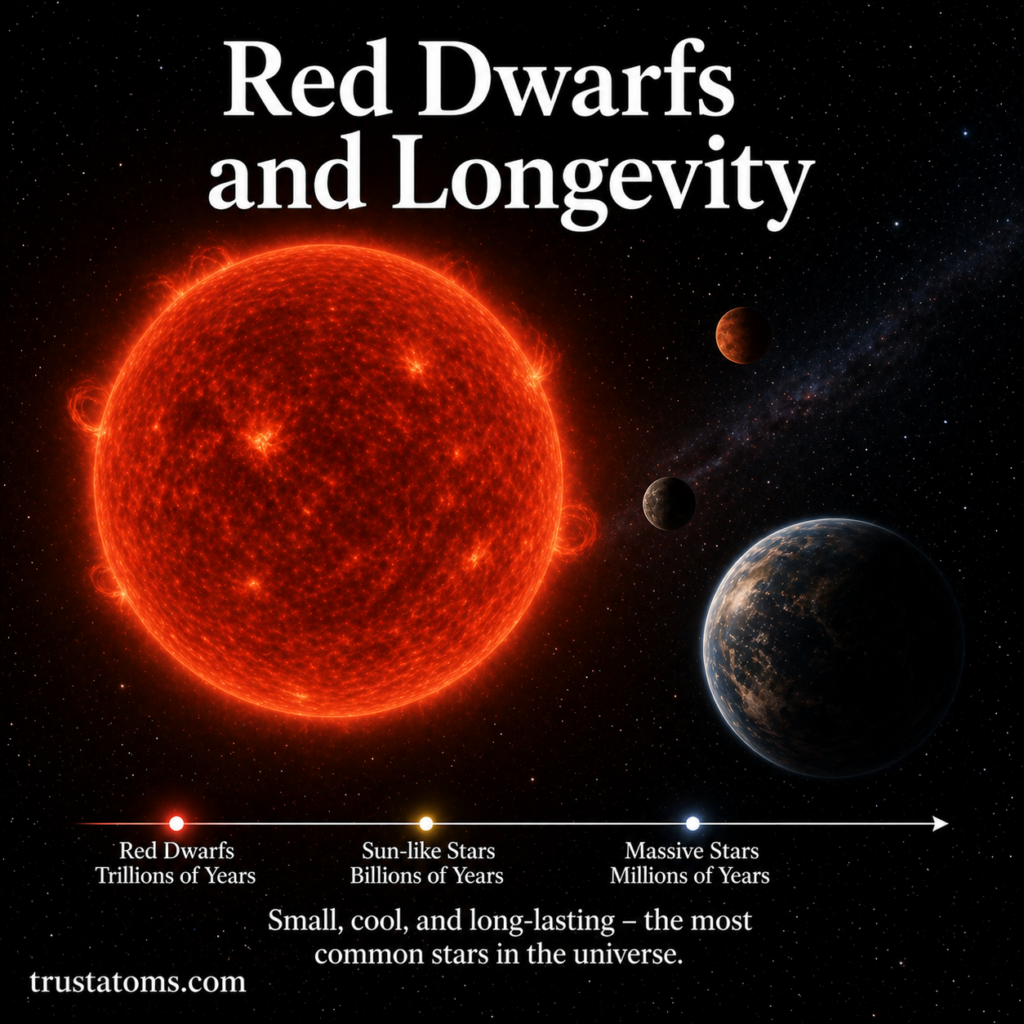
Red dwarfs are the most common stars in the universe—and also the longest-lived. While massive stars burn bright and die young, red dwarfs take the opposite approach: they burn slowly, steadily, and can last for trillions of years.
Their incredible longevity makes them a key focus in astronomy, especially when studying the future of the universe and the potential for long-term planetary systems.
What Are Red Dwarfs?
Red dwarfs are small, cool stars with relatively low mass and luminosity. They belong to the spectral class known as M-type stars.
Key characteristics:
- Mass ranges from about 0.08 to 0.6 times the Sun
- Surface temperatures between ~2,500–4,000 K
- Dim and reddish in appearance
- Extremely efficient at burning fuel
A well-known example is Proxima Centauri, the closest star to Earth outside our solar system.
Why Red Dwarfs Live So Long
The secret to a red dwarf’s longevity lies in how it uses its fuel.
Factors that extend their lifespan:
- Slow fusion rate: Hydrogen is fused at a much lower rate
- Efficient fuel usage: Nearly all hydrogen is available for fusion
- Full convection: Material circulates throughout the star
Unlike larger stars, red dwarfs don’t burn through their fuel quickly. Instead, they conserve energy and maintain stable fusion over incredibly long periods.
The Role of Full Convection
One of the most important features of red dwarfs is their internal structure.
What is full convection?
- Hot material rises while cooler material sinks
- This motion mixes the entire star evenly
- Hydrogen fuel is continuously redistributed
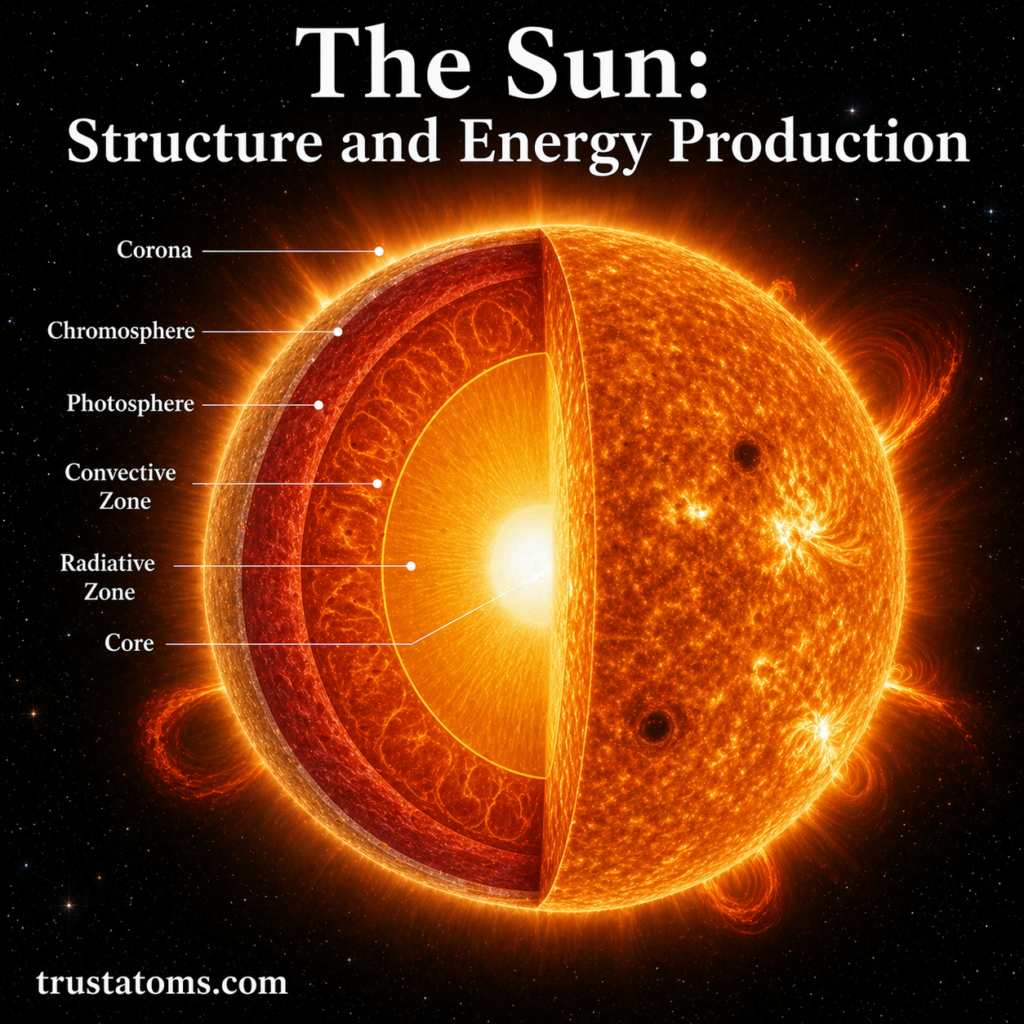
In stars like the Sun, only the outer layers are convective. But in red dwarfs, the entire star is mixed, allowing them to use nearly all their hydrogen fuel.
Lifespan Compared to Other Stars
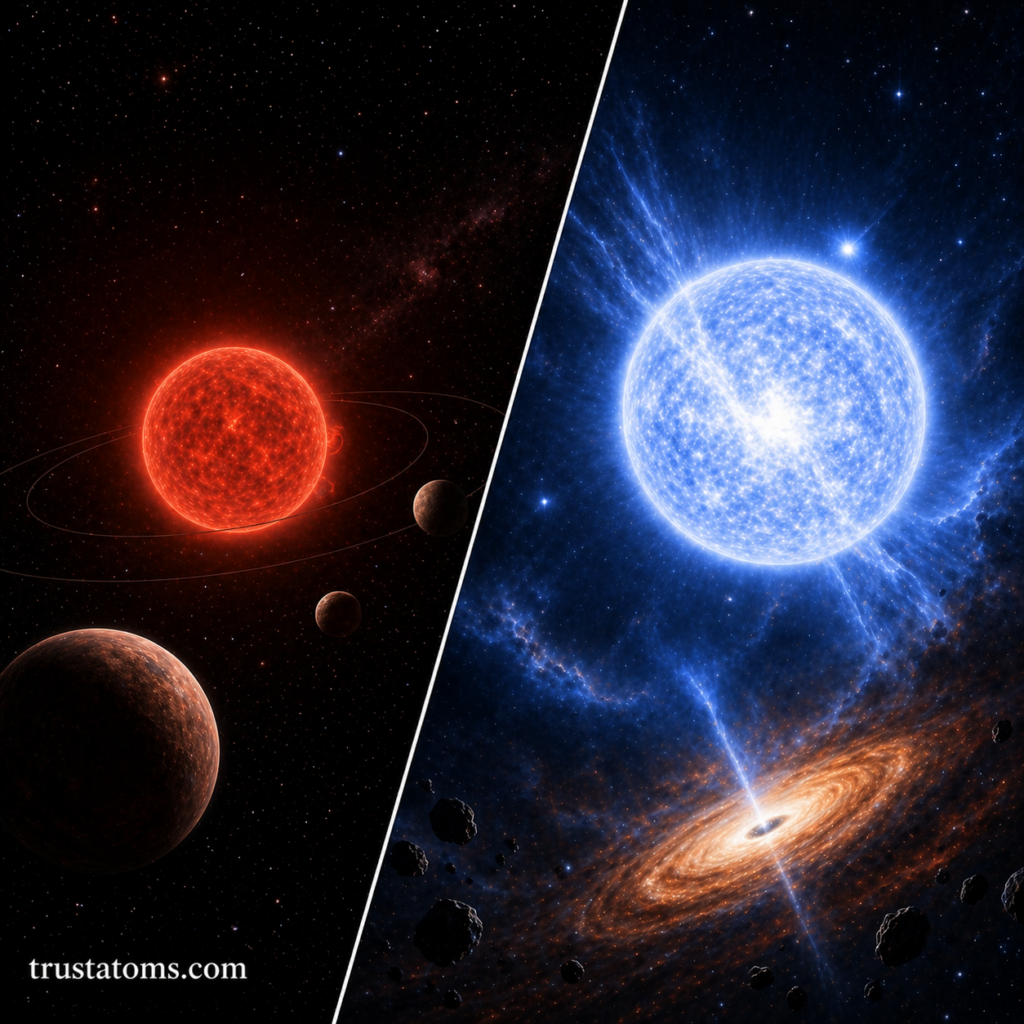
Red dwarfs outlive all other types of stars by an enormous margin.
Estimated lifespans:
- Massive stars: millions of years
- Sun-like stars: ~10 billion years
- Red dwarfs: trillions of years
Because the universe is about 13.8 billion years old, no red dwarf has yet reached the end of its life. They are still in their long, stable phase.
Stability and Activity
Red dwarfs are generally stable, but they can still exhibit strong magnetic activity, especially when they are young.
Common behaviors:
- Stellar flares that can be more powerful than the Sun’s
- Starspots covering large surface areas
- Variable brightness due to activity cycles
Despite their calm energy output overall, these bursts of activity can impact nearby planets.
Red Dwarfs and Planetary Systems
Red dwarfs are prime targets in the search for exoplanets.
Why they are important:
- Planets are easier to detect due to the star’s low brightness
- Habitable zones are much closer to the star
- Long lifespans provide extended time for potential life to develop
However, there are challenges.
Potential drawbacks:
- Intense flares can strip planetary atmospheres
- Tidal locking may occur, causing one side of a planet to always face the star
- High radiation levels in early stages
Scientists from organizations like NASA and the European Space Agency continue to study these systems to better understand their habitability.
The Future of Red Dwarfs
Red dwarfs will dominate the future universe.
What makes them unique:
- They will outlast all larger stars
- They evolve very slowly
- They may eventually become blue dwarfs (a theoretical stage)
Because no red dwarf has aged enough to reach its final stages, much of their long-term evolution remains theoretical.
Why Red Dwarfs Matter
Studying red dwarfs helps astronomers:
- Understand stellar efficiency and fuel usage
- Predict the long-term evolution of the universe
- Explore the potential for life beyond Earth
- Identify stable, long-lasting planetary systems
Research from institutions like Harvard-Smithsonian Center for Astrophysics continues to expand our knowledge of these enduring stars.
Final Thoughts
Red dwarfs may not be the brightest stars in the sky, but they are among the most important. Their slow-burning nature and extraordinary lifespans make them cosmic survivors, shaping the future of galaxies for trillions of years.
As the universe evolves, red dwarfs will remain—quietly shining long after other stars have faded.