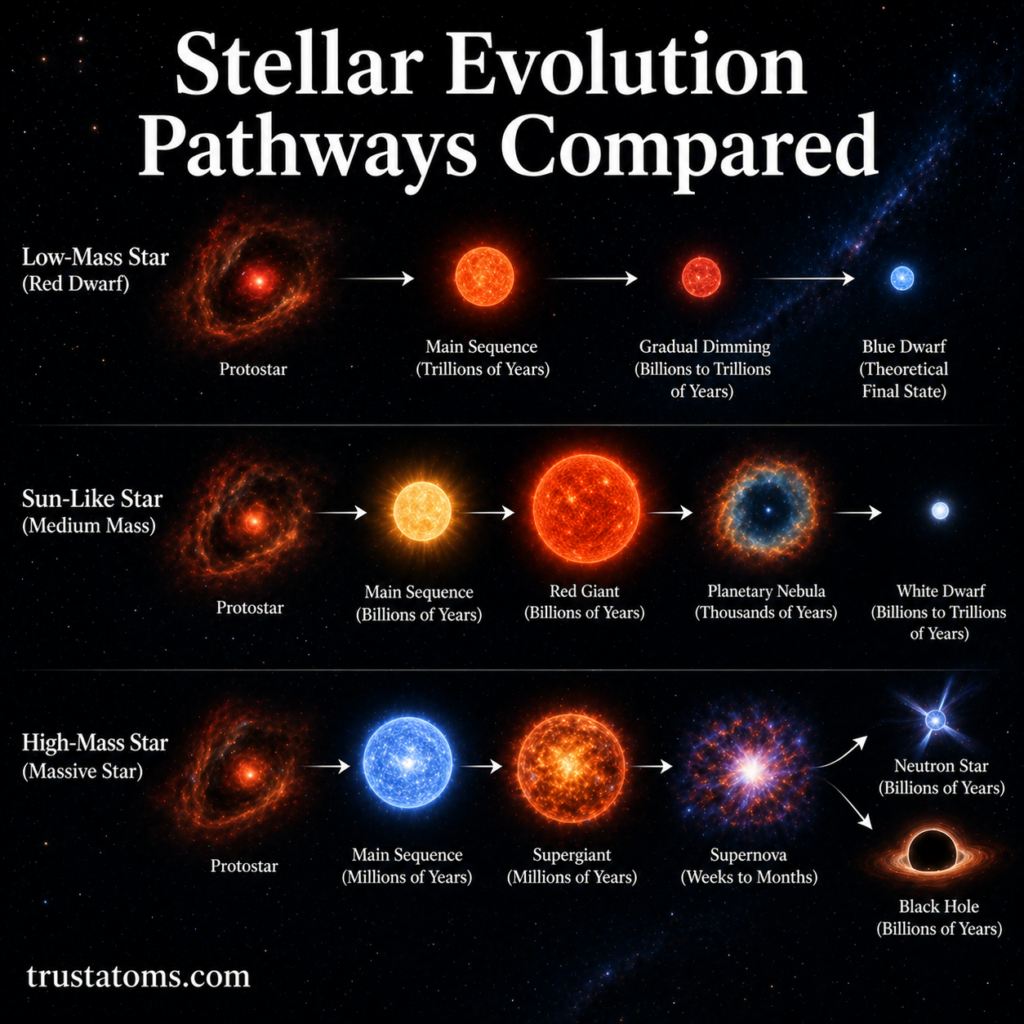
Stars are not eternal—they are born, evolve, and eventually die. However, not all stars follow the same life path. A star’s mass determines how it evolves, how long it lives, and how it ends its life.
By comparing stellar evolution pathways, astronomers can better understand the diversity of stars in the universe and predict their ultimate fates.
What Determines a Star’s Evolution?
The most important factor in a star’s lifecycle is its initial mass.
Why mass matters:
- Controls the rate of nuclear fusion
- Determines lifespan
- Influences internal structure
- Dictates how the star will die
Other factors like composition and rotation play roles, but mass is the primary driver.
The Birth of All Stars
All stars begin in massive clouds of gas and dust known as nebulae.
Early stages of stellar formation:
- Gravity pulls gas together into dense regions
- A protostar forms as material accumulates
- Temperature and pressure rise
- Nuclear fusion ignites in the core
Once fusion begins, the star enters the main sequence, where it spends most of its life.
Low-Mass Stars (Red Dwarfs)
Low-mass stars take the slow and steady route through stellar evolution.
Characteristics:
- Burn hydrogen very slowly
- Fully convective interiors
- Extremely long lifespans (trillions of years)
A classic example is Proxima Centauri.
Evolution pathway:
- Protostar
- Main sequence (long-lasting phase)
- Gradual dimming over time
- Theoretical transition into a “blue dwarf” (not yet observed)
These stars do not undergo dramatic explosive endings.
Sun-Like Stars (Intermediate Mass)
Stars similar to the Sun follow a more complex evolutionary path.
Key traits:
- Moderate fusion rate
- Lifespan of about 10 billion years
- Distinct late-life stages
Evolution pathway:
- Protostar
- Main sequence
- Red giant phase
- Planetary nebula formation
- White dwarf remnant
During the red giant phase, the star expands dramatically, potentially engulfing nearby planets.
Massive Stars
Massive stars live fast and die dramatically.
Key traits:
- High fusion rates
- Short lifespans (millions of years)
- Complex internal layering
Evolution pathway:
- Protostar
- Main sequence
- Supergiant phase
- Core collapse
- Supernova explosion
After the explosion, the remnant becomes either:
- A neutron star
- A black hole
An example of a stellar remnant is the Crab Pulsar.
Comparing Lifespans
One of the most striking differences between stellar pathways is lifespan.
Lifespan comparison:
- Red dwarfs → trillions of years
- Sun-like stars → billions of years
- Massive stars → millions of years
The more massive a star is, the faster it burns through its fuel.
Differences in Energy Output
Energy production varies greatly across different types of stars.
Key differences:
- Low-mass stars → steady, low energy output
- Sun-like stars → balanced and stable output
- Massive stars → extremely high luminosity
Massive stars may shine millions of times brighter than smaller stars, despite their shorter lifespans.
End States of Stars
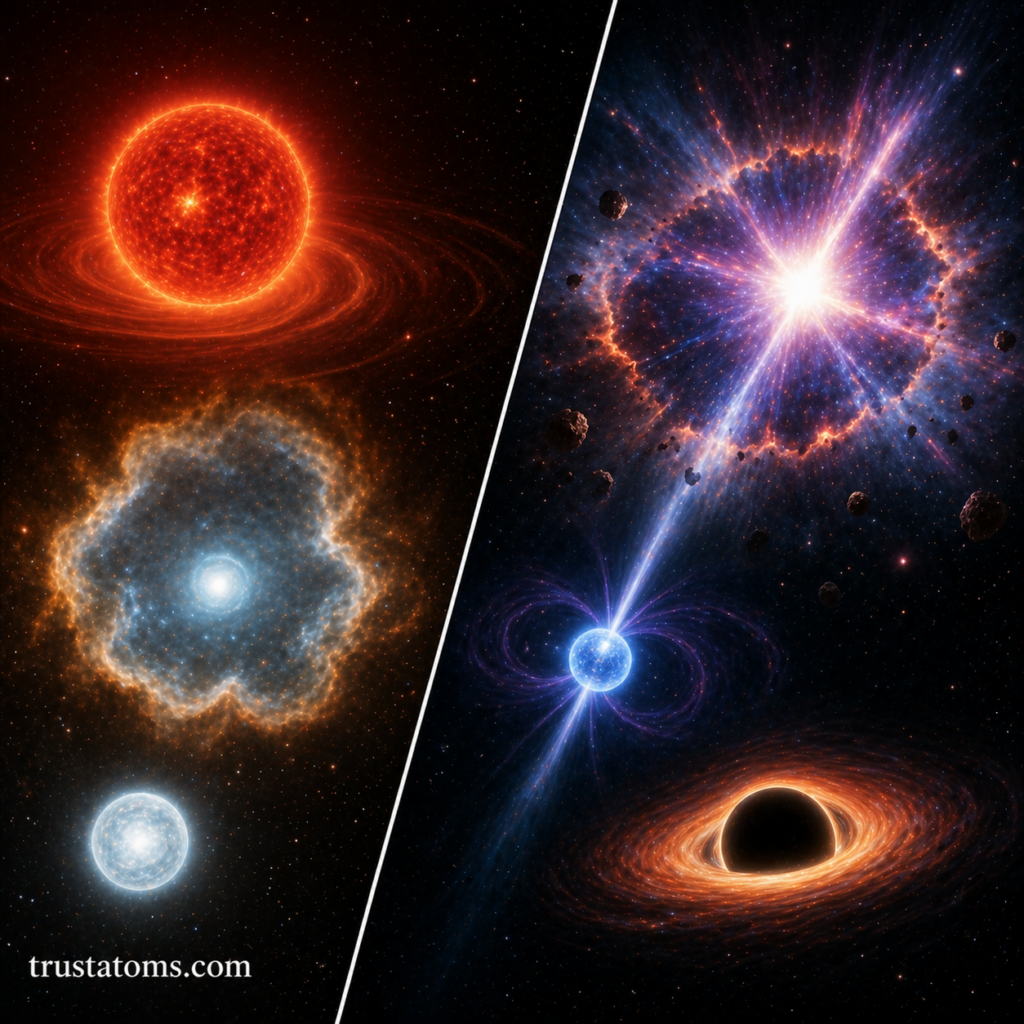
The final stage of a star depends entirely on its mass.
Final outcomes:
- Low-mass stars → slowly fade (no violent death)
- Sun-like stars → white dwarfs
- Massive stars → neutron stars or black holes
These remnants continue to influence their surroundings long after the star’s active life has ended.
Why Comparing Stellar Evolution Matters
Understanding these pathways helps astronomers:
- Predict the future of stars and galaxies
- Study the origin of heavy elements
- Understand cosmic events like supernovae
- Explore environments where planets and life may exist
Organizations like NASA and the European Space Agency actively study stellar evolution to improve models of the universe.
The Big Picture
Stellar evolution is not a single story—it’s a spectrum of possibilities shaped by mass and physics.
From slow-burning red dwarfs to explosive supernovae, each pathway contributes to the structure and chemistry of the universe. Research from institutions like Harvard-Smithsonian Center for Astrophysics continues to reveal how these life cycles connect to the broader cosmic story.
Final Thoughts
Comparing stellar evolution pathways highlights the incredible diversity of stars. While they all begin in similar ways, their journeys diverge dramatically based on mass.
By studying these differences, we gain a deeper understanding of how stars shape galaxies—and ultimately, how the universe evolves over time.