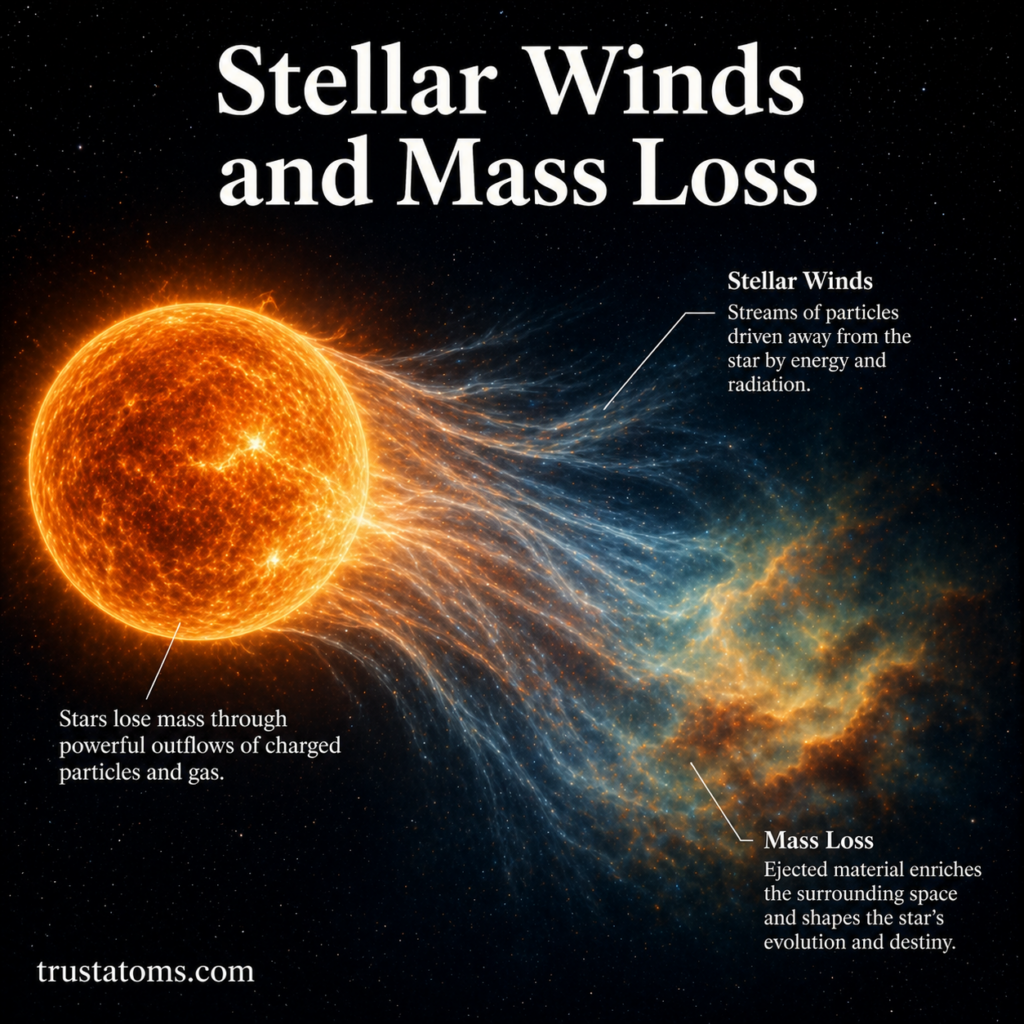
Stars are not as stable as they may appear. Throughout their lives, they continuously lose material into space through powerful outflows known as stellar winds. This process—called mass loss—plays a major role in how stars evolve, how long they live, and how they ultimately die.
From gentle particle streams to intense, high-speed outbursts, stellar winds shape both the star itself and the surrounding universe.
What Are Stellar Winds?
Stellar winds are flows of charged particles (plasma) ejected from a star’s outer layers. These winds travel outward into space, carrying mass and energy away from the star.
Key Features:
- Composed mostly of protons, electrons, and atomic nuclei
- Can vary from slow and steady to extremely fast and violent
- Occur in stars of all sizes, but with very different intensities
Even our Sun produces a continuous stellar wind, known as the solar wind, which influences planetary environments across the solar system.
What Causes Stellar Winds?
Stellar winds are driven by several physical mechanisms, depending on the type and stage of the star.
1. Thermal Pressure
Hot stars generate high-energy particles in their outer layers. These particles gain enough energy to escape the star’s gravitational pull.
- Common in stars like the Sun
- Produces steady, relatively low-density winds
2. Radiation Pressure
In very luminous stars, intense light pushes outward on particles in the star’s atmosphere.
- Dominant in massive, bright stars
- Can drive extremely powerful winds
3. Pulsations and Instabilities
Some stars expand and contract rhythmically, ejecting material during these cycles.
- Common in aging stars
- Leads to irregular mass loss
Types of Stellar Winds
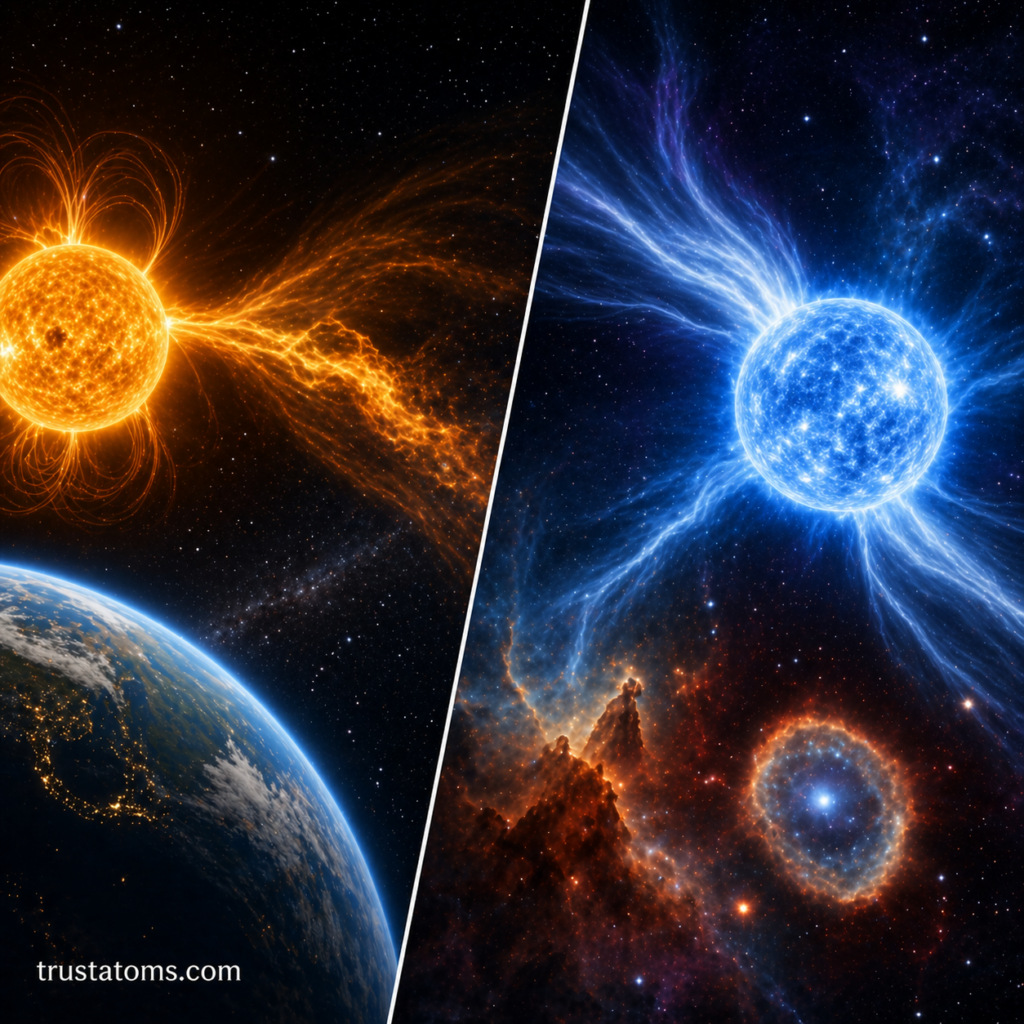
Different stars produce different kinds of winds based on their mass, temperature, and evolutionary stage.
Solar-Type Winds
- Found in medium-sized stars like the Sun
- Continuous and relatively weak
- Speeds: hundreds of kilometers per second
These winds gradually strip away small amounts of mass over billions of years.
Massive Star Winds
- Found in hot, high-mass stars
- Driven by intense radiation pressure
- Speeds: thousands of kilometers per second
These winds are strong enough to remove significant portions of a star’s mass during its lifetime.
Red Giant and Supergiant Winds
- Occur in late-stage stars
- Slow but extremely dense
- Often enriched with heavier elements
These winds contribute heavily to the material recycled into space.
How Mass Loss Affects Stellar Evolution
Mass loss is not just a side effect—it fundamentally changes how a star evolves.
Key Impacts:
- Reduces the star’s total mass over time
- Alters internal pressure and temperature
- Changes the rate of nuclear fusion
- Influences the star’s lifespan
Example Effects:
- Massive stars may lose enough mass to avoid becoming black holes
- Medium stars shed outer layers to form planetary nebulae
- Low-mass stars lose mass slowly and evolve more gradually
Stellar Winds and the End of a Star’s Life
Mass loss plays a critical role in determining how a star dies.
Low- and Medium-Mass Stars:
- Gradual mass loss leads to outer layers drifting away
- Forms glowing shells of gas called planetary nebulae
- Leaves behind a dense core known as a white dwarf
High-Mass Stars:
- Intense winds strip away outer layers before collapse
- Affects the size and energy of the eventual supernova
- Determines whether the remnant becomes a neutron star or black hole
The Role of Stellar Winds in the Universe
Stellar winds don’t just affect individual stars—they shape entire regions of space.
1. Formation of Nebulae
Ejected material accumulates to form vast clouds of gas and dust.
- These nebulae can become the birthplaces of new stars
- Enriched with elements like carbon, oxygen, and nitrogen
2. Chemical Enrichment
Stellar winds distribute heavy elements into the interstellar medium.
- Essential for forming planets and life
- Contributes to the cosmic recycling process
3. Interaction with Surroundings
Strong stellar winds can:
- Carve out bubbles in surrounding gas
- Trigger or suppress nearby star formation
- Influence the structure of galaxies
How Stellar Winds Compare Across Star Types
Low-Mass Stars:
- Weak, steady winds
- Minimal impact on mass over short timescales
- Long-term gradual evolution
Medium-Mass Stars:
- Moderate winds during main sequence
- Stronger winds during red giant phase
- Significant mass loss near end of life
High-Mass Stars:
- Extremely powerful winds
- Rapid mass loss throughout life
- Major influence on final fate
Why Stellar Winds Matter in Astronomy
Understanding stellar winds helps scientists:
- Predict how stars evolve over time
- Model supernova explosions
- Study galaxy formation and structure
- Trace the origins of elements in the universe
Without stellar winds, the universe would lack the rich diversity of elements needed to form planets, atmospheres, and living systems.
Final Thoughts
Stellar winds are a powerful reminder that stars are dynamic, ever-changing systems. Through the steady loss of mass, stars influence not only their own destinies but also the structure and composition of the universe around them.
- Small stars lose mass slowly over vast timescales
- Larger stars shed material rapidly and dramatically
- All stars contribute to the ongoing cycle of cosmic evolution
In the grand scale of the universe, stellar winds act as both endings and beginnings—carrying the building blocks of future stars, planets, and possibly life itself.