Stars may look similar when you glance up at the night sky, but their lives are dramatically different. The single most important factor that determines how a star forms, evolves, and dies is its mass.
From short-lived cosmic giants to long-lasting red dwarfs, mass dictates everything about a star’s lifespan. Understanding this relationship helps explain why some stars burn out quickly while others persist for billions—or even trillions—of years.
Why Mass Matters in Stellar Evolution
Mass is the amount of matter a star contains, usually measured relative to the Sun (solar masses). It directly affects:
- Core temperature and pressure
- Nuclear fusion rate
- Luminosity (brightness)
- Lifespan
In simple terms, more mass means more gravity, which leads to higher pressure and temperature in the core. This accelerates nuclear fusion—the process that powers stars.
The Relationship Between Mass and Lifespan
At first glance, you might expect larger stars to live longer because they have more fuel. Surprisingly, the opposite is true.
Key Principle:
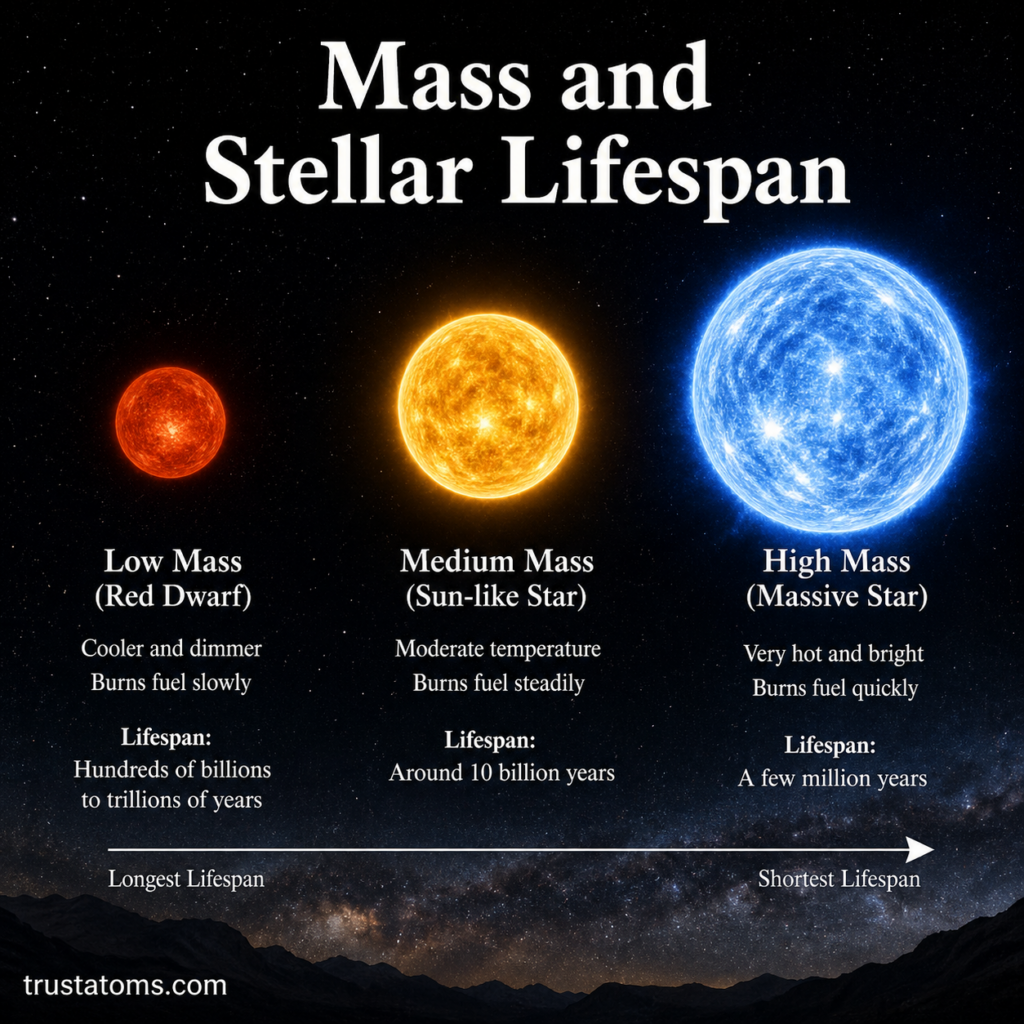
The more massive a star is, the shorter its lifespan.
This happens because:
- High-mass stars burn fuel extremely fast
- Low-mass stars burn fuel slowly and efficiently
General Lifespan Comparison
- High-mass stars: Millions of years
- Medium-mass stars (like the Sun): ~10 billion years
- Low-mass stars: Tens to hundreds of billions of years
Low-Mass Stars: The Long-Lived Burners
Low-mass stars, often called red dwarfs, are the most common stars in the universe.
Characteristics:
- Mass: Less than half the Sun’s mass
- Cooler core temperatures
- Slow nuclear fusion rates
Lifespan:
- Can last hundreds of billions to trillions of years
These stars conserve fuel efficiently and burn hydrogen slowly. Interestingly, none have reached the end of their life cycle yet because the universe isn’t old enough.
Medium-Mass Stars: Balanced Lifecycles
Stars like our Sun fall into this category.
Characteristics:
- Moderate fusion rate
- Stable “main sequence” phase
- Balanced energy output
Lifespan:
- Around 10 billion years
Life Stages:
- Main sequence (current phase for the Sun)
- Red giant expansion
- Planetary nebula formation
- White dwarf remnant
These stars represent a middle ground between stability and eventual dramatic change.
High-Mass Stars: Fast and Explosive Lives
High-mass stars live fast and die young.
Characteristics:
- Mass: More than 8 times the Sun’s mass
- Extremely hot and luminous
- Rapid fuel consumption
Lifespan:
- Only a few million years
End of Life:
- Supernova explosion
- Formation of neutron stars or black holes
Because they burn fuel so quickly, these stars evolve rapidly and end in some of the most energetic events in the universe.
Why Bigger Stars Burn Faster
The reason lies in the physics of gravity and fusion:
- Greater mass → stronger gravitational pull
- Stronger gravity → higher core pressure
- Higher pressure → higher temperatures
- Higher temperatures → faster fusion
This creates a feedback loop where massive stars consume fuel at an exponential rate.
Simple Analogy:
Think of two candles:
- A small candle burns slowly and lasts longer
- A large, intense flame burns bright but quickly disappears
Stars behave in a similar way.
The Mass-Luminosity Connection
A star’s brightness is closely tied to its mass.
Key Insight:
- High-mass stars are much more luminous
- They release far more energy per second
However, this increased energy output comes at a cost—rapid fuel depletion.
In fact, luminosity increases much faster than mass, which is why even a slightly more massive star can have a dramatically shorter lifespan.
What Happens When Fuel Runs Out
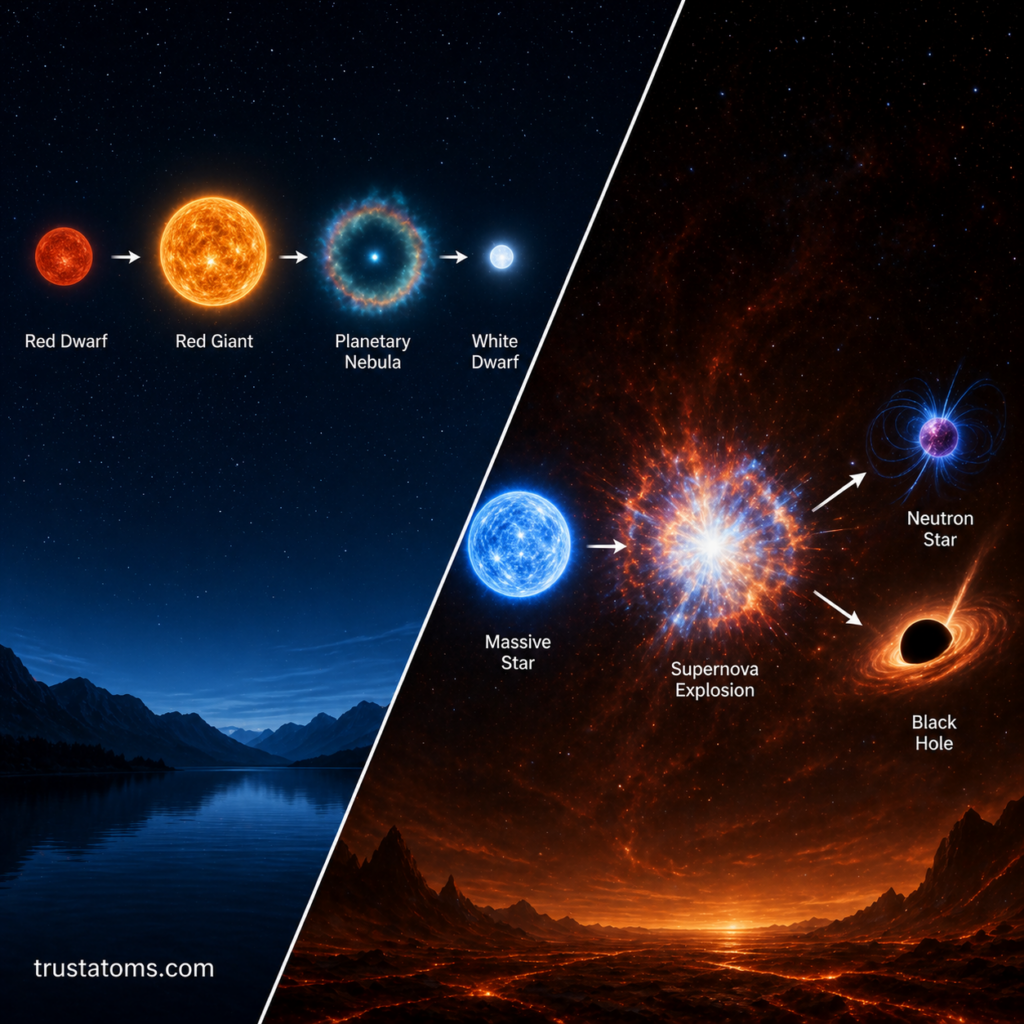
When a star exhausts its core hydrogen, its fate depends on its mass:
Low-Mass Stars:
- Gradually cool and fade
- Become white dwarfs over time
Medium-Mass Stars:
- Expand into red giants
- Shed outer layers
- Leave behind a white dwarf
High-Mass Stars:
- Fuse heavier elements
- Collapse under gravity
- Explode as supernovae
Each path highlights how mass determines not just lifespan—but the final outcome of a star’s life.
Why This Matters in Astronomy
Understanding the link between mass and stellar lifespan helps scientists:
- Predict the evolution of stars
- Study the formation of galaxies
- Identify habitable planetary systems
- Understand the origins of heavy elements
High-mass stars, despite their short lives, play a crucial role in enriching the universe with elements like iron, gold, and oxygen.
Final Thoughts
Mass is the master variable in a star’s life story. It determines how brightly a star shines, how quickly it burns through fuel, and how it ultimately dies.
- Small stars: slow, steady, and long-lasting
- Medium stars: balanced and stable
- Massive stars: bright, fast, and explosive
This relationship reveals a fascinating truth about the universe: the brightest stars often have the shortest lives, while the faintest can endure for unimaginable lengths of time.