Satellite communication systems play a major role in modern life, enabling everything from global television broadcasts and GPS navigation to internet access in remote regions and emergency communications during disasters.
Without satellites, many long-distance communication services would be slower, less reliable, or impossible in isolated parts of the world. These systems help connect continents, support military operations, power scientific research, and provide communication where traditional infrastructure cannot reach.
This guide explores how satellite communication systems work, the different types of satellites used, their advantages and limitations, and how they continue shaping global connectivity.
What Is a Satellite Communication System?
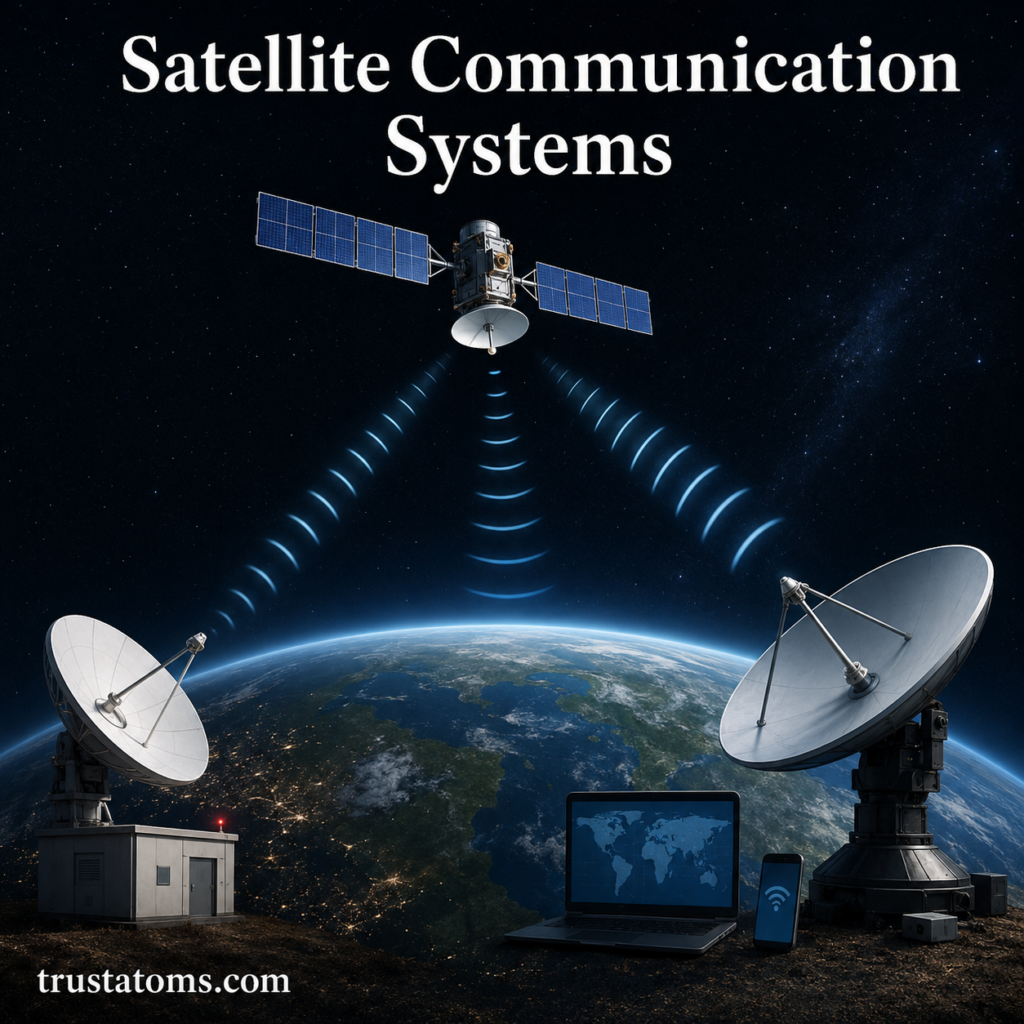
A satellite communication system is a network that uses artificial satellites to send and receive signals between different points on Earth.
The system usually includes:
- A satellite orbiting Earth
- Ground stations on Earth
- Communication devices such as antennas, phones, televisions, or internet terminals
The satellite acts like a relay station in space. It receives signals from one location, amplifies them, and transmits them back to another area on Earth.
These systems make global communication possible even across oceans, deserts, mountains, and rural regions.
How Satellite Communication Works
Satellite communication relies on radio waves traveling between Earth stations and satellites in orbit.
The process typically works like this:
- A ground station sends an uplink signal to a satellite
- The satellite receives and processes the signal
- The satellite retransmits the signal back to Earth as a downlink
- Receiving stations or devices decode the signal
The communication can involve:
- Television broadcasting
- Internet services
- Telephone communication
- GPS positioning
- Military communications
- Weather monitoring
Satellites use carefully assigned radio frequencies to prevent signal interference between systems.
Main Components of a Satellite Communication System
Satellites
The satellite itself contains:
- Transponders
- Antennas
- Solar panels
- Power systems
- Control systems
- Communication payloads
The transponder is one of the most important parts because it receives incoming signals and retransmits them at a different frequency.
Ground Stations
Ground stations communicate directly with satellites using large antennas.
Their responsibilities include:
- Sending data to satellites
- Receiving signals
- Tracking satellite positions
- Managing communication traffic
User Devices
User equipment may include:
- Satellite phones
- TV dishes
- GPS receivers
- Satellite internet terminals
- Ship and aircraft communication systems
These devices allow individuals and organizations to access satellite services.
Types of Communication Satellites
Different satellites operate at different orbital distances depending on their purpose.
Geostationary Satellites (GEO)
Geostationary satellites orbit about 35,786 kilometers above Earth.
They remain fixed over one location because their orbital speed matches Earth’s rotation.
Advantages include:
- Constant coverage over a large area
- Ideal for television broadcasting
- Stable communication links
Disadvantages include:
- Higher signal delay (latency)
- Expensive launches
- Weaker signals due to long distance
These satellites are commonly used for:
- Satellite TV
- Weather observation
- Long-distance communications
Medium Earth Orbit Satellites (MEO)
MEO satellites orbit between 2,000 and 35,786 kilometers above Earth.
They are commonly used for:
- Navigation systems
- GPS services
- Regional communications
They provide lower latency than GEO satellites while covering wider areas than low-orbit satellites.
Low Earth Orbit Satellites (LEO)
LEO satellites orbit between 160 and 2,000 kilometers above Earth.
Advantages include:
- Lower latency
- Faster internet speeds
- Stronger signals
- Lower launch costs per satellite
Disadvantages include:
- Smaller coverage areas
- Large constellations required
- Frequent satellite handoffs
Modern satellite internet systems increasingly rely on large LEO constellations.
Satellite Frequency Bands
Satellite communication systems operate using different radio frequency bands.
Common Frequency Bands
L-Band
Used for:
- GPS
- Mobile satellite communications
- Aviation systems
C-Band
Known for:
- Reliable weather resistance
- Television broadcasting
- Long-distance communication
Ku-Band
Common for:
- Satellite TV
- Broadband internet
- Data transmission
Ka-Band
Provides:
- High-speed internet
- Greater bandwidth capacity
- Modern broadband services
Higher-frequency bands generally allow faster data transmission but may experience more interference from rain and atmospheric conditions.
Applications of Satellite Communication Systems
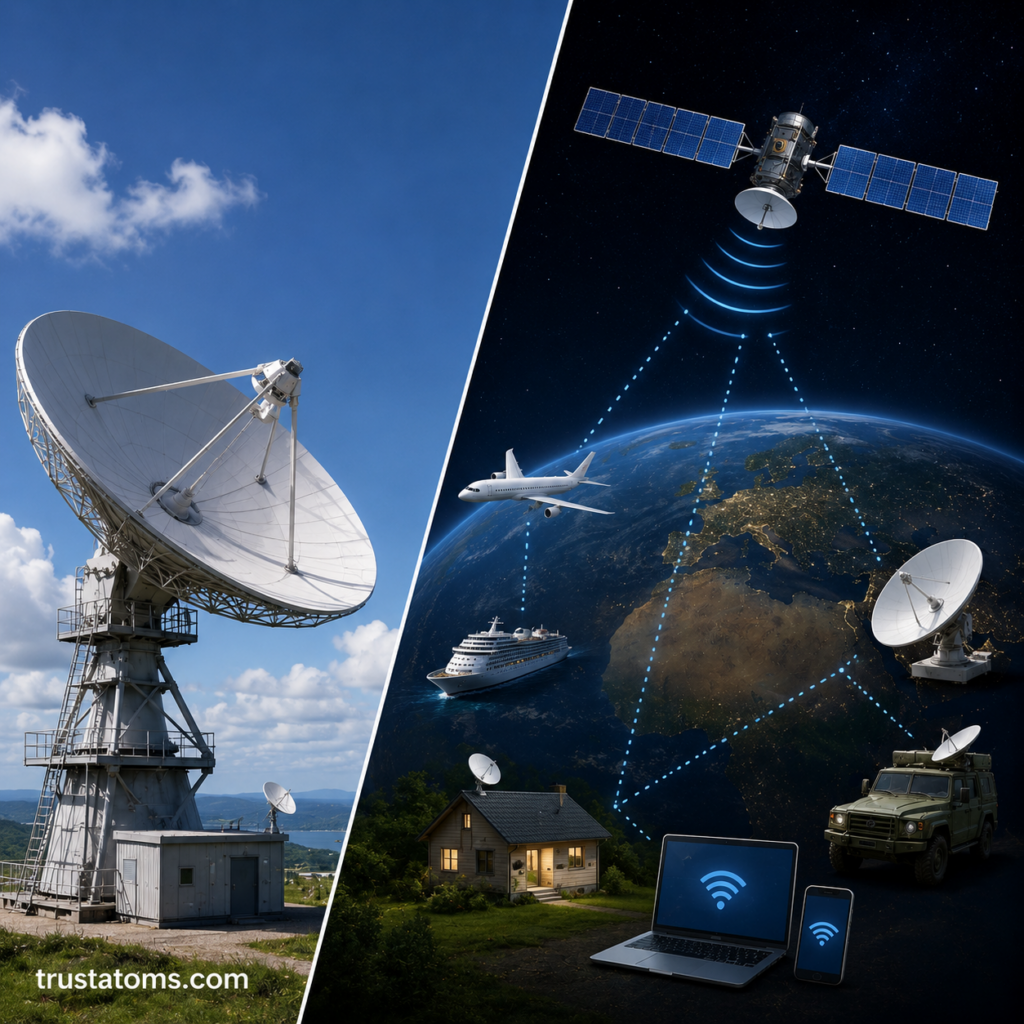
Satellite communication systems support many industries and technologies.
Television Broadcasting
Satellite TV distributes channels across entire countries and continents.
Benefits include:
- Wide geographic coverage
- Reliable signal delivery
- Access in remote regions
Satellite Internet
Satellite internet provides connectivity where fiber or cable infrastructure is unavailable.
It is especially useful in:
- Rural communities
- Ships at sea
- Airplanes
- Disaster zones
Modern LEO systems are improving internet speed and reducing latency significantly.
GPS and Navigation
Navigation satellites provide location and timing data used in:
- Smartphones
- Aircraft navigation
- Maritime navigation
- Military operations
- Mapping systems
Global navigation systems are essential to transportation and logistics worldwide.
Weather Forecasting
Weather satellites monitor:
- Storm systems
- Hurricanes
- Cloud patterns
- Temperature changes
- Climate trends
Meteorologists use satellite data to improve forecasting accuracy and disaster preparedness.
Military and Defense
Military satellite communication systems provide:
- Secure communications
- Surveillance support
- Battlefield coordination
- Intelligence gathering
- Navigation assistance
These systems are critical to modern defense operations.
Emergency Communications
During natural disasters, ground communication infrastructure may fail.
Satellites can provide:
- Emergency internet access
- Rescue coordination
- Backup communications
- Disaster monitoring
This makes them valuable during hurricanes, earthquakes, floods, and wildfires.
Advantages of Satellite Communication Systems
Satellite communication offers several important benefits.
Global Coverage
Satellites can connect remote and isolated regions where traditional infrastructure is impractical.
Scalability
One satellite can serve millions of users across vast geographic areas.
Reliability
Satellite systems remain operational even when terrestrial networks fail.
Mobility
Communication can continue while moving across oceans, deserts, or airspace.
Broadcasting Efficiency
A single signal can reach large audiences simultaneously.
Challenges and Limitations
Despite their advantages, satellite communication systems also face challenges.
Signal Delay
Signals traveling long distances create latency, especially with GEO satellites.
This can affect:
- Video calls
- Online gaming
- Real-time applications
Weather Interference
Rain, snow, and storms can weaken satellite signals, especially at higher frequencies.
This issue is often called rain fade.
High Costs
Satellite development and launch operations require massive investments.
Costs include:
- Rocket launches
- Satellite manufacturing
- Ground infrastructure
- Maintenance
Space Debris
Increasing numbers of satellites raise concerns about:
- Orbital congestion
- Collision risks
- Long-term sustainability
Managing space traffic is becoming increasingly important.
The Rise of Modern Satellite Networks
Recent advances are transforming satellite communication systems.
LEO Satellite Constellations
Companies are launching large networks of low-orbit satellites to improve internet access globally.
Benefits include:
- Lower latency
- Faster internet speeds
- Expanded rural coverage
These systems aim to compete with traditional broadband services.
Miniaturization
Smaller satellites reduce launch costs and increase deployment flexibility.
CubeSats and small satellites are now widely used for:
- Research
- Earth observation
- Experimental communication systems
Reusable Rockets
Reusable launch systems are lowering the cost of deploying satellites into orbit.
This trend may make satellite communication more affordable and widespread in the future.
The Future of Satellite Communication
Satellite communication systems are expected to become even more important as global connectivity demands grow.
Future developments may include:
- Faster global satellite internet
- Expanded 5G integration
- AI-assisted network management
- Improved deep-space communication
- Better disaster response systems
- Enhanced global navigation accuracy
As technology improves, satellites will continue connecting people, devices, and information across the planet.
Final Thoughts
Satellite communication systems are a cornerstone of modern global infrastructure.
They support television, internet access, navigation, defense, emergency response, and scientific research while enabling communication across regions where traditional systems cannot operate effectively.
From geostationary satellites providing worldwide broadcasts to low Earth orbit constellations delivering high-speed internet, satellite technology continues evolving rapidly.
As demand for global connectivity grows, satellite communication systems will remain essential to how humanity communicates, navigates, and shares information around the world.