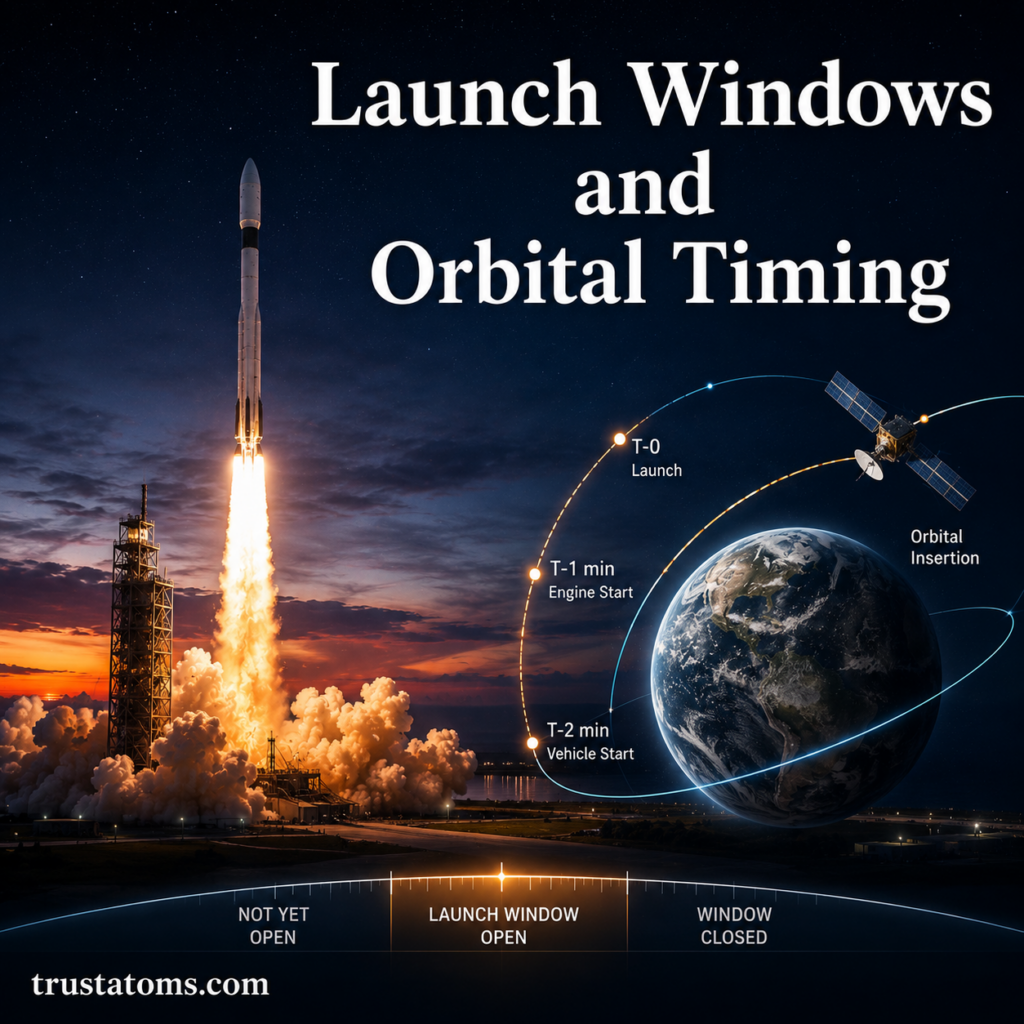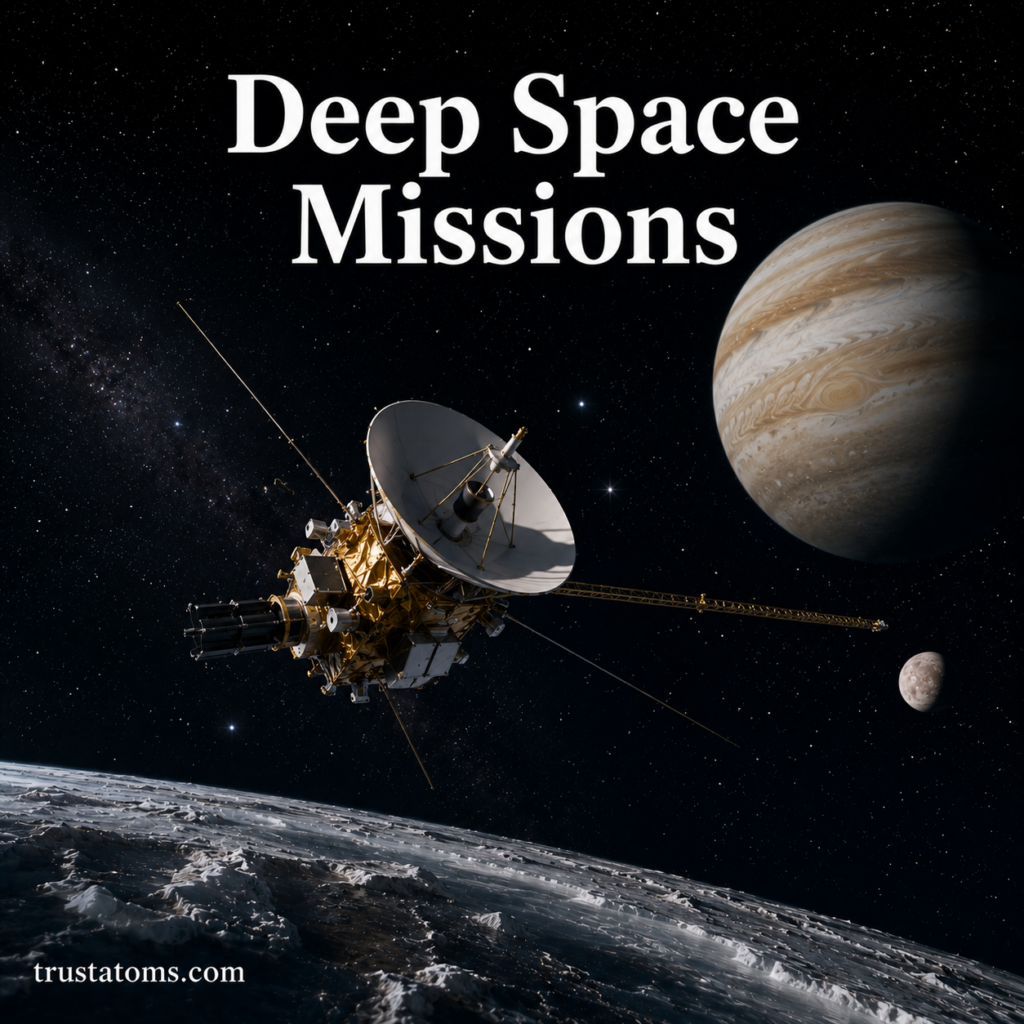
Deep space missions represent some of humanity’s most ambitious scientific achievements. These missions travel far beyond Earth and the Moon to explore distant planets, asteroids, comets, and even the outer boundaries of the solar system.
Using robotic spacecraft, advanced communication systems, and cutting-edge engineering, deep space exploration helps scientists better understand the origins of the solar system and the broader universe.
What Are Deep Space Missions?
Deep space missions are space exploration efforts that travel beyond Earth’s immediate orbit.
These missions may involve:
- Planetary exploration
- Asteroid and comet studies
- Solar system mapping
- Interstellar research
Most deep space missions are robotic because of the enormous distances, extreme environments, and long travel times involved.
Why Deep Space Exploration Matters
Exploring deep space provides valuable scientific and technological benefits.
Understanding the Solar System
Deep space missions help scientists study:
- Planet formation
- Planetary atmospheres
- Geological processes
Searching for Clues About Life
Researchers investigate whether conditions for life may exist or once existed elsewhere in the solar system.
Advancing Technology
Deep space exploration drives innovation in:
- Robotics
- Communication systems
- Navigation technologies
- Spacecraft engineering
Expanding Human Knowledge
These missions reveal information about distant worlds and cosmic environments that cannot be studied from Earth alone.
Types of Deep Space Missions
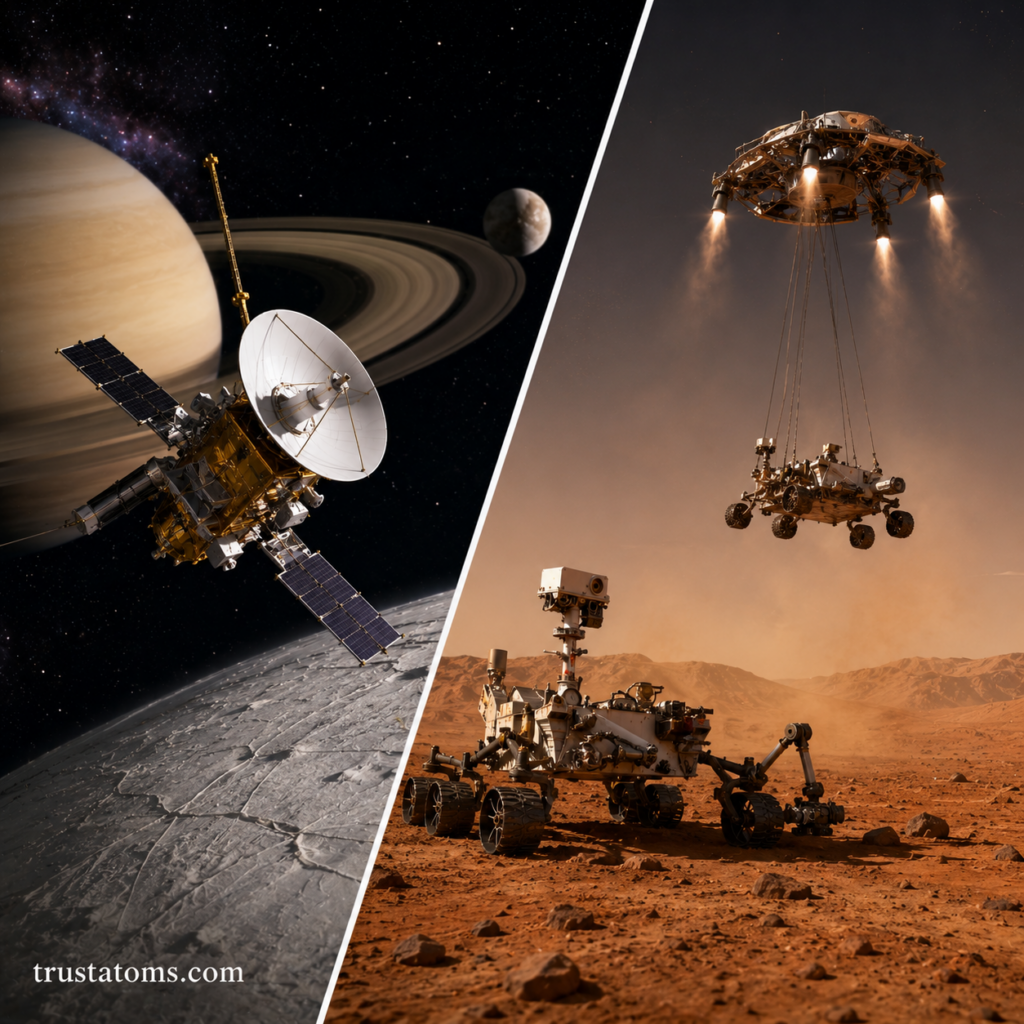
Different missions are designed for different scientific goals.
Flyby Missions
Flyby spacecraft pass near planets or moons to collect observations.
Advantages include:
- Faster mission timelines
- Lower fuel requirements
Orbiter Missions
Orbiters remain around a celestial body for extended observation.
Used for:
- Surface mapping
- Atmospheric studies
- Long-term monitoring
Lander Missions
Landers descend to the surface of planets or moons.
They perform:
- Soil analysis
- Environmental measurements
- Scientific experiments
Rover Missions
Rovers travel across surfaces to explore terrain and collect data.
Common tasks:
- Rock sampling
- Imaging
- Surface chemistry analysis
Sample Return Missions
These missions collect material and return it to Earth for detailed laboratory study.
How Deep Space Missions Work
Deep space missions require careful planning and precise execution.
1. Launch and Departure
A rocket launches the spacecraft from Earth into space.
2. Gravity Assists
Some missions use planetary gravity to:
- Increase speed
- Change trajectory
- Save fuel
3. Cruise Phase
The spacecraft travels for months or years through space.
4. Arrival Operations
Depending on the mission:
- Orbiters enter orbit
- Landers descend
- Flyby probes collect data during close passes
5. Scientific Data Collection
Instruments gather information and send it back to Earth.
Key Technologies Used in Deep Space Missions
Deep space exploration depends on highly advanced systems.
Autonomous Navigation
Spacecraft often operate independently because communication delays make real-time control impossible.
Scientific Instruments
Examples include:
- Cameras
- Spectrometers
- Magnetometers
- Radiation detectors
Communication Systems
Deep space antennas transmit signals across billions of kilometers.
Power Sources
Many missions use:
- Solar panels
- Radioisotope power systems for distant missions
Thermal Protection
Spacecraft must survive:
- Extreme cold
- Radiation exposure
- Temperature fluctuations
Major Achievements in Deep Space Exploration
Deep space missions have transformed modern astronomy and planetary science.
Planetary Discoveries
Missions revealed:
- Active volcanoes on moons
- Subsurface oceans
- Complex planetary weather systems
Outer Solar System Exploration
Spacecraft explored:
- Jupiter
- Saturn
- Uranus
- Neptune
Asteroid and Comet Studies
Scientists learned more about:
- Primitive solar system material
- Potential impact hazards
Interstellar Exploration
Some probes have traveled beyond the outer edges of the solar system into interstellar space.
Challenges of Deep Space Missions
Deep space exploration involves major technical difficulties.
Vast Distances
- Signals can take hours to travel
- Missions require long-term reliability
Communication Delays
Real-time control is impossible for distant spacecraft.
Harsh Environments
Spacecraft face:
- Radiation
- Extreme temperatures
- Micrometeoroids
Limited Repairs
Most deep space probes cannot be serviced once launched.
Long Mission Durations
Some missions operate for decades before completing objectives.
The Future of Deep Space Exploration
Future missions will explore even more distant and challenging environments.
Planned Exploration Targets
Scientists are focusing on:
- Icy moons with subsurface oceans
- Dwarf planets
- Asteroids rich in resources
Advanced Robotics
Future spacecraft may include:
- AI-assisted navigation
- Autonomous scientific decision-making
- Swarm robotic systems
Human Deep Space Missions
Long-term goals include:
- Human missions to Mars
- Deep space habitats
- Expanded interplanetary exploration
The Role of International Cooperation
Deep space exploration often involves partnerships between multiple nations and organizations.
Benefits include:
- Shared scientific expertise
- Reduced costs
- Combined technological resources
International cooperation helps make large-scale missions more achievable.
Why Deep Space Missions Inspire Humanity
Deep space exploration captures public imagination because it represents curiosity, discovery, and innovation.
Educational Impact
- Encourages interest in STEM fields
- Inspires future scientists and engineers
Scientific Curiosity
- Helps answer questions about the universe and humanity’s origins
Long-Term Exploration Goals
- Supports future expansion beyond Earth
Final Thoughts
Deep space missions are among the greatest achievements in modern science and engineering. By exploring distant worlds, studying extreme environments, and pushing technological boundaries, these missions continue to expand humanity’s understanding of the universe.
As future spacecraft travel farther into space, deep space exploration will remain essential to scientific discovery and the long-term future of human exploration beyond Earth.