Life support systems are among the most critical technologies in human space exploration. Without them, astronauts would be unable to survive in the harsh environment of space, where there is no breathable air, drinkable water, atmospheric pressure, or natural protection from extreme temperatures and radiation.
These systems create safe living environments inside spacecraft, space stations, and future planetary habitats by managing air, water, food, temperature, and waste.
As humanity prepares for longer missions to the Moon, Mars, and beyond, advanced life support systems are becoming even more important for sustainable space exploration.
This guide explores how life support systems work, their major components, the challenges of keeping humans alive in space, and how future technologies may support long-term space habitation.
What Are Life Support Systems?
Life support systems are technologies and equipment designed to maintain conditions necessary for human survival in space.
Their primary purpose is to provide astronauts with:
- Breathable oxygen
- Safe atmospheric pressure
- Clean water
- Temperature regulation
- Food storage and preparation
- Waste management
- Air filtration
These systems must function continuously and reliably because even small failures can quickly become dangerous in space.
Why Life Support Systems Are Essential
Earth naturally provides everything humans need to survive.
Space does not.
Outside spacecraft or habitats, astronauts face:
- Vacuum conditions
- Extreme temperatures
- Harmful radiation
- Lack of oxygen
- Micrometeoroid hazards
Life support systems recreate a small, controlled Earth-like environment that protects astronauts from these dangers.
Main Components of Space Life Support Systems
Modern spacecraft and space stations rely on multiple interconnected systems.
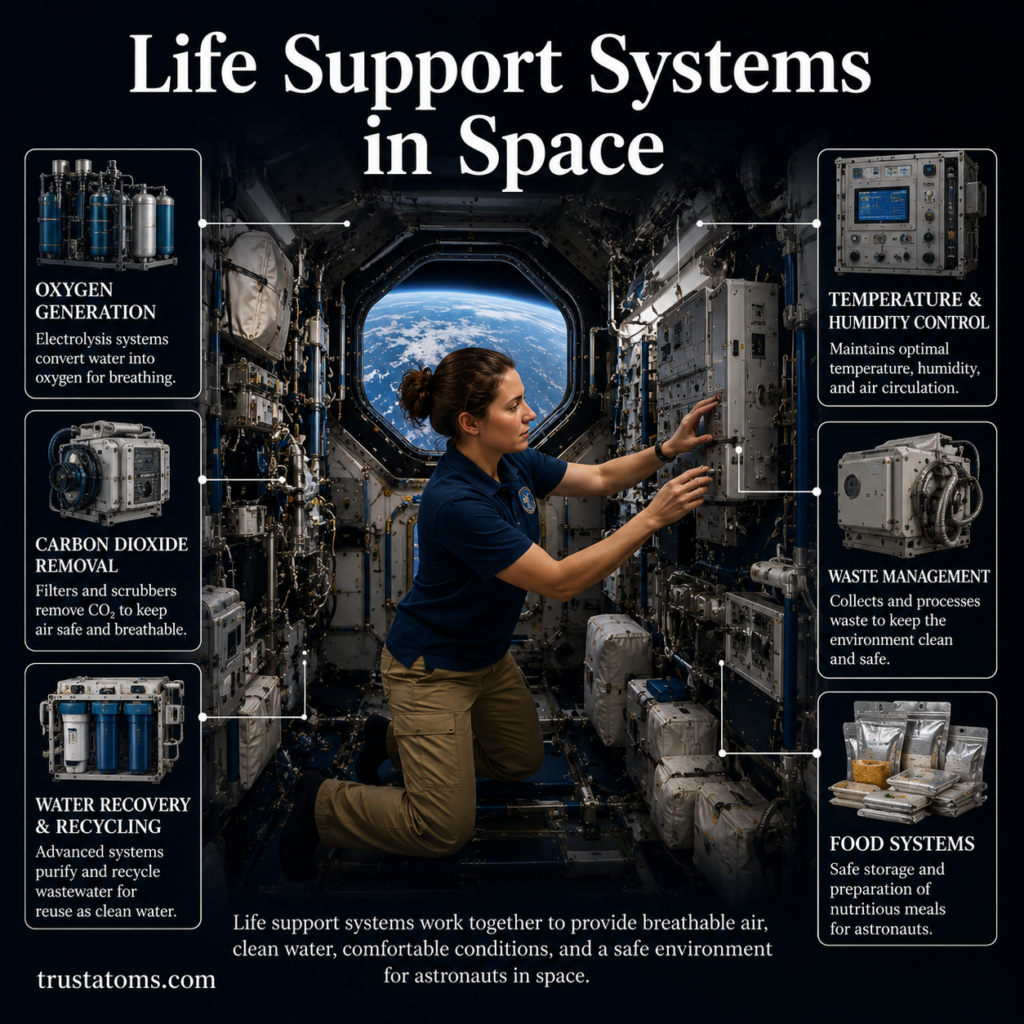
Oxygen Generation Systems
Astronauts require a steady supply of oxygen for breathing.
Oxygen can be supplied through:
- Stored oxygen tanks
- Chemical oxygen generators
- Water electrolysis systems
Many spacecraft use electrolysis to split water into oxygen and hydrogen.
The oxygen supports breathing, while hydrogen may be vented or reused in other systems.
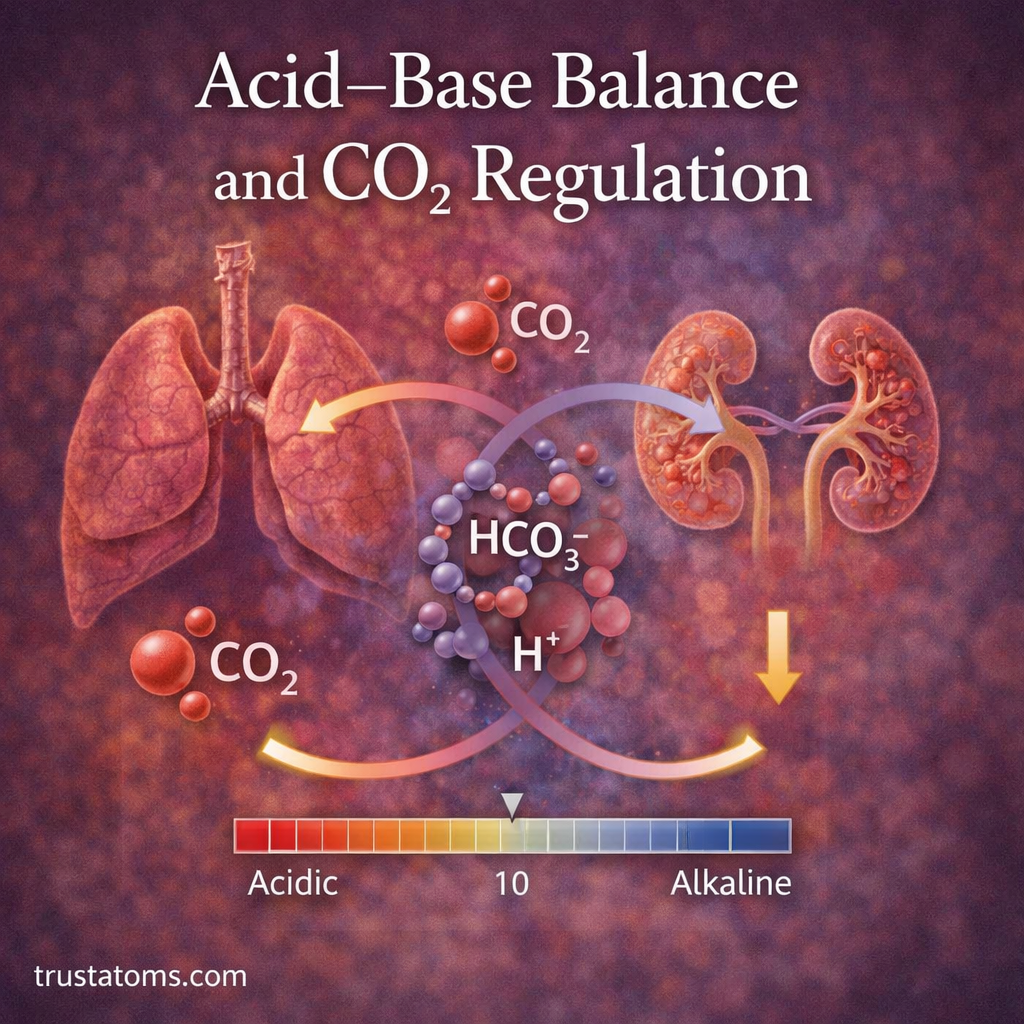
Carbon Dioxide Removal
As astronauts breathe, they release carbon dioxide into the cabin atmosphere.
Without removal systems, carbon dioxide levels would become dangerous.
Common removal methods include:
- Chemical scrubbers
- Absorption filters
- Regenerative air purification systems
Maintaining proper air composition is essential for crew safety and cognitive performance.
Water Recovery and Recycling
Water is extremely valuable in space because transporting it from Earth is expensive.
Modern systems recycle water from:
- Sweat
- Breath condensation
- Urine
- Hygiene activities
Advanced purification systems convert wastewater into clean drinking water.
Recycling dramatically reduces the need for resupply missions.
Temperature and Humidity Control
Spacecraft must maintain stable internal temperatures despite extreme conditions outside.
Thermal control systems regulate:
- Cabin temperature
- Humidity levels
- Heat generated by equipment
- Air circulation
Without proper temperature management, spacecraft interiors could become dangerously hot or cold.
Waste Management Systems
Managing waste in microgravity presents unique challenges.
Waste systems handle:
- Human waste
- Food waste
- Airborne particles
- Biological contaminants
Efficient waste management helps maintain hygiene and prevent contamination.
Food Storage and Preparation
Astronauts need balanced nutrition during missions.
Space food systems focus on:
- Long shelf life
- Nutritional value
- Minimal waste
- Safe packaging
Future long-duration missions may rely more heavily on growing food in space habitats.
Environmental Control and Life Support Systems (ECLSS)
Modern spacecraft often use integrated Environmental Control and Life Support Systems, commonly called ECLSS.
These systems combine multiple functions into one coordinated network.
ECLSS technology manages:
- Air quality
- Water recycling
- Pressure control
- Temperature regulation
- Fire detection
- Contaminant removal
The International Space Station uses advanced ECLSS technologies to support astronauts for months at a time.
Challenges of Maintaining Life in Space
Creating sustainable living environments in space is extremely difficult.
Limited Resources
Space missions cannot carry unlimited supplies.
Life support systems must maximize efficiency by:
- Recycling materials
- Reducing waste
- Conserving energy
- Reusing water and air
Efficiency becomes even more important during deep-space missions.
Reliability and Redundancy
Failures in life support systems can become emergencies very quickly.
For safety, spacecraft include:
- Backup systems
- Redundant components
- Emergency oxygen supplies
- Multiple monitoring systems
Reliability is one of the most important engineering priorities in human spaceflight.
Microgravity Effects
Microgravity changes how fluids, gases, and particles behave.
This affects:
- Air circulation
- Water management
- Waste collection
- Filtration systems
Engineers must design systems specifically for weightless environments.
Radiation Protection
Space radiation poses major risks to astronaut health.
Long-term exposure may increase risks involving:
- Cancer
- Tissue damage
- Nervous system effects
Life support systems work alongside shielding technologies to help protect crews.
Life Support on the International Space Station
The International Space Station serves as one of the best examples of advanced life support engineering.
The ISS supports astronauts by using systems that:
- Recycle water
- Generate oxygen
- Remove carbon dioxide
- Filter contaminants
- Maintain pressure and temperature
The station recycles a large percentage of onboard water, helping reduce supply needs from Earth.
ISS missions provide valuable data for future Moon and Mars exploration.
Spacesuits as Personal Life Support Systems
Spacesuits function as miniature spacecraft for astronauts during spacewalks.
They provide:
- Oxygen supply
- Temperature control
- Carbon dioxide removal
- Pressure regulation
- Radiation and micrometeoroid protection
Without spacesuits, astronauts could not survive exposure to space even briefly.
Future Life Support Technologies
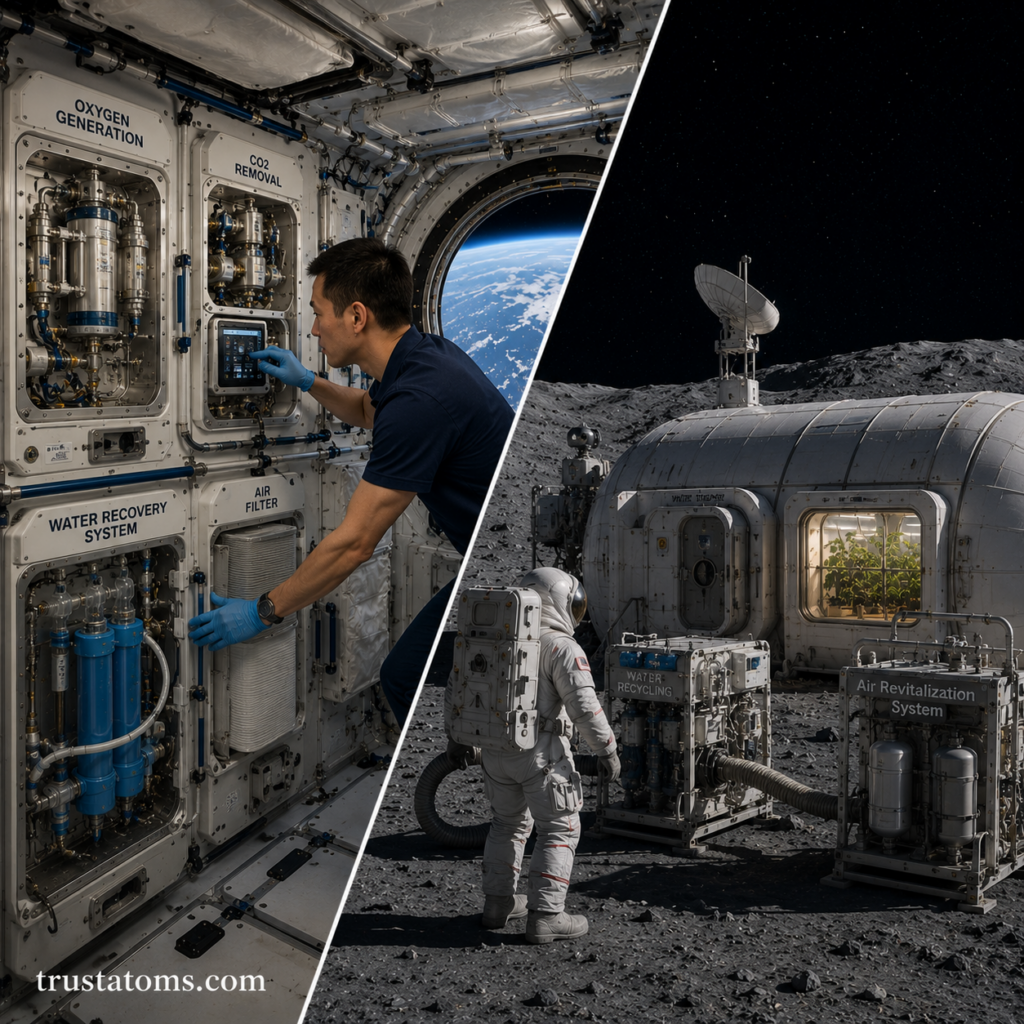
Future exploration missions will require more advanced and sustainable systems.
Closed-Loop Systems
Closed-loop systems aim to recycle nearly all resources.
Goals include:
- Reusing air and water continuously
- Reducing dependence on Earth resupply
- Supporting long-duration missions
These systems are essential for Mars exploration.
Space Agriculture
Growing food in space may become necessary during long missions.
Researchers are studying:
- Hydroponics
- Aeroponics
- Artificial lighting systems
- Controlled plant growth environments
Plants may also help recycle carbon dioxide into oxygen.
Artificial Intelligence and Automation
AI may help future systems:
- Detect failures
- Optimize resource usage
- Manage repairs
- Monitor astronaut health
Automation can improve safety and efficiency during long missions.
Lunar and Mars Habitats
Future planetary habitats will need robust life support systems adapted to local conditions.
These habitats may include:
- Radiation-shielded living spaces
- Underground structures
- Local resource utilization
- Advanced recycling technologies
Engineers are exploring how to use local materials to support sustainable living.
The Importance of Redundancy in Space Missions
Redundancy means having backup systems available if primary systems fail.
In life support engineering, redundancy is critical because survival depends on continuous operation.
Examples include:
- Multiple oxygen sources
- Backup power systems
- Emergency water reserves
- Secondary communication systems
Redundant designs help reduce mission risks significantly.
Can Humans Eventually Live Independently in Space?
Long-term independent living in space remains one of humanity’s greatest technological challenges.
To achieve this goal, future systems must become:
- Highly efficient
- Self-sustaining
- Durable
- Repairable
- Resource-efficient
Scientists continue researching technologies that may support permanent settlements beyond Earth.
Possible future habitats include:
- Lunar bases
- Mars colonies
- Rotating space habitats
- Orbital research stations
Life support systems will remain central to all future human space exploration.
Final Thoughts
Life support systems are the foundation of human survival in space.
They provide breathable air, clean water, safe temperatures, waste management, and environmental stability in some of the harshest conditions imaginable.
From spacecraft and space stations to future Moon and Mars habitats, these systems make human exploration beyond Earth possible.
As space technology advances, life support systems will continue evolving toward more sustainable, efficient, and self-sufficient designs that may one day support permanent human life beyond our planet.